

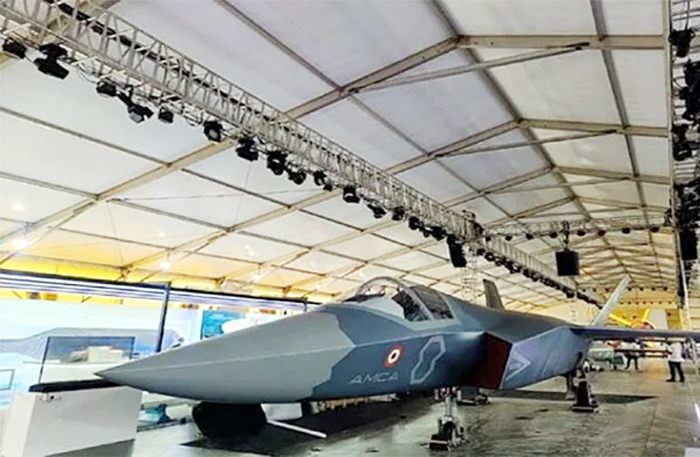
The laying of the foundation stone for the Advanced Medium Combat Aircraft programme infrastructure at Puttaparthi in Andhra Pradesh by the Defence Minister is far more than a ceremonial occasion. With a budgetary outlay of Rs 16,000 crore earmarked for this ambitious project, it marks a decisive leap in India’s long and often arduous journey towards achieving genuine self-reliance in one of the most complex and strategically critical domains of modern warfare – the design, development, and manufacture of advanced combat aircraft.
The contours of 21st-century conflict have been redrawn with unmistakable clarity. Wars are no longer won or lost solely on the ground. It is the sky that often determines the outcome. Advanced fighter jets, precision-guided missiles, and sophisticated drone swarms have become the decisive instruments of modern military power. India has long understood this reality, but has been slow to translate that understanding into homegrown capability. For decades, the Indian Air Force flew imported aircraft – MiGs from the Soviet Union, Jaguars and Mirages from France, and later Sukhois from Russia. Each of these acquisitions drained the foreign exchange reserves and, more critically, kept India tethered to the strategic priorities and export policies of supplier nations. The price of dependence is never merely financial; it is also geopolitical.
It is against this backdrop that the story of the LCA – now operational in the IAF as the Tejas – must be appreciated. The road from the drawing board to the runway was rocky, ridiculed at times, and stretched over decades. Yet India persisted and firmly established that Indian scientists, engineers, and institutions possess the intellectual and technical architecture to conceive and build a fighter jet from scratch. The AMCA is the next, and considerably more ambitious, chapter. A fifth-generation stealth fighter developed by the Aeronautical Development Agency under DRDO. The aircraft integration and advanced flight-testing centre being set up at Puttaparthi – on 650 acres of land – will be one of the most sophisticated facilities of its kind in the world. Once fully operational, this centre will anchor an entire ecosystem of aeronautical excellence in the region, generating approximately 7,500 direct employment opportunities and catalysing broader socio-economic transformation across the Sathya Sai district.
In the missile domain, India has long been a formidable power. The Agni series, BrahMos, Akash, and Pralay missiles have placed India in an elite global league. Operation Sindoor – India’s precision military strikes on terror infrastructure inside Pakistan following the Pahalgam massacre – demonstrated in the most emphatic terms the lethality and reliability of India’s indigenous missile systems.
The economic argument for self-reliance in defence manufacturing is as compelling as the strategic one. India currently spends billions of dollars annually importing fighter aircraft and drones. In an era of global economic uncertainty and fiscal discipline, the imperative to redirect these enormous outflows into indigenous manufacturing has never been more pressing. The AMCA project, alongside the drone manufacturing units being established in Kurnool as part of an integrated drone city, represents exactly the kind of systemic investment that can fundamentally alter this equation over time.
The Make in India initiative in the defence sector has matured from a slogan into a genuine policy architecture. The Government has raised the FDI cap in defence manufacturing, defined a positive indigenisation list that bars imports of hundreds of defence items, and consistently pushed defence public sector undertakings and private players to collaborate on next-generation platforms. The results are beginning to show in the growing confidence of India’s scientific and engineering community. The chariot of self-reliance is indeed in motion. Challenges remain formidable. Developing a fifth-generation combat aircraft requires mastery of stealth materials, advanced avionics, supercruise-capable engines, and sensor fusion technologies – each a specialised domain in which India is still building depth. The engine problem in particular – the absence of a fully indigenous, high-thrust jet engine – remains the most critical bottleneck. The AMCA cannot afford the delays that dogged its predecessor. But the direction is right, the commitment is real, and the stakes could not be higher. A nation of India’s size, history, and global ambitions cannot outsource the sky. The foundation stone laid last week is, in a very real sense, the cornerstone of India’s aerial sovereignty for generations to come.
 Follow our WhatsApp channel
