

Abha Chauhan
It was the end of March this year, and the wheat fields all around were still largely green in the border villages along the Line of Control (LoC) of Khour tehsil in the Jammu district, reflecting the soil’s productivity and richness. In the mornings, people are usually occupied with household chores, agricultural work, tending to domestic animals, and the many small tasks that shape daily life. By noon, however, the villages grow quiet. As we moved through them at this hour, we found people – women, the elderly, and the young alike, everywhere, eager to speak about their problems: the realities of living close to the LoC. We realised that the borders do speak – loud and clear!
The Sarpanch of Gram Panchayat Samwan, an educated and bold woman, articulated the difficulties faced by the villagers. The issues ranged from stopping the land compensation, displacement of people due to constant firing and shelling from across the border, lack of bunkers, and non-issuance of new ration cards, also needed for making their ALC (Actual Line of Control) certificates. A 64-year-old shopkeeper from a nearby village, Chhaprial, informed us that before the 1999 Kargil war, the village had nearly 350 households; now there are only 14. This decline is corroborated by the 2011 Census, which records the village’s total population at just 58, consisting of 32 males and 26 females. The local market, houses, shops, and a middle-level school are all shut down, and the village looked deserted. While some wheat fields are fenced to protect them from wild animals, most agricultural land has turned into grassland.
Nearly 95 percent people from village Chhapriyal have been displaced and reside in a campsite called Kodewala, near Akhnoor Town, about 35 km away. They have been allotted 5 marlas of land (about 1362 sq. ft) by the Government, and provided Rs 50,000 per household. The locals view these as insufficient. People from Samwan and Kachrial villages have also been relocated to this Camp. Families from other border villages, too, have received similar- sized plots and financial assistance at various camp-sites. For example, people from Gigrial, Sainth, and Garad villages were settled in the Naiwala Camp, while those from Pallanwala, Panchtoot, and Hamirpur villages were moved to Devipur Camp or Thandi-choi. Displacement and settlement thus remain the most urgent and critical issues facing border people.
Other important concerns are related to land and compensation. In nearly all the villages that we visited, people were equivocal about their loss of land and agriculture, mainly during the wars of 1971 and 1999 fought between India and Pakistan. In 1971, in the Akhnoor Sector across much of the LoC, a ditch-cum-band (DCB) was constructed for which land was taken from the locals. Additional land was acquired for establishing Army camps and for mining purposes. After the Kargil conflict in 1999, fencing was done along the LoC, as a result of which much of the agricultural land went beyond this line, and the locals found it difficult to cultivate their crops. In border villages such as Gigrial, Sainth, Garad, Hamirpur, Budwal, and others, residents reported that roughly 80-90% of cultivated land went beyond the fence. Now identity cards are issued to farmers, allowing them to tend their crops for a limited, stipulated period. The residents reported that much of their land has turned into a ‘jungle’ and has become unproductive due to irregular upkeep, limited irrigation, unpredictable rainfall, and crop damage caused by animals. Villagers also stated that they did not receive compensation for the land taken in 1971 after the year 2013, and that they received no compensation for land taken away soon after the 1999 Kargil conflict.
The internally displaced persons (IDPs) from Pakistan Occupied Jammu and Kashmir (POJK), referred to as ‘local allottees’, and those from Pakistan, known locally as ‘West Pakistan Refugees’ (WPR), also reside in these villages. While they were allotted land to cultivate crops, they were not made the legal owners of the land. They could not, therefore, sell or mortgage the land, nor receive any compensation for its loss, or for the crops grown on it. They were granted land from what is known as evacuee or custodial property, whose owners are those residing in POJK now. The WPRs have been given the domicile of J&K after the revocation of Article 370 by the Indian government in 2019, as well as the long pending compensation of rupees 5.5.lakh to each family. However, they need land ownership rights, which are currently in progress but still pending.
The local people consider the Gram Panchayat as a body that could resolve their specific issues, but the panchayats have become almost defunct as no elections are held in J&K after 2018, though some said it would be done this year, most probably. Many people also said that no new ration cards have been made for a long time, particularly since 2011, despite growing family size. A further barrier they mentioned is limited digital awareness and lower levels of education, especially among the less-educated residents, which makes it harder to access services that may now require online or documented processes.
The life of border people is marked by recurring insecurity. In any war or war-like situation, people are forced to abandon their homes, temporarily or for prolonged periods, simply to protect their families. This instability repeatedly breaks the link between people, land, and livelihood. During the Kargil war, when the migrants stayed in camps for nearly six years (1999-2005) , the people reported that their crops were completely ruined, the land became largely unproductive, and houses and livelihoods were shattered. The social and economic cost, therefore, extended far beyond the immediate period of conflict, affecting future agricultural cycles and income stability.
A gendered analysis of the conflict situation showed that women were much more adversely effected. A frail woman in her late eighties recalls the hardships she endured through decades of forced displacement. She lost her young son in Pallanwala market during the 1999 Kargil war. Another woman watched her husband die after years of nursing, while a third raised her mentally challenged daughter single-handedly amid the turmoil of war. These women spent nearly six years in a camp before returning to their villages, only to find widespread devastation and the painful necessity of starting their lives all over again.
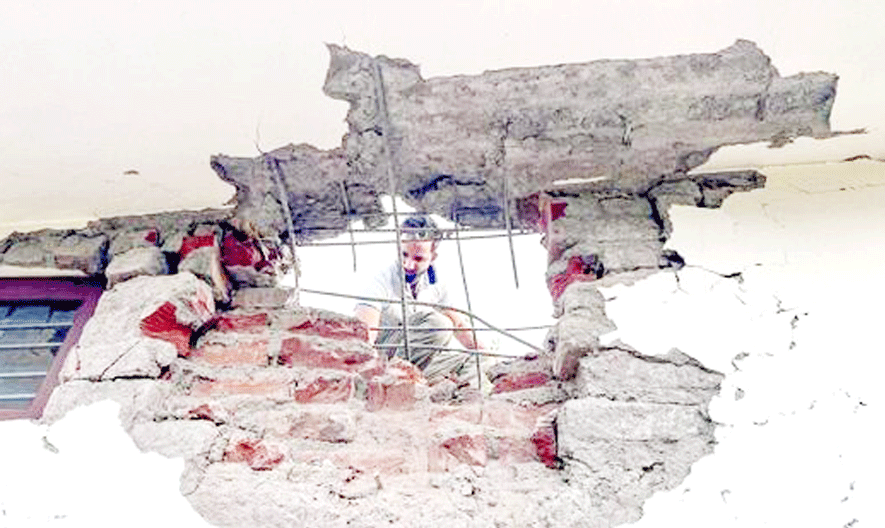
In group discussions at village Pallanwala, villagers described that such migrations have occurred not only in recent years but across generations. They cited major displacement events in the years 1947- 48, 1962, 1965, 1971, 1987, 1996, 1999, 2001, and 2025, along with other instances in between. This shows that border vulnerability is not an isolated occurrence; it is a repeating pattern, where communities remain in a near-constant state of readiness. A recent example was in April 2025, after the Pahalgam attack in Kashmir. Villagers stated that people were evacuated and, according to local accounts, remained outside their villages for approximately seven to thirty days, until the situation eased. Although bunkers are constructed in some villages, they are only a few and often not properly maintained. The Sarpanch of Pangali Gram Panchayat highlighted the urgent need for bunkers and requested their immediate installation, reflecting a wider community demand for practical, locally accessible protection during emergencies.
Unemployment emerged as one of the most significant problems that border people faced. They expressed strong anger regarding ongoing financial liabilities, particularly utility-related bills. Several community members raised concerns over payment requirements for electricity and water used for drinking and irrigation. In addition, some respondents objected to the implementation of new utility measures such as ‘smart meters.’ Many youth in this region opt for defence and armed force services and were critical of the Agniveer scheme. According to them, earlier forms for defence-related posts (including the Army, BSF, CRPF, and others) were available multiple times a year; now they are reduced to once a year, and the fees to apply have also increased.
The local villagers told us, in no uncertain terms, that experiments are being carried out on them without their informed consent, and they were not consulted about any development schemes or programs being initiated in their area. Since they live on the hostile borderlands and bear the brunt of these actions, the need of the hour is to listen to them with genuine concern and sensitivity!
The author is a former Professor and Head, Department of Sociology, University of Jammu, Jammu (J&K)
 Follow our WhatsApp channel
