

B S Dara
bsdara@gmail.com
The recent electoral developments in West Bengal are not an isolated political event. They reflect a deeper transformation in India’s political landscape, where the balance between regional leadership and national consolidation is steadily shifting.
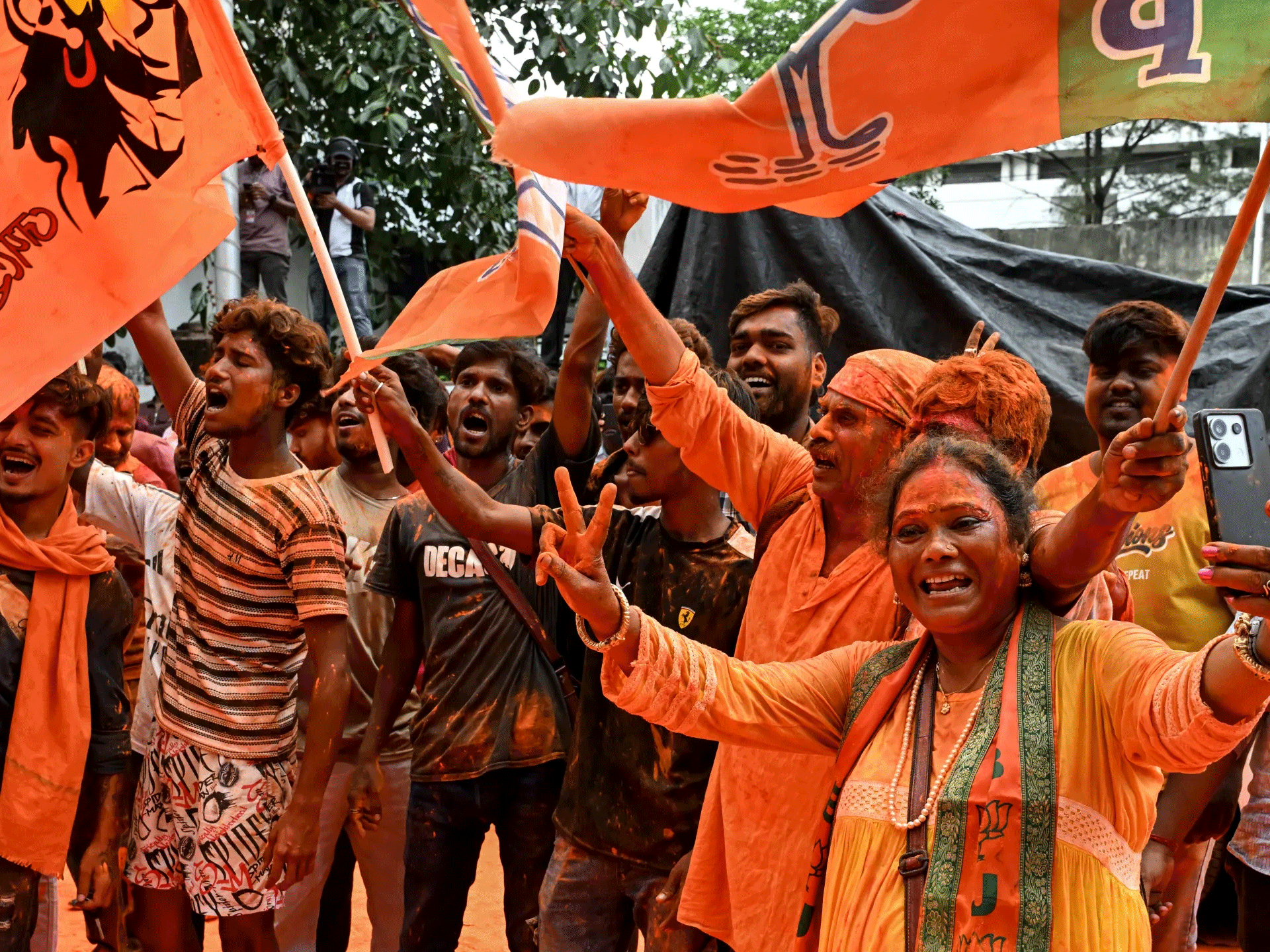
What was once considered an impregnable political fortress has, over time, been opened to contest. Bharatiya Janata Party’s rise and advance into eastern India, long defined by entrenched ideological dominance, particularly into West Bengal, marks the breaching of a long-held frontier in Indian politics. For decades under Left rule, the state stood as a closed domain where the BJP had neither structure nor significance. That distance has now been decisively narrowed.
To understand the present, it is necessary to trace the past. For nearly three decades, West Bengal was governed by the Left Front, led primarily by the Communist Party of India (Marxist). From 1977 to 2011, the state remained under Left rule, one of the longest-serving democratically elected communist governments in the world. During this period, the BJP had virtually no presence in the state. Its ideological framework and organisational network found little resonance in a political culture shaped by class-based mobilisation, trade union influence, and agrarian reforms.
The political landscape began to change in the late 2000s. The Left Front, after years of dominance, faced growing criticism over industrial policies, particularly the handling of land acquisition in Singur and Nandigram. These events created a political opening that was effectively utilised by Mamata Banerjee and her party, the All India Trinamool Congress (TMC). In 2011, Mamata Banerjee ended the 34-year Left rule and emerged as the central figure in West Bengal’s politics. Her rise was rooted in a strong regional narrative. She positioned herself as a leader of the people, speaking directly to local concerns and projecting resistance to both the Left’s institutional rigidity and the BJP’s national expansion. Over time, her governance style became increasingly centralised, and the TMC established itself as the dominant political force in the state.
For several years, West Bengal appeared politically settled. The BJP remained a marginal player. In the 2011 Assembly elections, the party secured only a small vote share, and its organisational footprint was limited. However, this phase did not reflect stagnation but preparation. The BJP’s approach to expansion in states where it lacked historical presence has been consistent. It does not depend solely on immediate electoral success. Instead, it invests in building grassroots networks, strengthening booth-level organisation, and identifying social coalitions that can be mobilised over time. This method, applied across multiple states, began to show results in West Bengal as well.
The 2014 general elections marked the first visible shift. The BJP increased its vote share in the state, signalling that it was no longer absent from the political conversation. This trend accelerated in the 2019 Lok Sabha elections, where the party won 18 out of 42 seats from West Bengal, a dramatic rise from its earlier position. Its vote share crossed 40 percent, indicating a substantial consolidation of support.
The 2021 Assembly elections further demonstrated the scale of this transformation. Although the TMC retained power with a decisive mandate, winning over 200 seats, the BJP emerged as the principal opposition with 77 seats. This was a significant jump from its earlier tally and confirmed that the party had established a durable presence in the state’s political structure.
The contest between Mamata Banerjee and the BJP must be understood as more than an electoral rivalry. It represents a structural confrontation between two different models of political authority. Mamata Banerjee embodies the traditional strength of regional leadership in India, where local identity, cultural familiarity, and state-specific narratives play a central role. The BJP, on the other hand, represents a national model, driven by organisational uniformity, ideological clarity, and central leadership. This confrontation has reshaped voter behaviour. Sections of the electorate that were once aligned with the Left or with regional formations have shifted, either due to dissatisfaction with governance, aspiration for change, or alignment with a broader national narrative. The BJP has also successfully expanded its base among communities that were not previously part of its core support.
At the same time, the persistence of Mamata Banerjee’s leadership highlights the continued relevance of regional politics. Her ability to retain power in 2021 demonstrated that regional leaders can still command strong loyalty when they effectively connect with local concerns and deliver targeted welfare measures. The current phase shows West Bengal has moved from a single-dominant-party system to a competitive bipolar contest. This change has implications that extend beyond the state.
India’s federal structure has historically been shaped by the presence of strong regional parties. These parties have acted as counterweights to the central government, ensuring that political authority remains distributed. They have articulated local issues, influenced national coalitions, and contributed to a balance of power within the system. The gradual weakening of regional dominance in certain states raises questions about this balance. As national parties expand their footprint, the centre’s influence increases. This does not necessarily undermine federalism, but it changes its operational dynamics. The negotiation between state and centre becomes less about multiple competing voices and more about alignment within a broader national framework. The visual representation of political control across India, often depicted through maps showing states under direct rule or alliance governments, reinforces the perception of consolidation. However, such images capture only one dimension of political reality. Electoral success is shaped by a complex interplay of organisational strength, leadership, voter sentiment, and institutional processes.
It is also important to acknowledge that, over multiple election cycles, several opposition parties have raised concerns about aspects of the electoral process, including the functioning of electronic voting systems. These concerns have been part of political discourse in India and have been voiced by parties such as the Congress, Samajwadi Party, and others at different points in time. At the same time, India’s electoral system continues to operate under constitutional institutions, with the Election Commission overseeing the conduct of elections and maintaining procedural frameworks.
For a general reader, it is essential to distinguish between political perception and institutional validation. Allegations and doubts form part of democratic contestation, but they coexist with formal processes that govern electoral outcomes. This duality influences how results are interpreted by different segments of society. The rise of the BJP in West Bengal, therefore, should not be seen only as a story of electoral gain. It is a reflection of a broader shift in how political power is organised and contested in India. It demonstrates the capacity of a national party to enter and expand within regions that were once considered politically closed. At the same time, it underscores the resilience of regional leadership when it adapts and responds to changing conditions.
Looking ahead, the key question is not limited to which party wins future elections in West Bengal. The more significant issue is how the balance between regional autonomy and national consolidation will evolve. Will regional parties regain strength and reassert their role as counterweights, or will national parties continue to expand, leading to a more centralised political structure? West Bengal stands at the centre of this transition. Its political journey, from Left dominance to regional assertion and now to competitive contestation with a national party, offers insight into the changing nature of Indian democracy.
The state’s experience suggests that political power in India is no longer static, it is fluid, responsive, and influenced by both historical legacies and contemporary strategies. As voters reassess their choices and parties refine their approaches, the structure of political authority will continue to evolve. In that evolution lies the future of India’s federal democracy.
It is perhaps in such moments that poetry captures what political language cannot fully express. As the poet Faiz Ahmad Faiz writes:
Daman mein musht-i-khak-i-jigar, saghar mein hai hasrat-i-khoon-i-mey
Lo daman hum ne jhar diya, lo jam ultae dete hain.
B. S. Dara is an independent geopolitical commentator and analyst of Indian foreign policy and defence strategies. He writes on strategic affairs and global power dynamics.My Regards,
 Follow our WhatsApp channel
