

NEW DELHI, Apr , 29: India has significantly expanded its Doppler Weather Radar (DWR) network since 2014, increasing from 14 operational units to 50, marking over 250% rise. These additions, covering over 87% of the country, improve forecasting for cyclones, heavy rain, and thunderstorms under the India Meteorological Department (IMD), with 50 more planned under Mission Mausam.
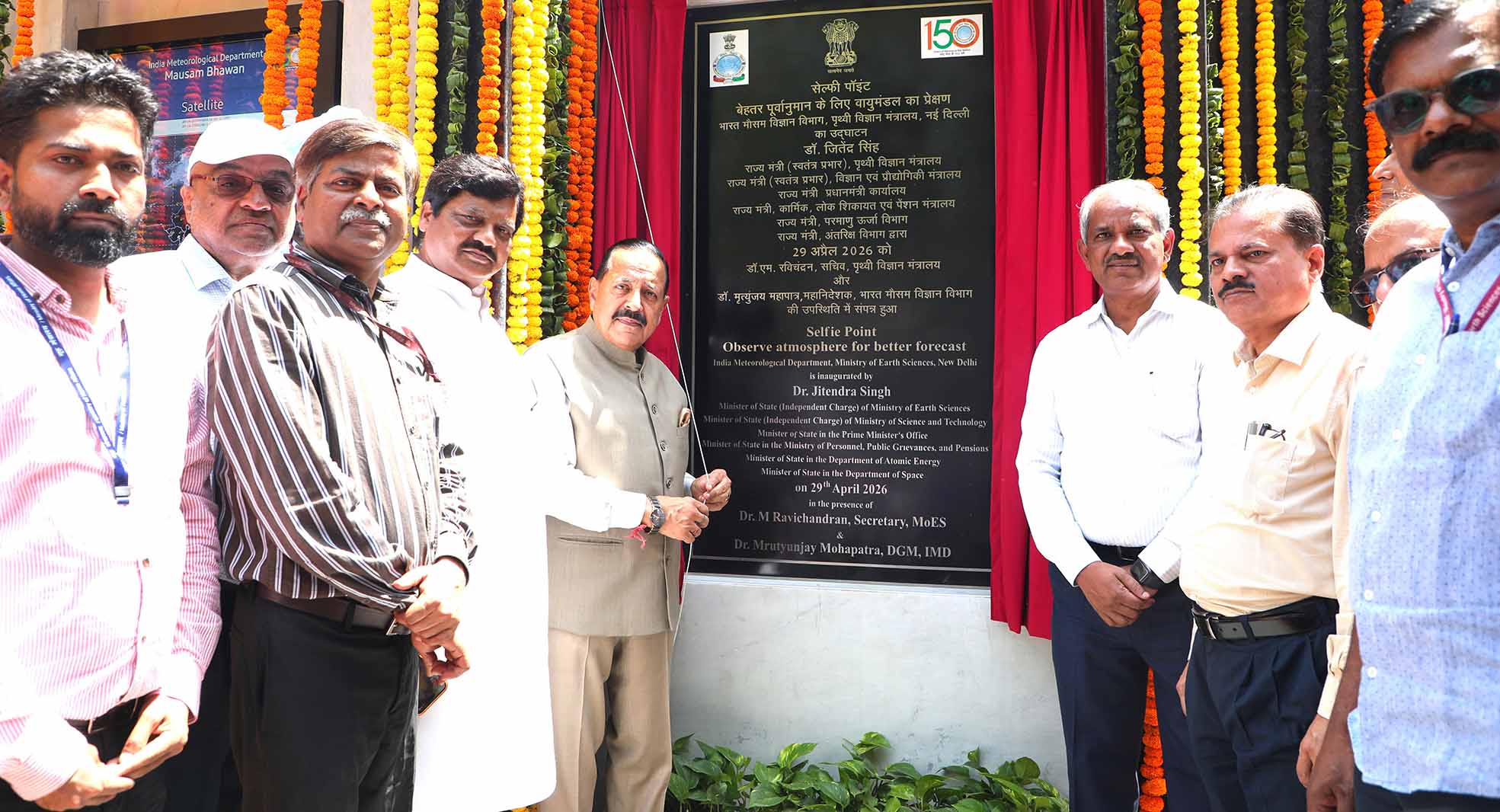
This was stated here today by Union Minister of State (Independent Charge) for Science & Technology and Earth Sciences, Dr. Jitendra Singh speaking to the media after inaugurating a Selfie Point, depicting Weather Radar, at the entrance gate of India Meteorological Department (IMD) headquarters, at Lodhi Road, here. The event was held in the presence of the Secretary, Ministry of Earth Sciences, Dr. M. Ravichandran, and Director General of Meteorology, IMD, Dr. Mrutyunjay Mohapatra, along with senior officials and scientists.
The Minister said, this transformation has been made possible due to the high priority accorded to the sector by the Government under the leadership of Prime Minister Narendra Modi, leading to greater accuracy, accessibility and public trust in forecasts.
Dr Jitendra Singh said that India’s meteorological services have undergone a remarkable transformation over the last decade. From a time when weather forecasts were often met with scepticism, the system today provides highly reliable and precise predictions used by a wide spectrum of users, from farmers and homemakers to pilots and event planners. He said that people now routinely check weather updates on their mobile phones before stepping out, reflecting the growing trust and reach of IMD services.
Referring to advancements in forecasting, he highlighted the introduction of ‘Nowcast’ services, which provide highly localised and accurate forecasts for the next three hours. He said that such real-time information is crucial for disaster preparedness, urban planning and day-to-day decision-making. He added that India’s forecasting capability has reached a stage where it can provide detailed inputs on rainfall intensity, type of precipitation, possibility of hailstorms, and even the size of raindrops.
Dr. Jitendra Singh also spoke about the role of Doppler Weather Radar technology in strengthening India’s weather monitoring system. These radars use the Doppler effect to track the movement and velocity of weather systems, enabling accurate and timely forecasts. The modern radars deployed by IMD are equipped with dual-polarization technology, allowing precise identification of precipitation types such as rain, hail and drizzle, improved rainfall estimation, and better detection of severe weather events while minimizing false signals.
Dr Jitendra Singh said that the expanding radar network enables continuous monitoring of the atmosphere over large distances and supports early warnings for cyclones, thunderstorms, heavy rainfall and other extreme weather events. It also plays a critical role in aviation safety, agricultural planning and disaster risk reduction.
Highlighting the broader impact, the Minister said that India’s forecasting capabilities are also benefiting neighbouring countries, reflecting the country’s commitment to global cooperation and shared resilience.
The Minister also referred to the government’s focused initiatives such as Mission Mausam, aimed at strengthening weather and climate services, and the ongoing expansion of radar infrastructure, including installations in vulnerable regions like Jammu & Kashmir following recent extreme weather events.
The Selfie Point inaugurated today showcases a legacy weather radar system, providing visitors with a tangible connection to the evolution of meteorological technology in India. It has been set up to create greater public awareness about weather science and to encourage citizens to engage with IMD’s services through platforms such as mobile applications, SMS alerts and social media.
Dr. Jitendra Singh said that such initiatives will help bridge the gap between scientific advancements and public awareness, enabling citizens to better understand and utilise weather information in their daily lives.
 Follow our WhatsApp channel
