

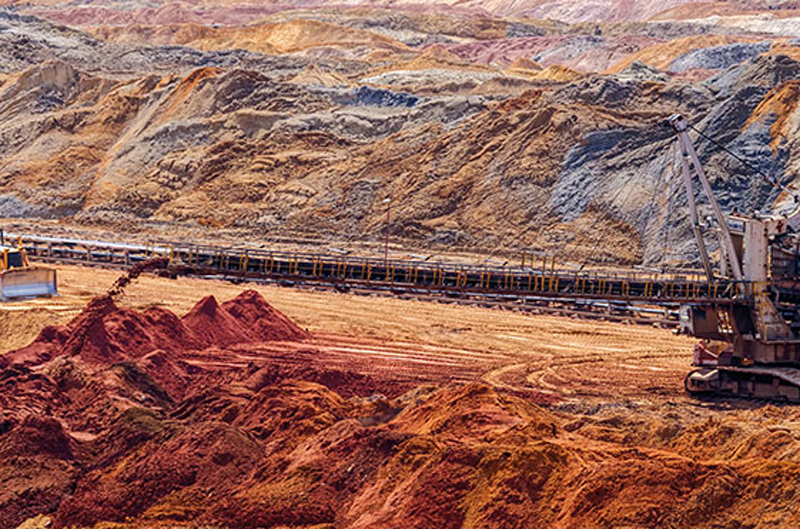
For generations, Jammu & Kashmir’s extraordinary mineral wealth lay sealed beneath its mountains – not for want of existence, but for want of access. Limestone belts stretching across Anantnag, Rajouri and Poonch; gypsum reserves that once supplied a pre-Partition subcontinent; sapphire deposits in the remote valleys of Paddar; and the tantalising promise of lithium in Reasi. The inventory was never in question. What was missing was the infrastructure, the governance architecture, and the political will to translate geological fortune into economic reality. That calculus is now changing – and changing rapidly.
The Union Ministry of Mines’ launch of the second tranche of e-auctions for 12 limestone blocks in J&K is far more than an administrative exercise in mineral bidding. It is a statement of intent – that the region is finally open for serious business, backed by roads that work, supply chains that function, and a transparent auction mechanism that investors can trust. The timing is not coincidental. It follows years of infrastructural investment that has, quietly but consequentially, transformed the logistics map of the region. The single most dramatic game-changer has been connectivity. The Jammu-Srinagar National Highway, long synonymous with disruption and delay, has been progressively widened and tunnelled into a far more reliable artery. The Banihal-Qazigund rail link brought the Kashmir Valley into India’s railway network for the first time, and the broader Udhampur-Srinagar-Baramulla Rail Link project – one of the most audacious engineering endeavours on the planet – is a reality now. Fully operational, it has connected Kashmir to the national rail grid in a manner that no mountain road ever could. For the mining sector, this development is transformational. Raw materials – particularly bulk commodities such as limestone – are economically viable only when transport costs are manageable. Rail freight, by its very nature, compresses those costs dramatically. A cement plant in the plains, sourcing limestone from the Kashmir Valley, would have once dismissed the idea outright. With rail connectivity, the arithmetic begins to make sense.
The improved Mughal Road and allied mountain corridors have similarly opened up Rajouri and Poonch, districts that were once considered logistically marooned. The limestone blocks being auctioned in these areas are no longer theoretical deposits on a geological survey map. They are commercially accessible resources, capable of feeding the voracious appetite of India’s construction and cement industries as the country pursues its infrastructure ambitions on an unprecedented scale.
And that national dimension deserves far greater emphasis than it typically receives. India’s infrastructure pipeline – expressways, metro corridors, housing projects under schemes such as PM Awas Yojana, the expansion of airports and industrial parks – requires staggering quantities of limestone, the foundational raw material for cement production. Domestic supply, despite recent growth, remains stretched by competing demands. The J&K blocks, therefore, are not merely a regional resource story. They are a national supply story, contributing to the raw material security of an economy that is building at scale.
The broader mineral portfolio only reinforces this argument. Critical minerals – lithium, nickel, cobalt, and graphite – sit at the heart of the green energy transition globally. India’s push to develop its own battery ecosystem, reduce import dependence, and anchor a domestic electric vehicle supply chain requires precisely these minerals. J&K’s emerging role in this landscape, even if still in the early stages of geological assessment, could prove strategically vital in the decades ahead.
Yet infrastructure and policy alone will not complete the picture. For mining to deliver genuine and lasting benefit to J&K’s communities – particularly in districts such as Rajouri and Poonch, where economic alternatives remain limited – the local dividend must be real and visible. Royalties must flow into District Development Funds. Environmental safeguards must be enforced with rigour, not merely cited in documentation. Skilling initiatives must accompany extraction so that young people from these communities are trained in geological surveying, equipment operation and logistics management, rather than remaining bystanders to an extractive economy. The second tranche of limestone auctions, then, represents an inflexion point. J&K is no longer a region pointing to its mineral wealth on a map while remaining unable to act upon it. The roads and rail connectivity are there. The bidders are arriving. The mountain and mineral wealth are, at last, beginning to unlock.
 Follow our WhatsApp channel
