

Excelsior Correspondent
JAMMU, Sept 24: A two-day International Conference on “Advancing Frontiers in Earth Sciences: Innovations, Challenges and Future Perspectives” organized by the School of Earth Sciences, Banasthali Vidyapith, was concluded here today.
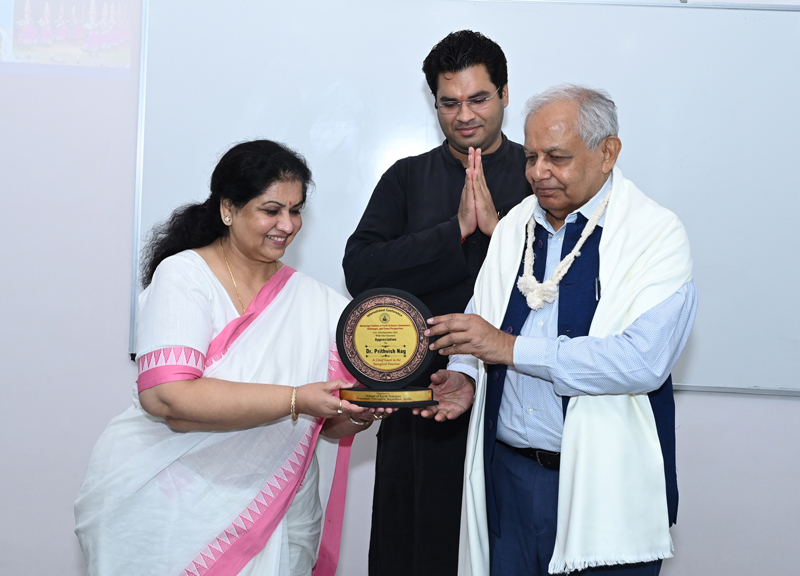
The inaugural session was graced by Prof Ina Aditya Shastri, Vice Chancellor, Prof Anshuman Shastri, Director, Centre for Artificial Intelligence, Dr Prithvish Nag, former Surveyor General of India and former Director of the National Atlas and Thematic Mapping Organisation (NATMO).
In the welcome address, Prof. Ina Aditya Shastri emphasised the growing importance of Earth Sciences in addressing global challenges such as climate change, resource management and sustainable development.
Following this, Prof Rashmi Sharma, Dean & Head of the School of Earth Sciences, introduced the conference theme and extended a warm welcome to the dignitaries and participants.
The highlight of the inaugural session was the keynote address by Dr Prithvish Nag, chief guest of the conference.
Dr Nag provided profound insights into the evolving scope of Earth Sciences and highlighted the transformative role of geospatial technologies, artificial intelligence and interdisciplinary approaches in redefining the field.
The event witnessed enthusiastic participation from international delegates representing Sri Lanka, Nepal, the Republic of Korea, Mexico and the United Kingdom, along with scholars and researchers from prestigious universities across India.
Participants joined from various Indian states including Uttar Pradesh, Rajasthan, Haryana, Madhya Pradesh, Uttarakhand, Meghalaya, Manipur, Maharashtra, West Bengal and Himachal Pradesh.
Across two days, the programme featured one keynote address, a high-level panel discussion, 15 offline technical sessions, and three online sessions.
The programme concluded with a vote of thanks proposed by Prof Anshuman Shastri.
The inaugural day set the tone for two days of enriching academic discussions, knowledge sharing and collaborative exploration.
 Follow our WhatsApp channel
