

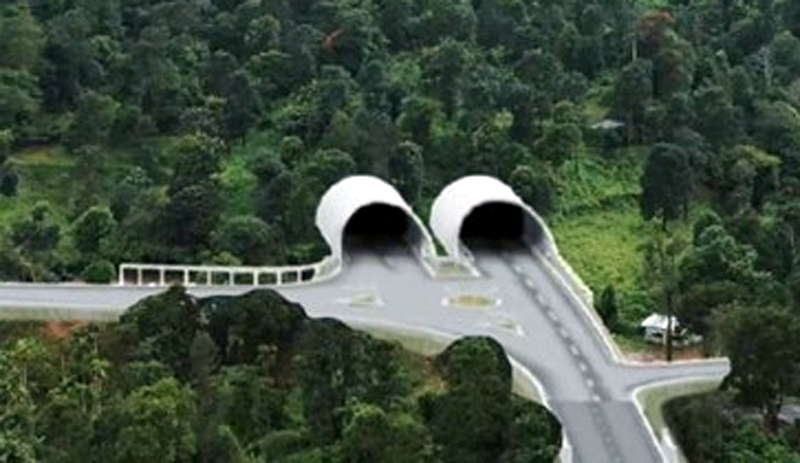
When the Public Investment Board of the Union Finance Ministry granted its approval for two critical tunnel projects on National Highway-244 – the Twin Tube Sudhmahadev-Dranga Tunnel in Udhampur and the Singhpora-Vailoo Tunnel linking Kishtwar with Anantnag – it did far more than sanction Rs 9,779 crore of infrastructure spending. It sketched, in concrete and steel, the outline of a transformed Jammu and Kashmir. These are not ordinary highway projects. They are arguably the most consequential all-weather connectivity investments in the Union Territory after the Kashmir rail connectivity. For decades, the singular vulnerability of Jammu and Kashmir’s road network has been its dependence on one lifeline: the Jammu-Srinagar National Highway-44 through Ramban and Banihal. This corridor, perpetually at the mercy of landslides, cloud-bursts and seasonal snowfall, has periodically severed the Valley from the rest of the country – stranding tourists, spoiling harvests and exposing military logistics to unacceptable risk. The Mughal Road through Shopian offered only a partial seasonal remedy. The NH-244 approval now completes the strategic geometry: a third, all-weather arterial axis, along the Chenab basin through Doda and Kishtwar, and finally descending into South Kashmir via Anantnag.
The twin Singhpora-Vailoo Tunnel – at 38.61 kilometres, one of the longest in the Himalayan arc – is the keystone of this corridor. Once operational, it will eliminate the most forbidding terrain between Kishtwar and Anantnag, districts that share a latitude but have remained functionally separated by geography. The longstanding problem inherited from the old NH-244 alignment: the notoriously sinking stretch near Khelani, plagued by proximity to the Baglihar dam reservoir, has also been taken care of. The new alignment is not only 14.56 kilometres shorter but also avoids the 21-odd sinking locations that have made the Batote-Khelani stretch a perennial engineering nightmare.
The economic argument for these tunnels is most compelling precisely because Doda and Kishtwar are not districts destined for large-scale industrialisation. Their true wealth lies in agriculture, horticulture and an as-yet largely unexploited tourism inheritance. Apple, walnut and other orchard produce from the Kashmir and Chenab belt have historically suffered from delayed evacuation to markets, with farmers bearing the cost of a road network that closes without warning. A reliable NH-244 changes this calculus entirely. During peak horticulture season, traffic management could designate NH-244 as the primary fruit corridor – easing congestion on both routes simultaneously.
The tourism dividend could prove even more significant. The Sudhmahadev-Dranga Tunnel in Udhampur opens up the entire Sudhmahadev-Patnitop-Chenani belt, a region of extraordinary natural and religious character that has suffered from its position just off the beaten track. Further along NH-244, the Kishtwar-Anantnag corridor traverses landscapes that rank among the most dramatic in the western Himalayas – yet remain almost invisible on the tourist map. With nearly two crore visitors now arriving in J&K annually, the congestion on NH-44 is itself becoming a deterrent. NH-244 offers not a detour, but a destination in its own right. Pilgrim circuits, adventure tourism, and homestay economies can flourish along this entire belt as the road network gets reliable, precisely what these tunnels are designed to guarantee.
For the Army, the strategic value requires no elaboration. Three alternative road axes into the Valley – NH-44, the Mughal Road, and now NH-244 – represent a qualitative shift in logistical resilience for the Northern Command. The point is not redundancy alone, but the capacity to keep supply lines intact regardless of weather, geological event, or adversarial pressure at any single point. Candour, however, demands one honest caveat. The new Kishtwar-Anantnag alignment will traverse terrain that is geologically complex and climatically demanding.
That caveat noted, the approvals mark an inflexion point. The foundation has been laid – in policy intent, in financial sanction, and in the engineering ambition to tame some of the subcontinent’s most challenging terrain. The people of Doda, Kishtwar, Udhampur and Anantnag have waited long. What was once a Prime Minister’s announcement is now a funded project with approved drawings. The decisions are as historic as the Kashmir rail connectivity. The tunnels, when they open, will not merely move vehicles – they will move the arc of possibility for four districts that geography has kept waiting too long.
 Follow our WhatsApp channel
