

Harsha Kakar
kakarharsha@gmail.com
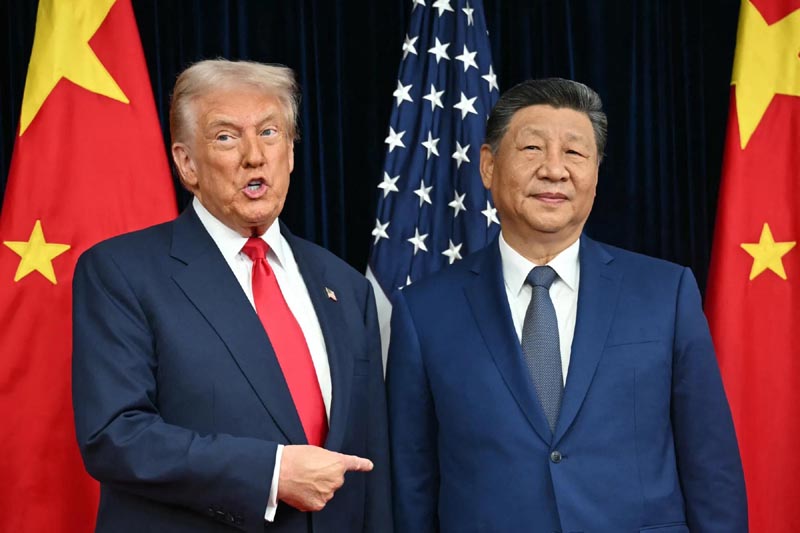
This week President Trump will be meeting Chinese President Xi Jinping in Beijing for a supposed historic summit. The last time the two met was in Busan, South Korea, in Oct last year. The meeting comes while the Iran war continues, where the US is seeking to subdue China’s closest Middle East ally, Iran. China and Iran, had in 2021, inked a 25-year cooperation agreement wherein, in lieu of cheap oil, China would invest USD 400 billion in energy and infrastructure projects. This is presently on hold.
Despite sanctions, China continued to procure over 80 percent of Iran’s oil, to the tune of 1.4 million barrels a day, mostly through shadow fleets of carriers. In return China provides goods, technology and investments. China had also supported Iran with intel on US bases as also deployment of its aircraft in the Middle East, enabling Iran to target them with accuracy. Damages to US bases and radars in the region would cost billions in repair.
The US economy is also degraded. Inflation is rising as is public anger in the Government’s handling of the war and economy. Trump cannot afford additional shocks which could emerge in case China further sells US bonds. China is no longer the largest holder of US bonds having dropped its holding from 768 billion to 682 billion in just one year. These were procured by European nations. Further selling could impact the dollar as the US and Europe are no longer on the same page. China also cancelled purchase of 500 US Boeing aircraft impacting jobs.
Following the Oct 2025 meeting with Xi in South Korea, Trump reduced sanctions on China, which have since been declared illegal by US courts, once Beijing agreed to a one-year pause on export controls for critical minerals, including gallium, germanium, and graphite. Beijing also agreed to purchase additional US farm products. There are reports that China has not stuck to its side of the bargain on farm products.
With the Iran war Trump threatened to impose additional sanctions if China supplied weapons to Iran or refused to remove retaliatory tariffs. China also continues to procure Iranian oil despite threats of tariffs. Recently, Trump sanctioned five Chinese refineries for procuring Iranian oil. In counter, China imposed its ‘blocking rules’ wherein it ordered its citizens and companies to disregard US sanctions. It is now openly challenging the US because it is aware that it holds the cards.
China has expanded its oil procurements with pipelines from Russia and Central Asia as also enhanced oil supplies from South America and Africa. The advantage which the US held over global supplies of oil, by overthrowing the Maduro Government in Venezuela, no longer exists. US taking over Venezuela has impacted China as it had provided an oil-backed USD 100 billion loan to it. China will seek repayment. Russian oil is also no longer under sanctions.
For Trump, when US vulnerability is increasing, a conflict with China is the last that he needs. Stopping exports of rare earths, interrupting supply chains or selling US bonds would all impact the US. Thus, Trump will have to dance to Xi’s tune. Added would be concerns if China looks to procure farm products from Brazil instead of the US.
The QUAD summit, scheduled to be held last year, is now postponed and is unlikely to happen in the near future. No one in the US talks about the QUAD. Rhetoric against China by Trump’s team has also reduced. This is all being done to appease Xi.
The US in the Iran war has expended a large amount of its munitions including missiles for its Patriot systems. Added has been supplies to Ukraine from its reserves. Pentagon had to move naval forces and marines from its bases in SE Asia to the gulf to enhance force levels. This includes 2000 marines and an amphibious assault ship from Japan as also THAAD anti-missile defence systems from South Korea. Thus, US deployment in SE Asia has weakened.
The war also exposed shortcomings in US bases located in the Middle East, which would have been studied by China. It would have also noted reduced stockpiles of US weaponry. An important aspect in ongoing negotiations with Iran is control over Hormuz. In case the US accepts Iranian control, China could claim the same over the Straits of Taiwan, as also the South China Sea. It would anyway have planned blockading of the Taiwan Straits in case it launches operations on Taiwan.
With weakened US military power, Trump cannot risk China attempting to regain its claimed territories in SE Asia. Thus, it will be Trump seeking assurances from China that it will not invade any nation during his tenure. He had done so during his last meeting with Xi in Seoul and announced the same proudly. It will be repeated.
Xi would also bargain hard. Trump would be forced to reign in statements from the Japanese leadership, delay sales of weapons to Taiwan and promise Xi that Taiwan will make no move which could force China’s hand. Iran will dominate talks as China would want to secure its investments as also see an end to the conflict. Hence, it would be Xi who would lay down Red Lines for Trump on Iran.
The Iran war has changed dynamics of US military and economic power. While Trump may continue screaming from the rooftops on having won the conflict, China would be aware of what transpired and the impact the war has had on the US. It is Washington seeking talks and not Tehran. The US is no longer as powerful as it claims.
Thus, Trump would not be visiting Beijing as head of a powerful state seeking to push China to bend, but of a nation desiring that China does nothing while the US rebuilds itself. Further, for Trump to secure his popularity at home, he will request Xi to procure more US agricultural products and re-commence purchasing Boeing aircraft.
It will be Trump seeking guarantees and additional procurements and in return would have to accept Beijing’s terms, though while speaking to the press, he may project a picture of gain, the reality is that he will be bending to Beijing’s demands. China will be choosing the tune for Trump to dance.
The author is Major General (Retd)
 Follow our WhatsApp channel
