

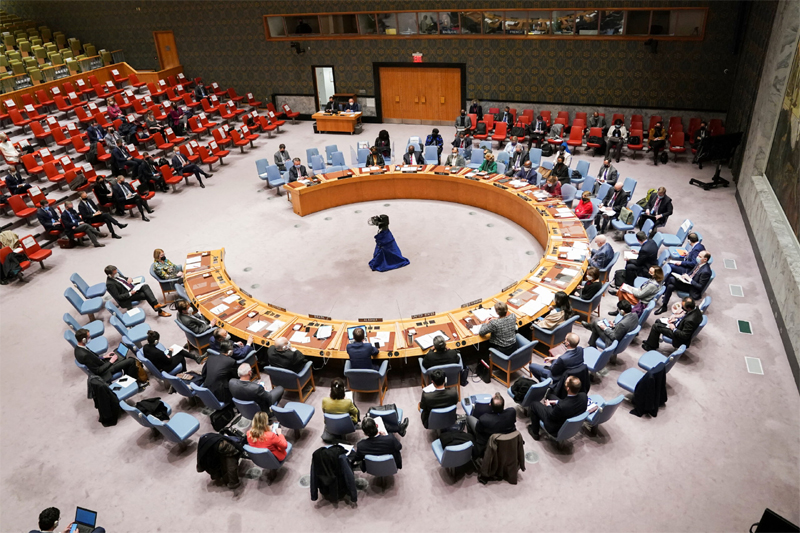
The UN Security Council’s veto privilege has not preserved global order. When India stood before the UNSC in the 1990s and produced irrefutable evidence of Pakistan’s state-sponsored terrorism-documents, intelligence intercepts, financial trails-it met not justice but geopolitical arithmetic. Washington and Beijing had their calculations; Islamabad was a useful variable in both. The world looked away. Then came 9/11/2001, and suddenly the planet discovered what India had been saying for decades. The hunter, so long cosseted by veto-wielding patrons, had turned upon his sponsors. Osama bin Laden, the architect of that carnage, was eventually found and eliminated – not in some ungoverned wasteland but in the garrison city of Abbottabad, a short drive from Pakistan’s premier military academy. History rendered its verdict. The Security Council never quite did. This is not a grievance. It is a case study in structural dysfunction. The UN Security Council was established in 1945, a year when the ink on the surrender documents of the Second World War was barely dry. The world it was built to govern has transformed beyond recognition. Empires have dissolved. Dozens of nations have gained independence. Nuclear arsenals have proliferated. The global economy has been rewired. Yet the architecture of the Council – five permanent members, each wielding an absolute veto – remains frozen in the amber of a post-war settlement that most of humanity had no hand in shaping.
The consequences of this fossilisation are not academic. They are counted in bodies. Every time the Security Council has failed to designate a known terror financier as a global threat – because one permanent member tabled an objection – that failure has had a human address. Every time a resolution for humanitarian intervention or a ceasefire has been vetoed for reasons of bilateral alliance rather than international law, the civilians caught in the crossfire paid the price. The veto was conceived as a tool of last resort, a safeguard against great-power confrontation. It has mutated, over eight decades, into a licence for protectionism – a mechanism by which powerful nations insulate their client states from accountability and their rivals from relief.
India’s experience is the starkest illustration available. For nearly four decades, the subcontinent has bled under what strategic analysts have long described as a policy of a thousand cuts – a calibrated, deniable campaign of terror financing, cross-border infiltration, and ideological radicalisation. Attempts to list the masterminds of attacks on Indian soil as designated terrorists were vetoed. India was left to absorb the cost in blood and treasure while the world debated the process. This protectionism is not unique to South Asia. Across the developing world – in Africa, the Middle East, and Latin America – nations that have sought justice, enforcement of sanctions, or authorisation for collective security action have encountered the same wall. The veto functions as a civilisational veto: a declaration that the interests of five nations, however narrowly defined, will always outweigh the collective will of the remaining 188. In comparative arithmetic, this is even more grotesque today than it was at the Council’s founding. When the body was created, the ratio of permanent to non-permanent members was 5:6. A reform in the 1960s expanded only the non-permanent category, shifting the ratio to 5:10 – paradoxically increasing the relative weight of the veto-holders. Any further reform that again expands only the non-permanent tier will compound this imbalance further.
India’s Permanent Representative, Ambassador Harish, was precise in his formulation: any reform that is not accompanied by expansion of the permanent category with a veto will only deepen the existing imbalance. Real reform demands that new permanent seats be created – and that those seats carry the same privileges as existing ones, or that the veto be abolished altogether for all holders. A democratic institution cannot sustain a two-tier architecture of sovereign equality in perpetuity. India – the world’s most populous democracy, the fifth-largest economy, a leading contributor to UN peacekeeping, and a nation that has championed multilateralism even when it failed it – has earned its place at the horseshoe table by every measure that matters. The question is no longer whether India deserves a permanent seat. The question is whether the United Nations can any longer afford to pretend that it does not.
 Follow our WhatsApp channel
