

Pushp Saraf
pushapsaraf@yahoo.com
Behind the scenic grandeur of Gilgit-Baltistan lies a region of chronic instability. It bears the scars of periodic eruptions of violence, political marginalisation, and a sectarian fault line that Pakistani authorities have never allowed to heal. At the heart of this tension is the systematic repression of the region’s Shia-majority population, a community that Islamabad has long regarded with deep suspicion: partly because of its roots in the former princely state of Jammu and Kashmir, and partly because of its religious kinship with Shia-dominated Iran. Those grievances, accumulated over decades, were violently rekindled when Ayatollah Ali Khamenei, Iran’s Supreme Leader, was killed in Israeli airstrikes on Tehran on February 28 this year.
The roots of this repression run deep. When the Iranian Islamic Revolution swept Ayatollah Ruhollah Khomeini to power in 1979, it sent a wave of alarm through Pakistan’s military establishment. Gen Zia-ul-Haq, the country’s iron-fisted ruler, responded not with diplomacy but with demographic engineering. Sunni extremists from neighbouring Pakistani provinces were deliberately pushed into Gilgit-Baltistan (henceforth G-B) in a calculated bid to dilute the territory’s Shia character. Under Zia’s patronage, militant outfits were given virtual free rein across the mountainous terrain, with the explicit purpose of pre-empting any Shia political assertion against a government that pursued a fanatically pro-Sunni agenda with rare and ruthless zeal.
Underlying this sectarian anxiety was a historical reality that Pakistan found inconvenient. G-B, as a constituent unit of J&K, had legally acceded to India in October 1947. Pakistan has controlled the region ever since through force, possessing no legal instrument to justify that control. That unresolved question has coloured the thinking of every Pakistani ruler since, military and civilian alike, lending an additional dimension of strategic paranoia to what might otherwise have been a purely sectarian conflict.The assassination of Khamenei on February 28 reignited all of this.
Mourning turns to fury
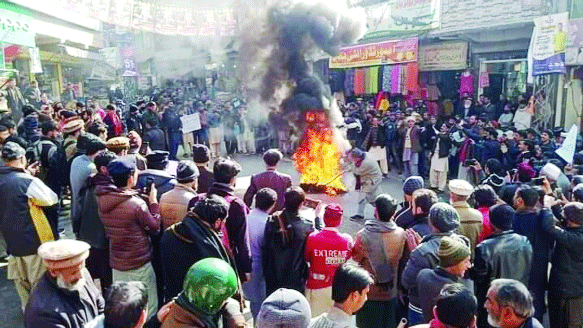
As news of his killing spread, people poured into the streets across G-B in mourning and in fury. They directed their rage at the United States and Israel. Pakistan’s response was swift and heavy-handed. The army was deployed across the region to contain the protests. In Skardu, clouds of smoke rose over the city as demonstrators set fire to government and private properties; elsewhere, critical infrastructure was targeted and damaged. The regional government moved quickly, imposing an indefinite curfew, suspending cellular services, and calling in the Pakistan Army. By the time the dust settled, at least 13 people were dead.
The body count tells its own story. For the people of G-B, the killing of Khamenei was not merely a foreign policy event. It was a wound inflicted on their identity. For Islamabad, their grief was, as it has always been, a security threat to be suppressed rather than a sentiment to be understood.
To mollify public anger, the G-B Government set up a judicial commission to investigate the unrest. Simultaneously, security forces launched a de-weaponisation campaign across the region.
The calm that followed is fragile at best. At the time of writing, authorities have tightened security measures at religious sites, key installations, and offices of law-enforcement agencies. But beyond deploying boots on the ground, Pakistan has reached for a more institutional instrument of control: the Counter-Terrorism Department, or CTD, established to operate out of Gilgit and tasked with bridging what official documents describe as “critical gaps in human and technical resources” in responding to militant incidents.
Made operational in February 2026 with a formal police station, the CTD is in the process of expanding its strength to 850 personnel through fresh recruitments. It will have jurisdiction over all counter-terrorism cases in the region, with first information reports being transferred to it from existing police stations. Its officers are being trained by specialists brought in from elsewhere in Pakistan. This is a telling admission that local capacity has long been deliberately kept thin.
One of the CTD’s first acts was registering the case relating to an IED (improvised explosive device) attack in the Tangir Valley, part of Diamer district. The target was a vehicle belonging to the Frontier Works Organisation, the Pakistan Army’s military engineering arm. The driver was killed; four others, including an army major, were wounded. The attack was claimed by a militant group in Diamer that has set itself explicitly against both the army’s presence in the region and what it regards as the plunder of its natural resources. Its grievance is neither new nor, given the history, difficult to understand.
Permanent State of Simmer
G-B is a region in a permanent state of simmer. The sources of discontent are many and mutually reinforcing. The locals find the military presence overbearing. They are treated as a security problem rather than as citizens. Chronic administrative failure has meant punishing electricity shortages, endemic poverty, and deliberate under-development spanning decades. Underneath it all run deep sectarian fault lines between Shia and Sunni communities. Even the periodic theatre of assembly elections offers little relief. Their outcomes are largely predetermined, with whichever party holds power in Islamabad reliably installing its own compliant government in the region.
Into this volatile mix, international geopolitics has now thrown a lit match. The killing of Ayatollah Khamenei has given the region’s sectarian tensions a global dimension, linking the grievances of a marginalised mountain community to a convulsion felt across the entire Muslim world. For Islamabad, that linkage is the stuff of nightmares. For the people of G-B, it is the latest chapter in a long story of being governed by a state that has never trusted them and has never given them reason to trust it in return.
 Follow our WhatsApp channel
