

By B. S. Dara
Pakistan’s emergence as a nuclear weapons state is often justified as a matter of security, but this explanation overlooks critical realities. The presence of nuclear weapons in Pakistan, given its record of cross-border terrorism and proxy warfare, is not only a concern for India but a risk to regional stability and even beyond. Pakistan developed its nuclear capability in secrecy, relying on external assistance and exploiting weaknesses in the global non-proliferation system, which repeatedly failed to act decisively. It concerns a state whose record continues to raise persistent questions about responsibility, control, and credibility.
The roots of this policy go back to the aftermath of the 1971 Indo-Pakistani War, when Pakistan lost East Pakistan and was forced to rethink its strategic direction. Zulfikar Ali Bhutto made it clear that Pakistan would pursue nuclear weapons regardless of economic consequences, turning it into a central state objective rather than just a scientific effort. This drive intensified after India conducted the Smiling Buddha nuclear test in 1974. However, the concern is not the existence of nuclear weapons alone, but the combination of nuclear capability with a continued pattern of supporting non-state actors, which significantly elevates the risks for regional and wider international security.
Pakistan moved rapidly, not through a transparent and accountable institutional process, but through a tightly controlled and covert structure designed to avoid international scrutiny. From an Indian perspective, this approach is significant because it reflects a pattern of strategic opacity that has long defined Pakistan’s security posture. At the center of this effort was Abdul Qadeer Khan, whose role went far beyond technical contribution. He secured access to centrifuge designs and international procurement networks, allowing Pakistan to bypass the time and discipline required for indigenous development. The uranium enrichment programme at Kahuta became the backbone of Pakistan’s nuclear capability. This pathway was neither accidental nor unknown. Declassified assessments from the Central Intelligence Agency indicate that by the late 1970s and early 1980s, U.S. intelligence had already identified Pakistan’s systematic efforts to acquire enrichment technology and sensitive components through European channels. A series of intelligence reports from that period concluded that Pakistan was actively pursuing a weapons capability and had crossed critical technological thresholds. For India, this reinforces a long-standing concern: that Pakistan’s nuclear development was not only opaque but also enabled by gaps in global oversight, raising enduring questions about accountability and regional security.
A 1982 declassified U.S. intelligence estimate stated that Pakistan was “seeking to develop a nuclear weapons capability as rapidly as possible,” noting procurement efforts that extended across multiple countries. By 1984, further intelligence assessments indicated that Pakistan had likely achieved the ability to produce weapons grade uranium. These findings were not speculative. They were part of official intelligence briefings within the U.S. government. Despite this, enforcement remained limited. The geopolitical context of the Soviet war in Afghanistan altered priorities. Pakistan became central to U.S. strategy in the region. As later acknowledged in U.S. Congressional discussions, non proliferation concerns were weighed against immediate strategic objectives. The result was a policy environment in which Pakistan’s nuclear program continued to advance with limited external constraint. This pattern was later reflected in legislative debates around the Pressler Amendment. While the amendment required certification that Pakistan did not possess nuclear weapons, intelligence assessments repeatedly raised doubts about compliance. The gap between intelligence findings and policy action became a defining feature of that period. By the late 1980s, Pakistan had effectively achieved nuclear capability. The formal declaration came in 1998, following India’s Pokhran-II nuclear tests. Pakistan’s tests in Balochistan confirmed its status as a nuclear weapons state. What makes this development more concerning is the environment in which it exists. Pakistan’s security framework has, for decades, included the use of non state actors and proxy groups. This is reflected in a series of incidents that have shaped regional security. The 2001 Indian Parliament attack brought India and Pakistan to the brink of war. The Mumbai attacks demonstrated the scale and coordination of cross border terrorism. These were not isolated events. They formed part of a sustained pattern that has been acknowledged in international assessments.
U.S. officials have been direct in their observations. Hillary Clinton stated that “you can’t keep snakes in your backyard and expect them only to bite your neighbors,” referring to militant groups operating from Pakistani territory. This was not rhetorical language. It reflected a consistent concern within U.S. policy circles. The discovery of Osama bin Laden in Abbottabad in 2011 intensified global scrutiny. The operation conducted by United States Navy SEALs located him in close proximity to a military cantonment. Following the operation, Barack Obama confirmed that he had been found “living in a compound deep inside Pakistan.” The implications were immediate. It raised questions about oversight that remain unresolved.
The A.Q. Khan network further reinforced these concerns. A 2004 statement by George W. Bush described it as “a clandestine network that spread nuclear weapons technology to countries around the world.” Declassified intelligence and subsequent investigations confirmed transfers to Iran, Libya, and North Korea. This was one of the most significant proliferation episodes in modern history. The United States Senate Select Committee on Intelligence later documented the scale of this network, highlighting systemic failures in oversight. These findings underscored that the issue was not confined to individual actions but reflected deeper institutional vulnerabilities.
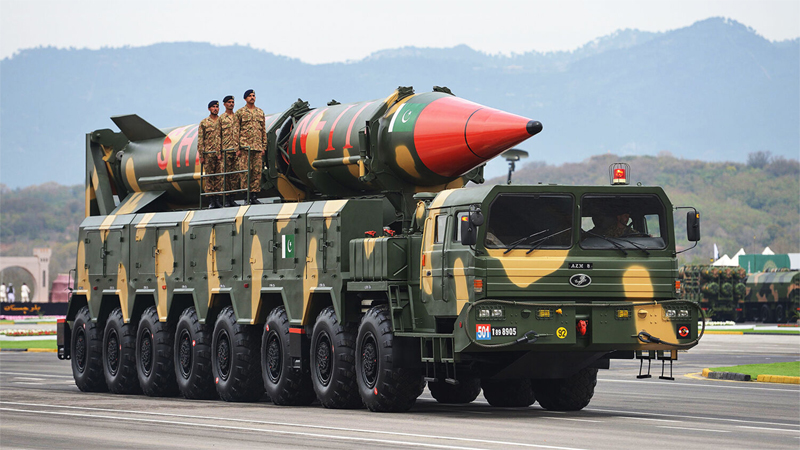
Today, Pakistan’s nuclear arsenal is estimated to exceed 160 warheads and continues to grow. It has also developed tactical nuclear weapons. U.S. defense assessments have repeatedly warned that such systems lower the threshold for use and increase the risk of escalation. A report by the United States Department of Defense noted that the deployment of tactical nuclear weapons complicates command and control and raises the possibility of rapid escalation under stress conditions. The contrast with India is clear and significant. India’s nuclear program has been characterized by institutional control, strategic restraint, and a doctrine of credible minimum deterrence. Over time, India secured international confidence, reflected in civil nuclear agreements and strategic partnerships. This confidence is rooted in governance and predictability.
Pakistan, by contrast, continues to face sustained international scrutiny. From an Indian standpoint, this perception is shaped by persistent economic fragility, political instability, and a long record of association with militant networks. This is not a constructed narrative but a conclusion supported by decades of documented events and official assessments. The central issue is not merely the existence of nuclear weapons, but the environment in which they are embedded. A state marked by recurring financial crises, limited institutional depth, and a history of proxy engagement presents a fundamentally different risk profile. In such a context, nuclear capability carries implications that go well beyond conventional deterrence and directly impact regional stability. My forthcoming work, The Ignored Bomb: Still Ticking, draws from this reality. It places a fictional narrative within a framework informed by declassified intelligence, documented developments, and observable strategic patterns. The book examines not only how the nuclear capability was developed, but also how the international system, despite having the mechanisms to respond, allowed it to take shape with limited accountability.
In conclusion, Pakistan’s nuclear programme may have achieved its immediate objective of deterrence, but it has also created long-term risks that remain unresolved. From an Indian perspective, these risks are not theoretical, they are driven by a continuing pattern of irregular conflict, cross-border terrorism, and internal instability. The presence of nuclear weapons in such an environment ensures that the issue cannot be treated as a closed chapter. It remains an active and evolving concern for regional and global security. The central question is now whether the international community has fully recognised the consequences of allowing such a capability to emerge under these conditions. That recognition cannot remain academic or selective. It must translate into a clear understanding of the risks that persist, the gaps that were exposed, and the responsibilities that were deferred. The issue does not belong to history alone. It continues to shape the strategic environment of the present, where deterrence coexists with instability and where unresolved vulnerabilities carry the potential for serious escalation. A durable response demands more than retrospective acknowledgement. It requires sustained vigilance, credible enforcement of global norms, and a willingness to confront uncomfortable realities that have too often been overlooked.
Author B. S. Dara is an independent foreign affairs analyst and geopolitical commentator.
 Follow our WhatsApp channel
