

Asif Khora
asifkhorasmailbox@rediffmail.com
The mountains of the Chenab Valley once stood as symbols of resilience and natural grandeur. Their snow-capped peaks, thick forests, and winding rivers shaped the identity of Doda district for generations. Today, however, those majestic horizons are slowly vanishing beneath an ever-expanding curtain of grey dust. The hills are no longer breathing freely. They are choking.
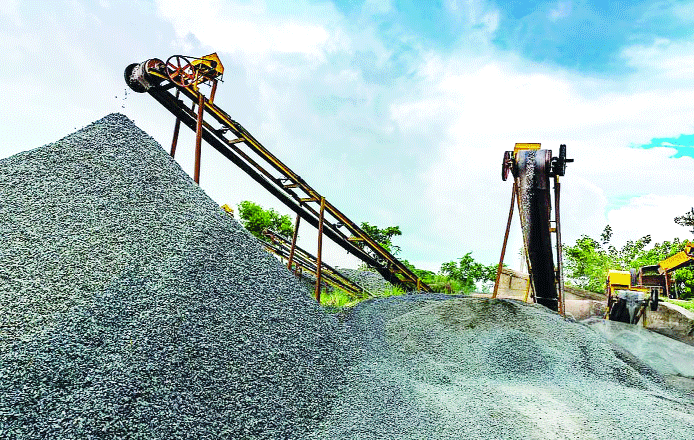
Across Doda district, an environmental crisis is unfolding with alarming speed. A dangerous combination of geological fragility and unchecked industrial expansion threatens to push the region toward irreversible ecological damage. While parts of Doda, particularly Thathri and Sinoo, have already been identified as highly vulnerable zones due to land subsidence and tectonic instability, another disaster is now being engineered by human activity itself: the unchecked proliferation of illegal stone crushers and hot mix plants.
These industrial units, many operating outside the framework of environmental law and regulatory norms, are not merely altering the landscape; they are dismantling the ecological balance of one of Jammu and Kashmir’s most sensitive mountain regions.
A Crisis Hidden in Plain Sight
The scale of industrial expansion linked to minor mineral extraction in Jammu and Kashmir has become a growing concern. Hundreds of stone crushers and hot mix plants operate across the Union Territory, yet questions continue to surround their compliance with environmental regulations.
Regulatory bodies have issued closure directions to numerous units in recent years. However, a significant gap remains between policy and implementation. In mountainous districts such as Doda, the challenge becomes even more severe.
The region’s difficult terrain has often limited routine monitoring and enforcement mechanisms. This gap has provided opportunities for operators to establish and continue industrial activity along strategic road corridors, including the Doda-Kishtwar and Doda-Jammu highways, often in close proximity to human settlements.
For local residents, these are not distant statistics. They are daily realities.
The Air People Are Forced to Breathe
Perhaps the most immediate consequence of this industrial expansion is the impact on public health.
In many areas across Bhalessa, Thathri, and Doda, stone crushers and hot mix plants have emerged close to schools, agricultural fields, residential settlements, roads, and places of worship. Residents allege that many of these units function without adequate safeguards and routinely violate environmental conditions intended to protect communities.
Fine particulate dust generated during crushing operations does not simply settle on roads and rooftops. It enters the lungs.
Medical research has consistently linked prolonged exposure to airborne particulate matter with respiratory illnesses, chronic asthma, bronchitis, eye irritation, and long-term pulmonary complications.
Parents describe children returning from school with persistent coughing and eye irritation. Elderly residents speak of breathing difficulties that have become increasingly common. Farmers working in nearby fields complain that a layer of dust settles daily over crops, homes, and drinking water sources.
The invisible threat has become part of everyday life.
Mountains Under Siege
The crisis extends far beyond polluted air.
Doda lies within an ecologically fragile Himalayan zone already vulnerable to landslides and seismic activity. Geological experts have repeatedly cautioned against unscientific excavation and heavy industrial vibration in such areas.
Stone quarrying and associated industrial activity involve drilling, excavation, and heavy machinery that disturb already sensitive slopes. Environmental observers fear that continued operations could accelerate land instability and increase risks linked to landslides and flash floods.
Communities that have lived for generations alongside these mountains increasingly fear that development without safeguards may ultimately destabilize the very land beneath their feet.
Rivers Becoming Dumping Grounds
The Chenab River and its network of tributaries serve as lifelines for thousands of families across the region.
Yet residents allege that industrial waste and processing debris are increasingly being dumped into nearby water bodies and natural drainage channels.
Environmental consequences of such practices can be severe: blocked water pathways, reduced agricultural productivity, soil degradation, and contamination of local water resources.
Farmers across affected areas say agricultural lands are gradually losing fertility. Crop yields have reportedly suffered, while livestock dependent on local water sources face growing risks.
For many communities, environmental destruction is now translating directly into economic distress.
Laws Exist. Enforcement Remains the Question
Environmental safeguards governing stone crushers and hot mix plants are not absent.
Regulations prescribe mandatory siting criteria, environmental clearances, consent mechanisms, operational restrictions, pollution-control infrastructure, and protective green belts around industrial units.
Requirements include:
* Safe distances from residential settlements and highways
* Consent to Establish (CTE) and Consent to Operate (CTO) approvals
* Wind-breaking boundary walls
* Mechanical dust suppression systems
* Peripheral plantation zones
* Restricted operating hours
Civil society groups and local residents, however, argue that many such provisions remain confined to official documents while violations continue on the ground.
The growing frustration among communities reflects a broader concern: environmental laws are only as effective as their enforcement.
Voices Rising Across Chenab
Public anger across Doda is steadily intensifying.
Civil society organizations, student groups, and local activists have begun demanding immediate and transparent intervention by authorities. Their demands include district-wide inspections, verification of operating permissions, strict action against violators, and accountability for environmental damage.
For many residents, the issue is no longer merely about pollution.
It is about survival :
The Chenab Valley is more than a geographic landscape. It is home, identity, culture, and inheritance. The mountains of Doda have endured centuries of natural change, but whether they can survive unchecked environmental exploitation remains uncertain.
As dust continues to rise over the valley, one question hangs heavily in the air:
How much of Doda will remain by the time action finally arrives?
(The author is President, Doda Development Forum)
 Follow our WhatsApp channel
