

By Dr. Gyan Pathak
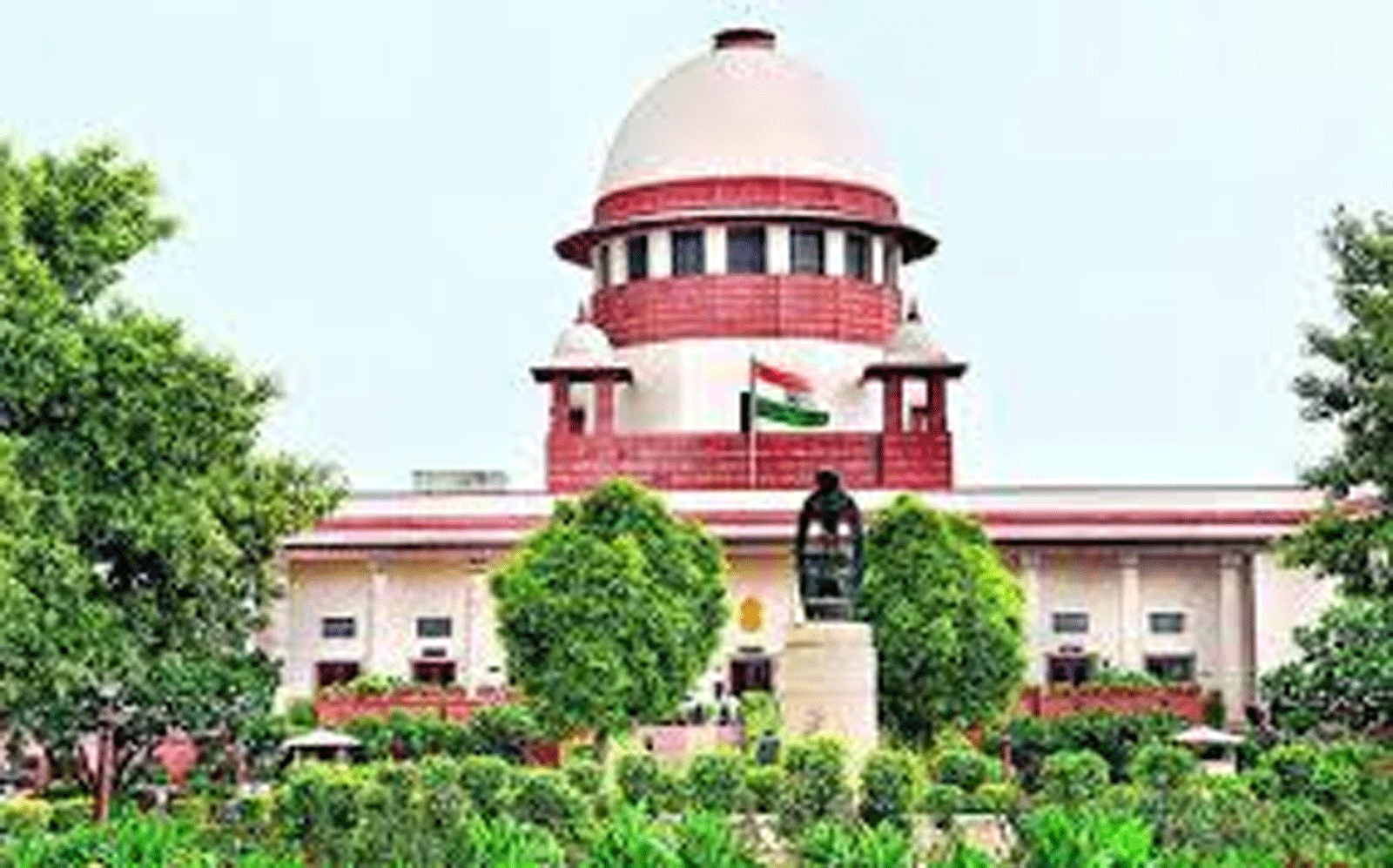
Supreme Court of India on May 27, 2026 upheld the legality of the Special Intensive Revision (SIR) of the electoral roll in Bihar and elsewhere and emphasized that this exercise is constitutionally connected to “free and fair polls”. The judgment strongly underlined the purity and accuracy of rolls giving priority to preventing bogus voters entering into the voter lists (deletion), but at the same time did not give equal weightage to, rather pushed into the rear, the task of protecting every eligible citizen’s right to vote (inclusion). This is where significant concerns lie, despite the judgement.
Before going into details of the judgement, it would be worth recalling the respective position of the ruling BJP and the political parties in opposition. The Ruling BJP and the Election Commission of India (ECI) have always emphasized on cleaning the electoral rolls after deletion of ineligible voters including Bangladeshi infiltrators, while the opposition has always grudged this and emphasized on protecting every eligible voter’s right to vote.
We have seen all through the SIR process the struggle between the two priorities – deletion of voters and the protection of citizens’ right to vote. At no point of time the so called “pure” voter list prepared by the ECI was complete even though election to the Legislative Assembly of West Bengal is over and results are out. The Tribunals are hearing the cases of excluded voters who could not exercise their right to vote, many of their names were cleared only after election was over, that benefited the BJP. The current judgement therefore suffers from giving less priority to “protection of the citizen’s right to vote” than deletion of voters for so called “purity” of electoral roll. One can therefore easily differ as to what constituted “purity” of the voter list that is prerequisite for “free and fair” polls.
Critics of the judgement argue that the Supreme Court failed to substantively examine the way SIR was implemented itself undermined free and fair elections. The court chiefly examined whether the ECI had statutory and constitution powers und Article 324 and the Representation of the People Act. The court gave less attention to whether the SIR exercise could disproportionately disenfranchise poor, migrant, minority, or document-deficient voters? The court justified the ECI’s requirement of documents, but on Aadhaar, it said that it can be accepted as an “additional indicative document” in future, which cannot itself determine citizenship status.
It should be noted that the bench itself had earlier acknowledged a possible “margin of error” in mass verification process. Yet in the latest judgement it seemed treating the mechanism as institutionally reliable without fully addressing whether large-scale verification can realistically avoid arbitrary deletions.
The bench comprising Chief Justice Surya Kant and Justice Joymalya Bagchi has pronounced the judgment after hearing a bunch of petitions that have challenged the notification issued by the ECI in June 2025 to conduct SIR in Bihar. The bench said, “When the statute itself authorises a special revision at any time, for reasons to be recorded and in such manner as the Election Commission may deem fit, the impugned exercise cannot be invalidated merely because it does not conform in every respect to the ordinary modalities contemplated for routine revision. In our considered opinion, the impugned SIR does not supplant the Representation of the People Act and the Rules. Rather, it breathes life into the constitutional mandate under Article 324 within the precise statutory contours provided by Section 21(3). Therefore, it cannot be said that the Commission has acted in excess of its statutory powers.”
The bench emphasized on the claimed objective of the SIR and said that it bore nexus with the constitutional goal of ensuring free and fair elections. It also noted that elections did not rest merely on the mechanics of polling but fundamentally depended on the integrity, accuracy, and credibility of the electoral rolls, which formed the foundation of the democratic process.
Every word of the bench seems to be important, but has different meanings for different people. What constitute “integrity, accuracy, and credibility of electoral rolls”? Answer to this question is not clear when we go through the judgement, since this is precisely the opposition’s allegation that “integrity, accuracy, and credibility of the electoral rolls” have been compromised because the PM Narendra Modi led government and the ECI have conspired to get SIR done in particular manner. Therefore the “foundation of the democratic process” that is preparation of pure and credible voter list with integrity and accuracy remains questionable in the light of the decisions of the Tribunals in West Bengal which has been finding thousands of eligible citizens who were excluded from electoral roll violating their right to vote.
CJI Kant has observed, “Calling upon electors to furnish supporting material in the course of such an exercise does not amount to negation of the presumption. Rather, it reflects the procedural mechanism through which the Commission seeks to reaffirm or, where necessary, correct existing entries. The presumption continues to operate, but it does not negate the possibility of verification.”
Moreover, the court said that ECI has power to go into questions of citizenship for the purpose of including in the electoral roll, but the negative determination of the ECI does not result in a conclusive finding that the person is not an Indian citizen. CJI pronounced, “The consequence of such a citizenship determination is correspondingly limited. It affects the individual’s entitlement to be included in the electoral rolls and thereby the right to participate in the electoral process. It does not, however, operate to divest the individual of claims to citizenship, nor does it foreclose adjudication of that question by the competent authority under the Citizenship Act.”
Where the country will be moving from SIR? There is an indication in the judgement itself. It says, in cases where commission is not satisfied that a person fulfils the statutory conditions for inclusion in the electoral rolls, it would be incumbent upon the Commission to refer such an individual to the competent authority of the Union Government for adjudication in accordance with law.
This confirms the opposition fear that “SIR was a backdoor NRC” which India will see soon, as we have already seen the case of Assam where D-voters (doubtful voters) were referred to authorities for ascertaining their citizenship. More so because the court has asked the ECI to forward the Central Government the names of persons deleted from the 2003 electoral rolls over doubtful citizenship within four weeks. (IPA Service)
 Follow our WhatsApp channel
