

Piotr Opaliński
In the backdrop of the two-day summit between US President Donald Trump and Chinese President Xi Jinping in Beijing, it’s worth examining is at all Southeast Asia figured in their discussions. The region remains one of the principal theatres of strategic rivalry between the United States and China. This competition extends beyond diplomacy into the military, economic and infrastructure domains.
The American presence in the region rests on a network of alliances and partnerships with countries such as the Philippines, Japan, South Korea and Australia, alongside an expanded military footprint across the Indo-Pacific. China, meanwhile, has steadily consolidated its position in the South China Sea through the expansion of island infrastructure, militarisation of artificial islands and increased projection of naval power.
At the same time, initiatives such as AUKUS and the QUAD reflect the continuing securitisation of the Indo-Pacific. These developments are directly shaping the strategic environment of the Association of Southeast Asian Nations countries, many of which seek to balance economic dependence on China with security ties to the US.
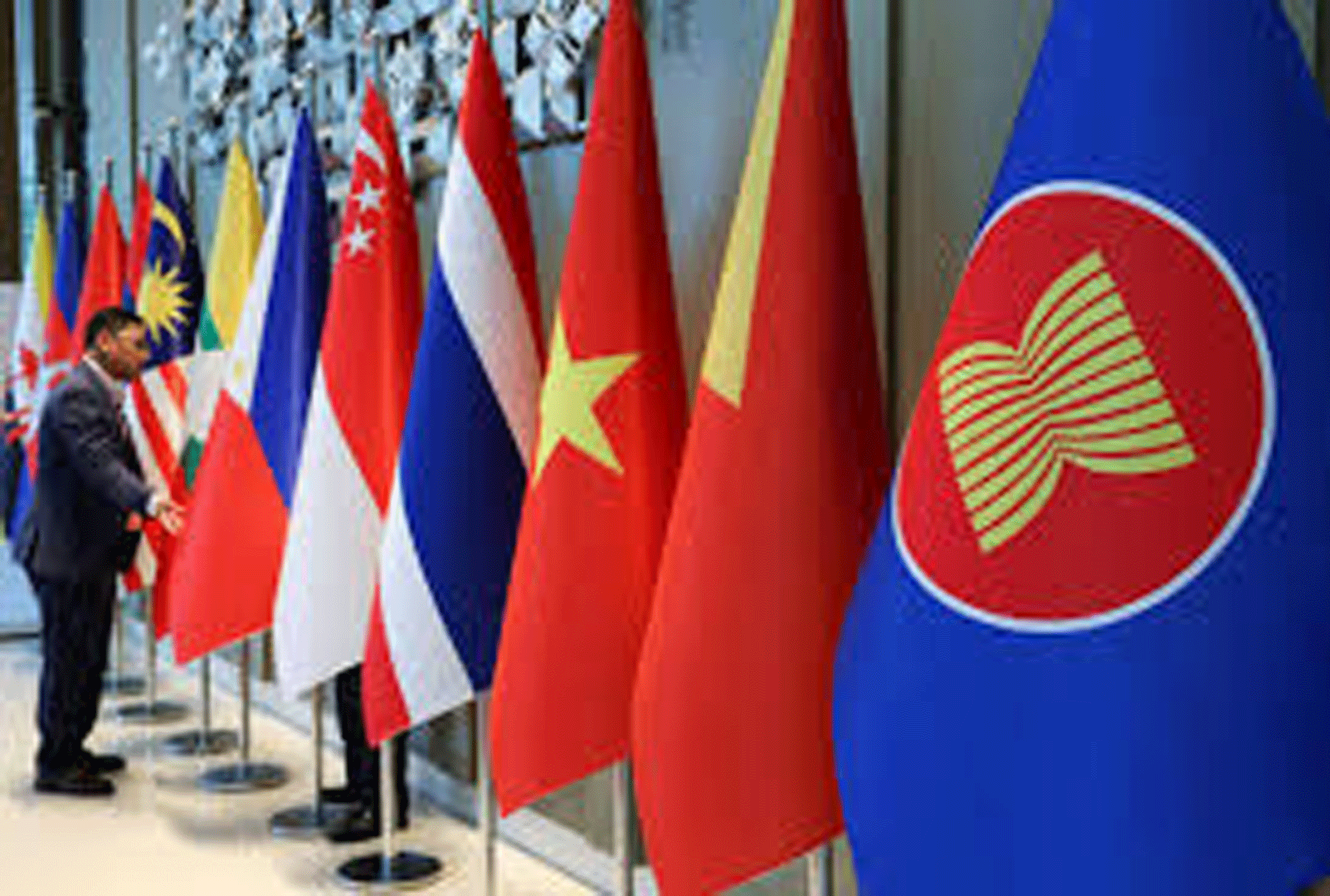
For Southeast Asian nations, intensifying rivalry presents both opportunities and risks. While competition between the major powers brings investment, trade and security cooperation, it also raises concerns over regional stability, maritime disputes and erosion of ASEAN centrality. Consequently, ASEAN states continue to advocate a balanced and inclusive regional order, resisting pressures to align exclusively with either Washington or Beijing.
ASEAN has developed a model of action that mitigates the risk of escalation by institutionalising dialogue and engaging rival actors in common formats. The organisation is a key hub of multilateral diplomacy in the Indo-Pacific, maintaining over 20 dialogue mechanisms involving all major global and regional powers. Instruments such as the ASEAN Regional Forum and the East Asia Summit are based on inclusiveness, a procedural approach to disputes, and gradual consensus-building.
This arrangement doesn’t facilitate quick resolutions, but it increases predictability and reduces the risk of escalating tensions. At the same time, a consensual decision-making model can be a source of political paralysis in particularly sensitive matters, as exemplified by the disputes in the South China Sea and the crisis in Myanmar. The South China Sea dispute, in particular, represents a major test of ASEAN cohesion, where the interests of member states intersect with China’s strategic pressure.
From a European perspective, this means that ASEAN contributes to creating conditions of relative stability in a region of key importance to the global economy. It’s worth emphasising, however, that this architecture is asymmetric and doesn’t eliminate internal tensions. In practice, ASEAN operates as a system of “managed incoherence,” in which the diverse interests of member states—including differing relations with China and varying levels of economic integration—limit the ability to make swift and binding decisions. As a result, the organisation more often stabilises the balance between actors than formulates a unified policy line. Growing differences in individual member states’ relations with China also lead to a partial fragmentation of ASEAN’s positions on security issues, limiting the possibility of developing coherent responses to regional crises.
Economy: ASEAN in Process of Reconfiguring Globalisation
The ASEAN region is playing an increasingly important role in transforming global value chains. A key element of this shift is the Regional Comprehensive Economic Partnership (RCEP), covering approximately 30 per cent of global GDP and creating the largest free trade area in the world.
This transformation is driven by three overlapping processes: trade tensions between the largest economies, the impact of the pandemic, and the growing importance of economic security. In this environment, ASEAN countries are becoming beneficiaries of a production diversification strategy (“China+1”), attracting investment in the electronics, automotive, and semiconductor sectors, which simultaneously strengthens their domestic markets and technological potential.
At the same time, ASEAN does not constitute a unified economic space. Singapore serves as a regional financial and technological center, Vietnam is strengthening its industrial position, while Indonesia remains the region’s largest economy and demographic core, while also facing infrastructure and transformational challenges.
In this context, the European Union remains primarily an economic actor in the region, with limited political and security projection capacity, resulting in a structural asymmetry of its influence vis-à-vis the United States and China. This implies a need for more operational and sectoral European Union engagement in the region. In turn, Poland is opening opportunities to participate in selected segments of new production chains, particularly in the areas of energy transformation, logistics, and digital services. From a systemic perspective, ASEAN is becoming one of the pillars of a more dispersed and multipolar globalisation.
Security: Infrastructure & System Dimensions
ASEAN’s security role stems from its location and role in the global trade system. The region encompasses key maritime routes, including the Strait of Malacca, through which approximately one-quarter of global seaborne trade passes.
The stability of this area directly impacts Europe’s economic security. Consequently, European countries are increasingly engaged in activities supporting maritime security and the resilience of critical infrastructure.
In practice, this includes participation in initiatives concerning the safety of navigation, the development of cooperation in the area of cyber security and the strengthening of the order based on international law, including within the framework of the United Nations.
Normative Dimension: Managing Differences in Approach
Relations between Europe and ASEAN are shaped by distinct political and normative traditions. The principle of non-interference and the consensual nature of ASEAN decisions influence how it responds to internal crises, as exemplified by the situation in Myanmar.
For Europe, this means pursuing policies that take into account both its own values and regional circumstances. European effectiveness in the region depends less on declarative pressure and more on the ability to pursue pragmatic sectoral cooperation, gradually strengthen institutions, and maintain channels of dialogue.
In sum, ASEAN remains one of the pillars of the emerging multipolar international order. Its importance stems not only from its stabilising role in the Indo-Pacific region but also from its structural role in the global economy. For Europe, this means shifting from a declarative presence to a selective, sectoral, and strategically focused presence in the region. The key is not so much “being present in Asia,” but building a specialised position in selected areas of cooperation—from maritime and cyber security to energy transition and critical technologies.
In a broader perspective, this means the need to treat the Indo-Pacific as one of the central areas in shaping the future international order, where the stability of the global economy and security architecture is determined.—INFA
(Copyright, India News & Feature Alliance)
New Delhi
15 May 2026
 Follow our WhatsApp channel
