

Dr. Lakhvinder Singh
lakhvinderofficialrecord@gmail.com
We all discuss pollution almost daily and our discussions mostly revolve around air quality index, climate changes, smog, rivers and drinking water sources. Everyone is conscious of the quality of air and water around us. However, we often neglect yet another vital component of the environment that supports life just as fundamentally but receives far less attention. This important component is our soil which lies quietly beneath our feet.
Soil rarely draws our attention because it does not show sudden or dramatic changes. Fields remain fertile, crops continue to grow and the land appears much the same year after year. Scientists however, repeatedly remind us that soil is not merely a surface we walk on. In fact, it is a living entity made up of countless organisms that continuously interact with the other abiotic and biotic parts of the environment. It too responds like a living system to human activities. Over time, human activities bring changes in soil and these gradual changes in structure and composition of the otherwise fertile soil can lead to a major environmental issue commonly known as soil pollution.
Soil is a complex mixture of minerals, air, water, organic matter and countless living organisms. Healthy soil supports plant growth, stores and filters water, regulates nutrient flow and sustains the microorganisms that drive natural cycles essential for the existence of life. Soil has a layered structure and consequently it has the ability to absorb and hold substances that come into contact with it. Substances released into the environment eventually find their way into soil. Soil reportedly changes very slowly unlike air and water. However, once affected, it may take years or even decades to recover to its healthy state.
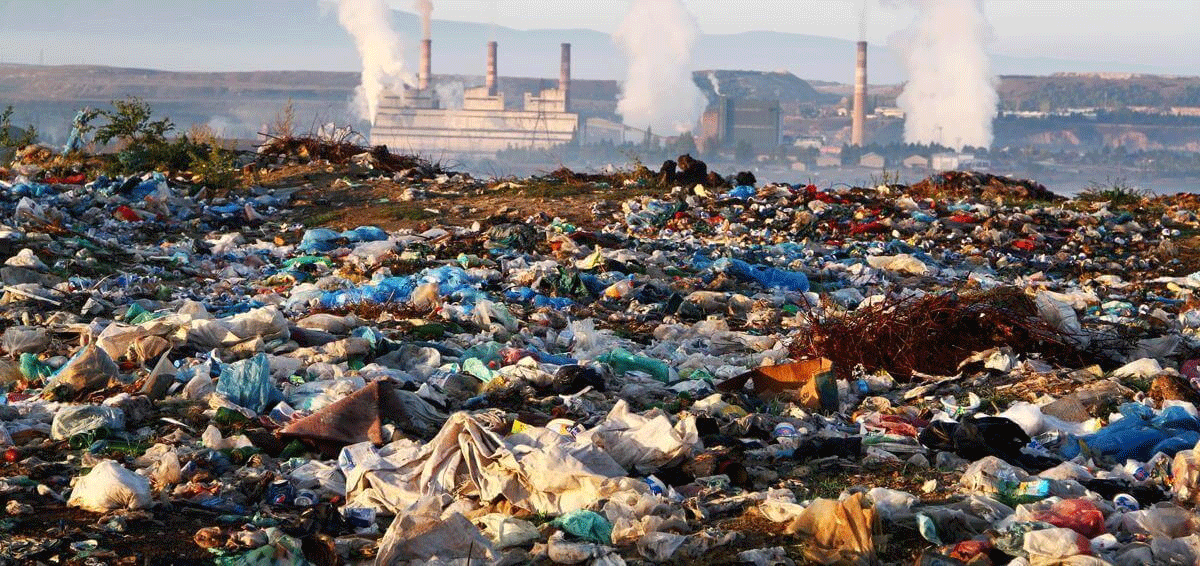
Soil pollution means the gradual accumulation of harmful substances in soil that may interfere with its natural functioning. These substances may include residues from agricultural chemicals, urban and industrial waste, mining by-products, petroleum residues, plastics or certain metals that do not degrade easily. A key and very significant feature of soil pollution is its cumulative nature. A single event rarely causes any visible damage. Instead, repeated small inputs over time slowly alter soil chemistry, biology and structure. Moreover, despite all the hidden damage slowly being done to the soil, it may still appear productive. Therefore, initially soil pollution often remains unnoticed until its effects start emerging indirectly.
Soil carries a long memory. It has been recording, layer by layer, the history of human activity ranging from agriculture, settlement, industry and now technology. Research across the world points to several common pathways through which soil quality is altered. These pathways are usually linked to everyday human activities rather than sudden events. Individually, these activities may seem routine. However collectively, over many years, they gradually alter the nature of soil.
Urbanization is one such important factor. Where waste disposal and land use are poorly managed, soil gradually becomes contaminated with persistent and often non-biodegradable pollutants. Expanding cities generate large amounts of solid waste, construction debris, plastic materials and e-waste. Dust and emissions from traffic also settle on nearby land. Modern agriculture too adds another layer of pressure. The long-term and repeated use of chemical fertilizers, pesticides, herbicides and plastic mulches has no doubt helped increase food production. However, residues from these non-biological inputs may persist in soil for decades. Over time, they can influence soil organisms and nutrient balance. Water use practices also play a role. In water-scarce regions, treated or untreated wastewater is sometimes used for irrigation and other uses. Repeated application of such polluted waters can introduce unwanted substances into soil.
In certain areas, industrial and mining activities influence soil quality more directly. For instance, removal of topsoil and exposure of deeper layers can change natural soil composition very rapidly. Undoubtedly these effects are often localized but they have long lasting consequences on soil quality.
Why is soil pollution often overlooked? One main reason soil pollution attracts limited public attention is its invisibility. Polluted air irritates the eyes and lungs. Contaminated water affects taste and health. Soil pollution, by contrast, works silently. However, once soil properties are altered beyond certain limits, recovery becomes slow and often difficult. Because soil forms the base of the food chain, these changes may eventually influence crop quality, groundwater and ecosystem health.
Soil does not exist in isolation. In fact it forms an interconnected system with water and food. Rainwater moves through soil, dissolving and transporting many substances. Groundwater drawn for drinking or irrigation repeatedly interacts with soil layers. Plants absorb nutrients and sometimes other substances from the soil in which they grow. This close connection reflects that soil quality directly influences water quality and consequently quality and safety of the food grown out of it. Protecting soil therefore supports broader environmental and public health goals. Across the world, rapid industrialization, uncontrolled urban growth and intensive land use have caused increasing pressure on the soil systems. All major scientific studies related to the issue recognize soil pollution and soil degradation as an alarming environmental challenge closely linked with food security and sustainable development.
In our country, soil holds particular importance because of its central role in agriculture and its related livelihoods. Studies conducted across the nation indicate that changing land use patterns, growing cities, expanding transport networks and intensive farming practices have altered soil conditions in many regions of the country. Response of the soils may vary depending on local conditions but the underlying pattern is similar: gradual change driven by cumulative human influence.
Some scientific studies carried out in Jammu and its adjoining regions such as Samba, Kathua and Reasi provide useful insight into local soil conditions. Researchers have examined soils from agricultural fields, peri-urban zones, areas near roads and industries and locations influenced by wastewater irrigation. All these studies clearly correlate the changes in soil characteristics with the land use practices. As per the conclusions of these studies, agricultural soils generally show better structure, while soils near urban settlements, traffic corridors and industrial belts often exhibit signs of chemical stress. Trace metals such as lead, chromium, cadmium, copper, iron and manganese have been detected in soils and nearby groundwater at varying levels. The presence of these harmful substances in our soils should be considered alarming because such elements are persistent and can accumulate gradually over time. Research from these regions consistently emphasizes that changes in soils are gradual rather than abrupt. Further it is also true that there is no single pattern of deterioration that applies everywhere. However, findings of these studies from the Jammu region align closely with observations from other parts of the country and the world.
Can polluted soil recover? Scientific research does not view soil as permanently damaged. Various remediation approaches have been explored nationally and internationally to reduce the impact of soil pollution and support recovery. Traditional physical and chemical methods, such as removal or isolation of contaminated soil, can be effective in specific situations. However such approaches are often costly and site-specific. Increasing attention has therefore now turned to biological and nature-based approaches.
We know that plants and soil microorganisms can work together to reduce the impact of pollutants, a process commonly referred to as phytoremediation. Certain plants have the natural ability to absorb, stabilize and reduce the movement of pollutants within the soil. Plant roots act as the first point of interaction. They either draw contaminants into plant tissues or hold them firmly in the soil so that these contaminants do not spread further.
Plant roots also release some natural substances in the soil that create a favorable environment for many beneficial microorganisms to grow. These microorganisms in turn play a crucial role by breaking down organic pollutants or converting harmful substances into less toxic forms. In soils affected by metals, these microbes bind contaminants tightly to soil particles, reducing their entry into crop plants and groundwater. Grasses, legumes and other hardy plant species are often highlighted in scientific literature for their ability to survive in stressed soils and assist in gradual soil recovery. Such biologically assisted processes no doubt occur slowly; but are environmentally safe and are also compatible with natural functioning of soil. Improving soil organic matter, maintaining diverse plant cover and enhancing soil biological activity help strengthen its natural ability to regulate contaminants. It should also be emphasized that remediation targets are achieved best when combined with mass awareness and careful land management. It is rightly said that prevention is always easier than correction. Soil in fact is also a resilient system. It has a capacity of gradual recovery but only when natural processes are supported and pressures are managed thoughtfully. In a human-dominated world, paying attention to the changing nature of soil along with other components of the biosphere is the need of the hour toward long-term environmental balance and a safe future for mankind.
(The author is a Senior Assistant Professor of Botany at Govt. Degree College for Women, Kathua).
 Follow our WhatsApp channel
