

Preetam Rana
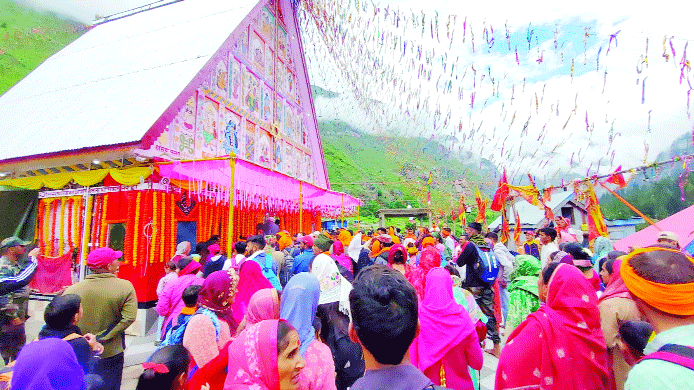
Shri Machail Mata Temple is a famous Hindu shrine dedicated to Goddess Durga, located at an altitude of around 9,500 feet above sea level in the remote Machail village of the Paddar Valley in Kishtwar. The temple is revered in Jammu, Himachal Pradesh, and several other northern states of India. Over time, it has evolved from a strenuous local mountain trek into a pilgrimage with smoother pathways and better facilities. Initially, the temple was mainly a local sacred site for the people of the remote Paddar Valley. Villagers worshipped the goddess as a protector, but gradually the spiritual importance of the shrine led to significant economic and social development in the region. Historically, the prominence of the shrine increased after a Dogra General sought blessings there in 1834 before his military expedition to Ladakh. However, the exact date of the temple’s construction is not recorded in historical texts, though it is believed to have been built in the early 18th century. The old temple was renovated and enlarged in 2009 in traditional Himalayan Pahari architecture by local artisans.
The real evolution of the modern pilgrimage began in 1976 when Thakur Kulveer Singh was posted in the valley. Deeply influenced by the spiritual atmosphere, he became devoted to the goddess. In 1987, for the first time, Thakur Kulveer Singh formally started the famous Holy Mace procession with merely 30 pilgrims. His contribution greatly strengthened the Machail Mata faith tradition. He was followed by many devotees, and stories about the divine presence of Shri Machail Mata spread widely. People increasingly sought devotional experiences, resulting in a steady rise in footfall over time.
With the growing number of pilgrims, it became necessary to regulate the procession. This consequently led to the emergence of the Sarv Shakti Sevak Sanstha (SSSS) in 1988, which was later officially registered in 1997 under the J&K Societies Registration Act. For several years, SSSS regulated the Yatra. Later, in 2022, a major administrative shift took place when the District Administration Kishtwar was formally entrusted with managing and conducting the annual Yatra. The administration introduced more formal systems such as proper registration and Radio Frequency Identification (RFID) cards for real-time tracking of pilgrims. Parallel to these management efforts, the government sanctioned funds over time for infrastructure development. Recently, the government sanctioned a project worth ?10.20 crore for the upgradation of infrastructure and beautification of the temple premises. Thus, the evolution from a non-formal pilgrimage to a more organized and managed Yatra reflects its growing popularity, faith, and massive footfall.
Paddar Valley is one of the remotest valleys in Jammu and Kashmir. Sluggish infrastructural development and difficult terrain long hindered the systematic completion of road projects in the valley. However, after several decades, road connectivity to the holy shrine is now close to completion. At present, around 95% of the route is motorable, while only 5% requires travel on foot. Before road connectivity, the journey often required several days or even weeks to complete, and temporary shelters were arranged in villages along the route. With improved road connectivity, the Machail Yatra gradually transformed from a seven-day journey into a three-day pilgrimage, evolving from a difficult regional pilgrimage into a major religious tourist destination in Jammu and Kashmir.
Today, Machail Mata has emerged as the third most visited religious site in Jammu and Kashmir, where more than three lakh devotees seek blessings every year. To facilitate easier travel and promote all-season pilgrimage (except during the three months of ritual restriction), the maintenance and construction of roads have recently been handed over to the Border Roads Organisation (BRO).
The geographical landscape, scenic beauty, and fresh environment of Paddar Valley make it highly attractive to visitors in addition to the spiritual significance of Shri Machail Mata Shrine. People visit the valley for its breathtaking natural beauty, rich culture, and peaceful environment. Surrounded by snow-covered mountains, dense forests, crystal-clear rivers, and lush green meadows, Paddar presents a landscape that appears untouched by rapid urbanization. The combination of natural grandeur, cultural traditions, and religious importance makes Paddar one of the most scenic and unique Himalayan regions of Jammu and Kashmir.
The spiritual significance along with the scenic natural beauty strongly attracts visitors, resulting in an annual increase of 10% to 20% in the number of pilgrims. From an initial gathering of just 30 pilgrims to lakhs of devotees today, the spiritual spark of Machail Mata has enlightened many souls across Jammu and Kashmir and other northern states. The number of pilgrims continues to increase every year. In 2022, approximately 2.5 lakh devotees undertook the sacred journey to Machail Mata. A substantial rise was noticed in 2024, when the count exceeded 3 lakh pilgrims, while in 2025 the number slightly declined due to weather irregularities and floods in nearby villages located en route to the holy temple.
The Holy Shri Machail Mata Yatra possesses both spiritual and economic significance. The Yatra has brought noticeable economic transformation to the region. There is a vast difference between the real per capita income of residents in 2010 and that of 2025. The pilgrimage provides seasonal employment opportunities to local residents. Officially, the Yatra begins in the last week of July and concludes in the first week of September, while the Holy Mace procession lasts for eight days during the middle phase of the pilgrimage period. Throughout the Yatra season, residents earn income through transport services, hotels and guest houses, food stalls, shops, and tent accommodations. Most residents rely heavily on the Yatra, as it serves as one of the primary sources of employment for them.
Media coverage has also contributed significantly to popularizing the shrine. Social media platforms and devotional campaigns are credited with the annual increase in the number of pilgrims.
 Follow our WhatsApp channel
