

“Killer roads, hollow promises”
Sunny Dua
sunnydua55@gmail.com
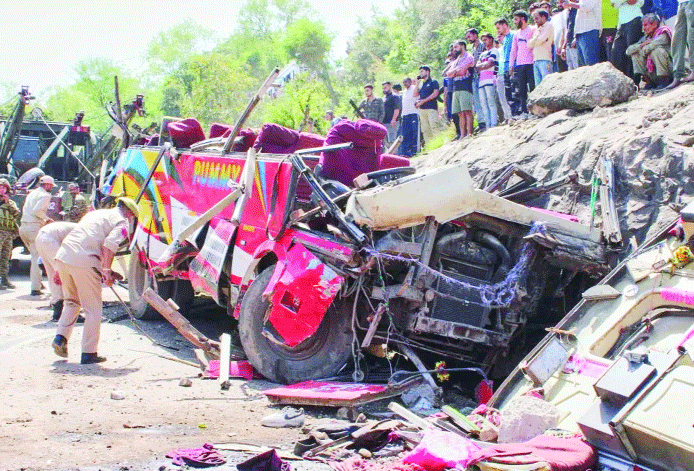
The horrific accident on the Ramnagar-Udhampur stretch on April 20 is not just another addition to road fatality statistics but it is a chilling indictment of a system that continues to fail its people. At least 21 lives were lost and around 60 others injured, many of them critically, when an overcrowded bus veered off the road and plunged nearly 100 metres down a hillside near Kagort village.
What makes this tragedy even more disturbing are the facts that have now emerged. The ill-fated bus, designed to carry 41 passengers, was operating with as many as 65 onboard. Records reveal it had already been penalised 15 times for overloading, with three additional challans still pending over the past three years. Yet, it continued to ply freely on the same roads, unchecked and unchallenged.
The negligence was not limited to the bus alone. An autorickshaw involved in the accident was reportedly carrying 16 passengers, far beyond its permitted capacity. These are not isolated violations; they point to a culture of routine disregard for safety norms, unfolding in plain sight of authorities tasked with enforcing them.
The accident occurred around 10 am when the driver reportedly lost control while negotiating a blind curve. An Army convoy passing through the area immediately launched rescue operations under extremely difficult conditions. Despite their swift response, the scale of devastation was immense. The bus, before plunging into the gorge, also struck the overcrowded autorickshaw, compounding the tragedy and underlining the vulnerability of every life on these roads.
Beyond the immediate cause lies a more troubling truth: such incidents are no longer mere accidents but they are the predictable outcome of systemic neglect. Despite claims of crores being spent under road safety initiatives, the roads of Jammu and Kashmir continue to turn into death traps. Tragedies in Reasi and Poonch serve as grim reminders that lessons are neither learned nor implemented.
The reality is stark. When enforcement agencies prioritise revenue generation over public safety, violations like overloading become routine. When repeated offences fail to attract strict penalties, accountability erodes. When transport vehicles operate without proper fitness certification, ticketing systems, or even basic compliance such as uniforms for drivers and conductors, safety becomes incidental rather than essential.
In hilly terrains like Ramnagar, overloading is not a minor infraction, it is a death sentence. Poor road conditions, inadequate maintenance, dangerous curves, and lack of protective infrastructure further compound the risks. Add to this the absence of strict monitoring, and the result is a deadly combination waiting to claim lives.
And yet, after every such tragedy, the response follows a familiar well drafted script. Condolences pour in. Compensation is announced. Promises of stricter enforcement are made. This time too, leaders including Droupadi Murmu, Narendra Modi, Manoj Sinha and Omar Abdullah besides army of ministers and bureaucrats and leaders expressed grief and announced ex-gratia relief. While these gestures may offer temporary solace, they increasingly appear to substitute, rather than ensure, accountability.
The larger and more uncomfortable question remains: have we begun to normalise preventable deaths? Are expressions of sympathy and financial aid enough to absolve systemic failures?
Road safety is not just about blaming drivers, though reckless and negligent driving certainly plays a role. It is equally about engineering failures, poor road design, lack of maintenance, and weak enforcement. Across Jammu and Kashmir, potholes, missing road signage, absence of guardrails, and unregulated traffic conditions continue to endanger lives, issues that even the Supreme Court has previously termed “unacceptable.”
Urban roads are no safer. Missing footpaths, lack of zebra crossings, unchecked movement of heavy vehicles, and chaotic planning have turned city streets into high-risk zones. Vehicles, including those belonging to private companies and even government departments, are often parked indiscriminately on highways, bridges, flyovers and poorly lit roads, further increasing the risk of accidents.
For the families who lost loved ones in this tragedy, this is not a policy debate, it is a lifetime of grief. Whether it is daily wagers, students, or entire families, the victims of such accidents often belong to the most vulnerable sections of society, people who lack the means to seek legal recourse or demand accountability. The Ramnagar tragedy is not an isolated incident; it is part of a continuing pattern of avoidable loss. If repeated disasters fail to provoke meaningful reform, one must ask: what will?
How many more lives must be lost before safety becomes a priority rather than an afterthought? Until accountability replaces apathy, and enforcement replaces empty assurances, our roads will continue to kill. And every condolence message, every compensation cheque, will stand as a silent acknowledgment that we chose to react rather than prevent.
(The writer is senior journalist)
 Follow our WhatsApp channel
