

* Watch video on www.excelsiornews.com
Excelsior Correspondent
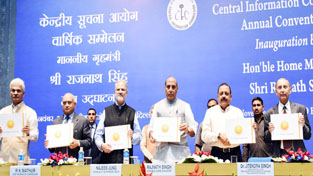
NEW DELHI, Nov 7: Union Home Minister Rajnath Singh launched here today, the first of its kind,”e-Court” software during the inaugural session of the two-day Annual Convention of Central Information Commission.
Union Minister Dr Jitendra Singh was the Guest of Honour on the occasion.
Also present on the occasion were Lt. Governor of Delhi Najeeb Jung, Chief Information Commissioner R.K. Mathur, Central Information Commissioners, Information Commissioners from different States, senior officers of Government of India and former Information Commissioners.
Rajnath Singh, flanked by Dr Jitendra Singh, launched an “e-Court” software” and a book based on RTI success stories on the occasion.
In his inaugural address, Rajnath reiterated the government’s commitment to absolute transparency and also to increase citizen participation in governance. It is with this objective, he said, that the Government has taken all steps to expedite the disposal of RTIs and reduce their pendency.
Rajnath Singh said, unlike the earlier Governments, the present Government is a Government which has nothing to hide and everything to share with the people of this country. He said, it is a compliment to the present government that in nearly two-and-a-half years of its term, there has not been a single case of corruption or scam against any members of the government.
Rajnath Singh stressed on eco-system and assured that the government has no hesitation in responding to all kinds of RTIs filed from different quarters.
Dr Jitendra Singh, in his address, emphasized the need to curtail the avoidable RTI applications, so that such applications that seek information which is already there in public domain or are out of context, could be avoided. He said, in the last two years, maximum amount of information, as far as the Government of India is concerned, is already available in the public domain and many of the RTI applications seek to obtain information without realizing that the same information can be accessed with a simple click of a mouse or on a mobile app.
Speaking from his personal experience of dealing with different departments including Department of Personnel & Training (DoPT), Department of Pensions and Ministry of Development of North-Eastern Region (DoNER), Dr Jitendra Singh said, not only the information is now being put in public domain with absolute transparency, but it is also being placed in public domain on virtually real-time basis, as a result of which even the decisions taken at the highest level like AICC, headed by Prime Minister, are immediately available on the website. In other words, he said, in the last two years, Government has evolved a mechanism whereby the citizen stands already informed without having to resort to his legal right to information.
In order to make the RTI applications more specific and focused, Dr Jitendra Singh suggested three basic bottom-line parameters. These, he said, were three questions which each one of us should ask ourselves while dealing with an RTI application … (a) whether the RTI application is based on genuine considerations or extraneous considerations, (b) whether the query is in public interest or in conscious / sub-conscious personal interest, and (c) whether it is a query based on honesty or on professional bravado.
Earlier, Chief Information Commissioner R.K. Mathur in his welcome address presented a detailed resume of the working of the Central Information Commission and its achievements in the last two years.
 Follow our WhatsApp channel
