

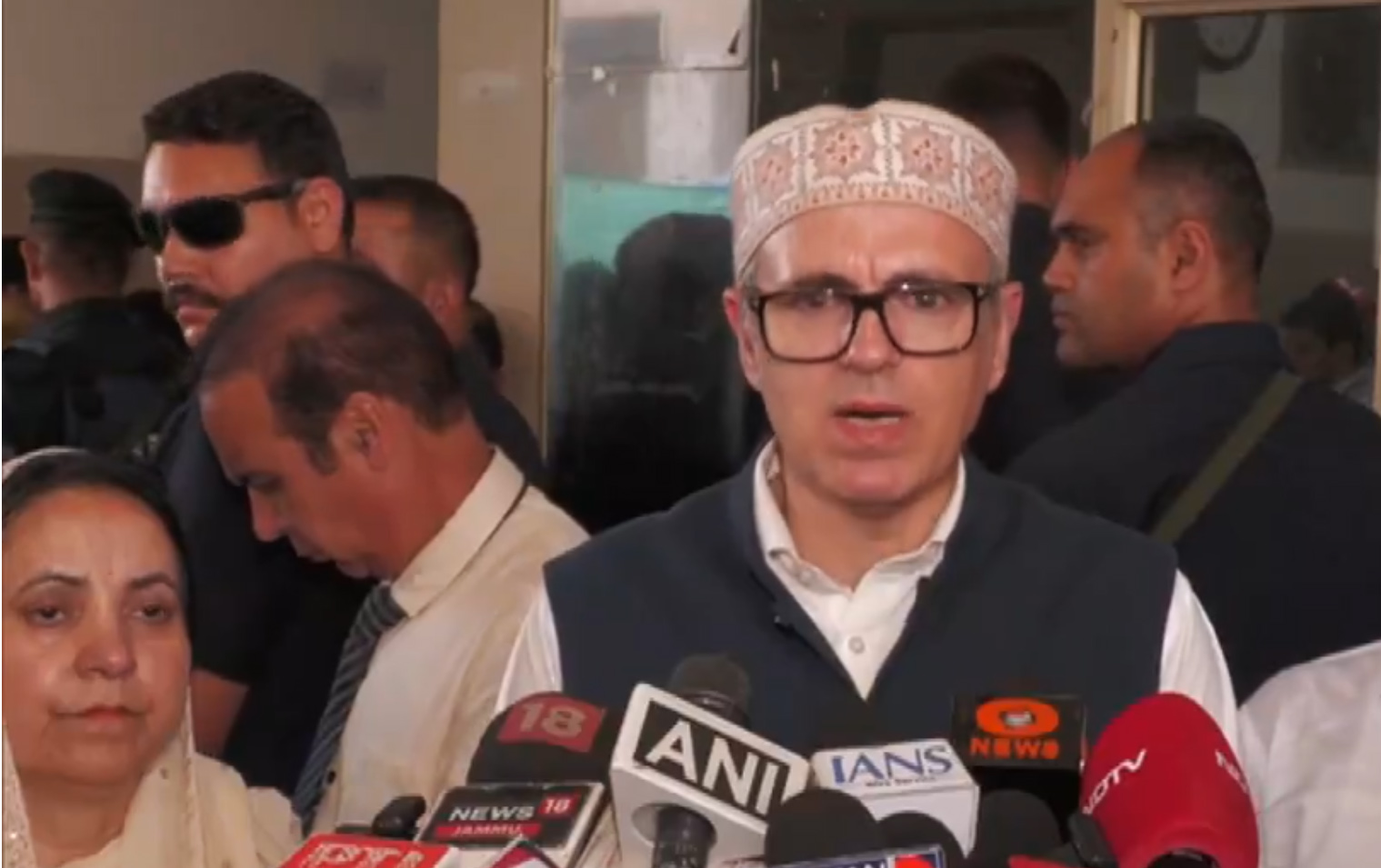
‘War must end now’: J&K CM Abdullah flags global fallout of West Asia conflict
UDHAMPUR, Apr 22: Jammu and Kashmir Chief Minister Omar Abdullah on Wednesday asserted that preventing a repeat of the Pahalgam-like tragedy remains a top priority.
He stressed that even if Pakistan attempts such actions, we will not allow them to succeed.
Marking the first anniversary of the terror attack in Pahalgam that left 25 tourists and a local pony-ride operator dead on this day last year, Abdullah emphasised joint action by the elected government, the Centre, and law enforcement agencies to ensure lasting security in the region.
He said the day continues to weigh heavily on the people of Jammu and Kashmir, as the region remembers the innocent tourists who lost their lives in the terror attack.
“We pay tribute to the innocent lives lost in a senseless act of terror. They had come only to spend their holidays, yet were mercilessly targeted and killed.
Even today, we stand in solidarity with their grieving families,” the chief minister said after visiting those injured in a recent bus accident at Government Medical College (GMC) hospital here.
At least 21 people were killed and 51 others injured on April 20 when an overcrowded passenger bus plunged nearly 100 metres down a hillside in the Ramnagar area of Udhampur, crushing an auto-rickshaw before landing upside down on the road below.
The chief minister said, “On that day (April 22, 2025), we resolved – and we remain committed – that we must do everything possible to ensure such (Pahalgam type) incidents never happen again. Whether it is the elected government, the central government, or the law and order machinery, we will all work together to make this effort successful.” When asked about any change in Pakistan following Operation Sindoor, he said such assessments are best left to those with access to intelligence reports.
“I can only say that we will make every possible effort to ensure that even if Pakistan intends such actions, we will not allow them to succeed. That will remain our priority,” he added.
On the impact of the Pahalgam terror attack on tourism, Omar Abdullah said, “It is your job to give report cards; ours is to make efforts. Our focus is to maintain normalcy.” He acknowledged that the attack has had some impact compared to last year, but expressed optimism as the season progresses. “We expect a good number of visitors to come to Jammu and Kashmir – whether for darshan at Vaishno Devi Temple, the Amarnath Yatra, or for general tourism,” he said.
The chief minister urged pilgrims to attend the upcoming Yatra in large numbers.
The 57-day annual Amarnath Yatra is set to commence on July 3 and conclude on August 28, coinciding with Raksha Bandhan. The pilgrimage will be
conducted via both the traditional Pahalgam route and the shorter Baltal route, with advance registration beginning on April 15.
Meanwhile, calling for an immediate end to the conflict in West Asia involving Iran, the US and Israel, Jammu and Kashmir Chief Minister Omar Abdullah on Wednesday said its repercussions are being felt worldwide, including rising oil prices and disruptions to critical supply chains.
However, he also noted that compared to many other countries, the situation in India remains relatively stable.
“We want this war to end; it should not be happening. As for the reasons behind the attack on Iran, only the countries directly involved – the US and Israel – can explain their actions, as their intentions remain unclear to us.
“What has happened is wrong, but it must stop now,” Abdullah told reporters, warning that the impact of the conflict is being felt globally.
Pointing to rising oil prices, shrinking supplies and disruptions in essential supply chains globally, Abdullah said several countries, particularly in Europe, are already facing severe strain, with fuel for ships being rationed.
“In our neighbouring country (Pakistan), airplanes are allowed entry but not permitted to refuel before departure,” he said, underscoring the scale of the crisis.
Despite the challenges, Abdullah said India’s situation remains comparatively stable. However, he warned that a prolonged conflict could deepen global disruptions.
“We hope the war ends as soon as possible,” Abdullah said, reiterating the need for stability amid growing international uncertainty.
Late Tuesday, US President Donald Trump said the US would indefinitely extend the ceasefire with Iran, which was due to expire on Wednesday, to give Tehran time to come up with a “unified proposal” ahead of possible negotiations.
Iran has offered no formal acknowledgment of Trump’s ceasefire extension so far. (Agencies)
 Follow our WhatsApp channel
