

Kuldeep Singh
kuldeepthakurkt7@gmail.com
There is a valley in the Kishtwar Himalayas that the modern world has visited only recently, and even now visits reluctantly. Paddar a narrow, Y-shaped cleft in the Great Himalayan range, some eighty kilometres along the Chenab, sealed for half year by mist and snow is one of the last inhabited places in India that feels, genuinely, like the edge of the known world. Here, in the shadow of peaks brushing 17,000 feet’s lives one of the subcontinent’s most quietly remarkable peoples: the Paddari tribe. They number barely twenty thousand. They speak a language few outsiders have heard of. They worship gods that predate most surrounding religions. They mined sapphires once traded weight for weight with Zanskar’s Buddhist villagers for salt. For most of recorded history, they governed themselves, paid taxes to whoever had the military strength to demand them, and otherwise continued exactly as they wished. In February 2024, the Parliament of India finally conferred upon them Scheduled Tribe status a recognition they had sought for decades. It was a moment of reckoning, long deferred. This editorial attempt to understand who the Paddaris are, where they came from, and what that recognition does and does not mean for the survival of their world.
Before the Maps
Ancient Origins and the Rana Chieftains: The origins of Paddar’s people are lost, in the space between memory and archaeology. The 12th-century Kashmiri chronicle Rajatarangini by Kalhana mentions the region, suggesting Paddar was known to Kashmir as a distant, distinct territory. Historians propose the earliest settlers arrived around the 8th century CE, drawn by fertile grazing terraces, from Kashmir, Bhaderwah, Lahaul, and possibly Ladakh. Between the 10th and 14th centuries, Paddar came under the influence of the Guge Kingdom, a powerful Tibetan Buddhist state. Villages such as Hango, Haloti, Lussani, Kabban, and Gandhari still reflect this legacy. A thousand-year-old gompa in Haluti, built reputedly by a lama named Serpo, still receives monks from Spiti, Kinnaur, and Manali on annual preaching visits. After Guge rule collapsed in the 14th century, Paddar fragmented into village clusters ruled by local Rajput chieftains called Ranas, The Rana of Leondi, the Rana of Sohal, the Rana of Garh, the Rana of Massu each commanding fierce loyalty within their terrain and fighting endlessly over pastures and trade routes. The Kishtwar Rajas attempted conquest, reached Atholi and were repelled. Paddar, for all practical purposes, governed itself. Manuscripts in the ancient Sharada script have been found in the region, evidencing literate tradition and connection to the broader Kashmiri cultural world. The earliest inhabitants were primarily serpent worshippers. Temples and shrines to Naga devtas, elaborately carved with snakes, dotted the valley suggesting an Aryan cultural substrate predating Kashmiri influence, or an indigenous animist tradition that absorbed Vedic symbolism over centuries.
The Age of Conquest
Chamba, Zorawar Singh, and the End of Isolation: By the mid-17th century, one Rana had risen to pre-eminence: Sheetal Singh of Leondi. His ambitions were ended by Chamba’s Raja Chattar Singh, who crossed the Chenab rope bridge (Jhullah) with his soldiers and brought Paddar under Chamba rule for six generations a period the sources describe as one of “peace and prosperity,” with new crops maize and potato introduced in the valley. This equilibrium was shattered in 1836 General Zorawar Singh Kalhuria, the legendary Dogra commander of Maharaja Gulab Singh of Jammu. When the local chieftain demolished the Chenab Bridge to stall his advance, Zorawar Singh waited three months, improvised a ropeway crossing with local peasants, and stormed Chattargarh with 3,000 soldiers. He renamed it as Gulabgarh, built a fort at Chishoti in 1838 and in 1845, Maharaja Gulab Singh formalised the region as a Tehsil. Paddar was absorbrd into the Dogra state. Infrastructure arrived reluctantly. The first paved road was built by the Border Roads Organisation decades after independence. The first primary school opened only in 1900, under Maharaja Partap Singh, at Tatta Pani Village. Indo-Pakistani conflicts of 1947-48, 1965, and the Kargil 1999 eliminated what little cross-border trade existed. The valley’s population density remained around 30 persons per square kilometre well into the 21st century one of the most sparsely populated inhabited zones in the subcontinent.
The Language That Lives in the Mountains
Of all the markers that distinguish the Paddari tribe, none is more singular or more precarious than their language. Paddari (sometimes spelled Padderi or Padri) is classified as a Western Pahari language of the Indo-Aryan family, close kin to Bhadarwahi and Pangwali of Himachal Pradesh heavily influenced by Kashmiri while retaining archaic features possibly rooted in Prakrit. Crucially, it is a territorial tongue, not an ethnic or religious one spoken by 80 percent of the valley’s population, Hindus, Muslims, and Buddhists alike regardless of caste or origin. Anyone who grows up in Paddar speaks Paddari. The Bhot communities in the upper villages of Hango, Haloti, Lussani, Kabban, and Gandhari speak Ladakhi among themselves but are thoroughly bilingual in Paddari. Even the Gujjars who summer in Paddar’s high pastures have absorbed the valley’s linguistic rhythms. UNESCO classifies the Western Pahari languages all of them except Dogri as either “definitely endangered” or “critically endangered.” Paddari has no official status, no standardised script, no government curriculum, no radio programming, and almost no published literature. It survives entirely by oral transmission, folk tales (sugli) narrated at winter firesides, devotional songs sung to the dhol and beinch (flute) at festivals, by the ritual speech at Naga shrines. The 1981 census recorded 10,000 Paddari speakers. The 2011 census counted 21,548 Paddaris overall, though no disaggregated language data is available. The language may be stabilising, or quietly contracting as educated youth migrate to Kishtwar, Jammu, and Delhi.
The Gods They Carry
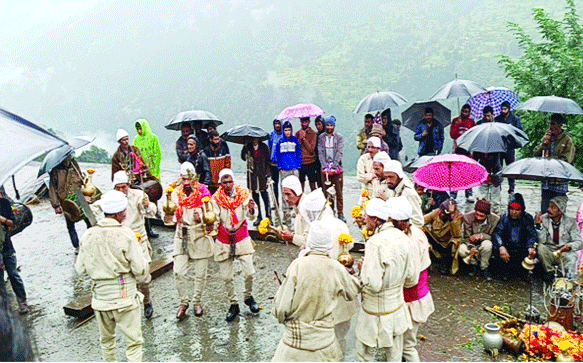
Religion, Ritual, and Sacred Ecology: To describe the Paddaris as simply “Hindu” as the census does at 83.6 percent is to say something true and immediately misleading. The dominant tradition of Paddar is a form of Shiva-Shakti worship closer to Kashmir Shaivism than plains Hinduism, animist in structure, syncretic in practice, profoundly local in its sacred topography. Every dramatic natural feature has a presiding spirit. Zehryun devta (Indra) governs the monsoon. Jwala Mata governs fire and warmth. The mountain peaks are not metaphors for divinity; they are divine. At Machail, the valley’s greatest shrine, the goddess Chandi manifests at the village level, while directly opposite, the summit of Shiv Pahad often wreathed in black cloud is read as the lingam of Mahadev himself. The simultaneous appearance of Shiv and Shakti in a single landscape is regarded by devotees as unique in all of India. The Naga devta, serpent gods, represent perhaps the oldest layer of Paddari religion. The first Muslims arrived during the reign of a Chamba king named Shantar Kantar; their descendants participate in the valley’s multi-faith festivals with remarkable ease. The Buddhist villages maintain their gompas and in 2013, the Dalai Lama visited Paddar, blessing what may be one of the subcontinent’s most quietly successful examples of lived inter-religious coexistence. The festival calendar is dense and distinct. Shivratri (locally Sheraeth) unfolds across four days with its own ritual logic. The first two days, Rekh and Kandey, are days of demonic sovereignty during which households seal doors with thorns, draw white lines (rekha) at their thresholds, and stay inside.
On these evenings, families play kaudi a traditional game believed to be beloved of Shiva and Parvati. The third day, Narath, involves household sacrifices and the preparation of mutton. The final day, Vrath (fast), and perform elaborate puja, and distribute walnuts, dry fruits, and kheer as prasad. Snow on this last day is read as divine blessing a promise written in weather. The Awaans festival at Karthie held triennially involves a bonfire lit before the village temple, the gathering of priests from surrounding villages in full traditional dress, and ceremonial dances that last through the night. The Uzzan festival, spanning multiple villages, centres on the ritual cleaning of a sacred kund (water source), the collection of alms, and grand communal ceremonies that bind the valley’s scattered hamlets into a single community. These are not performances for tourists. They are the living architecture of Paddari social life. The Machail Mata Yatra the great annual pilgrimage to the Chandi shrine has grown into one of the largest religious pilgrimages in the Jammu region, drawing hundreds of thousands of devotees.
The Material World
Sapphires, Shilajit: The Paddaris are the reluctant custodians of one of the world’s finest sapphire belts near Sumcham village, known for producing rare cornflower-blue sapphires of exceptional clarity. The story of these mines is also a story of extraction. Paddari villagers once tradeded raw sapphires to Zanskar Buddhist traders for equal weight in salt. The Maharajas brought mining under state control. The British extracted what local testimony describes as the lion’s share. Post-independence, the Indian government sealed the mines and posted police at Suncham, (3,385 metres). Legal mining today is minimal; Villagers say little of value remains. Beyond sapphires, the valley yields shilajit, chilgoza pine nuts, gucchi mushrooms, kala zeera (black cumin), and a pharmacopoeia of medicinal herbs documented at 32 species across 19 botanical families, used in magico-religious practices, as shrine offerings, and by traditional healers. This ethno-botanical knowledge exists nowhere in writing. It is entirely oral. The subsistence economy rests on terraced agriculture (maize, barley, potatoes, rajmash and pulses and the seasonal economy of the Machail Yatra, during which Paddari families serve as guides, porters, shopkeepers, and hosts, earning in weeks what the fields might not produce in months. The food culture is spare and hearty: millet rotis (kodre) with ghee, rajma-chawal, boiled potatoes with wild herb chutney, salted tea. In the upper villages, seasonal fermented beverages reflect the Ladakhi cultural spillover. Gucchi mushrooms and wild herbs are seasonal luxuries, treated with the reverence of delicacies.
Dress, Dance, and the Body as Memory
Paddari material culture costume, music, dance is where the tribe’s composite history is most visibly worn. Men wear the kamri (long robe), Sutad (loose trousers), and the toot, a woollen cap in severe winters. Women wear shalwar Kameez beneath a valley specific woollen chador and the Zuji (cap) which resembles to the headgear of the Kalash people of Chitral (Pakistan). Earlier generations women wore heavy silver jewellery: elaborate head ornaments, wide earrings, large nose pins, and multi-strand silver necklaces whose weight announced status and lineage. The signature dance is the Kharzath performed at temples and celebrations bears comparison to the Kud dance of the broader Jammu region while retaining distinctly local rhythms. Women’s gatherings feature Gurhey, a circle dance in which participants link hands and move in slow, coordinated steps while singing similar in structure to Kashmir’s Rauf. The instruments are the dhol, the nagara (kettledrum), and the beinch (flute), produce the tonal world within which all of Paddar’s religious and celebratory life unfolds. Since the 2010s, the Paddari Lok Kala Manch has begun staging performances to bring these traditions to wider audiences, a necessary but double-edged act of preservation.
Recognition, Reservation, and the Politics of Who Counts
The Constitution (Jammu and Kashmir) Scheduled Tribes Order (Amendment) Act, 2024 granted Scheduled Tribe status to four communities in J&K, including the Paddari tribe. The recommendation came from the Justice G. D. Sharma Commission (2020), received approval from the Registrar General of India in 2022, and was passed by Parliament in February 2024 before receiving Presidential assent. The strongest opposition came from the Gujjar-Bakerwal community, J&K’s largest ST group, which feared that adding new communities would reduce their share of benefits. Critics also argued that the Paddaris are only a linguistic group rather than a tribe, but the community’s shared language, culture, rituals, territory, and long common history strongly support their distinct tribal identity.
What Recognition Demands: Five Urgent Obligations
Scheduled Tribe status is a constitutional category, not a cultural guarantee. It provides reservation in government employment and educational institutions access to opportunities long denied. It does not, by itself, protect a language, preserve a shrine, or stop the outmigration of youth. Five obligations that must fulfil:
Language archive
Document and preserve the endangered Paddari language, oral traditions, ritual songs, and healing practices before they disappear with the last elders.
Sacred site protection
Protect naga temples, mountain shrines, and gompas as living sacred spaces, with community consent required for any development projects.
Ethno-botanical documentation
Record and conserve traditional medicinal plant knowledge in collaboration with botanists and local healers.
Sapphire revenue
Ensure legally enforceable revenue-sharing with local communities from any future sapphire mining in Paddar.
Educational infrastructure
Strengthen higher education in the valley through a full-fledged college offering courses on local history, ecology, culture, and the Paddari language.
(The writer is a research scholar)
 Follow our WhatsApp channel
