

Excelsior Correspondent
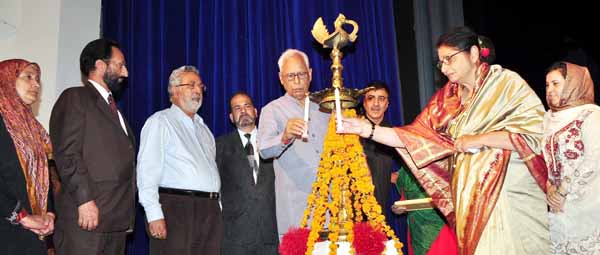
JAMMU, Apr 16 : Governor N. N. Vohra has highlighted the important role of the publicity organizations in generating greater awareness among the people about the developmental and welfare schemes launched by the Central and the State Governments for the socio-economic uplift of the masses.
The Governor, as Chief Guest, was inaugurating a cultural show “Jashan-e-Baharaan”, organized by the Inter Media Publicity Coordination Committee (IMPCC) in collaboration with the State Information Department at General Zorawar Singh Auditorium, Jammu University, here this evening.
Usha Vohra, First Lady, Taj Mohi-ud-Din, Minister for PHE, Irrigation and Flood Control, Sakina Itoo, Minister for Social Welfare, Prof. M. P. S. Ishar, Vice Chancellor, Jammu University, Bashir A. Malik, Chairman, IMPCC and Director News, Doordarshan and Radio Kashmir, Srinagar, Khawaja Farooq Renzushah, Director Information, Shabir Ahmad Buch, Director, Doordarshan Kendra, Jammu, Shami Shair, Director, Doordarshan Kendra, Srinagar, Qayoom Wadera, Director, Doordarshan Kendra, Leh, senior officers, media persons, prominent citizens and a large number of invited persons were present at the inaugural function.
The Governor observed that he had, some time back, addressed the Union Ministry of Information and Broadcasting to revive and effectively activate their publicity units in Jammu and Kashmir to proactively disseminate the programmes, policies, developmental activities and welfare schemes launched by the Government for the information of all the people of the State.
Referring to the role of the media, the Governor said that healthy criticism, highlighting aberrations and failures, is beneficial for promoting good governance. However, the media scrutiny must also focus on the good work being done in the State in the various development and welfare sectors.
Recalling the unfortunate situation which obtained in the State in the past years, he observed that when, after suffering huge human and economic losses, the State is sliding back to normalcy the media should do well to project stories of developmental successes.
Taj Mohi-ud-Din, Minister for PHE, Irrigation and Flood Control, lauded the IMPCC for organizing a scintillating cultural event and for other activities. He urged the media persons to project positive aspects of the actual ground situation in an objective manner so that progress could get a boost.
Sakina Itoo, Minister for Social Welfare, said that media persons have worked in very challenging situations and played an important role in the restoration of peace and normalcy in the State.
Governor for enlarging awareness about Govt’s people-oriented programmes, policies
Traffic jams and accidents in Jammu
Sir,
Day in and day out, we read news items pertaining to horrible accidents taking place sometimes at vulnerable areas having blind corners. On rough roads, mostly in winter and rainy season and sometimes on plain roads mostly due to overloading, or mismanagement or even absence of traffic personnel. Whatever may be the position, the accidents claim a heavy toll of human lives without any fault of theirs. The carelessness on the part of traffic personnel can be gauged from the fact that overloaded buses, matadors beyond capacity pass before their very nose and they overlook the matters, may be because of a tacit understanding between them and the owners of such vehicles, the drivers being the middle men. Sometimes the passengers request the drivers not to resort to overloading but their voice goes unheard. There is a big department to manage the traffic but the day today heart rending accidents defy big claims of traffic authorities regarding their discharge of legitimate duties. No doubt, once in a month or so the traffic authorities show exemplary activities by way of manning the traffic in a scientific manner. Heavy fines are imposed and realized on spot but alas, the spirit dies down next day and the same chaos and confusion prevails.
Apart from accidents, there are traffic jams lasting for hours. The passengers, mainly consisting of Govt employees or private employees in the morning hours fail to report to the offices in time. What about the patients who have fixed time with the doctors? What about students who mostly miss the periods ? Their woes can more be imagined rather than described. Here again the traffic personnel are mainly responsible who don’t man the traffic in systematic manner. The public in general need to follow traffic rules as responsible citizens to avoid traffic jams.
Yours etc…
Dwarika Nath Raina
Upper Muthi
Jammu
Arrear scam
Sir,
6th Pay Commission arrear scam might have opened the eyes of the Government. This will compel the Government to think over the issue and settle the case for good. Now the question arises: will the Govt held the officers responsible for this mishap or camouflage their crime? It is not the question of some employees who are benefitted illegally but the cause of the unemployed youth who aspire to settle their fortune in the nearest future. When corruption is coupled with the people who don’t carry much conviction, corruption flourishes…. It will be good for the Govt to fix responsibility upon the defaulters.
Yours etc…
M J Ahangar
On e-mail
SRTC is not criminal
Sir,
This is in reference to your editorial titled SRTC is criminal” DE Apr 4. You have held SRTC responsible for tragic road accidents happening on national highway with out any visible fault on their part. Most of the accidents in Doda sector has taken place due to over loading. Obviously, enforcement agencies such as Traffic Police and MVD have shown callous attitude for which SRTC can not be blamed. In spite of being paid comparatively meager salaries, JKSRTC officials are doing a commendable job by managing these vehicles out of petty resources. Nevertheless SRTC buses are considered safest mode of transport by the people of the state with out any prejudice. This reputation has been earned through consistent efforts and same shall continue for the safety of the people of the state.
Yours etc…
Showkat
On e-mail
Congress has to reinvent itself
By Harihar Swarup
Indian people have reason to be thoroughly disillusioned with two national parties-the ruling Congress and the Bharatiya Janata Party. A sharp decline in the performance of the Congress party would not have been a matter of much concern, had its major national alternative, the BJP, inspired reasonable confidence that it was capable of sustaining the centre. The BJP has turned its back on all notions of responsibility and seriousness.
There is not the remotest possibilities of non-Congress and non-BJP partiers, mostly regional, coming on a platform and forming the much touted Third Front. The Marxists, who could have given a lead, have been themselves struggling for survival. The two non-Congress experiments in New Delhi – The Janata Party experiment (1977-79) and the Janata Dal/ National Front government (1989-90), failed miserably, and the nation put its faith in the Congress party and later in the BJP-led NDA.
In the year 2012, the BJP’s incurable infirmities caste a heavy burden on the Congress. Does the Congress leadership realize the heavy burden the history has put on its shoulders? Will it rise to the occasion?
What the Congress needs is to clarity on political and policy fronts. In the run up to 2014 Lok Sabha elections, the Congress will primarily be confronting the BJP in Himachal Pradesh, Gujarat and Karnataka later this year, and then in Rajasthan, Madhya Pradesh, Chhattisgarh and Delhi next year. Therefore, It will be illogical to expect the BJP to help the Congress to push through its legislative agenda-especially if such policy initiatives are going to help the ruling dispensation in the elections. Only the Congress can help itself by undertaking a course-correction, and a bit of house cleaning. The Congress leadership may begin by accepting that the organization has become ineffective. Sonia Gandhi has been the party’s President and undisputed leader since 1998; yet, she has been reluctant to give her party a thorough shake up. Instead she allowed herself to be persuaded that fair and free organizational elections would destabilize her and the party set up; a rival centre of power may emerge.
It has been argued that elections would only give rise to instability and that moneyed individuals would capture the organization. There may be some merit in the argument, but it cannot be anybody’s case that this precaution has produced genuine and sincere cadres at any level. On the contrary, the leaders at the state and central levels seem to have devised a mutually self-serving protocol to keep their stranglehold on the organizational hierarchy at the expense of the party’s democratic vitality. Worse, this stranglehold merely reinforced status quoits impulses.
A deep-rooted political party, like Congress, should reflect on Indian society’s changing aspirations and ambitions; It Is still not too late to revive and reorganize an internal election authority. Between now and the next Lok Sabha poll in 2014, the Congress leadership has ample time to initiate a meaningful election process in order to weed out obsolete elements and co-opt new generation of activists and cadre. The Congress President may consider dissolving the Congress Working Committee and the Central Election Committee and replacing them with duly elected CWC and CEC. These two forums have become platforms for leaders to promote themselves, their family members and cronies. On the government side, the “core group” mechanism should be scraped immediately. It produces only political timidity and policy confusion. If the Congress wants to make its way back into middle-class respectability, it has to raise its own decency. At least, very minimum, the country needs to see for itself that the Congress has respect for constitutional and political institutions. As the oldest and most responsible political party, it is the Congress’s historic burden to inculcate good manners in the polity. It should be matter of considerable concern for the Congress leadership that for the first time the Election Commission had to reprimand three cabinet ministers. The Congress leader have become far too enamoured of manipulation. And, as it moves from one election to another, the party is not able to see its way beyond immediate electoral gains. This type of short-sightedness has been particularly injurious to party’s image and its government’s credibility.
What Congress needs is to give a firm and fair governance. In other words the Congress ministers should start pursuing the public interest policies and projects so that the country feels reassured that the Congress stands for probity and high moral standards.
The imperfect policy choices have unwittingly produced disproportionate gains-even windfall profits-for a very tiny business elite. This will have to be rectified.
There is no denying the fact that the party and its government do possess an internal moral compass. It is still not too late for the Congress to recommit itself to the first principles of good governance, if the party wants to return in 2014 general election for another five-year term. (IPA)
Right To Education Will Two + Two make Four?
By Poonam I Kaushish
A for apple, B for bat, C for cat…soon India’s future should be reciting this all over the country. No longer will children plan to spend their time playing gulli-danda. Nor will education make Jack a dull boy! It will make Ram an educated boy!
Thanks to a three-judge Bench Supreme Court majority verdict which upheld the Constitutional validity of the Right to Education Act, 2009, (RTE) which mandates 25 per cent free seats to the poor between 6 to 14 years in Government and private unaided schools except unaided private minority schools on Thursday last.
Undoubtedly, the Government has taken the first historical step in education. True, the objective of the RTE is laudable. There is need to strengthen our social fabric by providing equal opportunities to all. Certainly, it is the duty of the State to provide free and compulsory education to poor kids. The moot point: Does it know what constitutes education? Does writing one’s name make one literate? Will two plus two equal four?
Indeed, talk of each one, teach one sounds good but this has to translate into concrete action. The judgment not only underscores the collapse of the Government schooling system but also made it possible for the State to shrug-off its responsibility. Is it justified to ask unaided private schools to comply with the Government diktat?
Pertinently, the RTE has eliminated the age group between zero and six years. The Government and the State run the risk of leaving the young innocents illiterate. For, by the time a child reaches age six without even rudimentary education in terms of sound, colour and pictorials, how will het show any inclination or aptitude? Early childhood care cannot be segregated from education. The UN chapter for Education 1992, to which India is a signatory, states that early childhood care education should be taken care of by the Government. Why the exclusion?
Just by sending poor kids to a private school does not necessarily ensure education or success. Where they come from, do they get enough sleep and food is important, apart from their academic preparedness. Think. Four in 10 children suffer chronic malnutrition before reaching school age impairing their brain development and learning ability. According to recent annual report, of rural schools fewer than half of class 5 children could read a textbook and do basic arithmetic sums for class 2 students.
With 25 per cent seats reserved for the poor where should those who get in on merit go for education? Better would have been for the Government to first provide schools and teachers instead of offloading and outsourcing its responsibility. Where are the schools? Teachers? And infrastructure? Worse, schools are over-crowded with classrooms boasting of at least 50 children. It’s like putting the cart before the horse.
What after age 14 where will these students go after class VIII? Who will pay for books, uniforms, field trips, activity material, examination fee etc? Can they afford them? Topping this there is an acute shortage of teachers, good teachers a far cry of whom 25 per cent are always absent resulting in abysmal quality of teaching and decreased school hours.
Alas, universal elementary education has remained basically a paper tiger and has not been realised properly. Given that all villages are not listed on India’s map? They are neither commutable nor connected. School buildings are non-existent and basic infrastructure like classrooms, black boards etc are missing.
The text books quality is pathetic, study material out-dated, English is full of grammatical errors wherein it’s a miracle to find a paragraph with no errors. Student enrollment is a huge problem and incentives like mid-day meals are given to enroll them. Worse, poor parents read their children as a pair of additional hands to work rather than educate. Thus, it would be extremely difficult to make parents appreciate the benefits of education which would, in the long run, yield higher productivity and higher incomes.
Moreover, RTE sounds great and is excellent vote bank politics. But it does not make good economic sense as the Government does not have enough money. It would need Rs 2.3 lakh crores to fund its initiative for 2010-14 with the Centre-State in a ration of 65-35.
Astonishingly, the RTE bill is almost 5 times India’s allocation for school education (Rs 48,781 crores for 2012-13), more than the total annual subsidies of Rs 1.9lakh crore and larger than the estimated income tax receipts of Rs 1.96 lakhs. Where and how will it generate these extra funds? What with a growing deficit and runaway inflation. With unemployment on the ascendance, who will generate income and money for ploughing it back in education?
Sadly, even after 64 years of Independence, our literacy rate is only 66 per cent. According to the World Education Report, India shares 32.3 per cent of the illiterates of the world. Now look at the public expenditure per student per capita of the Gross National Income. It is only 16.3 per cent in India while the world figure is 23.3 per cent.
Thus, with the state failing to provide the accompanying wherewithal and making it incumbent on the parents to wrest the initiative, quality education will remain a pipe dream. Instead, poor substandard second rate and skeletal programmes like the Education Guarantee Scheme will be fobbed off as education. Add to it the deadly potion of underpaid and under qualified teachers, one has a surefire recipe for disaster in the name of education.
Besides, a majority of middle class parents are thoroughly disillusioned with State schools. The peasantry and urban poor see no prospect of education becoming relevant for their children or the teacher showing warmth towards them. Bias against village life is so central to modern education and its curriculum that one cannot imagine how the high drop-out rate can be brought down without drastic alterations in perspective. In the midst of increasing social disparities and smugness of the urban elite and empowerment how will the Government implement is a puzzle.
Looking ahead, the shortcomings in India’s education system threaten to convert a potential demographic dividend into a disaster. The country has one of the world’s youngest population profiles, and is getting younger: by 2020, the median age will be 28. India needs to create around 12m new jobs a year for young people entering the labour market. Against this backdrop, how will the Government deliver what it promises?
The tragedy is that India is raised on slogans. Today RTE is a buzzword but if the Government is serious it should add the word “good” in the Right to Education. Along-with improving its delivery systems. Given that a school is a microcosm of the education challenges facing India. All blueprints can be drawn up, buildings built, teachers hired. But till one has the will, two plus two will not make four. Elementary, isn’t it? INFA
Man behind the machine
By Col R D Singh
The recent revelations in the media about the critical deficiencies of arms, ammunition, and equipment in the Army stunned the nation. And rightly so, when you tell the people that we have tank ammunition only for two days, 97 percent of the air defence weapons are obsolete, the artillery guns are over 25 years old, the special forces lack latest weapons, and 80 percent of our tanks are night blind. My aim here is not to play down the deficiencies, which the MOD must immediately take stock of and make up on priority, but to give the readers a positive side of the picture – the man behind the machine. I will explain it with personal experience, having participated in OP Parakram, and operated in the valley, Siachen, North East, plains of Punjab, and the deserts of Rajasthan.
Starting my career in Armoured Corps in 1974, I trained and operated on the good old Centurian tank, followed by our own Vijayant, then the Russian T -55, and finally the upgraded version of it ( with indigenous 105 mm gun). Now, my son, also a young tank man, is training on the latest T–90 tank. So, firstly, it is not that we are not modernizing, and upgrading our equipment, be it any arm. We are constantly moving forward with time. Yes, modernization is slow due to red tappism in the bureaucracy, and not so good relations between the MOD and Army HQ, which the present controversies have adequately highlighted, and should lead to remedial measures. It is also not that we have tank ammunition for only two or three days. That may be the case with one type of ammunition – armour piercing fin stabilized discarding sabot ( APFSDT). But we have adequate ammo in terms of high explosive squash head ( HESH), HEAT, or the tank mounted missiles, and machine guns. Evan in artillery, lets not forget that it was Bofors which hit the Tiger Hill top pin point, and we operated at night, along special forces, with the help of night vision devices. The AD arty does possess the long range modern ground to air missiles and rockets, and is well trained to bring down the enemy aircrafts. Our army is also well equipped with the latest drones ( remotely piloted vehicles) which can look into the enemy territory, take pictures, and pass valuable information. The automated networked combat communications, backed by integrated logistics, is capable of giving real time processed information and data to the commanders in the battle zone. So, let me assure you as a veteran that, as we stand today, we are battle worthy, and the nation is fit for war.
I say this with conviction , more so because of our man behind the machine – the Indian soldier, who is par excellence. In motivation, training, discipline, and fearlessness, he out classes our adversaries. That is the most important factor for winning a war. Let me elaborate. When battling with the enemy, it is not the equipment alone, but man behind it who makes all the difference. It may be the latest T 90 tank with all the ammunition and night fighting devices, but if the driver is not well trained, either he will take a wrong fire position, leading to first shot by the enemy, or he will get bogged down in a ditch. Second, if he does not have the killer instinct in him, he will be scared to close in, there by losing an opportunity to shoot the enemy. Take the gunner. In case weak, he will keep missing the targets, giving a chance to the enemy to do the job. And in war, you do not get a second chance. Come to the loader. If he is slow , and fumbles with the ammunition, the gun will either have a misfire or a round will get stuck in the chamber, there by rendering the tank ineffective, for a long time. And most important, the commander of the tank. If he is dashing, full of initiative, and ready to scare hell out of the enemy like Arun Khetrapal (PVC), he will lead his troop/squadron/regiment to victory by a tactical sound manouevre, and accurate firing – one round one tank. So, it is the man behind the machine who wins the battle. It holds good for all arms and services, be it an air force pilot or the crew of a naval ship.
During my service, I have rarely come across a jawan who was coward or not ready to sacrifice his life for the ‘ ijjat of his
Paltan’. Our young officers are a treat. See any action in the valley, and it is they who lead the operations and bring down the militants ( latest being Lt Navdeep, AC). When required, even our COs take the lead ( Col Vasanth Venugopal, Col John Thomas etc). During all these operations, the formation commanders also remain in picture, and are available to their commanding officers. This desire to carry out a task, and do it well, is not only during operations, but also during military’s aid to the civil authorities. The battle drill and standard operating procedures ( SOPs) are very well set. Once a task is given, army has never let down. That is why we are the second largest, and finest army of the world.
So, let the recent controversies surrounding the Army Chief, or the corruption charges against some senior officers, or the equipment shortages, not lead us to wrong conclusions, or dampen our spirits about the men in uniform. The controversies will die down, and the culprits punished. The system will even be healthier as the dead skin will be removed and new skin will come up. As long as the man behind the machine is top class, we need to fear none. So, three cheers to the Indian soldier.


