

NEW DELHI, Apr 12:
India and Pakistan are expected to formally announce by next month finalisation of a new visa regime to facilitate movement of businessmen from both the countries, visiting Commerce Secretary Zafar Mahmood said today.
“In principle, the visa things are finalised. But it needs to be formally announced and approved. This would be done by by the Interior Ministry of Pakistan and the Home Ministry of India,” Mahmood said.
He was speaking to reporters after the inaugural function of the four-day ‘Lifestyle Pakistan’ exhibition here.
Mahmood said there are possibilities, under the new agreement, that a businessman from either country would get visa for more than one year and that too for more number of cities.
“We expect that the meeting (between the Interior Ministry of Pakistan and the Home Ministry of India) would take place in April or May and this would be formally announced,” he added.
India and Pakistan are working towards revising the existing bilateral visa agreement that was signed in 1974 to facilitate travel by bonafide businessmen from both the countries.
Mahmood said now the movement of people is restrictive wherein “a (Pakistani) businessman coming to Delhi cannot even go to Gurgaon (in Haryana)” .
He also said that there is need to improve the infrastructure at borders to boost the movement of goods like cement.
When asked about prospects of investments from Pakistan, Mahmood said Indian businessmen are always welcome to do investment in Pakistan, but “for us there are restrictions in India”.
Meanwhile, inaugurating the exhibition, Commerce and Industry Minister Anand Sharma said he would discuss all the issues, including allowing trade of power and petroleum products, tomorrow with his Pakistani counterpart Makhdoom Amin Fahim.
“We are talking about trade in petroleum products. We are also working towards opening up of bank branches of both the countries. The central banks of both the countries are in dialogue to finalise the modalities. We will be discussing all these issues,” Sharma said.
The minister also said that the informal trade between the countries exceed the official trade and there is a need to address the issue.
Bilateral trade between the two countries at present is around USD 2.8 billion, although the informal trade, mainly via countries like Dubai and Singapore, is estimated to be USD 10 billion. (PTI)
India, Pak to have new visa regime
President in another land row
NEW DELHI, Apr 12:
President Pratibha Patil was at the centre of yet another controversy over her post-retirement home in Pune.
An organisation of ex-servicemen in Pune has alleged that over five acres of land had been alloted for purpose of her residence after she demits office later in July this year when her five-year term ends.
Suresh Patil, a retired Lt Col of the Pune-based ‘Justice for Jawan’, part of NGO ‘Green Thumb’ group, who has accessed details about the Government’s measures for providing her housing in Pune, claims that a large extent of land measuring over 2.60 lakh square feet has been alloted to her in Khadki cantonment in Pune.
He claims that a house with a plinth area of 4,500 square feet is being built for her by bringing down two British-era county bungalows.
The former Army official questioned why such a large extent of land was being fenced to protect this house for Pratibha Patil, who recently made news when an RTI application brought out the fact that over Rs 205 crore were spent on her foreign travels.
However, Rashtrapati Bhavan maintains that there has been no wrong doing or violation of rules. All rules were being strictly adhered to for a post-retirement house for the President.
Under rules, a former President is entitled to a furnished bungalow anywhere in India of his or her choice. In places where Government accommodation is available, it should be comparable to the highest type of residence available to the Union Ministers.
Where it is not available, the size of residence should not exceed 4,500 square feet with a living area not exceeding 2,000 square feet. The privilege is extended to the spouse after the death of the President or a former President.
Col Patil said that he had sent several RTI applications to the Army’s Southern Command seeking reasons for fencing the entire five acre land with a wall but failed to get any response.
Reacting to the allegations, Rashtrapati Bhavan spokesperson Archana Datta said “the land in question is a defence land. The question of transfer of land to any individual does not arise.”
She said the house will remain with the President till her life time and go back to the defence.
Asked about the new construction being undertaken at the site, she said “It was not a vacant land and there is no new construction taking place. Its only a renovation.”
To a question about the allegation that around five acres of land had been fenced for the President’s house, the spokesperson said that Ministry of Defence would be an appropriate authority to reply on this. “I maintain that no rules have been violated.” (PTI)
28 X-ray technicians selected by SSB on forged documents
Fayaz Bukhari
SRINAGAR, Apr 12: The Services Selection Board (SSB) has selected 28 X-ray Assistants for the Health Department in Kashmir division in which several of them figuring at the top in the list have produced tampered certificates to the SSB.
According to the notification issued by the SSB in March this year, 28 candidates were selected as X-ray assistants in response to Notification No. 08 of 2010 dated 24-12-2010. Fifteen of them were selected in open merit, 5 in RBA, 7 in SC and one in ST category.
Among 9 selected candidates who are on top of the selection list in Open merit category, 5 have produced tampered certificates for the selection in the Health Department as X-ray technicians.
Figuring on the top of the list at No. 1 is Mudaseer Ahmad Bhat son of Mohammad Ramzan Bhat of Shopian. He has produced diploma certificate in the SSB that showed he has got 2047 marks out of 2400.
Last year, Bhat had also applied for the post of X-ray technician in Government Medical College and Associated Hospital. He has produced diploma certificate of Institute of Public Health and Hygiene, Mahipalpur, New Delhi where he has secured 1751 marks out of 2400. In first year, he has secured 872 marks out of 1200 as per the marks sheet issued on May 31, 2007 and in second year, he has secured 879 marks out of 1200 as per the marks sheet issued on August 9, 2008.
At Number 2 in the SSB list is Lafief Ahmad Dar son of Abdul Gani Dar of Srinagar. He has produced diploma certificate to the SSB that showed he got 2051 marks out of 2400. While the certificate he has produced in Bone and Joint hospital last year showed him securing 1751 marks out of 2400.
In response to a verification letter (BJSH/Est-II/970 dated 15-06-2011) of the Medical Superintendent Government Hospital for Bone and Joint and Joint Surgery, Barzulla of six candidates, the Institute of Public Health and Hygiene, Mahipalpur, New Delhi has said that Dar was a regular student of the Institute in 2003-2005 batch and has passed the examination in first division by securing 1751 marks.
Another selected candidate at Serial No. 7, Manzoor Ahmad Mir son of Ghulam Hussain Mir of Budgam has produced diploma certificate with the SSB where he has got 851 marks out of 1000. While the diploma certificate he has produced in Government Medical College and Associated Hospitals, Srinagar last year, showed that he has secured 751 marks out of 1000.
Mir was at serial no. 29 in the combined merit list of candidates for the post of X-ray Assistant of Government Medical College and Associated Hospitals, Srinagar that they have issued last year and have provided to one Ashiq Hussain and others under no AH/RTI/2012/20 datead 06-04-2012 in response to an RTI application.
Meanwhile, around 32 candidates who had produced the tampered certificates didn’t appear in the interview fearing detection of the fraud by the SSB.
3 docs arrested for negligent death
Expired drugs seized from hospital
Excelsior Correspondent
SRINAGAR, Apr 12: Police last night raided Government hospital Anantnag and recovered expired drugs that were being distributed to the patients while three doctors were arrested for death of a woman in a Nursing Home in the town for alleged medical negligence.
According to reports, Anatnang police last night raided Mirza Afzal Beg Memorial Hospital in Anantnag after attendants of a patient, who was admitted in the hospital lodged a complaint with the police about supply of expired drugs.
The patient’s attendants were provided with the expired medicine at the hospital for the patient. Police raided the hospital and recovered expired medicine, which were being provided to the patients in the hospital.
One of the Pharmacists of the hospital, Nazir Ahmad was arrested by the police and investigations are going on. Residents alleged that the higher ups of the Health department were hand in glove with the district hospital authorities and said that such complaints were frequent in the hospital and health authorities gave a deaf ear to them.
In the meantime, the Member Parliament, Mehboob Beg, today visited the hospital and expressed his concern over the supply of expired medicine to the patients. He said that this is not the first time that patients have complained about the supply of expired drugs to them. Beg asked the Health department to investigate matter.
Meanwhile police arrested three doctors for the death of a woman in SKJ Nursing Home at K P road in Anantnag.
Shahzada , 35, wife of Fayaz Ahmad Shah resident of Brad Ashmuqam was admitted to the hospital yesterday and died due to alleged negligence of doctors. A case has been registered in this regard in Police Station Mattan.
Three doctors Dr Muzaffar Kocahak, Dr Farooq and Dr Mushtaq were detained by police for alleged medical negligence.
Govt to submit report on Fai’s links to MHA in one month
*116 hawala transactions detected
Sanjeev Pargal
JAMMU, Apr 12: The Special Investigating Team (SIT), constituted by the State Government to probe the links of Kashmiri separatist Sayyid Ghulam Nabi alias Fai in Jammu and Kashmir and outside the State and hawala funding made by him to terror outfits, separatists, NGOs, journalists, intellectuals and other organisations, has been asked to complete its findings and recommendations within one month period.
The SIT has been directed to expedite its probe in the aftermath of a directive from the Ministry of Home Affairs (MHA) that all facts and figures pertaining to Fai and his agents should be made available to it at the earliest.
The directive had been issued at a high level security review meeting chaired by Union Home Minister P Chidambaram here on April 10 and attended by top brass of civil and police administration, Central Police Forces and Intelligence agencies among others.
Official sources told the Excelsior that SIT headed by SSP Badgam Uttam Chand has been asked to expedite its findings and complete them in a month’s time.
The Government would submit findings pertaining to the Central Government to the MHA and act on the issues, which have to be tackled by the State, sources said, adding the Home Minister had also sought facts and figures on all activities of Fai since seventies onwards and the persons, who had benefited of his hawala transactions including separatists, terror outfits, journalists, NGOs etc.
Fai was recently sentenced to two months imprisonment by a Virginia court in the United States.
Sources said the findings and recommendations of the SIT, which pertained to the Central Government, would be submitted to the MHA as soon as they were received while the points on which the State Government and Police Department had to act on its own would be pursued to logical conclusion.
To expedite investigations in the activities of Fai, both within the State and outside, the Government had appointed two more officers to Uttam Chand headed SIT. They included Junaid Mehmood, SP CID (Counter Intelligence), Kashmir and Chief Prosecuting Officer (CPO), Srinagar.
Sources said even as investigations by the SIT were in progress, Police Department had established that 116 major hawala transactions have taken place in Jammu and Kashmir, some of which had direct or indirect hand of Fai.
The hawala transactions would run into several crores. While some of hawala transactions had been made through businessmen, few others were conducted through banking and other available channels.
“A number of persons had benefited of hawala transactions in Jammu and Kashmir including Kashmiri separatists, commanders of militant outfits like Lashkar-e-Toiba (LeT) and Hizbul Mujahideen, journalists, NGOs and other organisations. The SIT would work out details of hawala money that had flown through into the State over a period of time and names of its beneficiaries, both militants and their over ground supporters”, sources said.
It may be mentioned that based on the report of the SIT pertaining to activities of Fai, there was a possibility that the Central Government could issue a red corner notice against the Kashmiri separatist to ensure his repatriation to India once he completed two years sentence awarded to him by the Virginia court.
As reported, in connection with participants from India to the 11th annual conference of KAC, a national newspaper quoting from the footnotes of Attorney’s report had said, “Mirwaiz Umer Farooq was supported and controlled by the ISI. Fai invited Attiya Inayatullah to KAC conferences at the ISI’s direction. Gautam Navlakha was introduced to an ISI General for recruitment by Fai at the ISI’s behest”.
Prominent among those who wrote a letter in support of Fai to the US District Judge seeking leniency were Rajmohan Gandhi, Ved Bhasin, Karen Parker, Zaffer A Shah, Zahid G Muhammad and Hamida Bano.
According to an overview of the KAC conference sent to the media after the 2009 event by Fai, Ved Bhasin was quoted as advocating for Kashmir as an independent state in South Asia.
“The only solution is an independent state in South Asia. The status quo is not a solution, the division of the State is not a solution,” reported Kashmir Images of 22 July, 2011 quoting Ved Bhasin. Prof. Hamida Bano was among Fai’s beneficiaries but inclusion of Jatinder Bakhshi, rather a non-descript Kashmir Pandit migrant entity remained a mystery.
The Telegraph of 21 July reported that several Indian journalists and activists had also accepted the invitation from the group to take part in seminars in the US, which involved business class travel and “some luxury”. Sources said journalists such as Kuldip Nayar, Dileep Padgaonkar, Harinder Baweja, Ved Bhasin, Rajmohan Gandhi and activists Rita Manchanda and Gautam Navlakha and politician Subramanian Swamy had attended some of these seminars. Bharat Bhushan, who writes on India-Pakistan relations and is a former journalist with The Telegraph, declined to deny or confirm if he participated in any event organized by the group.
Siddharth Varadarajan, National Bureau Chief of The Hindu, said Fai invited him to attend a seminar in 2009. “But I declined,” Varadarajan said. What aroused Varadarajan’s suspicion was Fai having listed India’s envoy to Washington Meera Shankar as one of the speakers at the event. “I checked with my sources on how come she was attending? They told me she wasn’t,” Varadarajan said.
Unaided schools must give 25 % free seats, says SC
Validity of RTE Act upheld
NEW DELHI, Apr 12:
The Supreme Court today upheld the constitutional validity of UPA government’s landmark Right To Education Act (RTE), providing for reservation of 25 percent seats for poor children in all Government, private aided and unaided schools but not in minority institutions.
The ruling by a majority 2:1 judgement of a three-judge bench, headed by Chief Justice S H Kapadia is a shot in the arm for the Centre as the 2009 legislation was its flagship programme aimed at providing free and compulsory education to all children in the age group of 6 to 14 years despite stiff resistance from unaided private institutions.
While Justice Kapadia and Justice Swatanter Kumar gave the majority verdict, Justice K S Radhakrishnan, who gave a dissenting judgement on some aspects of the law, asserted that the provision for 25 percent compulsory free seats would not apply either to unaided private institutions or to unaided minority schools.
Significantly, the majority view also asked the Government to weed out “under performing and non-performing ” aided schools to ensure that only those schools who meet the standards required under the 2009 Act are allowed to continue.
The apex court rejected the arguments of the private schools that imposition of such conditions violated their Fundamental Right guaranteed under Article 19(1)(g) (carry out any profession) as being “unreasonable”.
“A child who is denied right to access education is not only deprived of his right to live with dignity, he is also deprived of his right to freedom of speech and expression enshrined in Article 19(1)(a).
“The 2009 Act seeks to remove all those barriers including financial and psychological barriers which a child belonging to the weaker section and disadvantaged group has to face while seeking admission.
“The 2009 Act has been enacted to give effect to Article 21A,” said Justice Kapadia, writing the majority judgement.
The apex court said Article 15(5) is an enabling provision and it is for the respective states either to enact a law or issue an executive instruction providing for the reservation except in the case of minority educational institutions referred to in Article 30(1) (minority institutions).
“The intention of the Parliament is that the minority educational institution referred to in Article 30(1) is a separate category of institutions, which needs protection of Article 30(1) and viewed in that light we are of the view that unaided minority school(s) needs special protection under Article 30(1).
“Article 30(1) is not conditional as Article 19(1)(g). In a sense, it is absolute. Reservation of 25 percent in such unaided minority schools (would) result in changing the character of the schools. Thus, the 2009 Act including Section 12(1)© violates the right conferred on such unaided minority schools under Article 30(1),” the apex court said.
The apex court said the Act has been enacted keeping in mind the crucial role of universal elementary education for strengthening the social fabric of democracy through provision of equal opportunities to all.
“Since the Article 19(1)(g) right is not an absolute right as Article 30(1), the 2009 Act cannot be termed as unreasonable. To put an obligation on the unaided non-minority school to admit 25 percent children in class I under Section 12(1)© cannot be termed as an unreasonable restriction.
“Such a law cannot be said to transgress any constitutional limitation. The object of the 2009 Act is to remove the barriers faced by a child who seeks admission to class I and not to restrict the freedom under Article 19(1)(g),” the court said.
According to the Government, there are 1. 8 lakh private unaided schools in the country and 1.2 lakh private aided ones, besides the 8 lakh Government schools.
Writing the dissenting judgement Justice Radhakrishnan said Government cannot abdicate its responsibility and compel “non-state actors” to discharge its duties.
“Non-state actors exercising the state functions like establishing and running private educational institutions are also expected to respect and protect the rights of the child, but they are, not expected to surrender their constitutionally guaranteed rights.
“The state, however, cannot free itself from obligations under Article 21A by offloading or outsourcing its obligation to private state actors like unaided private educational institutions or to coerce them to act on the state’s dictate,” the judge said.
Justice Radhakrishnan said Article 21A has used the expression “such manner” which means the manner in which the state has to discharge its constitutional obligation and not “offloading those obligations on unaided educational institutions.”
The judge said the Act cannot go to contrary to the Constitution bench ruling in the TMA Pai and Inamadar case which prohibited unreasonable restrictions on private unaided institutions.
“To compel the unaided non minority and minority private educational institutions, to admit 25 percent of the students on the fee structure determined by the state, is nothing but an invasion as well as appropriation of the rights guaranteed to them under Article 19(1)(g) and Article 30(1) of the Constitution.
“Legislature cannot under the guise of interest of general public arbitrarily cast burden or responsibility on private citizens running a private school, totally unaided”, he said. (PTI)
Padgaonkar panel rejects autonomy, self-rule, Azadi
‘Case-by-case review’ of Central laws proposed

Mohinder Verma
JAMMU, Apr 12: The much-awaited report of Dileep Padgaonkar-headed panel of interlocutors on Jammu and Kashmir contains nothing to soothe the Valley-based political majors—National Conference, PDP, Hurriyat Conference—as it has outrightly rejected the options of autonomy, self-rule and Azadi. Three-member committee, comprising journalist Dileep Padgaonkar, academician Prof Radha Kumar and former Central Information Commissioner M M Ansari, that deliberated on contentious political issues with regard to J&K for full year between October 2010 and October 2011, does not seem to have accommodated key aspirations of either the ruling National Conference or the opposition PDP. Separatist Hurriyat Conference, which did not interact with the committee set up by the Union Ministry of Home Affairs, has been equally disappointed.
Chief Minister Omar Abdullah’s National Conference is unlikely to rejoice over the committee’s final report as its key slogan of greater autonomy has been completely rejected. Almost consistent with the Indira-Abdullah Accord of 1975, the committee has instead proposed “case-by-case review” of the central laws applied in J&K in the last 60 years.
Asserting that a pure and simple return to the pre-1953 situation would create a dangerous constitutional vacuum in the relationship between the Centre and Jammu and Kashmir, the report has recommended “case-by-case review of all Central laws and Articles of the Constitution of India extended to the State” since 1952.
It has proposed setting up of a Constitutional Committee that would review the applicability of Central statutes extended to Jammu and Kashmir after the July 1952 Delhi Agreement. The review process — once ratified by Parliament and the State legislature — would eventually end the extension by Presidential order of further Central laws to the State.
One of the key recommendations of the report is that Parliament will make no new laws applicable to Jammu and Kashmir unless these relate to the country’s internal and external security and its vital economic interest. In the report, the Interlocutors have suggested that eminent jurist should head the Constitutional Committee and it should have members from the State and the rest of the country, who inspire confidence in all stakeholders.
The Committee will bear in mind the dual character of Jammu and Kashmir — as a constituent of the Indian Union and as a State enjoying special status in the Union under Article 370 of the Constitution while determining whether and to what extent the Central Acts and Articles have abridged the State Government’s powers to cater to the welfare of its people.
“The Constitutional Committee should be future-oriented and it should conduct its review solely on the basis of the powers the State needs to address the political, economic, social and cultural interests, concerns, grievances and aspirations of the people in all the three regions—Jammu, Kashmir and Ladakh, and all the sub-regions”, the report said, adding “the Committee will also need to reflect on the quantum of legislative, financial and administrative powers that the State Government should delegate to the three regions at all levels of governance”.
The report said that the recommendations of Constitutional Committee must be reached through consensus so that they are acceptable to all stakeholders represented in the State Assembly and Parliament. The next step would be for the President, in exercise of the powers conferred by Clauses (1) and (3) of Article 370, to issue an order incorporating the recommendations. This will have to be ratified by a Bill in both Houses of Parliament and by each House in the State Legislature by a margin of not less than two-thirds majority. It will then be presented to the President for assent.
“Once this process is over, Clauses (1) and (3) of Article 370 will cease to be operative and no orders will be made by the President under these clauses from the date of the final order,” the report further said.
However, the group members believed that many of the Central laws made applicable to the State over the past six decades “should not give rise to any strong objections” as these were “fairly innocuous laws that have been beneficial to the State and its people.”
Mentioning that search for a solution in J&K should not be made contingent on India-Pakistan talks, the report said, “if the stakeholders in Jammu and Kashmir are willing to enter into a settlement, the door can always be kept open for Pakistan to join”. The key objective, it added, was to make the Line of Control irrelevant. “It should become a symbol of concord and cooperation”, the report further said.
A hassle-free movement of people, goods and services across the LoC and the International Border must be swiftly ensured leading to institutionalised cooperation between the two parts of the former princely State. Another recommendation pertains to taking all appropriate measures to consider J&K as a bridge between South and Central Asia.
About harmonization of relations across the LoC, the report noted that no permanent solution can be achieved unless it applies to those parts of the former princely State that are now under Pakistani administration. “Any attempt at harmonization of Centre-State relations and devolution of powers at the regional, district and panchayat/municipality levels across the LoC, therefore, will necessitate wide-ranging constitutional change in Pakistan-occupied Jammu and Kashmir. If agreed, such harmonization will permit the development of joint institutions across the LoC for development, resource generation and other common matters,” the report said while recommending that these issues should be discussed with the representatives on the other side of the LoC.
The group has suggested promotion of Track II interactions for a resolution on both sides of the LoC. It has suggested resumption of Government of India-Hurriyat dialogue at the earliest opportunity and stressed that Pakistan and Pakistani-administered areas should be encouraged to enter into dialogue on the recommendations to be fine-tuned by the Constitutional Committee and the points that emerge from the GoI-Hurriyat dialogue.
The other recommendations relate to replacement of word “Temporary” from the heading of Article 370 with the word “Special” as has been used for other States under Article 371, appointment of the Governor from a list of names prepared by the State Government in consultation with opposition parties, holding of fresh election within three months if Article 356 is used.
Three Regional Councils, one each for Jammu, Kashmir and Ladakh, should be created with Ladakh no longer a division of Kashmir. The proportion of officers from the All India Services should be gradually reduced in favour of officers from the State civil service.
The report noted that the roadmap leading to political, economic and cultural freedoms depend on the credibility of the dialogue process, implementation of key Confidence Building Measures and building a consensus among stakeholders. The CBMs suggested included speeding up of reforms related to human rights and rule of law, amendment of the Public Safety Act, and review of the Disturbed Areas Act and the Armed Forces Special Powers Act. It also called for a Judicial Commission to look into the unmarked graves, with emphasis on identification of missing/ disappeared persons.
In order to ensure better implementation of the CBMs, the group has recommended the establishment of an empowered group to monitor them.
BSF WWA organizes medical camp
Excelsior Correspondent
SRINAGAR, Apr 12: Border Security Force (BSF) Wives Welfare Association (BWWA) Kashmir Frontier in association with blood bank and hematology unit of SMHS Hospital, Srinagar, organized a medical camp at Composite Hospital BSF, Kashmir at Humhama today.
In a press release issued here, a spokesman of BSF said that the medical camp was held in connection with ‘World Health Day’ observed few days back. He said the medical camp was inaugurated by Sudha Rathore, President, BWWA Kashmir Frontier. He said that Dashrath S Rathore, Inspector General, BSF Kashmir Frontier was also present on the occasion.
“During the medical camp more than 100 units of blood were donated by BSF officers and jawans. These were handed over to SHMS Hospital, Srinagar. Apart from blood donation, families and troops of BSF voluntarily participated in screening of diabetes, anaemia, hypertension and dental check-up by doctors of BSF as well as specialists from SMHS Hospital, Srinagar,” said the spokesman.
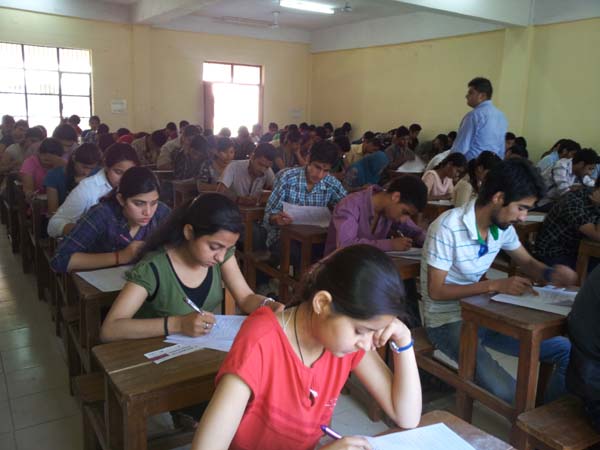
JRE conducts AIEEE Mock Test
Excelsior Correspondent
JAMMU, Apr 12: JRE Group of Institutions conducted AIEEE mock test to prepare students for the upcoming AIEEE exam, at Government Women College, Gandhi Nagar, in which nearly 150 students participated.
The initiative was taken to prepare students for the test and helping them in realizing their dreams of entering in the best colleges of the country.
On this occasion, Harpreet Singh, president, JRE Group of Institutions said that mock tests make students familiar with the main exam’s pattern and relieve students from the anxiety of appearing for the paper.
He said that their aim is to provide the best quality education services to the country so that their this initiative could help students.
The event was supported by Head Hunterz and Achievers Jammu.
Baisakhi celebrated with enthusiasm

Excelsior Correspondent
JAMMU, Apr 12: Various institutions across the State celebrated Baisakhi with fanfare and enthusiasm. On the occasion, students presented various cultural items and lifted the mood of the audience with their sizzling performances.
Baisakhi was celebrated at GD Goenka Public School with zeal and fanfare. On the occasion, Principal of the school, Poonam Jha, was the chief guest, who while speaking appreciated an active participation of beginners in the celebration. Students attired in colourful traditional dress of Punjab performed Bhangra and Gidda, which was applauded by the audience with thundering applause. The function was organised by Anupama Khashu, Coordinator of the school.
Little Champs Playway School, New Plot, celebrated Baisakhi function with fervour and gaiety. On the occasion, students presented various cultural programmes depicting the culture of Punjab and Jammu. Principal of the school Sonal Abrol, in her speech apprised the students about the importance of the day. Captain Vinay Abrol, Chairperson of the school and faculty members were also present.
Euro Care Pre-Schooling System celebrated Baisakhi with zeal and gaiety. Children attired in colourful dresses danced on the beats of Bhangra. Ritu, Principal of the school and faculty members were also present on the occasion.
Baisakhi was celebrated with great zeal and enthusiasm in Shanti Swaroop Memorial Jammu Public Higher Secondary School, Sarwal, where students and staff members presented a variety of cultural items. Kusum Bhatia, Principal of the school and RK Bali, president, Managing Committee, were also present on the occasion.
SM Shishu Niketan Higher Secondary School, Anand Nagar, and its junior wing ‘Kidzee’, celebrated Baisakhi with zeal and enthusiasm. On the occasion, Chairman, TR Mahajan, Managing Director, Parneesh Mahajan, Laision Officer, Harvinder Singh, Principal, Sunita Koul, coordinator Kawaljeet Kour and faculty members were also present. The tiny toddlers participated in Bhangra and flower arrangements competitions. While speaking, TR Mahajan, said that Baisakhi has tremendous religious significance and is celebrated in open field with great enthusiasm.
Baisakhi Mela was organised at DBN, Mubarak Mandi to mark Baisakhi celebrations. Students presented colourful cultural items, which were applauded by the audience. Rajinder Kakkar, Manager Trust, gave a brief description on the importance of Baisakhi. Director Academics Suresh Sharma, Principal Indu Puri, Headmaster Shubh Sharma, teachers and staff members were also present on the occasion.
Little Flower Higher Secondary School, Greater Kailash, celebrated Baisakhi with great zest and enthusiasm. Children of different classes presented colourful programmes and mesmerized the audience. Speaking on the occasion, Principal of the school enlightened students about the festival.