

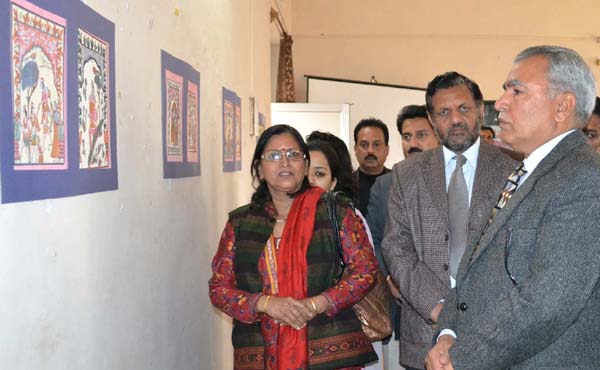
Dignitaries at the Workshop on Dogra Wall Paintings at GDC Udhampur on Thursday.
Athletes sweating-it-out during a racing event of Inter-Collegiate Athletic Meet in Jammu University on Thursday. -Excelsior/Rakesh

-Excelsior/Rakesh
J&K Police Bill proposes Security Commission, Establishment Board, Complaints Authority
Neeraj Rohmetra
JAMMU, Feb 14: In a major initiative aimed at ushering police reforms in the State, the Home Department today put into public domain the draft of the proposed Jammu and Kashmir Police Bill, 2013 and invited suggestions from all the stakeholders including social organizations, NGOs, academicians and other cross-section of society.
The proposed draft Legislation bearing number Home/PB-III/20/2013 dated 14th February, which has been issued by Principal Secretary Home, Suresh Kumar stated that the Act is aimed at consolidating and amending the law relating to the establishment, regulation, power and duties of Police Service in the State and for matter connected therewith and incidental thereto.
While emphasizing the need to redefine the role of Police, its duties and responsibilities, by taking into account the emerging challenges of policing and security of State, the Act proposed to constitute Police Complaints Authority, State Security Commission, Police Establishment Board and Police Welfare Board. The Act also proposed separation of the Investigation wing of Police Department from the Law and Order wing for better management of affairs.
Further, as per the Section 60 (i), the Act while asserting on the need to change the police system in urban areas proposed for appointment of Police Commissioners not below the rank of Deputy Inspector General (DIG). The move has been proposed in view of typical complex problems of crime, public order and internal security in urban areas, which call for quick and comprehensive response.
“The Commissioner shall exercise such powers, perform such functions and duties and shall have such responsibilities and authority as are provided by or under the Act. Provided that any of these powers, function or duties performed by the Commissioner, shall be subject to the overall control and direction of DGP”, said the clause.
The Act further said, “in any area for which a Commissioner is appointed and is empowered to exercise any power or duty under this Act, the District Magistrate (DM) shall not exercise the same power or perform the same function or duty notwithstanding the fact that such areas formed part of the District within the territorial jurisdiction of the DM”.
The Government on the recommendations of DGP shall divide the entire State into one or more police zones and each zone, comprising two or more police ranges, which shall be headed by an officer of the rank of Inspector General of Police (IGP).
Further, the entire geographical area of Police Zones may be divided into one or more police ranges and each range, comprising two or more Police Districts, shall be headed by an officer of the rank of DIG, who shall supervise the police administration or the range and report to IG of the Zone in the jurisdiction of which the Range falls.
Chapter VI titled, “Superintendence and Administration of Police” of the proposed legislation stated that the Government shall, within six months of the coming into force of this Act, establish a State Security Commission to review the security scenario at regular intervals and further define and lay down areas of concern and priority. The Commission would frame policy guidelines for promoting efficient, effective, responsive and accountable policing in accordance with the law.
The Commission, which shall be headed by the Chief Minister as Chairperson, would comprise other members including Home Minister, a retired High Court Judge, Chief Secretary, Home Secretary, DGP and three non-official members, who shall be persons of eminence including one woman.
The Commission may meet at regular intervals as it deems fit provided that the gap between the two meetings shall not be more than six months. At the end of each year, the Commission shall present to the Government a report on its working during the preceding year and also on the evaluation of performance of the service. The Government shall lay the Annual Report of the Commission before the State Legislature in the budget session.
Section 77 of the Act proposed setting up of the Police Establishment Board with the DGP as its Chairperson and four other senior most Police officers serving in the cadre as members.
The Board shall make appropriate recommendations to the State Government on the transfers and postings of officers of and above the rank of the Superintendent of Police (SP) and equivalent levels except the Director General of Police (DGP).
Besides, the Board would also recommend to the DGP names of officers of and up to the rank of Deputy Superintendent (DySP) or equivalent levels of posting and transfers.
The Board would also be empowered to decide on complaints and appeals in respect of service matters like transfers, promotions, etc. of Police Officers of and up to the rank of DySP and equivalent levels and make appropriate recommendations. The DGP may give due consideration to the recommendation of the Board.
The Act also proposed to constitute a Police Welfare Board under the Chairmanship of an officer not below the rank of an Additional Director General of Police to aid and advise the DGP on matters related to the welfare of police personnel and their implementation.
Chapter VIII, which deals with issues pertaining to Effective Crime Investigations stated that he Act proposed separation of Investigation from Law and Order. “The Government on recommendations of the DGP and having regard to the population of an areas or circumstances prevailing in an area, by order, separate the investigating Police from the law and order Police in such area as may be specified in order to ensure speedy, effective and professional investigations”. The DySP shall ensure efficient and effective coordination between the two wings of the Police.
Elaborating further, the Act stated that the DGP by notification can create in crime prone Districts under the direct supervision of concerned SP, a specialized crime investigation unit, headed by an officer not below the rank of DySP with an appropriate staff for investigation economic and heinous crimes. The personnel posted to this unit shall not be detailed for any other duty, except with the written permission of the DGP.
Section 100 of the Act stated that the Government shall within six months of the coming into force of this Act constitute a State Police Complaints Authority and District Police Complaints Authorities for each District or for group of Districts to examine and enquire into complaints of misconduct against Police Officers.
The Chairperson of the Authority shall be a retired High Court Judge, who shall be appointed by the Government in consultation with the Chief Justice of State. The other members would include a retired officer not below the rank of Principal Secretary, a retired officer not below the rank of Additional Director General of Police and two persons from a panel of five members with a minimum of 20 years of experience as a Judicial Officer, Public Prosecutor, Practicing Advocate, Professor of Law or a person of eminence from civil society, of whom one shall be a woman.
Section 81 of the Act also stated that the DGP shall draw up Internal Security Scheme for the entire State and for each of the District and Urban Areas. The Scheme so formulated shall be reviewed annually and more than once, if required and will incorporate regularly updated comprehensive Standard Operating Procedures (SOP) for action to be taken by Police, independently or in coordination with other concerned agencies.
Further, the Government by notification can declare any area as a Special Security Zones, when such area is widely and intolerably beset with violence or insurgency or destruction of public property on account of communal or terrorist or anti-national activities.
Chapter IV of the Act, which deals with Constitution and Oganisation of Police Services states that an officer posted as IG of a Zone or Police Commissioner of a City or DIG of a Range or SP of a district or SDPO or DySP of a sub-division or Station House Officer (SHO) shall have a minimum tenure of two years.
“The Government shall also ensure a minimum tenure of two years for the DGP subject to his superannuation”, it added. However, the Government may on the recommendations of the Screening Committee headed by the Chief Secretary appoint one or more officers equivalent to the ranks of Director General. The Screening Committee can also recommend appointment of officers to the rank of ADG, IG, DIG and such officers as id mandate to the Screening Committee under IPS (Pay) Rules, 2007.
The direct recruitment to the rank of DySP shall be made on the recommendations of the Jammu and Kashmir Public Service Commission. The Police Recruitment Board constituted by the Director General of Police shall recommend direct recruitment to various subordinate ranks in the Police Service.
Govt hands over Poonch power scam to Vigilance
Sanjeev Pargal
JAMMU, Feb 14: Chief Minister Omar Abdullah today ordered suspension of seven Engineers including a Chief Engineer and action against six others (totaling 13) after an Inquiry Committee headed by Principal Secretary, Power AK Mehta found “serious lapses’’ in installation of transmission towers in Poonch that led to complete power failure in the border district on January 18 after normal snowfall.
Omar, who holds the portfolio of Power Development Department, has handed over the case to the State Vigilance Organisation (SVO) for further investigations as five Engineers involved in the lapses and financial irregularities have retired.
“Seven serving Engineers, who were at the helm of affairs at the time of procurement and installation of transmission towers, have been suspended while six others involved in the scam have retired. Of six retired Engineers, one has been absconding while another has expired. Action against the retired and absconding Engineers would be taken by the Vigilance Organisation’’, official sources told the Excelsior.
Excelsior had today exclusively reported that the Chief Minister has ordered action against the erring Engineers on the basis of preliminary inquiry conducted by a high level Committee headed by Mr Mehta, which confirmed various lapses in the installation of transmission towers in Poonch.
After approval of the file by Chief Minister and Minister of State for Power Vikar Rasool, Mr Mehta today issued a Government Order No. 36 PDD of 2013 dated 14-2-2013 suspending seven Engineers from the services. The suspended officers would remain attached with the office of the Development Commissioner (Power) during the period of suspension.
The suspended Engineers were Mohammad Qasim, Chief Engineer, Procurement & Material Management, J&K (then Executive Engineer), Devinder Pal Singh Bali, Executive Engineer, Rajiv Gandhi Grameen Vidyutikaran Yojana, Rajouri-Poonch (then AEE), Nissar Hussain, Executive Engineer, Commercial Division, Jammu (C&S wing) (then AEE), Rajeev Chopra, Assistant Engineer, EM&RE Division-II, Jammu (then Junior Engineer Store), Sumit Puri, JE Electric Central Stores Division, Jammu (then JE), Barkat Hussain, JE TLCD-I, Jammu (then JE) and Murrir Hussain, AEE, EM&RE Division Batote, Sub Division Banihal (then JE).
Of six retired Engineers, who were involved in the scam, one has since died while another was absconding as he couldn’t be traced. They would be investigated by the Vigilance Organisation along with seven serving Engineers.
Sources said the Inquiry Committee headed by Mr Mehta and comprising Chief Engineer (Designs) Vinod Khajuria among others had found that a total of 245 transmission towers had been installed in the border district of Poonch during 2005-2008, which were commissioned in 2011.
“Instead of purchasing the transmission towers from three specified companies including Public Sector Undertakings SAIL, the then PDD Engineers went for purchase from another company reportedly for undue benefits’’, sources said.
They added that the towers turned out to be sub standard, which was evident from the fact that within two years of commissioning, most of them were either uprooted or got folded with normal snowfall and windstorm.
“As the border district of Poonch was prone to snowfall, the transmission towers had to be of high density and top quality to ensure that they withstand impact of windstorm and snowfall. However, the sub standard quality towers were uprooted with normal snowfall on January 18 this year leading to disruption of electricity supply as 133 KV transmission line in Poonch district was made non functional’’, sources said.
They added that the Enquiry Committee has also pointed out that in addition to sub standard towers and use of other material, there was also fault in dimensional installation, due to which the towers were uprooted. “This indicated lack of technical expertise in installation of towers’’, they said.
Sources said the Vigilance Organisations would investigate the aspect of monetary considerations in installation of transmission towers as the case has been handed over to them. The Vigilance Organisation would be formally submitted entire record pertaining to purchase of towers and preliminary report of the Inquiry Committee for registration of a case and initiating further action in the matter.
“As the Engineers went for purchases from a company, which didn’t figure among three companies approved for purchases by the State Government, there was every possibility that the sub standard towers were purchased due to monetary considerations’’, sources said.
The added that the PDD top brass was also examining installation of existing transmission towers right from Bafliaz to Thanna Mandi to look into their quality and ensure that they too were not uprooted during further snowstorm.
“Some of the existing towers could also be in danger’’, sources said but added that the authorities would take precautionary measures for them so that they withstand windstorm or snowfall.
Worthwhile to mention here that on January 18, windstorm and normal snowfall had uprooted several transmission towers and folded others leading to failure of 133 KV transmission line in Poonch, which disrupted power supply in the entire border district.
The district was now being fed from 33 KV transmission line from Mendhar.
As reported, the Government has released funds and taken the help of Power Grid Corporation of India (PGCI) for repair work and restoration of electricity supply in Poonch district. The Government hoped that electricity supply would be completely restored in Poonch in one and a half months.
Relative calm as curfew relaxed in parts of Kashmir
Fayaz Bukhari
SRINAGAR, Feb 14: Barring stray incidents of stone pelting, the situation in Kashmir valley remained under control today as authorities relaxed curfew from parts of Kashmir while in sensitive areas it continued for sixth consecutive day today. And in the meantime, fearing trouble, authorities have decided to impose curfew in Srinagar city and major towns of Kashmir valley on the occasion of Friday.
Sources said that authorities have decided to impose curfew in Srinagar and other major towns as part of precautionary measures following a call by the hardline separatist leader, Syed Ali Shah Geelani, in which he has asked people to march to Srinagar’s Eidgah on Friday in protest against hanging of Parliament attack convict Afzal Guru. He has also demanded that Guru’s body be handed to his family.
A police spokesman said here today that situation across Kashmir valley remained peaceful. He said that a couple of incidents of stone pelting were reported from few places, however, no one was hurt.
The spokesman said that curfew was relaxed in all areas of Budgam, Kupwara and Awantipora district from this morning. He said that in Pulwama and Anantnag curfew was relaxed in all places of the districts except main towns of Pulwama and Anantnag.
However, Deputy Commissioner Anantnag, Farooq Shah, told Excelsior that curfew was lifted from Anchidora, Chee, Nandpora, Poshwara, Ashajipora, Donipawa, Madni Colony and SK Colony areas of Anantnag town while in FM Gali, Nai Basti and Janglat Mandi areas it was lifted partially. He said that in other parts of the town it was relaxed at 6 p.m. Reports said that there were incidents of stone pelting and tear smoke shelling from Lazibal area of the town in the evening. However, no one was hurt.
The police spokesman said that in Srinagar, the curfew was relaxed in areas falling under Police Stations of Ram Munshi Bagh, Kothibagh, Sadder, Rajbagh, Lalbazar, Shaheed Gung, Nigeen, Zakoora, Panthachowk, Parimpora, Bemina and Nowgam from this morning.
“In Ganderbal curfew was relaxed from all areas except Kangan, since this morning. In Kulgam curfew was relaxed from all places except main Kulgam town and Yaripora from morning”, the police spokesman added.
The spokesman said that in Baramulla curfew was relaxed in entire Baramulla district except Baramulla town, Sopore town and Pattan. “Later in the afternoon, partial relaxation in curfew was given in Baramulla town from 5 pm onwards and in Sopore town from 4 pm onwards”, he added.
The spokesman further said that in Bandipora curfew was relaxed from all areas from 11 am onwards. “In Handwara curfew was relaxed from all places except Langate and Kralgund from 12 am onwards”, he added.
Isolated incidents of stone pelting and tear-smoke shelling were reported from several parts of old city area of Srinagar, Wussan, Barwulla and Kangan areas of Ganderbal district, Bandipora and Rafiabad areas of North Kashmir. However, there were no reports of any injury from anywhere.
In the meantime, Kashmir High Court Bar Association today took a protest march in City Centre Lal Chowk. Scores of lawyers marched from Sadder Court to Lal Chowk and senior police officers rushed to the spot to prevent the situation from going out of control.
The lawyers were demanding that body of Parliament attack convict Afzal Guru be returned to his family so that it could be buried as per Muslim rites. The lawyers later dispersed peacefully.
PDD snaps connections of major defaulters
Nishikant Khajuria
JAMMU, Feb 14: Resorting to punitive action after expiry of the deadline for liquidating arrears, the Power Development Department (PDD) has started snapping electricity connection of major defaulting consumers while another list of defaulters having unpaid PDD tariff from Rs 1-5 lakh is being made public within days.
According to the authoritative sources, electricity connections of more than 500 defaulters have been snapped in Jammu and Kashmir provinces while the drive is still on for similar action against the consumers who did not clear their arrears by February 12.
Excluding the public utility installations like PHE and Health institutions, PDD also snapped the electricity connections of several defaulting Government departments, whose arrears were in lakhs, sources told the Excelsior. The office of Settlement Commissioner was among those who had to face electricity disconnection owing to non-payment of arrears, sources added.
Some prominent business establishments, whose electricity connections were snapped, included Hari Niwas Palace, Hotel Jewel and Restaurant, Choudhary Motors, KC Public School, AFCON, some banks and private cellular companies.
Before resorting to punitive action, the PDD had issued separate public notices informing about the defaulting consumers with electricity arrears in lakhs. On January 17, the Department served two-week disconnection notice to the consumers of commercial category against whom the electricity bills have swelled to Rs 10 lakh or more. The list included 130 consumers against whom the total arrears pending were Rs 54 crore. Again on January 30, the PDD came out with another list of consumers who had electricity arrears of Rs five lakh or more. They were also served two-week disconnection notice.
Some prominent business establishments, mentioned in the list of defaulters included Nawa-e-Subah, the headquarters of National Conference in Kashmir, Hari Niwas Palace, M/s Simula Software Solutions and Research Centre, Tramboo Joinery Mills, Tramboo Cement, Jewel Hotel and Restaurant, PNB, Amar Singh Club, Kargil House, Choudhary Motors, High Land Automobiles, BSNL, Reliance, Tawi Stone Crusher, Bahu Cold Storage, Airtel, Vodaphone, SKUAST, Dewan Modern Breweries, Jodhamal, Cadila Pharmaceuticals, Rajasthan Cement, LEIGHTON, AFCON etc.
As some of the defaulters escaped the punitive action by depositing their arrears, the PDD realized more than Rs 60 lakh recoveries from such consumers, sources said.
As reported by the Excelsior, the PDD is also going to initiate legal action the defaulting consumers in addition to disconnection of their electricity connection. The petition for recovery of arrears shall be filed before the Court of Electricity Magistrate under Section 50, 132 of Jammu and Kashmir Electricity Act 2010 and Section 8 of Jammu and Kashmir Electricity Duty Act 1963. To ensure legal sanctity to its action against the defaulters, the PDD has already filed a cavet in the State High Court.
Meanwhile, sources said that another list of defaulting consumers having arrears from Rs one lakh to Rs five lakh has almost been prepared by the PDD for serving disconnection notice and is likely to be made public within days.
The total electricity tariff arrears against consumers in Jammu and Kashmir are Rs 1160 crore. The Government departments owe more than Rs 810 crore while the arrears against domestic and commercial connection consumers are Rs 350 crore.
During the last financial year, a revenue of Rs 1203 crore was collected against the target of Rs 1600 crore.
Fate of 166 ‘vital’ decisions taken in DDB meetings hanging in balance
Mohinder Verma
JAMMU, Feb 14: Notwithstanding the tall claims of the Government about giving due importance to the Cabinet-cum-District Development Board meetings, the fate of around 166 ‘vital’ decisions taken at this platform during the past three years is hanging in balance and constitution of a committee of officers to review the status of implementation of the decisions has turned out to be an exercise in futility.
Official sources told EXCELSIOR that in the year 2010-11 a total of 245 decisions were taken with regard to developmental activities in the Cabinet-cum-District Development Board meetings of various districts but only 172 could see light of the day and the fate of remaining 73 is hanging in balance despite the lapse of three years.
Similarly, 194 decisions were taken in the District Development Board meetings in 2011-12 financial year and 133 of them could be implemented till date. The concerned authorities have failed to give practical shape to remaining 61 decisions till January ending this year. As against 51 decisions taken during the current financial year till date only 20 have been implemented and 31 decisions remain only on the official files, sources said.
In response to a question, sources said, “majority of such decisions were taken on the issues raised by the elected representatives of the people—MLAs and MLCs and had the same been implemented the developmental needs of the common masses could have been met”, adding “due to non-implementation of such decisions the people in some areas have even been deprived of road connectivity, drinking water facility and electricity supply”.
Holding lack of coordination between different departments responsible for non-implementation of 166 ‘vital’ decisions taken in the Cabinet-cum-District Development Board meetings during the past three years, sources said, “the implementation of majority of such decisions falls in the domain of Administrative Departments and in the absence of decision at the Secretariat level the field officers are finding it difficult to give practical shape to decisions despite lapse of considerable time”.
“The fate of such a large number of decisions is hanging in balance despite the fact that Government in the month of May last year had constituted a committee of officers to review the status of implementation of the decisions taken in the Cabinet-cum-District Development Board meetings”, sources regretted, adding “the committee comprising Administrative Secretaries of Finance, Power Development, Public Works, PHE, Irrigation and Flood Control, Health and Medical Education, School Education and Planning and Development Department had to submit its report within a period of three months but whether the committee met or carried out any exercise to ensure implementation of DDB decisions remains a mystery”.
Meanwhile, sources said that as holding of District Development Board meetings to review the achievements registered under the District Plan was unlikely this year, the Planning and Development Department has reviewed the expenditure registered in the districts till January ending and taken requirement of additional funds from the District Development Commissioners for completion of ongoing projects.
“The process of ascertaining the requirement of funds from Heads of the Departments has also been set in motion so that requirement of additionalities could be placed before the Chief Minister, Omar Abdullah for final decision”, sources said.
As per the figures furnished in the recent review meeting convened by Minister for Planning and Development, Ajay Sadhotra, Jammu has recorded 77% expenditure, Samba 79%, Kathua 65%, Udhampur and Doda 75%, Rajouri 76%, Ramban 82%, Poonch 83% and Reasi 67%.
Mubarak Mandi heritage complex renovation may take 50 years
Avtar Bhat
JAMMU, Feb 14: The renovation work of Mubarak Mandi heritage complex is going on at snail’s pace and if the progress of the work goes at this pace, it will take over 50 years to restore this heritage complex to its pristine glory.
According to sources, the Archeological Survey of India (ASI) which has been entrusted with the job of restoration of the Mubarak Mandi heritage complex is under constant pressure to intensify the pace of work to complete the project as early as possible.
However, in view of the delicate, artistic workmanship and old architecture, the ASI is not in a position to complete the work as early as possible, sources said, adding even after increasing the manpower the restoration of the Mubarak Mandi complex will not take less than eight to ten years.
Sources said if the work will go as per present pace the entire project will take 50 years to complete but the ASI being the only expert agency in restoration of ancient architecture so the work can’t be assigned to any other agency.
The Society is exerting pressure on ASI to intensify the pace of work by engaging more people.
Though started in year 2007, ASI has so far completed 80 percent work of erstwhile Army Headquarters and Foreign Office of Dogra regime while the rest of the complexes were yet to be taken in hand.
According to sources, the restoration work of entire Mubarak Mandi complex will need at least Rs 300 crore and it is not possible for the Central or State Government to provide such a huge amount at a time. So the project was divided into segments….. Palace wise by Mubarak Mandi Heritage Society, the organisation looking after the restoration work of the complex, sources added.
Sources said in the first segment two buildings of erstwhile Army Headquarters and Foreign Office were taken and they have been almost completed. The project was taken in hand in 13th Finance Commission and an estimate of Rs 53.9crore was projected for its restoration. Out of which, Rs 15 crore were sanctioned by Central Government so far but only Rs 8.57 crore were released, sources added.
The Detailed Project Reports (DPRs) for the heritage complex were prepared by Indian National Trust for Art and Cultural Heritage (INTACH).
Sources said under Mega Tourism Segment, the Heritage Society demanded Rs 24 . 92 crore for the restoration from Government of India (GoI) and it sanctioned Rs 16.80 crore only. Out of which Rs 3.38 crore were released.
In the 13th Finance Commission, Raja Amar Singh Palace, Dogra Art Museum, Badi Deodi, Royal Courts and Mahal of Raja Ram Singh Queens’ were taken, sources said, adding in this mega tourism project Raja Ram Singh Palace, Darbar Hall and Central Court Yard were included.
Sources said now the ASI has taken the work of Royal Courts, Badi Deodi, etc. Their drawings were completed and the work will start next month.
Admitting that work is going on at snail’s pace, Sujanya Sharma Executive Director, Mubarak Mandi Heritage Society said that restoration of old architecture being a delicate and artistic work it can’t be done in pace with modern technology.
However the Society has urged the ASI to increase its manpower to complete the entire project by five years to ten years, he said, adding that utmost care is being taken that the old architecture is not disturbed and the Dogra heritage and architecture is preserved for future generations.
He said the ASI has also taken up the work of Royal Courts, Badi Deodi etc. It has framed the drawings and will start the work next month. In the third segment Rs 78 crore were demanded out of which Rs 67 crore were approved and Rs 12 crore have been released, he added.
Govt seeks details from Italian firm
NEW DELHI, Feb 14:
Seeking to contain damage arising out of the alleged kickbacks in the VVIP chopper deal, Government today asked the Italian firm Finmeccanica to state whether any money was illegally paid to any Indian entity or individual coupled with a warning of blacklisting it.
Under attack over alleged payment of kickbacks to the tune of Rs 362 crore in the Rs 3,600 crore deal, the Defence Ministry also threatened to take legal action, including cancellation of the contract and recovery of money paid for the deal if it was proved that bribes have been paid.
As charges flew thick and fast and BJP targeted the Government demanding a Supreme Court-monitored probe, one of its leaders and former Defence Minister Jaswant Singh came to the rescue of former Air Chief S P Tyagi saying allegations should not be made before truth is known.
Italian prosecutors have told a court that three cousins of Tyagi have been paid bribes to the tune of Rs 72 lakh to get the requisite specifications for the tender changed through the then Air Chief Marshal. One of them cousins, Sanjeev Tyagi outright rejected the charge as “absolutely baseless”.
Through the change in specifications, AgustaWestland’s helicopter AW-101 became eligible to participate in the bid for 12 helicopters.
Issuing a fact-sheet of the sequence of events involved in the deal clinched in 2010, the Defence Ministry noted that the mandatory technical requirements of the chopper were changed in the tender during the Vajpayee Government in 2003, with the then National Security Adviser Brajesh Mishra playing a key role.
Seeking to show determination to act in a tough manner, the Minister said the CEO of AgustaWestland has been asked to “categorically state the clear position in view of the current developments indicating specifically if any financial transaction has taken place with any Indian individual/entity which would be violative of the Integrity Pact or any other terms and conditions of the contract.”
Noting that the contract with AgustaWestland carried an integrity pact that bars paying of bribes or involvement of middlemen, the Defence Ministry warned of “strict action including cancellation of contract, recovery of payment, blacklisting and penal action can be taken against the vendors.”
It said the Government is “determined to take all possible legal and administrative action against the guilty parties and accordingly has ordered a thorough probe by CBI.”
Giving details, the fact-sheet said the first Request for Proposal was issued in March 2002 mandating requirement of 6,000 metre (18,000 feet) flying altitude for selection of the chopper.
This requirement made it clear that AgustaWestland could not participate in the deal.
However, in a meeting taken by the then NSA (Brajesh Mishra), it was noted that the President and the Prime Minister have rarely made visits to places involving flying at an altitude beyond 4500 metres (15,000 feet) and it was decided to make the mandatory requirement for operational altitude 4500 meters.
“The higher flying ceiling of 6000 meters, and a cabinet height of 1.8 meters could be made desirable operational requirements,” it said.
Mishra suggested that the then IAF Chief and Defence Secretary may jointly review the matter to draw up realistic mandatory requirements satisfying operational, security and convenience requirements of VVIPs and also set in motion a fast track process for selection and acquisition of the replacement helicopters.
“In pursuance of the above directive, the Operational Requirements (ORs) were deliberated at length between IAF, NSA, SPG/PMO and Defence Ministry between March, 2005 to September, 2006 and the above indicated changes were incorporated,” the Ministry fact-sheet stated.
In these deliberations, the stakeholders took a decision to increase the number of choppers for VVIP duties from eight to 12.
After freezing the requirements, the Defence Ministry issued the RFP on September 27, 2006 after which three vendors, namely Sikorsky, AgustaWestland, AW-101 helicopter and Russian Rosoboronexport responded to it. The Russian firm’s bid was rejected as it did not deposit the earnest money and integrity pact.
After comprehensive field evaluation trials, in which the SPG was also represented, Sikorsky was declared to be non-compliant for not meeting four staff requirements.
The Ministry said during the contract negotiations, the Air Headquarters recommended inclusion of more systems on-board the chopper including Traffic Collusion Avoidance System (TCAS-II) and Enhanced Ground Proximity Warning System (EGPWS) for all 12 helicopters and SPG/PMO recommended inclusion of Medevac System for 8 VVIP helicopters.
After agreeing to induct these systems on board the choppers, the Contract Negotiations Committee (CNC)
Recommended conclusion of the contract at a negotiated price of EURO 556.262 million (around Rs 3,600 crore).
“On completion of CNC the proposal was submitted for approval of the Cabinet Committee on Security (CCS), which considered the proposal in its meeting held on 18 January 2010 and approved the proposal and a contract was signed on February 8, 2010,” the Ministry said.
The Defence Ministry said the contract signed with AgustaWestland includes “specific contractual provisions against bribery and the use of undue influence. Article 22 of the contract deals with penalty for use of undue influence. This clause entitles the ‘Buyer’ to cancel the contract with the ‘Seller’ and recover from him the amount of any loss arising from such cancellation.”
The Ministry said any breach of the provisions of the Integrity Pact entitles the ‘Buyer’ to take actions against the ‘Seller’ which includes forfeiture of the earnest money, performance bond, cancellation of the contract without giving any compensation, to recover all the sums already paid with interest, to cancel any other contracts.
It also debars the bidder from entering into any bid from the Government for a minimum period of five years which may be extended. (PTI)
1 yr imprisonment to LIC Manager
Excelsior Correspondent
JAMMU, Feb 14: Special Judge Anticorruption CBI Cases, B L Bhat today awarded one year imprisonment and fine of Rs 50000 to P N Koul, the then Manager (Claims) DO Cell, LIC Jammu (UPS-1), Urmilla Devi, wife of late Vinod Kumar of Madhya Pradesh and Param Satbir Singh, the then Higher Grade Assistant LIC Branch Office Kathua in corruption case.
According to the CBI case, on May 28, 1998 the accused persons entered into a criminal conspiracy and got an insurance policy issued from LIC Kathua on the name of non-existing person namely Puran Singh. On November 25, 1999 a bogus insurance claim to the tune of Rs 1,02,530 was paid through cheque in the name of Urmila Devi on the basis of fake death certificate and other documents mentioning that Puran Singh had died in a bomb blast on October 22, 1998.
During the investigation, it came to fore that proposal for insurance in the name of non-existing person Puran Singh was submitted by LIC agent Swarn Singh. The particulars of the fictitious proposal were given as Puran Singh, son of late Dev Singh of Chhatri Ka Pura, Subash Nagar Morena MP and accused Urmilla Devi as nominee (mother).
After hearing Senior Public Prosecutor CBI SK Bhat, Special Judge Anticorruption CBI Cases observed, “corruption has eaten in to the vitals of society. In recent times it has assumed menacing proportions hardly sparing any sphere of life. Insurance sector is no exception. However, the crime of bribery becomes more despicable when the fence starts eating the crop”.
With these observations, the Court awarded one year imprisonment and fine of Rs 50,000 to P N Koul, Urmilla Devi and Param Satbir Singh under Section 120-B RPC read with Sections 419,420,468,471 RPC and 5(2) read with 5(1) (d) of Jammu & Kashmir Prevention of Corruption Act.