

WASHINGTON, Jan 10: The US has stepped up assistance to Iraq to combat al-Qaeda-linked global terrorist groups who
have seized the oil-rich country’s two major cities in the western province of Al-Anbar, the White House has said.
“The administration is deeply engaged in efforts to consult with the Iraqi Government and also to step up assistance to the Iraqi Government in their effort to combat international terrorist groups operating in Anbar province, and that effort continues,” White House Press Secretary Jay Carney told reporters at his daily news conference.
He yesterday said Vice President Joe Biden has been in constant communication with top Iraqi leaders on this issue.
“Those kinds of consultations are ongoing as we provide assistance to sovereign Government of Iraq in its important effort to combat these al-Qaeda groups and international terrorist operations, because the overwhelming majority of Iraqis – no matter whether they’re Shiite or Sunni, no matter their political views – want to be rid of al-Qaeda,” he said.
Islamic State of Iraq and the Levant (ISIL), commonly known as al-Qaeda in Iraq, seized both Fallujah and Ramadi, two major cities in Al-Anbar, last week.
The Iraqi security forces took back Ramadi on Monday, but sporadic clashes continued on the outskirts of the city.
The House of Representative Speaker, John Boehner, urged President Barack Obama to be more engaged in Iraq.
“I know that Speaker Boehner opposed candidate Obama’s promise to end the war in Iraq. I know that. Maybe he still does. Maybe he thinks that American men and women in uniform ought to be fighting today in Anbar. That’s a disagreement that may continue to exist. I don’t know,” Carney said.
President Obama, he said, made a commitment to end the war in Iraq. He fulfilled that commitment.
“We, as a nation, continue to have an important relationship with Iraq and the Iraqi Government, and commitment to assist the sovereign nation of Iraq in the ways
that we are assisting the Government now, both through material assistance and through the good offices that we bring to bear in urging the various political leaders in that country to work together to resolve what has always been, or what has always demanded a political solution here,” he said.
“What we are hopefully seeing now – and it is still a very fluid situation – is an effort to reinvigorate that process, where Sunni tribes and others are being encouraged by and assisted by the Iraqi Government to deal with a common problem here, which is the presence of, and destructive
presence of the al-Qaeda affiliate that is doing so much – wreaking so much havoc in Anbar,” he said.
Carney said the US is very mindful of the fact that this al-Qaeda affiliate has created a lot of chaos and carnage in Anbar Province.
“That’s why we are engaged in the effort we are to assist the Iraqi Government to help them expel that presence,” he told reporters in response to a question. (AGENCIES)
US steps up assistance to Iraq to combat terrorist groups
Criminal procedure code applicable in treason case: Pak court
ISLAMABAD, Jan 10: In a fresh setback to embattled former Pakistani military dictator Pervez Musharraf, a special court hearing the high treason case against him today ruled that criminal procedure code is applicable in the case.
Justice Faisal Arab, heading the three-member bench, ruled that criminal procedure code is applicable in the case.
The court had on Wednesday reserved its verdict over the application of criminal laws in the case.
Prosecutor Akram Sheikh had on Wednesday said the Supreme Court had already issued a ruling according to which all crimes under the Army Act fell within the domain of Pakistan’s penal code.
He argued that the special court enjoyed all the powers of a High Court.
While presenting his arguments, 70-year-old Musharraf’s lawyer Anwar Mansoor said criminal code cannot be applied to it.
The court yesterday issued an order summoning Musharraf before it on January 16 after reviewing the medical report submitted by his counsel.
The court said that Musharraf’s medical report did not mention that he had a heart attack and that he was not in a position to appear before it.
It also said Musharraf had been granted exemption from appearance in the court thrice earlier and added that the former president’s counsel had not submitted an application for his no-show today.
Musharraf was rushed to a military hospital in Rawalpindi on January 2 after he suddenly developed a ‘heart complication’ while en route to attend the hearing of the case.
The former military strongman had also missed two earlier hearings in his case because of bomb threats, and there has been rampant speculation in the media that he would be evacuated from the country under medical pretence. (AGENCIES)
Dubious Coal Block allocation be scrapped
Arun Jaitley
On the eve of the Prime Minister’s Press Conference I had posed five questions that I would have liked to ask the Prime Minister. My first question was “In the Prime Minister’s opinion how would history judge him”. The Prime Minister in the course of his media interaction repeatedly said that his performance was for history to judge and he hoped that history would be kinder to him than the contemporary media.
If the Prime Minister had chosen to assert himself at the right time would the situation had been different today? Let us consider three different cases which admittedly brought a bad name to the Government.
The image decline of this government commenced with the reports that all was not well in the organization of the Commonwealth Games. The government itself received several reports of the wrong doings in the Organizing Committee. Months before the Games, the Prime Minister could have stepped in and changed the Organizing Committee. The Chairman of the Organizing Committee, Shri Suresh Kalmadi could have been asked to quit or sacked. A Special Secretary of the Government of India should have been asked to chair the Committee. The country would have got the message that the Prime Minister asserted himself at the right time.
In November-December 2007, the Prime Minister started receiving reports that all is not well with the 2G Spectrum allocation. Spectrum was being undervalued and the allocation was being done through an arbitrary process. The goal post had been shifted to favour a few. The Prime Minister Office was fully aware of the goings-on. It exchanged correspondence with the Telecom Minister but lacked the courage to stop the allocation and scrap it altogether. In January 2008 the Prime Minister remained a mute spectator when the allocation had taken place to a favoured few. If before this situation he had stepped in, scrapped the allocation and constituted a committee to oversee an auction (as was done in 3G) he could have prevented a huge loss to the Exchequer. There would have been no adverse CAG report and no adverse impact on the government’s reputation, no cancellation of the licenses by the Supreme Court. And obviously no impact on the investment environment in the country. The Prime Minister would have been quoted “as a man who asserted himself at the right time”.
In the coal block allocation, his culpability was higher since he himself was the Cabinet Minister for Coal. His choice of the Ministers of State was a suspect. The coal blocks were being allocated on the basis of recommendations of the party. The allocation had been linked to the Party’s fund raising campaign. There was no objectivity. There was no objectivity in the criteria for allocation. If in 2006 and 2007, the Prime Minister as a Coal Minister had followed the criteria of auctioning – something which he himself had decided in 2004, the coal scam would not have taken place. He allowed Congressmen to act as sweat equity beneficiaries and rentiers. Media reports indicate that his Attorney General had admitted before the highest court that the allocation could have unintentionally gone wrong. In the process power generation which is vital to this country’ economic development has suffered. India with 200 years coal reserve is today importing coal. It is a drain on the foreign exchange reserves. Additionally, our goal of ‘power on demand’ has not been realized. The power generation has not become a success story. There was an opportunity for the Prime Minister to have refrained from making these allocations. When the CAG report was submitted he could have utilized that as another God sent opportunity to scrap the allocations. Today when the Government admits through its principal law officer that things could have unwittingly gone wrong, there is yet another opportunity to correct the error. If this opportunity is not availed, the country stands to suffer in terms of delay in power generation. The Prime Minister and the Government continue to suffer from an image of indecisiveness and a taint of corruption.
(The author is Leader of Oppostion in Rajya Sabha)
Chief Secretary Mohd Iqbal Khandey chairing FAC meeting at Jammu on Friday.
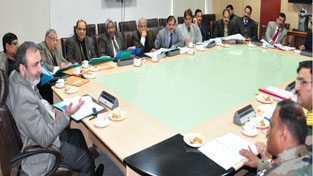
Chief Secretary Mohd Iqbal Khandey chairing FAC meeting at Jammu on Friday.
Chief Minister Omar Abdullah interacting with Sarpanchs and Panchs at Jammu on Friday.
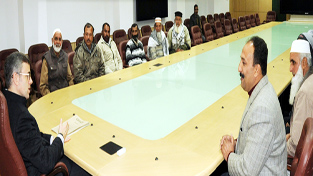
Chief Minister Omar Abdullah interacting with Sarpanchs and Panchs at Jammu on Friday.
Deputy Chief Minister Tara Chand alongwith members of CSC interacting with people’s representatives at Kathua on Friday.
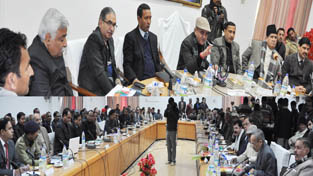
Deputy Chief Minister Tara Chand alongwith members of CSC interacting with people’s representatives at Kathua on Friday.
PHE workers staging protest outside Chief Engineer’s office at B C Road in Jammu on Friday. —Excelsior/Rakesh
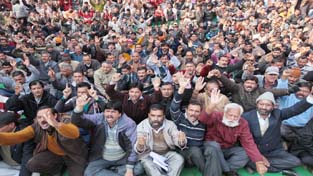
PHE workers staging protest outside Chief Engineer’s office at B C Road in Jammu on Friday.
—Excelsior/Rakesh
Minister of State for Health Shabir Ahmad Khan addressing public gathering at Rajouri on Friday.
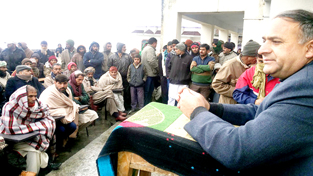
Minister of State for Health Shabir Ahmad Khan addressing public gathering at Rajouri on Friday.
A delegation of BLSKS in a meeting with Union Minister of Culture, Chandershwari Katoch at New Delhi.
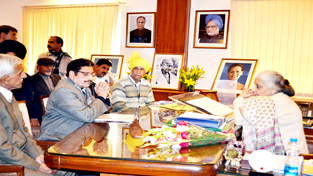
A delegation of BLSKS in a meeting with Union Minister of Culture, Chandershwari Katoch at New Delhi.
Naresh Kumar, Director, The Strings interacting with media persons at Jammu on Friday. -Excelsior/Rakesh
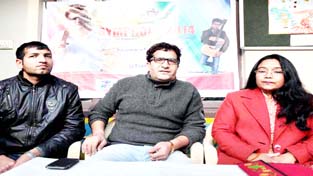
Naresh Kumar, Director, The Strings interacting with media persons at Jammu on Friday. -Excelsior/Rakesh