

SINGAPORE, Jan 10: Asian financial hub Singapore today said it was scrutinising trade in virtual currencies such as Bitcoin as well as precious stones and metals to forestall new forms of illicit financing by criminals and terrorists.
In an inaugural report on money laundering and terrorist financing risks, the city-state said these sectors were identified for further study “as technology evolves and criminals become more sophisticated”.
“Authorities will seek to better understand how money laundering and terrorist financing can be carried out through these channels,” said the joint report by the finance and home affairs ministries as well as the Monetary Authority of Singapore (MAS).
It said the government would “review international best practices, to determine whether any safeguards and mitigating measures are needed”.
The report said virtual money and precious metal-backed currencies carry the risk of being abused due to their anonymity, cross-border nature and low transaction costs.
The MAS, which serves as the city-state’s central bank, “is closely monitoring developments in this area and will consider the need for regulation if necessary”, the report said.
Bitcoin, the world’s most popular form of electronic money, made headlines last year when US authorities closed the Silk Road website when it was found the currency was being used to buy illegal drugs, forged documents, hacker tools and even the services of hitmen.
The report also said Singapore was monitoring the trade in precious stones and metals.
“There are international typologies on the use of precious stones and metals as a tool to launder money, particularly as a store-of-value to move illicit proceeds easily,” it added.
The bank said of 22 sectors that were assessed, the city’s vast financial sector remained among the most vulnerable to abuse owing to the large number of transactions that take place and its wide international reach.
Singapore houses the regional offices of some of the world’s top financial institutions and its total assets under management are now around 1.4 trillion Singapore dollars (USD 1.02 trillion), according to the MAS.
The report said “relevant controls are in place” for financial institutions, including supervision by MAS, record keeping, transaction monitoring and rigorous customer due diligence measures. (AGENCIES)
Singapore monitoring new forms of illicit financing
Hollande says may sue magazine over affair claim
PARIS, Jan 10: French President Francois Hollande today said he was considering legal action against Closer after the magazine said he was having an affair with an actress.
Speaking in a personal capacity, Hollande condemned the coverage as an “attack on the right to privacy,” to which he “like every other citizen has a right”.
Hollande told reporters in a statement he was “looking into possible action, including legal action,” against the weekly magazine.
Closer said on its website today that Francois Hollande was having an affair with actress Julie Gayet, promising to back its claim with photographs after months of swirling rumours.
The website said its print edition today would feature seven pages of revelations and pictures on the 59-year-old president’s alleged relationship with Gayet.
Closer, echoing reports published on various websites in recent days, said Hollande routinely drives through Paris on his scooter to spend the night with the 41-year-old. (AGENCIES)
Let’s adopt ‘Pehle Aap’ attitude
Bhumesh Sharma
Transport has emerged as a major social and economic concern in India. Roads are the lifelines of the country as the arteries in the heart carry blood from one part to the other in the same way the vehicles on road carry people from one place to another. In fact, roads have occupied most surface area of our cities and towns. Transportation has become an inevitable part of social life, to work, to school, to temples, to playgrounds, to hospital to meet friends…………..Everyone has to take the road.
Things have changed after the industrial revolution. Motor cars and other vehicles have made enormous presence on the roads society. A recent survey points out that there are more roads being built than schools or hospitals. What is a road in the Indian context? Stretches of broken concrete interlaced with potholes, the less said about them the better.
J&K, state is a hilly and accident prone state and burden on the roads is enormous. Our state’s economy largely depends upon tourism. Every year millions of tourists visit this state, for this we need safe roads. The total length of our roads in the country exceeds 3.01 million kilometers. This complicated network consists of 34,608 km of national highways, 128,622 km of state highways.
Every year as many as thousands of people get injured on J&k roads and more than 1500 die. In other words three to four people die every day on roads in J&k. Each of those killed has a network of family, neighbor or colleague who also get affected emotionally and otherwise. Families struggle with poverty when they lose a bread winner or have to bear the expsenses of accident viticms. Motor Vehicles Department and Traffic Police have a greater responsibility to generate confidence among the general public about safe road travel. The number of vehicles are increasing day by day. It is thought of as a sign of improving economy of the country as well as state. It is a bitter truth that also adds to accidents on roads. The growing number of accidents is a cause of worry for all of us. The alarming rate of road mishaps in the state is an immense concern for everyone, within and outside the administration. Education is key method for avoiding accidents by adopting good practices.
The good news is that the number of death related to road accidents can be prevented and reduced. All sections of the society need to be involved in creating traffic awareness among people which include Govt./ Private schools and communities. Youth are great advocates they should ‘demand’ road safety laws in their communities, so that they can go to school/colleges and be safe. Youth can lobby and educate decision-makers and ask for road safety.
Keeping in the view the theme for “Road Safety Week” this time (When on road, always say “Pehle Aap”). In order to spread road safety awareness “Road Safety Week” is observed all over the country in the month of January every year.
Till now 24 such road safety weeks have been observed. The ensuing 25th Road Safety Week is being celebrated from 11th January to 17th January,2014.
Surface Transport ministry’s financial assistance upto Rs. five lakh is being provided to every state for organizing road safety related activities in school. These activities may include debate/painting and essay competition/rallies and other such events with token prizes/certificates and also, all the states may hold a symbolic “Walkathon” on Sunday,12th of January, 2014, in the morning hours. Involvement of all the concerned agencies like Police, Health, Information, Education etc. and other field agencies like Transport, Districts authorities, voluntary organizations etc. may be ensured in addition, a proactive enforcement drive during the week would underscore the seriousness about safety on roads.
The union minister for road transport and highways has assured that the ministry will set a target to bring down the road accident deaths by 50% in coming years and “vision zero” will be the goal. Govt. already launched six pilot projects for providing cashless treatment to road accident victims for first 48 hours at expenditure upto a limit of Rs. 30,000/- for different accident prone streaches on national highways in different states.
When on road, always say “Pehle Aap” is the theme of 25th road safety week. Chaos on the roads, lack of respect for traffic rules, aggresive driving and worst of all, road rage, have become the norm in Indian cities, not everyone who drives on city roads makes the effort diffuse tension- when it is not so difficult to do so. Because road rage has even led to murder, it is dangerous even for passers by to try and mediate between the warring parties.
Road rage usually strikes people with ego problem. Ego is often directly related to size of your vehicle, the bigger your vehicle, the bigger will be your ego. The car or bus becomes an extension of our ego- laden self. It obeys us instantly. As soon as we slide behind the steering wheel, we use the vehicle as a way to exercise control and experience a sense of achievement. I have often heard bus deivers shouting expletives at small cars for daring to overtake them” oye machchar, kuchaldoonga” ( Hey you masquito, I’ll squash you ) or “mere say panga leta hai, sabundani” ( Don’t mess with me, you soap box ) are a common refrain.
Why do we blow our top so frequently, especially on the road and during traffic jam? Although we can point to various reasons like poor road infrastructure, bad driving, getting late for appointments all leading to stress, the real reason is more deep-rooted. Why do we find it so difficult to be calm and compassionate? Where is the ‘Pehle Aap’ (you first) etiquette? The major ‘speed breaker’ here is your ego.
All drivers should be educated in the etiquettes of “Lakhnavi Tahjib” Every person driving a vehicle should follow the Principle ‘Pehle Aap’.This will prevent many avoidable accidents on road and save many precious lives and make journey less stressfull what can you do in your community is to raise awareness on road safety? We want hear your ideas, experiences,and the challenges you face when it comes to road safety.
(The author is KAS officer).
Kenya says 30 Shebab rebels killed in Somalia air strike
NAIROBI, Jan 10: Kenya said today it had killed at least 30 Shebab rebels including top commanders in an air strike on a training camp in Somalia, although the militants quickly denied the claim.
The Kenyan military said the raid yesterday evening targeted a Shebab camp in Garbarahey in Gedo region, situated around 600 kilometres northwest of the capital Mogadishu and near the border with Kenya and Ethiopia.
“KDF (Kenya Defence Force) fighter jets attacked an Al Shebab camp, where a meeting was being held,” a senior KDF official said.
“Initial battle damage assessment indicates more than 30 Al Shebab militants killed, including key commanders,” the official added.
Another military official said the Kenyan armed forces were trying to determine the identities of those killed in the raid.
“We are yet to establish their identities, but they are definitely big shots in the militant group’s hierarchy,” the official said, adding that five vehicles and other “key assets” were destroyed in the raid.
Officials said they believed dozens of other militants were also wounded.
Contacted by reporters, a Shebab military spokesman dismissed the Kenyan claims.
“We have no troop presence there. There were no Shebab fighters in the area, none of our people were killed,” said the spokesman, Abdiaziz Abu Musab.
“The Kenyans are claiming the casualties to please their bosses in the West who have contracted them for the war in Somalia,” he added.
Kenya has been battling the Al-Qaeda-inspired Shebab on Somali soil since October 2011, and has since joined the African Union force deployed in the country.
President Uhuru Kenyatta has vowed to maintain Kenya’s military presence in the war-torn country despite Shebab attacks inside Kenya — including the attack on the Westgate shopping mall in September last year.
“Let them (Shebab) know that we will not relent on the war,” Kenyatta said late last year.
“Our forces will remain in Somalia until such time when we are satisfied that there is peace.” (AGENCIES)
Taiwan ex-colonel gets life term for spying for China
TAIPEI, Jan 10: A former Taiwanese air force officer was sentenced to life in prison for spying for China, a court
said today, adding to a string of spying scandals in recent years.
Lieutenant Colonel Yuan Hsiao-feng was convicted on 12 accounts of leaking confidential military information to China between 2003 and 2007, the supreme court said.
Yuan handed the secrets to China via retired colleague Chen Wen-jen, who was recruited by Beijing after he went there to do business. Chen received a 20-year jail term for his involvement in the case, according to the court.
The court also imposed a fine of USD 260,000 on Yuan – the amount of payment he collected for passing the secrets. The ruling is final.
The duo have been detained since 2012 when they failed to recruit two junior colleagues, who turned them into the authorities instead.
Taiwan and China have spied on each other ever since they split in 1949 at the end of a civil war. Beijing still regards the self-ruled island as part of its territory awaiting reunification, by force if necessary.
Taiwan has been rocked by a spate of espionage scandals in recent years, reflecting the fact that intelligence gathering has continued despite warming ties with China under current Taiwanese President Ma Ying-jeou.
In September 2013, a retired vice admiral was jailed for 14 months for collecting confidential military information for China, just months after an ex-lieutenant general was indicted for leaking secrets to Beijing.
In 2011, an army general and chief of an intelligence unit was sentenced to life for spying for China in one of Taiwan’s worst espionage scandals. (AGENCIES)
Snowden no whistleblower: FBI chief
WASHINGTON, Jan 10: FBI Director James Comey today said he does not consider Edward Snowden worthy of being
called a whistleblower or hero, and was baffled by reports granting him the label.
The federal criminal investigation and intelligence chief swiftly dismissed calls for clemency issued by The New York Times and The Guardian newspapers, which said Snowden had done the United States a service by exposing the vast scope of secret digital surveillance run by the National Security Agency.
“I see the Government operating the way the founders intended,” Comey told a small group of reporters, “so I have trouble applying the whistleblower label to… someone who basically disagrees with the way our Government is structured and operates.”
Reports based on Snowden’s leaked files have revealed a global dragnet run by Washington and its allies in the English-speaking world, scooping up Internet traffic and telephone call logs.
The revelations triggered outrage, including from some US telecoms users and foreign Governments targeted in the indiscriminate sweeps, and it has touched off a political and legal debate in the United States.
While Snowden remains in Moscow, protected under a one-year grant of political asylum, US courts have begun examining the legality of the snooping and the White House has carried out an internal review.
Comey did not detail US evidence against Snowden, a former NSA contractor who has been charged under the Espionage Act.
“Whistleblowers are very important,” he said. “I struggle to understand how you can apply the hero whistleblower label to that kind of information, so it confuses me.”
US lawmakers, citing a confidential Pentagon report, warned that Snowden’s theft of 1.7 million secret documents could potentially put US military forces in “lethal” danger worldwide.
“Snowden handed terrorists a copy of our country’s playbook and now we are paying the price,” the House Intelligence Committee’s top Democrat Dutch Ruppersberger said.
“We have begun to see terrorists changing their methods because of the leaks and this report indicates that the harm to our country and its citizens will only continue to endure.”
The lawmakers’ reaction to the report came on the same day President Barack Obama met with US lawmakers, including critics of the NSA surveillance operations, to discuss possible reforms to the programs. (AGENCIES)
US steps up assistance to Iraq to combat terrorist groups
WASHINGTON, Jan 10: The US has stepped up assistance to Iraq to combat al-Qaeda-linked global terrorist groups who
have seized the oil-rich country’s two major cities in the western province of Al-Anbar, the White House has said.
“The administration is deeply engaged in efforts to consult with the Iraqi Government and also to step up assistance to the Iraqi Government in their effort to combat international terrorist groups operating in Anbar province, and that effort continues,” White House Press Secretary Jay Carney told reporters at his daily news conference.
He yesterday said Vice President Joe Biden has been in constant communication with top Iraqi leaders on this issue.
“Those kinds of consultations are ongoing as we provide assistance to sovereign Government of Iraq in its important effort to combat these al-Qaeda groups and international terrorist operations, because the overwhelming majority of Iraqis – no matter whether they’re Shiite or Sunni, no matter their political views – want to be rid of al-Qaeda,” he said.
Islamic State of Iraq and the Levant (ISIL), commonly known as al-Qaeda in Iraq, seized both Fallujah and Ramadi, two major cities in Al-Anbar, last week.
The Iraqi security forces took back Ramadi on Monday, but sporadic clashes continued on the outskirts of the city.
The House of Representative Speaker, John Boehner, urged President Barack Obama to be more engaged in Iraq.
“I know that Speaker Boehner opposed candidate Obama’s promise to end the war in Iraq. I know that. Maybe he still does. Maybe he thinks that American men and women in uniform ought to be fighting today in Anbar. That’s a disagreement that may continue to exist. I don’t know,” Carney said.
President Obama, he said, made a commitment to end the war in Iraq. He fulfilled that commitment.
“We, as a nation, continue to have an important relationship with Iraq and the Iraqi Government, and commitment to assist the sovereign nation of Iraq in the ways
that we are assisting the Government now, both through material assistance and through the good offices that we bring to bear in urging the various political leaders in that country to work together to resolve what has always been, or what has always demanded a political solution here,” he said.
“What we are hopefully seeing now – and it is still a very fluid situation – is an effort to reinvigorate that process, where Sunni tribes and others are being encouraged by and assisted by the Iraqi Government to deal with a common problem here, which is the presence of, and destructive
presence of the al-Qaeda affiliate that is doing so much – wreaking so much havoc in Anbar,” he said.
Carney said the US is very mindful of the fact that this al-Qaeda affiliate has created a lot of chaos and carnage in Anbar Province.
“That’s why we are engaged in the effort we are to assist the Iraqi Government to help them expel that presence,” he told reporters in response to a question. (AGENCIES)
Criminal procedure code applicable in treason case: Pak court
ISLAMABAD, Jan 10: In a fresh setback to embattled former Pakistani military dictator Pervez Musharraf, a special court hearing the high treason case against him today ruled that criminal procedure code is applicable in the case.
Justice Faisal Arab, heading the three-member bench, ruled that criminal procedure code is applicable in the case.
The court had on Wednesday reserved its verdict over the application of criminal laws in the case.
Prosecutor Akram Sheikh had on Wednesday said the Supreme Court had already issued a ruling according to which all crimes under the Army Act fell within the domain of Pakistan’s penal code.
He argued that the special court enjoyed all the powers of a High Court.
While presenting his arguments, 70-year-old Musharraf’s lawyer Anwar Mansoor said criminal code cannot be applied to it.
The court yesterday issued an order summoning Musharraf before it on January 16 after reviewing the medical report submitted by his counsel.
The court said that Musharraf’s medical report did not mention that he had a heart attack and that he was not in a position to appear before it.
It also said Musharraf had been granted exemption from appearance in the court thrice earlier and added that the former president’s counsel had not submitted an application for his no-show today.
Musharraf was rushed to a military hospital in Rawalpindi on January 2 after he suddenly developed a ‘heart complication’ while en route to attend the hearing of the case.
The former military strongman had also missed two earlier hearings in his case because of bomb threats, and there has been rampant speculation in the media that he would be evacuated from the country under medical pretence. (AGENCIES)
Dubious Coal Block allocation be scrapped
Arun Jaitley
On the eve of the Prime Minister’s Press Conference I had posed five questions that I would have liked to ask the Prime Minister. My first question was “In the Prime Minister’s opinion how would history judge him”. The Prime Minister in the course of his media interaction repeatedly said that his performance was for history to judge and he hoped that history would be kinder to him than the contemporary media.
If the Prime Minister had chosen to assert himself at the right time would the situation had been different today? Let us consider three different cases which admittedly brought a bad name to the Government.
The image decline of this government commenced with the reports that all was not well in the organization of the Commonwealth Games. The government itself received several reports of the wrong doings in the Organizing Committee. Months before the Games, the Prime Minister could have stepped in and changed the Organizing Committee. The Chairman of the Organizing Committee, Shri Suresh Kalmadi could have been asked to quit or sacked. A Special Secretary of the Government of India should have been asked to chair the Committee. The country would have got the message that the Prime Minister asserted himself at the right time.
In November-December 2007, the Prime Minister started receiving reports that all is not well with the 2G Spectrum allocation. Spectrum was being undervalued and the allocation was being done through an arbitrary process. The goal post had been shifted to favour a few. The Prime Minister Office was fully aware of the goings-on. It exchanged correspondence with the Telecom Minister but lacked the courage to stop the allocation and scrap it altogether. In January 2008 the Prime Minister remained a mute spectator when the allocation had taken place to a favoured few. If before this situation he had stepped in, scrapped the allocation and constituted a committee to oversee an auction (as was done in 3G) he could have prevented a huge loss to the Exchequer. There would have been no adverse CAG report and no adverse impact on the government’s reputation, no cancellation of the licenses by the Supreme Court. And obviously no impact on the investment environment in the country. The Prime Minister would have been quoted “as a man who asserted himself at the right time”.
In the coal block allocation, his culpability was higher since he himself was the Cabinet Minister for Coal. His choice of the Ministers of State was a suspect. The coal blocks were being allocated on the basis of recommendations of the party. The allocation had been linked to the Party’s fund raising campaign. There was no objectivity. There was no objectivity in the criteria for allocation. If in 2006 and 2007, the Prime Minister as a Coal Minister had followed the criteria of auctioning – something which he himself had decided in 2004, the coal scam would not have taken place. He allowed Congressmen to act as sweat equity beneficiaries and rentiers. Media reports indicate that his Attorney General had admitted before the highest court that the allocation could have unintentionally gone wrong. In the process power generation which is vital to this country’ economic development has suffered. India with 200 years coal reserve is today importing coal. It is a drain on the foreign exchange reserves. Additionally, our goal of ‘power on demand’ has not been realized. The power generation has not become a success story. There was an opportunity for the Prime Minister to have refrained from making these allocations. When the CAG report was submitted he could have utilized that as another God sent opportunity to scrap the allocations. Today when the Government admits through its principal law officer that things could have unwittingly gone wrong, there is yet another opportunity to correct the error. If this opportunity is not availed, the country stands to suffer in terms of delay in power generation. The Prime Minister and the Government continue to suffer from an image of indecisiveness and a taint of corruption.
(The author is Leader of Oppostion in Rajya Sabha)
Chief Secretary Mohd Iqbal Khandey chairing FAC meeting at Jammu on Friday.
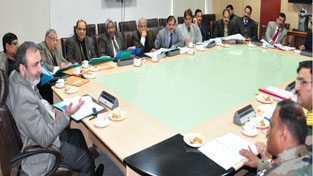
Chief Secretary Mohd Iqbal Khandey chairing FAC meeting at Jammu on Friday.