Friday, April 24, 2026
E-Paper
Home Blog Page 80230

‘US may be violating own laws on wages for its Indian staff’


NEW DELHI, Dec 29:  The US embassy and its consulates may be in violation of their own laws concerning the wages paid to the Indian staff employed by these missions as well as by individual diplomats, informed sources said here today.

Keeping up the pressure on the US, a special group set up in the External Affairs Ministry will meet here tomorrow to scrutinise the available information regarding the wages being paid to their Indian staff amid indications that these may be violative of the laws.

US embassy and its consulates are still dragging their feet in furnishing to the government the details it has sought about the number of Indian staff employed both in the diplomatic mission and also at the residences by their diplomats. The details sought include the wages paid as well as the tax details.

The deadline to provide such information was December 23 but according to the Ministry of External Affairs no information has been provided as yet. It is understood that the US Embassy has cited Christmas and New Year holidays as the reason for the delay.

The government’s action is a fallout of the arrest and strip-search of Deputy Consul General Devyani Khobragade, who was arrested in New York on visa fraud charges.

Enforcing strict reciprocity, Indian government has withdrawn extra privilges enjoyed by American Ambassador Nancy Powell and other diplomats such as special access at Indian airports.

While the government is awaiting American response, information available indicates that Indian staff like cooks and drivers were being paid between Rs 12000-15000 which is equivalent to USD 200-250, way below the minimum wage of USD 9.47 per hour applicable in New York or in any other US city.

Thus, American diplomats would be in violation of US law of minimum wages since their residences as well as the embassy and consulates are treated as American territory.

Even if they provide legal justifications and claim exemption from US laws for the salaries being paid to Indian employees, the public disclosure of such payment practices by US Embassy and diplomats in their personal capacities is likely to deeply embarrass the US.

The US insists on high hourly wages for Indian diplomats employing maids but pays much lower salaries to Indians being employed by its own Embassy and diplomats in India for similar work. There was no immediate response from the US Embassy when contacted.

The government’s reaction to set up the special group, comprising inter-divisonal experts, including from legal, financial and human resources departments of MEA, to assess and monitor the inputs sought by the governments came after Khobragade, the 39-year-old 1999-batch IFS officer, was arrested in New York on December 12.

Khobragade is accused of making false declarations in a visa application for her maid Sangeeta Richard. The diplomat’s arrest and subsequent treatment had sparked an outrage in India which demanded an apology and dropping of all charges against her.

There are also reports that the commercial facilities run by American Community Support Association (ACSA), including a beauty salon and other full-scale commercial facilities hosted by the US Embassy within its compound which include the sale and service establishment, were open not only to US diplomats from third countries but to non-diplomatic personnel as well.

“This is a misuse of diplomatic privilege that is not extended by the US to others in their country,” sources said.

There is a view in the government that the US diplomats at the Embassy in New Delhi and in their Consulates in other cities in India have always enjoyed a high degree of non-reciprocal privileges and facilitation.

These include tax-free treatment of their nationals working in the American Embassy School in New Delhi, extra privileges and immunities for their consulate officials at their consulates in Calcutta, Mumbai, Chennai and Hyderabad, approvals for extra staffing, including the deputation of short-term ‘extra staff’ for deployment in the embassy which are usually extended repeatedly and become regular one to two year postings effectively.

The sources also observed that the US has been ignoring the principle of reciprocity on privileges such as special traffic measures, including dedicated parking spaces and jersey barriers on roads adjacent to the Embassy. In contrast, the US authorities opened the parking in front of the Indian Embassy in Washington DC to general public and has refused to reinstate it despite repeated requests.

“The US action has forced India to review these privileges to bring them strictly in line with reciprocity, the cornerstone of diplomatic ties. Special traffic measures enjoyed by US Embassy in New Delhi have been revoked… Restrictions have been imposed on tax-free shipments being brought in by the US Embassy,” the sources said.

“Strict reciprocity is being applied in terms of airports access and privileges for US Embassy and officials,” the sources added.

The government is also unhappy with the unwillingness of the US to repatriate the India Based Domestic Assistants to India as required under the terms of employment contract as required by US laws which it terms as “inexplicable”.

The sources said, “The government repeatedly sought the help of the US authorities to locate and repatriate her (Sangeeta) to India; instead of fulfilling its obligations by repatriating her, the US Government on the contrary, ‘evacuated’ the entire Richard family from India by presumptively issuing them ‘T visas’ which are issued to next of kin of victims of human trafficking.”

Rather than being a case of human trafficking, the whole episode can only be seen as a “conspiracy by Ms. Richard and her family to subvert and misuse the US immigration laws to gain residency in the US, with the assistance of some NGOs and US authorities.

“They were able to execute this conspiracy in active collusion with the US officials posted in the US Embassy in New Delhi, the State Department and the Department of Justice,” the sources said. (PTI)
Mussa Club blanks Jammu Sports to enter semis

Excelsior Sports Correspondent


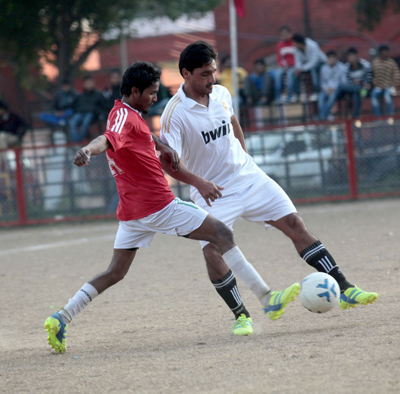
Tough tussle between footballers to get hold of the ball during a match of Christmas Soccer Championship in Jammu on Sunday.— Excelsior/ Rakesh
Tough tussle between footballers to get hold of the ball during a match of Christmas Soccer Championship in Jammu on Sunday. — Excelsior/ Rakesh

JAMMU, Dec 29: Blanking Jammu Sports by five goals to nil (5-0) in the quarterfinals, formidable Mussa Club entered the semifinals of the ongoing Christmas Soccer Championship, being organized by Christian Sports Organisation J&K at GGM Science College Football ground, here.
Now, in the first semifinal, Mussa Club will take on JK Bank at the same venue tomorrow, while JK Bank Academy will face JK PDC in another semifinal.
Earlier, Mussa Club players played like a cohensive unit and dominated the game right from the word go and score back to back in both the halves. Ramesh scored the first goal in 23rd minute, which was followed by back to back goals in 25th and 28th minutes by Sandeep and Aayush. Then Rohit struck twice in 44th and 48th minute, followed by a superb goal in 52nd minute by Vivek to make it (6-0) in favour of Mussa Club. The players of Jammu Sports were out of sorts throughout the match.
The matches were officiated by Rajib Deb, Harneel Singh, Harmanjeet, Amit Sotra and Rinku Gill.

Too late for Modi to express pain over 2002 riots: Sibal


NEW DELHI, Dec 29:  Claiming that it was “too late” for Narendra Modi to be saying that Gujarat riots had shaken him to the core, Union Minister Kapil Sibal today attacked the BJP Prime Ministerial candidate saying his recent comments in a blog were only a belated reaction before Lok Sabha polls.

“Modi’s riots baggage will remain. It is too late for him to express that he was shaken to the core. Had that been so, the core would have reacted in time, not a belated reaction just before the Lok Sabha elections,” Sibal said in a write-up on his website.

The “pain and agony” reflected in Modi’s blog is for an audience whose sympathy will be vital in May, 2014, the Union Law minister added.

He further said that pain was heartfelt, spontaneous and an emotion that is expressed without calculation.

“Pain can never be a belated reaction after 11 years of silence. And a person who suffers in silence cannot remain silent for 11 years. While I do not want to be cynical in my comments, I do not want to be dishonest either. This act of liberation does not connect us with the real Modi,” he said.

Sibal was reacting to a blog post written by the Gujarat Chief Minister in which he said that he felt “liberated and at peace” in the wake of the clean chit given to him by a local court in a case related to the 2002 riots and claimed he was “shattered” by the blame laid at his door for the killings.

Modi, who had avoided media questioning on the issue for over a decade and had never said sorry or apologised for the riots, had in the blog said that he was “shaken to the core”.

Referring to Modi’s blog, Sibal said that he wondered which sisters and brothers the Gujarat CM was addressing when he talked about his personal pain.

The sisters and brothers of those who lost their lives needed the healing touch and, that too, immediately after the riots, Sibal said, adding that “11 years is too late”.

In his article, written in reaction to Modi’s blog, Sibal said that it is the “harrowing ordeal” of the victims, and not that of Modi, that needs attention. The wisdom of the scriptures should have dawned on Modi in 2002, not in 2013, he further stated.

“Those who plan in solitude never suffer pain in solitude. Those who believe in Newton’s Laws of Motion do not wait for 11 years to react,” Sibal said.

Sibal also posed a series of questions.

He asked where the “pain” was when the State of Gujarat defended those who now stand convicted.

“Where was the pain when affidavits about their innocence were filed in courts? Where was the pain when lawyers were paid for defending the indefensible? Where was the pain when the State did not reach out to those who were crying for help? Where was the pain of those who were seeking justice but were left in the cold? Where was the pain when the State was collaborating with the accused to settle their affidavits, while they were being prosecuted in court?,” Sibal asked. (PTI)


Int’l drug cartel busted; 49kg drugs recovered


NEW DELHI, Dec 29:  Special Cell of Delhi Police has busted an international drug cartel operating across Southeast Asia and the Gulf countries with the arrest of an alleged drug trafficker and recovery of 47kg of heroin and 2kg of cocaine, valued at Rs 150 crore on the international market.

According to police, Autar Singh (48), a resident of Delhi, was arrested yesterday following a tip-off.

Three other members of the gang, A Venugopal Reddy (29), a resident of Kadapa district of Andhra Pradesh, Ragmeet Singh (25) and Shurbir Singh (28), both residents of Delhi, were arrested earlier this month and 9kg of heroin, worth Rs 30 crore, recovered from them.

Piecing together the information collected from the above trio and that which was gathered from various other sources, police were able to close in on Autar.

“A trap was laid yesterday near the red light in Sanjay Gandhi Transport Nagar and Autar was apprehended in the early hours. On a search of his Hyundai Santro car, a total of 32kg of fine-quality heroin and 2kg cocaine was found neatly packed in polythene bags,” said DCP (Special Cell), Sanjeev Kumar Yadav.

Following his arrest, Autar was produced before court and placed in police remand. During interrogation, he disclosed that there was a consignment of 6kg heroin at his residence, Yadav added.

He was then taken to his Tilak Nagar residence where the additional 6kg heroin was recovered. A total drug haul of 49kg has thus so far been recovered during the operation.

The Hyundai car he was driving at the time of his arrest has been confirmed as having been stolen from the Shalimar Bagh area.

Information was received a few months back by police about a drug syndicate operating out of Delhi which was engaged in receipt and onward distribution as well as transnational peddling of high-quality Afghanistan-made heroin, Yadav said.

“It was also learnt that the syndicate was being run by one Ali, based in Kuwait, and one Samiullah, who was based in Afghanistan, and that there were several Pakistani, Indian and Sri Lankan nationals who were engaged in the trade.

“The syndicate was engaged in trans-border smuggling of heroin from Pakistan through the Punjab border into India and in its onward movement to Sri Lanka and other foreign destinations,” Yadav added.

During investigation, it was learnt that several conduits for the cartel hailing from Andhra Pradesh would frequently visit Delhi and meet certain Sikh families who had migrated from Afghanistan over two decades back to settle here.

On December 18, a tip-off was received that Reddy would come to Shankar Road here to collect drugs from the suspected suppliers for the syndicate.

“A trap was laid and Reddy was apprehended and 3kg heroin seized from his possession. By the time he was located, identified and apprehended, the supplier had managed to leave the scene,” said Yadav.

During questioning, Reddy disclosed that he has been into the illegal trade for the last six months along with some associates. Reddy also revealed that during this month alone, he had received two big consignments from a man known to him as ‘Mr Singh’ and another person known to him as ‘Arun’, both residents of Delhi.

Reddy provided inputs about the identities of two persons who were coordinating the trade and living somewhere in the Mahavir Nagar area.

While efforts were on to locate the above duo, a team of Punjab Police on Thursday arrived at the office of the Special Cell and sought assistance to arrest a suspect known to them as Shurbir of Delhi.

This Shurbir was wanted in a case registered under NDPS Act in Punjab and, finding the similarities in the suspects being pursued by Special Cell and Punjab Police, a joint team was formed, police said.

“Sources were put to work and, soon, it was learnt that suspects Shurbir Singh and Ragmeet Singh were present in the area of Majnu Ka Tila where they were supposed to meet another courier of the syndicate for delivering a heroin consignment.

“The joint team reached the spot and nabbed the duo. They were found to be in possession of 6kg heroin,” Yadav said.

During preliminary interrogation, the duo said that they were members of a large trans-national drugs racket being jointly coordinated by Ali and Samiullah, police said.

“Ali finds customers while the delivery is done by Samiullah, who controls production in Afghanistan,” said Yadav, adding that from Afghanistan, the contraband is taken to Pakistan and pushed through the Punjab border from where it is carried by road and rail to Delhi.

In Delhi, Tamil and Telugu operators take over and utilise several conduits to send the heroin into the southern part of the country from where Sri Lankan nationals receive it for smuggling into their country, Yadav added.

“The accused disclosed that since January, they have received around 125kg heroin which was pushed down the chain in the manner stated above for bulk and retail buyers,” said Yadav.

Shurbir and Ragmeet also disclosed that Autar, who is a relative of the former, was locally the senior-most member of their syndicate and was dealing with bulk consignments being smuggled into India from Afghanistan and Pakistan.

Following the interrogations, efforts were launched to apprehend Autar.

Several raids were conducted, suspect warehouses, parking lots, drug dens, etc. Were searched and many known associates of the arrested peddlers examined.

Police’s sustained efforts bore fruit yesterday when Autar was finally nabbed. (PTI)


India Inc strikes 480 M&A deals for $27.4 bn in 2013


New Delhi, Dec 29: Hit by sluggish economic trends, merger and acquisition activities of Indian companies slowed down in 2013 to a total of nearly 500 deals worth close to USD 30 billion, but the momentum is set to pick up in the new year especially after the general elections.

In comparison, Indian companies were involved in 598 M&A deals worth USD 35.4 billion in 2012 and 644 transactions worth USD 44.6 billion a year ago in 2011, shows an analysis of data compiled by various deal-tracking firms.

While deal volumes have slipped for two consecutive years now, experts believe there is a lot of pent up demand for M&A transactions and the deal momentum is set to pick up in 2014.

Muted economic growth projections and uncertainty over policies held back M&A transactions, and deals are now taking longer to close because of macroeconomic concerns.

According to Grant Thornton, there have been a total of 480 deals amounting to USD 27.4 billion during 2013 involving Indian companies, as on December 13, 2013.

A few more deals have been announced since then.

Global deal-tracking firm mergermarket’s India Bureau Chief Mithun Varkey said deals would be mostly driven by local consumption story, especially in sectors like consumer durables and pharmaceuticals, during 2014.

“A revival in core sectors such as in power, road and infrastructure sectors still seem unlikely as due to lack of investor confidence,” he said.

Moreover, the upcoming general elections are also holding many deals back, as many investors and dealmakers prefer to wait and watch.

“We expect subdued activity in the first quarter of 2014 and then based on the election results and market sentiment we believe there would be a big uptick in M&A thereafter,” said Harish HV, Partner, India Leadership Team of Grant Thornton.

According to Vikram Utamsingh, Managing Director, Transaction Advisory services, Alvarez & Marsal India, there are several insights to the M&A deal tally of this year.

Firstly, both global buyers and investors now believe that it is an opportune time to do deals in India as deals have become cheaper in dollar terms due to the sharp devaluation of the rupee against the US dollar.

Secondly, global investors believe that the Indian economy is at the bottom of its economic cycle and with government elections in the new year coupled with efforts by the present government to increase growth, India should start growing at a higher rate from 2014.

Thirdly, valuations in some sectors like industry and auto have reached more reasonable levels for deals to get done.

“We could see several large transactions in the power and road industry where the large infrastructure conglomerates in India look to find ways to generate cash to reduce their incredibly high debt burdens. These assets, if already operational or near operational, will see interest from global players,” Utamsingh said.

PwC India, Executive Director and Leader (Private Equity), Sanjeev Krishan, believes that “overseas investors continued to be cagey (in 2013) about India, owing to the tax issues which surfaced in 2012 and lack of any path-breaking policy moves”.

The recovery in the US markets and the upturn in the European economies also meant that overseas investors focused on their home territories more than emerging markets including India, Krishan said.

The year 2013 has witnessed five deals valued at over a billion dollars each, and there were 36 deals valued at over a 100 million dollars each.

Topping the list, Unilever’s stake hike in Hindustan Unilever was worth USD 3.1 billion, followed by ONGC’s Rovuma oil block acquisitions for over USD 2.5 billion each.

According to data from mergermarket, domestic M&A deal value fell by almost 67 per cent year-on-year in 2013.

In 2012, domestic deal value was at about USD 20.8 billion from 167 deals, but in 2013 it stood at about USD 7 billion from 140 deals. Inbound deals fell to a total of 148 in 2013 from 172 in 2012. (PTI)

Cleanliness drive launched

Excelsior Correspondent


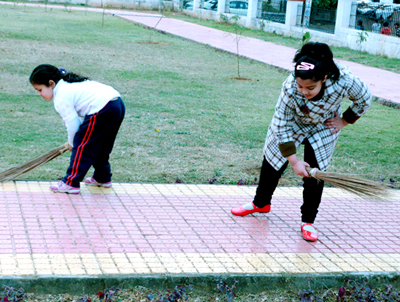
Children cleaning the public park at Channi Himmat Housing Colony.

JAMMU, Dec 29: Giving message of social responsibility and love for their motherland, the residents of Sector 5 Channi Himmat Housing Colony Jammu today launched a cleanliness drive and cleaned the only public park in their locality with brooms and disposable bags in their hands.
To ensure that the park serves best the purpose of providing healthy environment to the residents, on the initiative of “Mother The Nature”, an NGO that is actively involved in its upkeep, the residents decided to clean their park regularly on last Sunday of every month in future.
On the occasion the residents unanimously approved the name “Nature’s Beauty Parlour” for the Park.
The cleanliness drive, at the conclusion of which they all entertained themselves with hot tea and ‘garam halva’ bracing wintery weather, turned out to be a picnic integrating all into a close knit family- something missed in the urbanized life.
The park used by security forces for long years was got freed after long struggle of residents about three years ago. The State Housing Board under close monitoring of Minister for Housing, Horticulture and Culture, Raman Bhalla took keen interest in providing basic essentials of a park including fencing, walking tracks, lights and the lawns while Urban Forestry of District Jammu and “Mother The Nature”, an NGO jointly took up drive and planted saplings of medicinal plants with the latter ensuring their regular upkeep.

Cong facing tough battle in new year after rout in polls


NEW DELHI, Dec 29: With the rout in the year-end assembly elections, Congress has been left looking at the bottom of the barrel ahead of the Lok Sabha elections, with Narendra Modi breathing down its neck.

It was all bouquets for Rahul Gandhi at the beginning of the year when he was made the Congress Vice President at the Jaipur Chintan Shivir but there is nothing much to show for him as 2013 comes to a close.

The party now has to decide whether to project him as its prime ministerial candidate when the AICC meets in more than a fortnight.

The debacle in Delhi, Chhattisgarh, Rajasthan and Madhya Pradesh has thrown up questions over Rahul’s ability to rally the party for a hat-trick in the parliamentary elections with his mother and party chief Sonia Gandhi virtually taking a backseat in the day-to-day affairs of the organisation.

While Rahul has now hinted changes beyond imagination in the party and its working, suggestions that Sonia Gandhi will again take the lead in the organisation have started gradually gaining ground with a do-or-die battle looming ahead.

An AICC restructuring is on the cards sooner than later and an AICC meeting is scheduled here on January 17 which is expected to give a glimpse of the party strategy for facing the Lok Sabha polls just a few months away.

Congress is in power as head of the UPA coalition for ten years since May 2004.

With several leaders rooting for him as the “natural choice” to lead the party in the polls, the meet is being held amid speculation that Rahul could be declared the prime ministerial candidate by the party.

Sonia Gandhi has said that the party would decide its PM candidate at an opportune time.

The year gone by also saw the party storming back to power in Karnataka after seven years in what was seen as an anti-BJP vote due to the controversial rule of B S Yeddyurappa marked by allegations graft and nepotism.

Congress succeeded in getting the Food Security Bill as also the Land Acquisition Bill passed in Parliament amid projections of the two schemes as the game changers for the organisation in the Lok Sabha polls.

At the fag end of the year, the ruling party also succeeded in getting the Lokpal Bill passed with the help of the main opposition BJP in the backdrop of both the major parties suffering a setback with the emergence of Aam Aadmi Party in Delhi.

AAP, led by Arvind Kejriwal, has formed Government in the national capital with Congress’ support. The emergence of the nascent party has come as a morale booster for several regional parties.

What is worrying for the Congress as it prepares for the Lok Sabha polls is the extent of loss it suffered in the just concluded Assembly polls in states like Delhi and Rajasthan.

After 15 years in power in Delhi under the leadership of Shiela Dikshit, the party was suddenly reduced to an ‘also ran’ status with just eight seats in the 70–member Assembly, down from 43. This was despite the fact that it had claimed that Dikshit era had led to unprecedented development in the national capital.

The result showed not only intense infighting in the party, but also the failure of the leadership to gauge the mood of the people in the backdrop of an atmosphere of scams and scandals, anger against the price rise and the December 16 gangrape incident last year.

In neighbouring Rajasthan, the party not only lost power but was routed so badly that it came up with the worst ever performance winning just 21 seats in a House of 200. Even in the Assembly polls held after the Emergency in the mid-70s, the party had secured 40 odd seats.

So stunned was the party that Ashok Gehlot, who led the campaign as the Chief Minister, said he had no words as there was no-anti incumbency against his Government and the party.

He claimed the reason could be mainly the “Goebellisian” tactics of Modi to spread communal agenda.

“Narendra Modi’s thoughts are a threat to Indian democracy,” Gehlot declared as the party was grappling on how to tackle the challenge posed by the Gujarat strongman.

The challenge before the party could be gauged from the fact that Modi is known as the “most polarising” politician in India and abroad in the wake of the Gujarat riots of 2002.

Besides, he has emerged as the most aggressive campaigner in recent times when questions are being raised about the way Rahul Gandhi canvasses.

Despite bifurcation of Andhra Pradesh being a ticklish issue, Congress took decisive steps for the formation of a separate Telangana amid hopes that the new state could be a reality in the New Year.

Andhra Pradesh, which has the distinction of being the only major state where Congress is in power on its own, is turning tricky for the party with the emergence of the YSR Congress led by Y S Jaganmohan Reddy, who has been recently out on bail from jail.

The party had to face the ignominy of one of its MPs and CWC member Rashid Masood losing the membership of the Rajya Sabha after being convicted in a graft case.

It also saw two Union Ministers Ashwani Kumar and Pawan Kumar Bansal being forced to quit in the wake of controversies surrounding them. As the year came to a close, Environment Minister Jayanthi Natajan put in her papers in what was believed to be not a voluntary act.

The solar panel scam in Kerala, where the opposition is targeting Chief Minister Oomen Chandy, brought lot of problems for the party in the southern state.

The year also saw DMK, the second largest constituent of the UPA after Congress, leaving the alliance and its chief M Karunandidhi accusing the ruling party of being “ungrateful”.

The riots in Muzaffarnagar have brought in fresh problems for the party in Uttar Pradesh where the BJP is seeking to exploit the communal divide after Modi’s close associate Amit Shah was made the BJP in-charge in the politically most crucial state having 80 Lok Sabha seats.

In Bihar, Lalu Prasad’s release from the jail on bail in a fodder scam case has ignited talk of a Congress alliance with the RJD. The year had seen growing bonhomie between Congress and Bihar Chief Minister Nitish Kumar of the JD-U after he parted ways with the BJP.

Congress is said to be exploring the possibility of an alliance with Mayawati’s BSP and Lalu Prasad’s RJD in the next Lok Sabha polls which will brighten its prospects in the key states of Uttar Pradesh and Bihar, together which hold 120 Parliamentary seats.

If such an alliance which also involved Ram Vilas Paswan’s LJP was stitched together, the party would also benefit in Jharkhand in 14 Lok Sabha seats, besides the ripple effect benefit in states like Haryana and Punjab.

In the backdrop of the reverses in four states, NCP Chief Sharad Pawar, has attacked the Congress leadership, telling them that “people do not like weak rulers” and they want strong and decisive leaders.

With challenges galore, organisational weaknesses coming again to the fore and Modi projecting himself as a strong and decisive leader, outspoken party leaders like Mani Shankar Aiyar have publicly said that a stint in the opposition would do Congress good. (PTI)

BSF School bags 15 medals in Open Judo C’ship

Excelsior Sports Correspondent

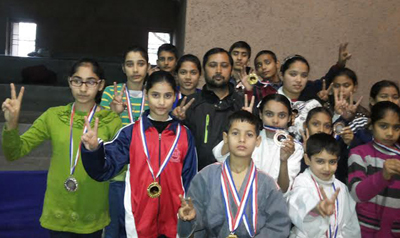
Judokas of BSF School Paloura who bagged galaxy of medals in Open Judo Championship.

JAMMU, Dec 29: BSF Primary School bagged 15 medals, with 4 gold, to emerge champions in the inaugural Jammu and Kashmir State Open Judo championship, here.
The tournament was organised by State Judo Association at MA stadium in Jammu.
The gold medal were won in Under-12 boys category by Shivam Baloria (20kg), Aryaveer Singh Jamwal (30kg) while silver was bagged by Om Baloria (25kg) and bronze went to Aditey Singh (20kg), Vanshveer Singh (30kg) and Anirudh Sharma.
In under-12 girls category, Palak Sharma and Bhagya Thakur secured gold in 25kg and 35kg category respectively.
Silver medals were won by Asvina Bhat in 40kg division and Amisha.
Meenakshi Devi (25kg), Imran (30kg), Tazinder (35kg), Bhawana Hans (40kg) and Riya Sarma (40kg) claimed bronze medals.
Headmaster of the School, Gaytri Kotwal lauded the efforts of the judokas and their coach Rameshwar Singh Jamwal.

Kamal Farooqui drops clear hints about joining AAP

GHAZIABAD, Dec 29:  Dropping clear hints about joining Aam Aadmi Party, expelled SP leader Kamal Farooqui today met Arvind Kejriwal and said “everybody is interested” in joining the nascent party.

Farooqui, who was sacked by SP as its secretary in September following his controversial comment that Indian Mujahideen co-founder Yasin Bhatkal was arrested because of being a Muslim, said here that he would announce his decision on joining AAP tomorrow.

“We met Kejriwal and congratulated him for becoming Delhi’s Chief Minister,” Farooqui told reporters here after meeting the AAP chief.

On being asked whether he was going to join AAP, Farooqui said that he “would let you know (reporters) tomorrow”.

“Right now, everybody is interested to join Kejriwal,” he said. “I have met Kejriwal and discussed about the manifesto” Farooqui said after the meeting.

Confirming the development, AAP leader Sanjay Singh said that discussions about “Farooqui joining the party is on”.

Singh said that there are several good people in political parties, and “we appeal them to join Aam Aadmi Party”.

“For Lok Sabha elections, we will need good leaders working with other political parties.

“As Kejriwal has already invited such good persons, we again appeal them to join us and help us throw corrupt people from Indian politics,” Singh told reporters.

The AAP leader criticised Akhilesh Yadav-led SP government for “demolishing few relief camps” meant for riots victims of Muzaffarnagar and Shamli.

“UP government should compensate victims and do something for them,” Singh added.

According to sources, the AAP is mulling contesting on all seats in Uttar Pradesh in the upcoming Lok Sabha polls. (PTI)


2013- tough year for Defence : Pak, China remain concerns

NEW DELHI, Dec 29:  Ceasefire violations and killings of  Indian jawans by Pakistani troops, border incursions by Chinese  and commissioning of the aircraft carrier INS Vikramaditya  (formerly Admiral Gorshkov) were a few of the highlights of  Indian Defence Forces during 2013.

The year also saw self-reliance in advanced missile technology development programme and augmentation of Defence preparedness  by addition of new weapons.

In Defence R and D, successful test flight of 5000 km range ICBM Agni-V, launching of long-range cruise missile Nirbhay and continued successful user trials of Agni-II, Agni-III,Agni-IV,  Prithvi-II, Supersonic BrahMos and Beyond Visual Range missile Astra marked India’s Defence prowess.

The commissioning of India’s biggest aircraft carrier INS Vikramaditya on November 16, preceded by the launching of India’s own IAC-INS Vikrant and induction of deadly Mig-29K squadron into the Indian Navy were also major developments of 2013.

The year gone by also saw systematic force projection of the Armed Forces in India’s neighbourhood and far off Asian Region.

These highs notwithstanding, there were some lows too.

The sudden and unprovoked attack by the Pakistan Army in the guise of armed infiltration along the Line of Control (LOC) in Poonch and later in Keran sector of Jammu and Kashmir brought disquiet into the region.

Pakistan continued to resort to ceasefire violations and border firing all through the year.

The thaw in India-China border relations was also broken in April when Chinese Peoples’ Liberation Army (PLA) jawans repeatedly infiltrated into Ladakh Sector on the Line of Actual Control (LAC).

Despite that, India signed a crucial Border Defence Cooperation Agreement (BDC) with China during Prime Minister Manmohan Singh’s  visit to Beijing in October.

The agreement is expected to bring in a relatively peaceful  and intrusion free LAC in the northern sector.

The agreement lays down a protocol to prevent incidents like the intrusion when Chinese troops pitched tents inside Indian  territories in August/September.

On July 2, India unveiled the much awaited National Cyber Security Policy to create a secure cyber eco-system in the country.

The devastating fire accident in the frontline submarine INS Sindhurakshak and its sinking under sea in Mumbai Naval Dockyard in August was a big jolt to the Indian Navy.

During the year, India reiterated its expertise in high-end missile technology when the second test flight of over 5000 KM Intermediate Range Ballistic Missile (IRBM) Agni-V proved successful on September 15.

The much awaited indigenous Light Combat Aircraft (LCA) Tejas for the IAF also saw the light of the day.

Tejas, a fourth generation fighter aircraft, is meant to meet the requirements of the IAF as its front-line multi mission aircraft.

India launched its first indigenous aircraft carrier INS Vikrant on August 12 at Kochi, marking the end of Phase-I (IAC-I) of the project.

Indian Defence scientists successfully activated the atomic reactor on board INS Arihant in early August.

India finally commissioned its second aircraft carrier 44,500 tonne INS Vikramaditya into the Navy at the Sevmash Shipyard in Severodvinsk of Russia on November 16 when Defence Minister A K Antony commissioned it after its extensive refurbishment and refit over the past few years.

The Carrier, in its previous avtar as Admiral Gorshkov, can carry over 30 combat aircraft/helicopters and has the staying power of operating nearly 45 days in high seas with its 1600 crew and officers.

The Indian Navy inducted the first fully Indian manufactured Hawk Advanced Jet Trainer (AJT) at INS Dega, Vishakhapatnam, in November.

During the year, the Indian Army conducted bilateral exercises with China, France, UK, Russia and Nepal.

India-China joint exercises Hand-in-Hand 2013 conducted in Chengdu Province of China culminated on November 13.

Exercise ‘Ajeya Warrior’, a four week Indo-UK joint military exercise, also aimed at enhancing counter terrorism skills.

In October, Indian and Russian armies conducted a joint exercise, Indra, at Mahajan field firing range in Thar Desert of Rajasthan.

The event saw both sides perform various combat exercises, including anti-terrorist operations.

A joint exercise between India and the French armies was organised from September 9-20 in the French Alps at Grenoble.

During the year, the Defence Ministry ordered a CBI probe into Augusta Westland Contract for 12 VVIP Helicopters.

The Indian Navy held exercises with the Navies of several countries including the US, the UK, Japan and Brazil and South Africa (IBSA), Sri Lanka, Myanmar, Thailand, Indonesia, Singapore and Oman.

The 13th Meeting of the India-Russia Inter-Governmental Commission on Military and Technical Co-operation (IRIGC-MTC) was held in Moscow at November, which was co-chaired by Defence Minister A K Antony and his Russian counterpart Sergey Shiogu.

Keeping in view the rapidly changing geo-political situation and to fulfil its new operational stance, the IAF took a number of steps related to its force level, infrastructure development, force multipliers, training and most importantly, its mindset from a tactical to a strategic entity.

In addition to tying up with Russia for development and manufacture of state-of-the-art 5th Generation Fighter Aircraft (FGFA), India also collaborated with Russia for development of a multi-role transport aircraft.

The Indo-French High Committee on Defence Co-operation, which met in October this year, decided to further strengthen the ties in different fields which include joint R and D in high technology and transfer of technology, Defence equipment collaboration, training and close navy-to-navy interaction in matters like joint exercises and Defence exchanges.

Drawing lessons from 26/11 terrorist attacks on Mumbai in 2008, the Government took a number of steps to close the gaps in India’s vast coastline and strengthen the coastal security apparatus.

Under Phase-I of the Coastal Surveillance Network Project, installation of 36 radar chain to have a gap free Coastal Surveillance Network (CSN) was envisaged.

Of late, a worrisome trend has arisen of Private Armed Security Guards on board Commercial ships in international waters as well as territorial waters.

A high-level meeting on Coastal Security recently decided to take up this issue of Private Armed Security Guards with international fora like the International Maritime Organisation (IMO).

To further encourage indigenisation and development of Defence industrial base in the country, the Government promulgated amended Defence Procurement Procedure on June 1.

   Indian Air Force formally grounded its Mig-21 (FL) fleet in December. Their place will be taken by the LCA fighter version.

   The Naresh Chandra Task Force constituted by the Government on national security and higher Defence management submitted its recommendations, which include creation of the post of Chief of Defence Staff (CDS) in the Indian Armed Forces.

   The foundation stone for India’s first National Defence University (INDU) was laid by Prime Minister Manmohan Singh in Binola, near Gurgaon on May 23.


(UNI)