The science of Yoga is an ancient one owing its origin to India. Of late, however, Yoga has become a subject of modern scientific evaluation even among the western researchers.
Specific Yoga “Asanas” useful in Diabetes are being identified and evaluated at different research centers across the world. For example, “Pranayama” practised for 30 minutes followed by “Shavasana” for 15 minutes daily over a period of one month has been shown to result in a significant fall in levels of fasting as well as post prandial Blood Sugar.
BENEFIT SEEN EVEN IN INSULIN DEPENDENT CASES
A number of studies reveal that optimum control of Diabetes can be achieved by practising certain Asanas like “Dhanurasana” and “Ardhamatasayendrasana.” While “Halasana,” “Vajrasana,” “Pachimotasana,” “Bhujangasana,” “Naukasana” etc have also been effective, when evaluated individually, “Dhanurasana” is found to be more effective.
The beneficial effects of Yoga on Diabetes are brought about by changes in the harmonal and biochemical profile, elimination of stress and instillation of a sense of discipline. Remarkably, these effects are seen not only in Type 2 Diabetes but also in Type 1 Diabetes where the affected individual is insulin dependent for life because of insufficient or absence of insulin production from pancreatic cells.
CONSEQUENT REDUCTION IN DOSE OF ANTI-DIABETIC MEDICATION
Long term follow-up studies show a significant fall in Blood Sugar levels in case of both Type-2 as well as Type-1 Diabetes. Continued practice of Yoga exercises leads to a steady, smooth and better control of Diabetes. On the other hand, those of the diabetics who discontinue Yogic practices for some time and then restart show poor control when Yogic exercises are discontinued with return to normal values after restarting the Yogic practices.
An important feature of the Yoga effect on Diabetes is a consequential reduction in the requirement of the dose of anti-diabetic tablets or Insulin. In borderline cases of Diabetes, regular continued practice of Yoga along with other non-medicinal measures like diet regulation can, in many cases, lead to total elimination of anti-diabetic tablets or Insulin injection. In other cases too, there is a welcome relief in the form of reduced number of tablets or units of Insulin injection.
An added or concomitant effect of Yoga is its positive effect on other important health parameters like blood pressure, body weight, lipid or cholestrol, heart etc.
In a nutshell, Yoga could prove to be an inexpensive, harmless and at the same time, an effective adjuvant to the treatment of Diabetes.
In the sports segment, prominent books will be autobiographies by tennis stars Sania Mirza and Mahesh Bhupathi (both HarperCollins) and a book on Pakistan cricket “Wounded Tiger: The History of Cricket in Pakistan” by Peter Oborne (Simon & Schuster).
Besides there will be several books on a bevy of subjects like health and fitness, motivation and self help, young adult fiction, cuisines and entertainment.
“The Accidental Prime Minister: The Making and Unmaking of Manmohan Singh” by one of his closest aides Sanjaya Baru will be published by Penguin India in March. In his account, the former media adviser of Singh tells his story of what it was like to ‘manage’ public opinion for the prime minister while giving us a riveting look at Indian politics as it happened behind the scenes.
HarperCollins will also publish a biography of President Pranab Mukherjee by Jayanta Ghosal.
Simon & Schuster’s big title will be Hillary’s memoir in which she will share key decisions and experiences as Secretary of State and her ideas for how the US can address the challenges of a dramatically changing world in the 21st century.
“We couldn’t be happier to continue our long association with Secretary Clinton and to bring readers worldwide her unique insights into the most dramatic events and critically important issues of our time,” says Carolyn Reidy, President and Chief Executive Officer of Simon & Schuster, Inc.
“This will be the ultimate book for people who are interested in world affairs and America’s place in the world today,” adds Jonathan Karp, President and Publisher of the Simon & Schuster Publishing Group.
The year will also see a couple of books on Modi to be brought out by HarperCollins – “Modi and Godhra: The Fiction of Fact-finding” by Manoj Mitta and “Narendra Modi” by Ramesh Menon. There will also be book on Nitish Kumar (by HarperCollins) – “Single Man: Nitish Kumar of Bihar” by journalist Sankarshan Thakur.
A retelling of the Aarushi murder (Penguin) by journalist Avirook Sen will be another anticipated book this year. Sen, who followed the court case and interviewed key players among investigators, lawyers, family and Aarushi’s friends, tries to answer the biggest question of all – who murdered the 14-year-old.
Pan Macmillan India’s major title is Archer’s fourth spellbinding book in his epic “Clifton Chronicles series 1957” – “As Be Careful What You Wish For”.
Other titles from the publishing house include “Big Bad Wolf” by Nele Heuhaus; “Memoir, an electrifying memoir by blind Chinese activist Chen Guangcheng who inspired millions with his fight for justice, and his belief in the cause of freedom; “The Target”, “The Finisher” and “King and Maxwell” by David Baldacci; “In the Light of What we Know” by Zia Haider Rahman; “Want you Dead” by Peter James; “Dead Letter Drop” by Peter James; “Burial Rites” by Hannah Kent and “Vicious Circle” by Wilbur Smith.
Westland’s titles for 2014 include “Why I Write: Essays” by Sadat Hasan Manto (Translated by Aakar Patel), “India Uninc” by Prof R Vaidyanathan, “Take Me Home” by Rashmi Bansal, “Butchers of Banaras” by Mahendra Jakhar, “Kamasutra Diaries” by Sally Howard, “Post-Haste: A History of India Through Stamps” by B G Verghese and “Making of Exile: Sindhis & Partition” by Nandita Bhavnani.
Simon & Schuster will also publish “The Farm” by Tom Rob Smith, “A Short Guide to a Long Life” By David B Agus, ” A Thousand Shards of Glass” By Michael Katakis and “Gold: The Race for the World’s Most Seductive Metal” By Matthew Hart.
HarperCollins fiction list includes “Idris: Keeper of the Light” by Anita Nair, “Karachi Raj” by Anis Shivani, “Gulab” by Annie Zaidi, “The Gypsy Goddess” by Meena Kandaswamy, “And Death Came Calling” by Mukul Deva and “Transgressions” by Vaiju Naravane.
In the ‘Mind, Body, Spirit’ section Simon and Schuster will publish Brendon Burchard’s “The Motivation Manifesto: 7 Declarations to Claim Your Personal Power” and HarperCollins a number of titles like “Who Wrote the Bhagavad Gita: A Secular Enquiry into a Sacred Text” by Lord Meghnad Desai, “Indra’s Net: Defining Modern Hinduism and a Vision for its Future” by Rajiv Malhotra and “The Anti-Ageing Book” by Jamuna Pai.
“How to Age” by Anne Karpf; “How to Think about Exercise” by Damon Young; “How to Deal with Adversity” by Christopher Hamilton; How to Create Emotional Health” by Oliver James; “How to be Alone” by Sara Maitland; “Talk Like Ted: The 9 Public Speaking Secrets of the World’s Top Minds” by Carmine Gallo and “The Skeleton Cupboard” by Tanya Byron, in which the author shares powerful stories from her final years of training as a clinical psychologist, will be brought out by Pan Macmillan India.
The books in the Young Adult section include “Manan” by Mohit Parikh (HarperCollins) and “Half Bad” by Sally Green, “The Blood of Olympus” by Rick Riordan and “Mortal Instruments 6: City of Heavenly Fire” by Cassandra Clare (all Penguin).
According to Hemali Sodhi, vice president (Marketing and Corporate Communications) of Penguin Group India, Penguin enters 2014 “stronger than ever, with a very exciting publishing line up both of our Indian lists, and international lists we represent”.
The publishing house’s other titles include “Noontide Toll”, an extraordinary portrait of post-war Sri Lanka grappling with the ghosts of its troubled past, by Romesh Gunsekera, who was shortlisted for the Booker Prize in 1994; “Family Life” by Akhil Sharma; “Panty” by Sangeeta Bandyopadhyay and translated from Bengali by Arunava Sinha; “Rebooting Government” by Nandan Nilekani and Viral B Shah; “A Strange Kind of Paradise: India through Foreign Eyes” by Sam Miller.
Penguin’s international titles include “The Last Word” by Hanif Kureishi; “Frog” by Mo Yan; “Runner” by Patrick Lee, “The Strangler Vine” by M J Carter; “Richard Branson: The Man Behind the Mask” by Tom Bower.
Says Karthika V K, publisher and Chief Editor of HarperCollins India, “2013 was a year of some exciting acquisitions that will find their way into bookstores in 2014 – former President A P J Abdul Kalam’s ‘A Manifesto for Change’ and Upamanyu Chatterjee’s novel ‘Fairy Tales at Fifty’ top the list.”
HarperCollins non-fiction titles include “Capital: A Portrait of Twenty-First Century Delhi” by Rana Dasgupta, “Travelling In, Travelling Out: A Book of Unexpected Journeys” by Namita Gokhale, “Indians in a Globalizing World” by Dilip Hiro, “The Connected Age” by Sudhakar Ram and “At the Helm” by V Krishnamurthy, “Get Your Act Together: A Master Class on Becoming an Actor” by Tisca Chopra and “Jagijit Singh: A Musical Biography” by Sathya Saran.
The publishing house also has some books on translations like “Fourteen: Stories that Ray Made into Films” edited and translated by Bhaskar Chattopadhyay, “Reserved Seat & Other Stories” by Man Booker 2013 nominee Intizaar Hussain and translated by Rakshanda Jalil, and “The Boatwreck/ Naukadoobi” by Rabindranath Tagore and translated by Arunava Sinha. (PTI)
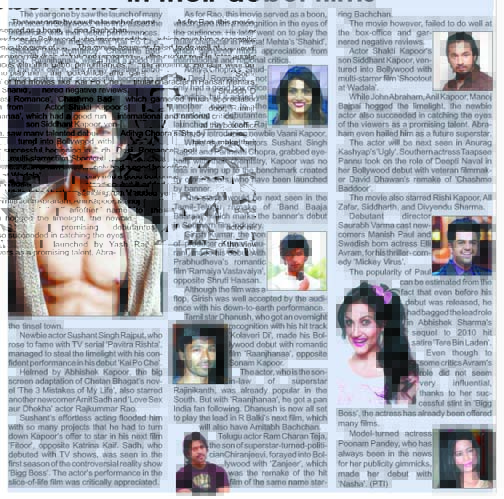
The year gone by saw the launch of many new faces in Bollywood, who impressed the audiences with their debut performances.
Some of the movies like ‘Kai Po Che’, ‘Shuddh Desi Romance’, ‘Chashme Baddoor, ‘Raanjhanaa’, which had a good run at the box office, saw many talented debutantes make their successful beginning in the tinsel town.
Newbie actor Sushant Singh Rajput, who rose to fame with TV serial ‘Pavitra Rishta’, managed to steal the limelight with his confident performance in his debut ‘Kai Po Che’.
Helmed by Abhishek Kapoor, the big screen adaptation of Chetan Bhagat’s novel ‘The 3 Mistakes of My Life’, also starred another newcomer Amit Sadh and ‘Love Sex aur Dhokha’ actor Rajkummar Rao.
Sushant’s effortless acting flooded him with so many projects that he had to turn down Kapoor’s offer to star in his next film ‘Fitoor’, opposite Katrina Kaif. Sadh, who debuted with TV shows, was seen in the first season of the controversial reality show ‘Bigg Boss’. The actor’s performance in the slice-of-life film was critically appreciated.
As for Rao, this movie served as a boon, which gave him a recognition in the eyes of the audience. He later went on to play the titular character in Hansa! Mehta’s ‘Shahid’, which garnered much appreciation from international and national critics.
Aditya Chopra’s ‘Shuddh Desi Romance’, not only had a good box office standing, but it added yet another name to the promising debutantes launched by Yash Raj Films, by introducing newbie Vaani Kapoor.
While the lead actors Sushant Singh Rajput and Parineeti Chopra, grabbed eyeballs with their chemistry, Kapoor was no less in living up to the benchmark created by other actors, who have been launched by banner.
The starlet would be next seen in the Tamil-Telugu remake of ‘Band Baaja Baaraat’, which marks the banner’s debut in Southern film industry.
Girish Kumar, the son of producer Kumar Taurani, made his debut with Prabhudheva’s romantic film ‘Ramaiya Vastavaiya’, opposite Shruti Haasan.
Although the film was a flop, Girish was well accepted by the audience with his down-to-earth performance.
Tamil star Dhanush, who got an overnight recognition with his hit track ‘Kolaveri Di’, made his Bollywood debut with romantic film ‘Raanjhanaa’, opposite Sonam Kapoor.
The actor, who is the son-in-law of superstar Rajinikanth, was already popular in the South. But with ‘Raanjhanaa’, he got a pan India fan following. Dhanush is now all set to play the lead in R Balki’s next film, which will also have Amitabh Bachchan.
Telugu actor Ram Charan Teja, the son of superstar-turned-politicianChiranjeevi, forayed into Bollywood with ‘Zanjeer’, which was the remake of the hit film of the same name starring Bachchan.
The movie however, failed to do well at the box-office and garnered negative reviews.
Actor Shakti Kapoor’s son Siddhant Kapoor, ventured into Bollywood with multi-starrer film ‘Shootout at Wadala’.
While John Abraham, Anil Kapoor, Manoj Bajpai hogged the limelight, the newbie actor also succeeded in catching the eyes of the viewers as a promising talent. Abraham even hailed him as a future superstar.
The actor will be next seen in Anurag Kashyap’s ‘Ugly’. Southern actress Taapsee Pannu took on the role of Deepti Naval in her Bollywood debut with veteran filmmaker David Dhawan’s remake of ‘Chashme Baddoor’.
The movie also starred Rishi Kapoor, All Zafar, Siddharth, and Divyendu Sharma.
Debutant director Saurabh Varma cast newcomers Manish Paul and Swedish born actress Elli Avram, for his thriller- comedy ‘Mickey Virus’.
The popularity of Paul can be estimated from the fact that even before his debut was released, he had bagged the lead role in Abhishek Sharma’s sequel to 2010 hit satire ‘Tere Bin Laden’.
Even though to some critics Avram’s role did not seem very influential, thanks to her successful stint in ‘Bigg Boss’, the actress has already been offered many films.
Model-turned actress Poonam Pandey, who has always been in the news for her publicity gimmicks, made her debut with ‘Nasha’. (PTI)
Does the Enforcement Department or Delhi Police, who arrested Nasir Safi Mir in Delhi and recovered from his possession Rs.55 lakh, RDX and arms, deserve bouquets or brickbats? We pose the question after going through the entire macabre adventures of the man who, way back in 1990, came to be known to have links with the militant organizations. Even a layman, after going through the story that has percolated down from his interrogation, will feel bewildered at the inefficiency of the police, security, vigilance and anti-terrorism agencies, one and all, on how this man has been swindling and befooling them not for one or two years but continuously right from 2006 to present day when he was first arrested for clandestine links with terrorists. If nothing else, at least, his father’s known links with militant organizations should have alerted security and police authorities about what perfidy the man was capable of doing. This should have invited extraordinary caution on the part of law enforcing agencies as well as the judiciary while handling the case. The affluence in which he has been living with base in Dubai should have given sufficient hint to the police authorities that everything was not so simple and straight with this man. If he was regularly reporting to police about his presence during the period when on bail, did the police make silent and subtle probes into his connections, acquaintances, life style, associates and all activities? There is no proof of having recorded anything of the sort. If it had been recorded and his links had been kept ready to be exploited in case of exigency, he would not have been able to flee to Nepal and then from there run away to a foreign country with a clandestine passport. Why did not the security authorities make full enquiry from 2008 to present day about his movements in Dubai and his ability to get a fake passport issued in his name on which he travelled?
How can we dismiss the doubt that he has been helped by insiders to disappear from Delhi when on bail and surface in Nepal? If the reports of his presence in Nepal were in hand, why was nothing done to extradite him but allow him the opportunity to give a slip to the security agencies. This is not so simple a story that will have takers. He has been in full focus so much so that a casual enquiry was made from Hurriyat leader Mirwaiz Omar who dismissed the doubt or accusation quite summarily. Who does not know that hawala funds flow to all separatist and secessionist groups besides the militants in Kashmir? This has been going on ever since the surfacing of militancy in 1990. A loud noise had been made by the media, the police and other concerned agencies about hawala money being transferred to militant organizations and individual conduits underground as well as over-ground. But till date no foolproof mechanism has been hammered to put a halt to this illegal activity. Who wants to block the flow of enormous funds when there are so many actors ready to grease their palms? Anti-terrorism culture has become an industry for some and at the cost of the security, development and health of the State.
But saying so does not mean that we do not appreciate and applaud the sense of duty among those security and police personnel who are really patriotic and dedicated to their duty. Most of them are and deserve our appreciation. After this diehard crony who had been giving slip after slip has been trapped along with money, arms and explosives. What he has disclosed to sleuths shows that there is a fairly widespread network of hawala operatives in the country and apprehending one does not mean the entire network has been busted. It could be just the tip of the iceberg. As such, on the basis of the story that he has related, our internal and external intelligence agencies need to upgrade their anti-terrorist operations. One can say with fair amount of certitude that the money laundering and hawala transactions have sucked in quite a number of Government functionaries even at the higher rungs as well. So far their misdoings have not come to light for reasons which we all know. But as honest and committed cadres in various organizations related to law and order enforcement, perform their duty in conformity with the law of the land, we should expect that all clandestine channels of importing cash will be plugged.
NEW DELHI, Jan 4: The wholesale gur (Jaggery) market settled at previous levels in the national capital today following small buying support along with sufficient stocks position.
Muzaffarnagar and Muradnagar gur markets also ended at unchanged levels on little doing.
Marketmen said scattered buying support and adequate stocks position mainly kept prices unaltered.
The following are today’s quotations per quintal:
Gur chakku 2,700-2,800, pedi 2,800-2,900, dhayya 3,000-3,100 and shakkar 3,100-3,200.
Muzaffarnagar: Rasket 2,400-2,450, chakku 2,500-2,650 khurpa 2,500-2,550 and Ladoo 2,650-2,750.
Muradnagar: Pedi 2,500-2,575 and dhayya 2,600-2,650. (AGENCIES)
NEW DELHI, Jan 4: Freight rates for nine-tonne load improved by Rs 1,000 in the local truck transport market today following increased cargo movements amid short position of trucks in the markets.
Transporters said less position of trucks against increased cargo movements mainly pushed up freights.
Delhi to Hyderabad, Vijaywada and Mumbai rates moved up by Rs 1,000 each to Rs 56,000, Rs 58,000 and Rs 30,000.
Rates to Banglore, Chennai and Kolkatta also went up by Rs 1,000 each to Rs 66,000, Rs 68,000 and Rs 32,000.
The following are today’s freights per 10-tonne load: Jaipur 18,000 Hyderabad 56,000
Chandigarh 19,500 Vijayawada 58,000
Ludhiana 20,500 Bangalore 66,000
Kanpur 20,000 Chennai 68,000
Indore 23,000 Mysore 68,000
Ahmedabad 24,000 Pondicherry 70,000
Baroda 26,000 Coimbatore 73,000
Patna 27,000 Kochi 76,000
Surat 27,000 Thiruvananthapuram 79,000 Mumbai 30,000 Goa 53,000
Pune 31,000 Gwalior 13,000
Kolkata 32,000 Guwahati 54,000. (AGENCIES)
MUMBAI, Jan 4: The benchmark index of Bombay Stock Exchange (BSE) crashed by 342.25 points, below 21K to 20,851.33, a two-week-low amid concerns over sluggish growth and rising fiscal deficit.
The Nifty of National Stock Exchange (NSE) fell by 103 points to 6,211.
Core eight infrastructure industries registered a muted growth at just 1.7 per cent in November 2013 compared with 5.8 per cent in November 2012. In October 2013, production of these core industries fell 0.6 per cent.
The fiscal deficit for the first eight months (April-November)stood at Rs 5.1 lakh crore of the Budget estimates for 2013-14 clearly showing fiscal strain in the economy.
The S&P BSE Mid-Cap index slipped by 4.58 points to 6,659.18 and the S&P BSE Small-Cap index rose by 36.92 points to 6,553. Both these indices outperformed the Sensex.
On the first day of trading, the Sensex shed by 50.57 points to settle at 21,143.01, after Reserve Bank of India (RBI) Governor Raghuram Rajan said that the commencement of tapering by the US Federal Reserve will mean a repricing of certain assets with consequent volatility in the global financial markets and that a potential additional source of uncertainty for India is the coming general election.
Very next day, a slight improvement was seen as the Sensex rose by 27.67 points to 21,170.68.
On Wednesday, the Sensex declined by 30 points to 21,140 as selling pressure was seen in Oil and Gas, Technology and IT stocks after the data on Government’s finances raised concerns that India may overshoot its ambitious target of containing fiscal deficit at 4.8 pc of GDP this year and after another data showed a muted growth in the core sector in November 2013.
On Thursday, it further crashed by 252.15 points to settle at 20,888.33, its lowest closing level since December 19, 2013 as European stocks declined as gauges of manufacturing in China, the world’s second-biggest economy declined.
The negative trend lasted for third day too, as on Friday, it marginally declined by 37 points to 20,851.33, a two week low as profit booking witnessed in Metal, Auto, Oil and Gas and Power stocks.
(AGENCIES)