

Er. B.M.Kohli
While world is moving fast in every technology and vehicle industry is also keeping pace by bringing all the new models in the market. Unfortunately more emphasis is on gasoline (petrol or diesel) which apart from having being a scarce commodity, causes lot of pollution in the atmosphere creating worrisome situation for the existence of mankind on Earth. The use of CNG (compressed natural gas) in vehicles is the better alternative. It can give some relief and is more environmentally clean and comparatively safer. Obviously due to lack of storage and distribution system this fossil fuel is taking much time since it needs absolutely different storage infrastructure. To win over this problem manufacturers brought dual fuel vehicles in the market as well . Its ability to disburse quickly, being lighter than air giving less chance of accumulation on ground and having limited range of flammability are the other plus points besides easy leakage detection due to its strong sulfur like smell. As it does not produce greenhouse gases is more environmentally clean alternative emitting very less concentration of carbon in the atmosphere. In India , Delhi Govt. under the order of Supreme court of India in the year 1998 made it mandatory for all city buses fleet and auto rickshaws to run on CNG by 31st March 2001 feeling the necessity to reduce growing problem of air pollution in Delhi. But due to some compulsions the order could not be implemented fully and the Govt. had to ensure the supply of lead free fuel , as is used in world class cities to overcome this problem to some extent besides changeover of auto rickshaws and Government fleet of buses to CNG . Out of 14.8 million World over ( in 2011) CNG used vehicles India has only 1.1 million whereas Iran topped the list with 2.86 followed by Pakistan with 2.85 million, Argentina 2.07 and Brazil with 1.7 million. Due to increasing prices of Gasoline after 2008 ,the CNG used vehicles are increasing very sharply @ 30 % annually world over. As per survey Iran possesses 2nd largest reserves @ 15.9 % next to Russia with 26.9 % and Qatar 14.3% , Saudi Arbia 4.1 % and USA with only 3.8 % of total known world reserves. Iran has also 2nd largest rate of consumption @ 435 gallons gasoline per vehicle per year after America . In spite of having 9700 Km gas pipe lines along total road length of 12000 Km , Iran could not achieve more than 50 % CNG conversion of vehicles because of the greater amount of space required for storage in vehicles although its 43 % of the total energy consumption is on Natural Gas and 55 % is on Oil products. Today, the biggest environmental problem in Iran is air pollution especially in Tehran. In Tehran producing about 1.5 tons pollutants and the carbon dioxide that is released from the exhausts of the cars is responsible for the high percentage of the pollution. More than 500 thousand out of more than two millions motor vehicles existing in Tehran are more than 15 years old and lack catalytic converter for refining the pollutants releasing from the exhausts. In Malaysia, it was introduced in 1990 by the Govt. After Govt. removed the fuel subsidies in June 2008 resulting 41 % hike , the CNG vehicles increased by 500 percent by the end of 2008. In Germany CNG generated vehicles are expected to increase to 2 million units of motor transport by the year 2020. Also in Egypt 7,80,00 have been produced as dual fuel vehicles by the auto manufacturers in last 2 years. At present the big cities of the world are exposed to very serious dangers arising from the pollutants and the automobiles are the main source of pollution in most-populated cities of the world. In this respect, Environment Protection Organization has acted more seriously. For preventing air pollution, the Organization has asked the automobile companies to comply with the standards including ECE1504 standard which later was changed to EURO1 standard. At present, Environment Protection Organization intends to enforce EURO2 standard which is the standard of European Union. According to experts , Russian cars daily contributes 14 million tons in terms of harmful substances and if converted to Natural Gas this load can be reduced to 2 to 3. Gas as a motor fuel has been used in more than 80 countries in the world and Russia in spite of having 26.9 % of its reserves is on 20th place for the use of gas fuel vehicles. In May 2013 Gas operated vehicles reached 17 millions in 80 countries and Russia with only 0.1 million. Realizing the necessity for both economic environmental effects , Vladimir Putin of Russia on 14th May this year , has announced comprehensive plans and adopt various measures to expand the use of Natural Gas as motor fuel and in other fields. China which has only 1.2 % of the Gas reserves had only 4,50,000 NGV in 2009 had planned to achieve 1 million mark by 1012, 1.5 million by 2015 & 3 million by the end of 2020 and emerged among top seven markets in the world. More and more research and financial resources are being utilized to develop and further improve to convert the gasoline engines to Natural gas due to the fact that Gas engines produce 20-30 % less carbon dioxide, 75 % less hydrocarbons and reduces 95 % of particle matter ( RM) emissions to make the world a little less polluted since 95 % fuel is consumed on roads and only 1 % on railways throughout the world. Economic experts have also worked out that CNG vehicles are much cheaper considering all the factors even involving all the aspects of lower cargo space of the vehicle due to providing extra space for storage. Besides CNG powered vehicles have lower maintenance cost when compared to other hydrocarbon fuel -powered vehicles apart from having higher flash point and low ignition temperature to make it sure not to lead to explosions.
CNG best alternative fuel
Revisiting alcohol policy
Drawing the attention of the Delhi Government to the rising incidents of crime near and around liquor vends in the city, the Court of Additional Sessions Judge, Delhi has solicited that the policy of giving licenses to more liquor vends should be revisited and it has to be ensured that occurrence of crime owing to drinking need to be controlled. It has been observed that crimes like chain snatching, robberies, bawls, molestations and eve teasing mostly take place owing to drinking and a state of inebriation. Agreed that blanket prohibition of consuming alcohol cannot be ordered because of vast number of citizens who are employed by the industry and the enormous revenues that the industry generates, but that does not mean the law, security and morality should be made a victim of this phenomenon. The government will have to reform the laws so as to control the crime emanating from consuming alcohol. At the same time the increasing number of liquor vends is also something that needs to be controlled. We can say that this is not true only of the capital city, even in towns and cities in the states, there is need to control the widespread habit of drinking, taking up brawls or committing crimes. It is the responsibility of law enforcing agencies to create conditions that will undo the evil.
It is amusing that while we have numerous NGOs who claim to be working for eradication of many social evils in society, there are hardly any of them that are reported to be engaged in controlling liquor addiction. We see that the government seriously took up the case of smoking and today this health risk has been controlled to a large extent. If there is a serious attempt on the part of the government backed up by support from NGOs it is possible to reduce the level of alcohol consumption among the people in the country.
Vice-President inaugurates NCC Republic Day camp 2014
NEW DELHI, Jan 7: Vice-President Mohd Hamid Ansari today lauded the National Cadet Corps (NCC) cadets for their emergency relief and humanitarian assistance to the people in distress during the devastating floods of Uttarakhand, last year.
Inaugurating the NCC Republic Day Camp 2014 here, Dr Ansari said the NCC had undertaken laudable initiatives for socio-economic welfare for citizens on important issues such as adult education and health care.
NCC programmes for combating social evils such as drug abuse, gender discrimination, dowry and corruption and its efforts for environmental conservation and protection were commendable, Dr Ansari said.
The Vice-President complimented the efforts of NCC, the largest uniformed organisation in grooming the youth of the country and its contribution towards ‘Nation Building’.
“NCC was the vanguard of all activities of our youth helping to channelise their energies to a creative force in order to usher in social changes through spectrum of activities. The NCC cadets should avail their training and turn out to be more responsible and empowered citizens.
Earlier, the Vice-President was received by the Director General NCC, Lt Gen Aniruddha Chakravarty.
A contingent of smartly turned out NCC cadets drawn from all the three wings of Army, Navy and Air Force, presented a ‘Guard of Honour’ to the Vice-President on his arrival.
This was followed by a Band Display presented by NCC cadets from Scindia School Gwalior and North Eastern Region.
The Vice-President also visited the Flag Area where he listened to the young cadets briefing about their respective States and appreciated the various social themes displayed in the Flag Areas prepared by them.
This year, 2070 Cadets including 702 girl cadets drawn from 17 NCC Directorates covering all the States and Union Territories of the Country are participating in this camp which will culminate on the Prime Minister’s Rally on January 28 2014.
The cadets attending the camp will be participating in a number of activities like Cultural Programme, National Integration Awareness and Institutional Training Competitions. (UNI)
Vice-President inaugurates NCC Republic Day camp 2014
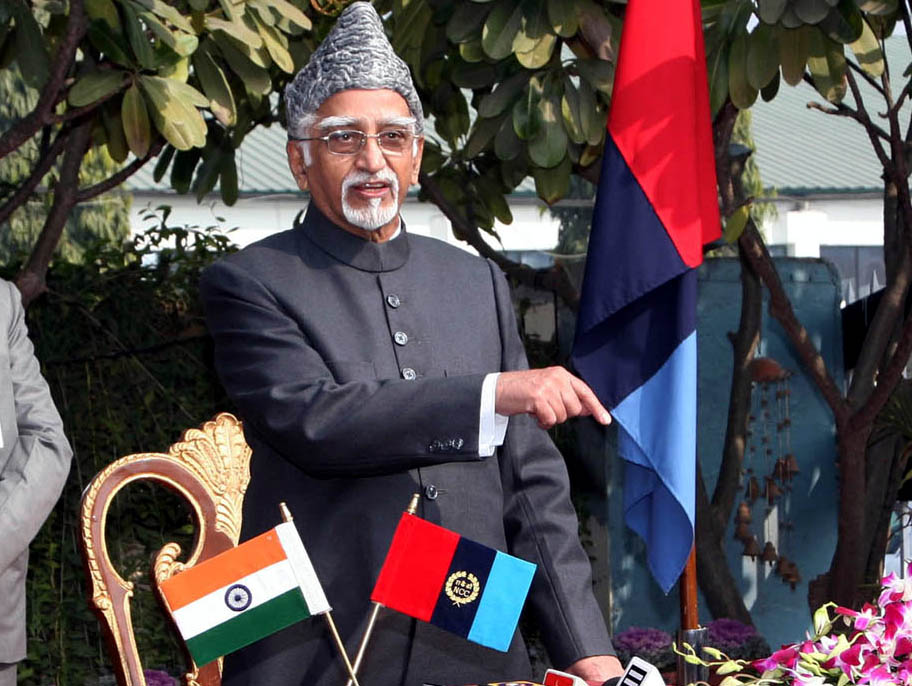
NEW DELHI, Jan 7:
Vice-President Mohd Hamid Ansari today lauded the National Cadet Corps (NCC) cadets for their emergency relief and humanitarian assistance to the people in distress during the devastating floods of Uttarakhand, last year.
Inaugurating the NCC Republic Day Camp 2014 here, Dr Ansari said the NCC had undertaken laudable initiatives for socio-economic welfare for citizens on important issues such as adult education and health care. NCC programmes for combating social evils such as drug abuse, gender discrimination, dowry and corruption and its efforts for environmental conservation and protection were commendable, Dr Ansari said.
The Vice-President complimented the efforts of NCC, the largest uniformed organisation in grooming the youth of the country and its contribution towards ‘Nation Building’.
“NCC was the vanguard of all activities of our youth helping to channelise their energies to a creative force in order to usher in social changes through spectrum of activities. The NCC cadets should avail their training and turn out to be more responsible and empowered citizens.
Earlier, the Vice-President was received by the Director General NCC, Lt Gen Aniruddha Chakravarty.
A contingent of smartly turned out NCC cadets drawn from all the three wings of Army, Navy and Air Force, presented a ‘Guard of Honour’ to the Vice-President on his arrival.
This was followed by a Band Display presented by NCC cadets from Scindia School Gwalior and North Eastern Region. The Vice-President also visited the Flag Area where he listened to the young cadets briefing about their respective States and appreciated the various social themes displayed in the Flag Areas prepared by them.
This year, 2070 Cadets including 702 girl cadets drawn from 17 NCC Directorates covering all the States and Union Territories of the Country are participating in this camp which will culminate on the Prime Minister’s Rally on January 28 2014.
The cadets attending the camp will be participating in a number of activities like Cultural Programme, National Integration Awareness and Institutional Training Competitions. (UNI)
Adarsh Housing scam: Ashok Chavan writes to Maharashtra CM
MUMBAI, Jan 7:
Former Maharashtra Chief Minister Ashok Chavan has written to Prithviraj Chavan and the state Chief Secretary, claiming that the Adarsh inquiry Commission report does not do him justice and is against the principles of natural justice.
Sources close to Ashok Chavan said that in the letter, he has objected to the Commission reneging on its assurance to hear his side of the story.
“The report is bad and great injustice has been done to me. Before indicting me, the Commission did not hear my contention. This, despite it being specifically brought to its notice that if it was passing strictures against me, then as per section 8 of the Commissions Of Inquiry Act, I should have been heard,” the sources quoted Ashok Chavan as saying in the letter to the Chief Minister and Chief Secretary J S Saharia.
“The concerned were aware that as per the Act, if the reputation of a person is likely to be prejudicially affected by an inquiry, the commission shall give him a reasonable opportunity of being heard and produce evidence in his defence,” the sources said.
“The Government will take note of the letter. It has also received representations from a section of bureaucrats indicted by the inquiry Commission,” a Mantralaya official said.
In its report, the Commission observed that while Ashok Chavan cannot be said to have favoured or obliged the Adarsh Co-operative Housing Society by allowing civilians to become members, his approval of non-deduction of 15 per cent recreational ground while calculating FSI cannot be treated as an innocent act.
“We are not concerned with the legality or otherwise of the said decision. It may be legal and justifiable…However, this decision when followed by the grant of membership and allotment of flats to his close relatives becomes indicative of quid pro quo,” the Commission said in its report.
Sources close to Ashok Chavan said, “There is no connection between him and the then state government’s decision to reduce the width of the proposed 60.97-metre Captain Prakash Pethe Marg near the Adarsh Society. It was entirely an urban development department related matter and there was no role of Ashok Chavan as the then Revenue minister.”
The Maharashtra Government had, on December 20, rejected the Commission’s report on the Adarsh scam, tabled in the State Legislative Assembly.
However, after Rahul Gandhi’s intervention the Government this month decided to partially implement the panel’s recommendations, which the Opposition has alleged, favours politicians while putting the onus only on bureaucrats.
The report of the two-member Commission headed by retired High Court judge J A Patil indicted several politicians including four former Chief Ministers- Ashok Chavan, late Vilasrao Deshmukh, Sushilkumar Shinde and Shivajirao Nilangekar Patil- for “blatant violations” of statutory provisions. (PTI)
Maharashtra face Mumbai in state Derby fight for semis
Mumbai, Jan 7: Group toppers Maharashtra will play defending champions Mumbai, who barely made it to the knock-out stage, in the five-day quater-final of the Ranji Trophy that promises to be a keen fight at the Wankhede Stadium, starting here tomorrow.
While Maharashtra advanced to the elimination phase by finishing on top of Group C, 40-time champions Mumbai staged a grand comeback from the brink in Group A after conceding a 99-run first innings lead to Gujarat in their final league game before winning outright to qualify for the quarter-final.
All these facts would be confined to the dustbin when the two arch-rivals meet in what is considered to be the Maharashtra state version of the well-known ‘War of Roses’ between Lancashire and Yorkshire in English county cricket.
Though the visitors from across the Sahyadri ranges topped their group that consisted of the championship’s weakest teams, they would find Mumbai – bolstered by the return of veteran pacer Zaheer Khan and all-rounder Abhishek Nayar – a tough nut to crack in the latter’s backyard.
Zaheer, who will lead the hosts, is available for this game after missing a few earlier when he was with the Indian team in South Africa and his mere presence would lift the Mumbai bowling attack on a track that generally has bounce and assists pacers for the first couple of days.
Maharashtra’s leading batsmen – opener Harshad Khadiwale, Kedar Jadhav, Ankit Bawne, captain and wicket keeper Rohit Motwane and India’s under-19 Asia cup-winning skipper Vijay Zol – would have their hands full against the home side attack that has been lifted by the selection of experienced left-arm spinner Iqbal Abdulla.
It was Abdulla’s 11-wicket (6 for 42 and 5 for 44) haul that dashed Gujarat’s hopes at Valsad. He will have support from Mumbai’s top wicket taker of the season, Vishal Dabholkar (38 wickets), who also bowls slow left-arm orthodox stuff.
The welcome news for Maharashtra is that Zol, who cracked a hundred earlier in the season and a match-winning hundred against Pakistan in the Asia Cup final at Sharjah last week, has recovered from his groin niggle and is fit to play. (PTI)
Babus facing graft charge to get copy of UPSC advice
NEW DELHI, Jan 7:
Officers facing corruption charges will now be mandatorily given a copy of the advice tendered by Union Public Service Commission to disciplinary authorities, before a final decision is taken against them.
Earlier, the UPSC, which is consulted in corruption cases against officers of All India Services (IAS, IPS and IFS), Group A categories and other such personnel recruited by them, was directly giving its advice to disciplinary authorities.
As per the new rules, on receiving the inquiry report, the Disciplinary Authority (DA) may examine it and forward it to the UPSC with its observations.
On receiving the Commission’s report, the DA will examine it and forward it to the charged officer along with the inquiry report and his tentative reasons for disagreement with the inquiry report and/or the advice of the UPSC.
The charged officer would be required to submit, if he so desires, his written representation or submission to the DA within 15 days, irrespective of whether the inquiry report or advice of UPSC is in his favour or not, the rules said.
The Disciplinary Authority would consider the representation of the charged officer and take further action, they said.
“A copy of the advice of UPSC, in all cases where the Commission is consulted, may be provided to the charged officer,” the Ministry of Personnel said in a directive issued to all central government departments yesterday.
All cases, where final orders have not been issued, may be processed as per these (new) guidelines, it said.
As per the existing procedure, the inquiry officer would give his report to the disciplinary authority, which would send its copy along with tentative reasons for disagreement with findings of inquiry, if any, to the charged officer.
The charged officer would then give his representation to the DA, which would send inquiry report and representation of the charged officer to the UPSC for advice. The Commission would then give its advice against the delinquent officer to the DA, which would issue a final order against him.
However, as per the new rules, the DA would send enquiry report to the UPSC, based on which, the Commission would give its advice to the DA.
The disciplinary authority would then give copies of the inquiry report and UPSC’s advice to the officer. The officer would give a copy of his representation to the DA which would then issue a final order.
The new rules were formed after the Centre found that the manner of communication of the advice of the UPSC to the delinquent government servant had been subject matter of litigation in some cases in Central Administrative Tribunal (CAT) and High Courts. (PTI)
India successfully test- fires Prithvi-II missile
BALASORE (ODISHA), Jan 7:
India today successfully test-fired its indigenously developed nuclear-capable Prithvi-II missile, which has a strike range of 350 kms and is capable of carrying warheads of upto 1000 kgs, from a test range in Odisha.
The launch was part of a user trial by the Army.
Describing the trial of the sophisticated missile as a “complete success”, Integrated Test Range Director M V K V Prasad said the launch conducted by the specially formed Strategic Forces Command (SFC) met all the parameters.
The surface-to-surface missile was test fired from a mobile launcher in salvo mode from launch complex-3 of the ITR at Chandipur near here at about 0948 hrs.
“The missile was randomly chosen from the production stock and the entire launch activities were carried out by SFC and monitored by the scientists of Defence Research and Development Organisation (DRDO) as part of training exercise,” sources said.
“The missile trajectory was tracked by DRDO radars, electro-optical tracking systems and telemetry stations located along the coast of Odisha,” they said.
“The downrange teams onboard the ship deployed near the designated impact point in the Bay of Bengal monitored the terminal events and splashdown,” they said.
Inducted into India’s SFC in 2003, Prithvi II, the first missile to be developed by DRDO under India’s prestigious IGMDP (Integrated Guided Missile Development Program) is now a proven technology, a defence source said.
“The launch was part of a regular training exercise of SFC and monitored by DRDO scientists,” the source said.
Such training launches clearly indicate India’s operational readiness to meet any eventuality and also establishes the reliability of this deterrent component of India’s Strategic arsenal, the source said.
Prithvi is capable of carrying 500 kg to 1,000 kg of warheads and is thrusted by liquid propulsion twine engines.
The last user trial of Prithvi-II missile was successfully carried out from the same base on December 3, 2013. (PTI)
Pune FC face Mumbai Tigers in U 19 I-League opener
Pune, Jan 7: Two-time defending champions Pune FC will open their campaign against Mumbai Tigers FC in the Under-19 I-League here, starting on January 14.
Pune FC goes into the tournament looking for a hat-trick of wins after emerging at the top of the heap in the last two editions of the competition in Kalyani (2012) and Jamshedpur (2013), respectively.
Clubbed in the five-team Maharashtra-zone, Pune FC Under-19s — comprising the second batch of the Peninsula Pune Football Club Academy (PPFCA) players — will be up against U-19 teams of Mumbai FC, Kenkre FC, PIFA Colaba FC and AIFF Navi Mumbai Academy, apart from Mumbai Tigers.
Post expansion, the U-19 I-League will be played in a new format and will have 29 teams contesting for top honours in a two-tier run to the title.
The five zones include, Kolkata, Mumbai, Shillong, Goa and Rest of India.
The four city-named zones will engage themselves in a home-away format with the winner advancing to the final leg to be held in Jamshedpur. The Rest of India zone will play a single-leg in Jamshedpur with the top two advancing.
The final leg of the tournament, which would feature six teams, is scheduled in mid-April in Jamshedpur and will be played on a single-leg. (PTI)
Karnataka look to continue winning streak
Bangalore, Jan 7: Riding high on their five consecutive victories, Karnataka will be looking to continue their winning streak when they take on Uttar Pradesh in the quarterfinals of the Ranji Trophy at Chinnaswamy Stadium here tomorrow.
Karnataka have been on a roll as never before, as they scripted five outright victories in a row this season in the league stage. The most unforgettable one was against traditional rivals Mumbai, whom they beat by 160-run margin.
The host captain Vinay Kumar would undoubtedly be hoping to take full advantage of playing in home conditions and give a hard time to the visitors, who have senior pros in their ranks like India discards — Mohammad Kaif, Piyush Chawla, Praveen Kumar and RP Singh.
Vinay might be disappointed with the absence of in-form all-rounder Stuart Binny due to his inclusion in India’s ODI squad for New Zealand tour, but must be relieved to have Robin Uthappa back in the side, having recovered from hamstring injury.
The swashbuckling Uthappa will replace Mayank Agarwal, who has been in good form. The Karnataka opener will be missing the quarterfinals as he is being named in Karnataka’s U-25 squad for the CK Nayudu Trophy quarterfinal against Himachal Pradesh in Dharamsala from January 5.
Left-arm spinner KP Appanna will return to the squad after he was rested in the previous match against Delhi, which Karnataka won by eight wickets to finish the league stage with five consecutive victories.
Karnataka have a formidable batting line-up.
Almost all the top order batsmen have put their hands up when others had failed to make any impression. Lokesh Rahul, Manish Pandey, Ganesh Satish and CM Gautam, all of them have been among runs. Especially, Rahul has been the real force behind the home side’s batting with 777 runs under his belt after cracking two centuries and three half centuries.
Karun Nair, who blasted a ton on debut, 105 against Delhi in the last match, could give match-less Uthappa a much needed confidence at the other end. Form of Pandey, Satish and Gautam, in the middle order will not be a cause of concern for Vinay ahead of the match. (PTI)