

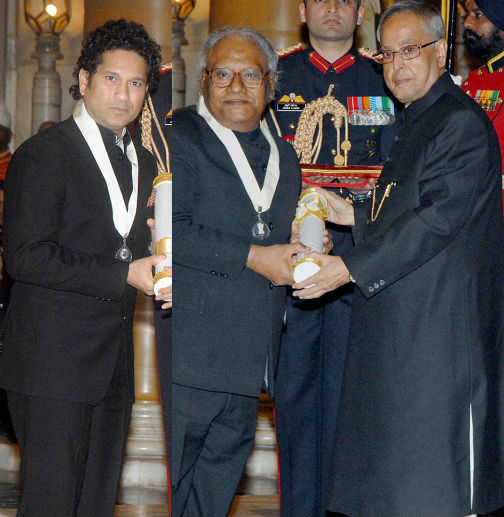
President Pranab Mukherjee conferring Bharat Ratna Award – 2014 to cricketer Sachin Tendulkar and Prof CNR Rao at Rashtrapati Bhavan in New Delhi on Tuesday. (UNI)
President Pranab Mukherjee conferring Bharat Ratna Award – 2014 to cricketer Sachin Tendulkar and Prof CNR Rao at Rashtrapati Bhavan in New Delhi on Tuesday. (UNI)
EPFO meet today to make Rs 1,000 monthly pension a reality
NEW DELHI, Feb 4: Trustees of Retirement fund body EPFO will decide tomorrow on amending the scheme to provide a minimum monthly pension of Rs 1,000, which will immediately benefit about its 28 lakh pensioners.
The Central Board of Trustees (CBT), the apex decision making body of EPFO, will also decide on amending EPF scheme 1952 to raise the monthly wage ceiling to Rs 15,000 to cover more workers under its various social security programmes like Employees’ Provident Fund (EPF)Scheme 1952, Employees’ Pension Scheme 1995 (EPS-95) and Employees’ Deposit Linked Insurance (EDLI) Scheme 1976.
At present, workers getting basic wages, including basic pay and DA, of up to Rs 6,500 are covered under the ambit of Employees’ Provident Fund Organisation (EPFO).
According to EPFO, the Finance Ministry has already approved the Labour Ministry’s proposals for entitlement of minimum monthly pension of Rs 1,000 and enhancing wage ceiling to Rs 15,000 per month.
The Government would have to provide an additional amount of Rs 1,217 crore to ensure the minimum pension of Rs 1,000 starting 2014-15. Pensioners are, therefore, expected to get benefit with effect from April 1 this year.
As per the agenda listed for the meeting, the trustees would meet on February 5 to approve the amendment in schemes run by EPFO to operationalise the two decisions.
The Central Board of Trustees (CBT), the apex decision making body of EPFO, had earlier approved the two proposals, following which the Labour Ministry pursued it with the Finance Ministry.
According to sources, after the nod given by the CBT, headed by the Labour Minister Oscar Fernandes, the two proposals would be put before the Union Cabinet for approval as the Government would have to make provision of funds for the purpose.
The move to ensure Rs 1,000 minimum pension under EPS-95 will immediately benefit about 28 lakh pensioners including five lakh widows. There are about 44 Lakh pensioners.
The other proposal for raising wage ceiling under EPF Scheme from Rs 6,500 to Rs 15,000 is expected to bring in 50 lakh more workers under the ambit of schemes run by EPFO.
Besides, the trustee would also consider a proposal to raise the retirement age of organised sector workers to 60 years under EPS-95.
At present, under EPS-95, the EPFO subscribers cease to be a member of the pension scheme after attaining the age of 58 years and can apply for fixation of his/her pension thereafter.
However, there is no age bar for contributing to the EPF and EDLI schemes run by the EPFO.
The CBT is also expected to deliberate on a proposal to withdraw two years bonus under the pension scheme provided to subscribers after rendering 20 years of pensionable service.
The Finance Ministry in its memorandum to Labour Ministry has proposed these amendments in the EPS-95 after giving its concurrence for providing a minimum entitlement of Rs 1,000 minimum monthly pension under the scheme.
The Finance Ministry is of the view that raising the retirement age for this purpose will help subscribers accumulate a bigger corpus while delaying the pay-out by two years.
Besides, the trustees will also consider the proposal for changing the methodology of computing the pensionable salary.
It is proposed to calculate pensionable salary on the basis of average salary of last 60 months instead of 12 months presently.
The pensionable salary is used for fixing pension of the EPFO subscribers after attaining the age of 58 years. (PTI)
Govt asks states to implement SC order on death row convicts
NEW DELHI, Feb 4: The Centre today directed all states to take “urgent suitable action” in implementing the Supreme Court’s guidelines for safeguarding the interest of the death row convicts.
In a communication, the Home Ministry said the court had examined several individual death row cases and commuted capital punishment of the petitioners to life imprisonment.
“You are requested to take urgent suitable action for implementing the orders of the Supreme Court in your state/ Union Territories,” Joint Secretary in the Home Ministry S Suresh Kumar said in the communication accessed by reporters.
The Ministry said the apex court had said legal aid should be provided to the convicts at all stages even after the rejection of mercy petition.
Hence, Superintendents of Jail are directed to intimate the rejection of mercy petitions to the nearest legal aid centre apart from intimating the convicts.
It said the convict has a constitutional right under Article 72 of the Constitution to make a mercy petition and hence the rejection of the mercy plea by the President should forthwith be communicated to the convict and his family in writing.
It would be mandatory for prison authorities to facilitate and allow a final meeting between the prisoner and his family and friends prior to his execution.
Following the hanging of Parliament attack case convict Afzal Guru about a year ago, his family members had complained that they were not informed in advance about his scheduled execution at Tihar Jail in Delhi.
The family had said they received the information only after his hanging, that too through the media.
Facing flak, the Home Ministry had claimed that they sent a letter to Guru’s family in Kashmir through SpeedPost which the family received a few days after his execution.
Quoting the January 21 Supreme Court verdict, the Home Ministry said death row convicts were entitled to receive a copy of the rejection of the mercy petition by the President and the Governor.
It said solitary or single cell confinement prior to rejection of the mercy petition by the President is unconstitutional. Even though prison manuals of the states do have necessary rules, the court felt that the rules should not be interpreted to run counter to its ruling and violate Article 21 of the Constitution.
As and when a mercy petition is received or communicated by the state Government after its rejection by the Governor, all necessary materials such as police records, judgements of the trial court, high court and the Supreme Court and all other connected documents should be called at once fixing a time limit without fail for rendering the same to the Home Ministry in one go and not in a piece-meal manner.
As a convict has a constitutional right under Article 161 to make a mercy petition to the Governor, he is entitled to be informed in writing of the decision on that mercy petition.
The rejection of the mercy petition by the Governor should forthwith be communicated to the convict and his family in writing or through some other available mode of communication.
A minimum period of 14 days was stipulated by the Supreme Court between the receipt of the communication of the rejection of the mercy petition and the scheduled date of execution. This is to enable the convict to prepare himself and settle his affairs and meet his family members for one last time or to avail any judicial remedy.
As it is quite possible that some death row convicts might lose their mental balance, there should be regular mental health evaluation and appropriate medical care should be given to those in need, the Ministry said.
After the execution warrant is issued, the prison superintendent should satisfy himself on the basis of medical reports by Government doctors and psychiatrists that the prisoner is in a fit physical and mental condition to be executed.
If the superintendent is of the opinion that the prisoner is not fit, he should forthwith stop the execution and produce the prisoner before a medical board for a comprehensive evaluation and shall forward the report of the same to the state Government for further action.
Death row convicts should be provided with copies of relevant documents within a week of conviction by the prison authorities to assist in making mercy petition and petitioning the courts.
After the execution of death penalty, post-mortem would need to be mandatorily performed to ascertain the exact cause of death, it said. (PTI)
ustice Mathur to head 7th Central Pay Commission
NEW DELHI, Feb 4: Prime Minister Manmohan Singh has approved composition of the 7th Pay Commission, which will revise the salaries of over 50 lakh Central Government employees.
“The Prime Minister has approved the composition of the 7th Central Pay Commission,” the Finance Ministry said in a statement today.
Former Supreme Court Justice Ashok Kumar Mathur has been appointed as chairman of the Commission, with Oil Secretary Vivek Rae as full time Member.
Rathin Roy (Director, NIPFP) will be part-time Member and Meena Agarwal (OSD, Department of Expenditure) its Secretary.
Earlier in September 2013, the Prime Minister had approved setting up of the 7th Pay Commission.
The Commission has been mandated to submit its report in two years time and its recommendations would be implemented from January 1, 2016.
The setting up of the Commission, whose recommendations will benefit about 50 lakh Central Government employees, including those in defence and railways, and about 30 lakh pensioners, comes ahead of the general elections.
The Government constitutes Pay Commission almost every ten years to revise the pay scales of its employees and often these are adopted by states after some modification.
The sixth Pay Commission was implemented with effect from January 1,2006, the fifth from January 1, 1996 and fourth from January 1, 1986. (PTI)
Sachin, Prof C N R Rao given Bharat Ratna
NEW DELHI, Feb 3: Legendary cricketer Sachin Tendulkar and eminent scientist Prof C N R Rao were today conferred with the country’s highest civilian honour Bharat Ratna by President Pranab Mukherjee.
The President presented the honours at a brief function at Rashtrapati Bhavan’s Durbar Hall attended by Vice President Hamid Ansari, Union ministers, Sachin’s wife Anjali, daughter Sara and a host of dignitaries.
Master batsman Tendulkar, who retired from international cricket on November 16 last year, is the first sportsman to bestowed with the honour.
Tendulkar (40) and Rao (79), both of whom are recipients of Padma Vibhushan — the country’s second highest civilian honour, will join a list of 41 eminent personalities who have been conferred with the award that is given in recognition of exceptional service of the highest order since it was instituted in 1954.
In a fitting finale to a record-breaking career spanning 24 years, Tendulkar, a former India Captain, was chosen for the prestigious award, after his farewell 200th Test against the West Indies in Mumbai on November 16, 2013.
An official statement had said Tendulkar has been a true Ambassador of India in the world of sports and his achievements in cricket are unparallelled, the records set by him unmatched, and the spirit of sportsmanship displayed by him exemplary.
“That he has been honoured with several awards is testimony to his extraordinary brilliance as a sportsman,” it said, noting that Tendulkar has played cricket across the world and won laurels for the country during the last 24 years since a young age of 16.
An outspoken scientist, Prof Chintamani Nagesa Ramachandra Rao is a well recognized international authority on solid state and materials chemistry who has published over 1,400 research papers and 45 books.
He is the third scientist after C V Raman and former President A P J Abdul Kalam to be conferred with the Bharat Ratna.
Prof Rao’s contributions have been recognized by most major scientific academies around the world through conferment of memberships and fellowships and has been honoured with several national and international awards, the official announcement said.
He currently serves as the Head of the Scientific Advisory Council to the Prime Minister of India.
The Bharat Ratna was announced after a gap of four years with Hindustani music doyen Bhimsen Joshi being the last recipient in 2009. (PTI)
Justice Mathur to head 7th Central Pay Commission
NEW DELHI, Feb 4: Former Supreme Court Judge Ashok Kumar Mathur will head the 7th Pay Commission, which will revise salaries of over 50 lakh Central Government employees and remuneration of 30 lakh pensioners.
“The Prime Minister has approved the composition of the 7th Central Pay Commission,” the Finance Ministry said in a statement today.
The announcement for composition of the Commission comes ahead of imposition of model conduct which would come into force once the schedule for the general election due in April-May is notified.
The Retired Supreme Court Judge, who had also headed the Armed Forces Tribunal, has been appointed chairman of the Commission.
The Commission has been mandated to submit its report in two years time and its recommendations would be implemented from January 1, 2016.
The other members of the Commission, include, Oil Secretary Vivek Rae (full time Member), NIPFP Director Rathin Roy (part-time Member) and OSD in Expenditure Department Meena Agarwal (Secretary).
Earlier in September 2013, the Prime Minister had approved setting up of the 7th Pay Commission.
The recommendations of the Commission will benefit about 50 lakh Central Government employees, including those in defence and railways, and about 30 lakh pensioners.
The Government constitutes Pay Commission almost every ten years to revise the pay scales of its employees and often these are adopted by states after some modification.
The sixth Pay Commission was implemented with effect from January 1,2006, the fifth from January 1, 1996 and fourth from January 1, 1986. (PTI)
30 year later, they recall how ‘Gandhi’ was shot
NEW DELHI, Feb 4: Richard Attenborough’s Oscar- winning biopic on the Mahatma, continues to hold its magic for those involved in its making, even 30 years after it was first shot in various cities of India.
New York-based film critic Aseem Chhabra who enacted one of the “front-line” extras in the film, “Gandhi” reminisces about the cold freezing morning of Delhi in December 1980, where the film was being made.
“It was Attenborough’s hugely ambitious project and we were excited to be cast as front-line extras. We were given our costumes, white pyjama kurtas and a large group of us were bussed from Ashoka Hotel to a small railway station near Faridabad which doubled as the Sabarmati station,” Chhabra told reporters over phone.
In December 1982, as a student at Columbia’s journalism school, Chhabra said his “heart leapt out” he saw “Gandhi” at Manhattan’s Ziegfeld theatre in the company of his Indian friends.
“I worked for four days for Rs 75 a day and earned Rs 300 on the sets. But, even 30 years later, my heart still skips a beat everytime I see myself on screen, as being practically immortalised as part of this immortal classic,” said Chhabra, who now also runs the New York Indian Film Festival.
Pablo Bartholomew, Chhabra’s classmate from Delhi’s Modern School and now a renowned photographer, also recalls the “phenomenal experience,” of working for Attenborough’s film.
Bartholomew was the stills man with the second unit of the the British director Attenbourgh’s production team.
“It was great working under the likes of Attenborough. He was a true professional and wanted perfect shots. His style gave us so many things to learn on the sets, in terms of shooting a film as well as well as working with brilliant international team that he had put together for this magnum opus of his,” Bartholomew said.
The over three-hour film was shot on different locations in India, in cities like Delhi, Bombay (now Mumbai), Pune, and Patna among others.
Actor Ben Kingsly debut as the Mahatma won him an Academy Award in the best actor category, while the film won eight Oscars altogether including best picture and best director.
Fifty-something Robin Tekari in Patna still fondly recalls “playing golf with ‘Gandhi'” at the city’s colonial-era Golf Club.
“You recall the famous Koelwar Bridge scene in the film near Ara town. That time the cast and crew were staying in a famous hotel in Patna. I ran into Kingsley there (Patna), who had asked me if he and some of his crew members could play golf somewhere.
“Since, I am an old Patna Golf Club member, I arranged it for them. But, it was only when I later enquired that they told me that they were here for the film shoot. I didn’t know I was playing golf with a Gandhi. It was his first film. Who knew Kingsley then,” Robin said, with a laugh.
Bihar-resident Nath, who was present as an onlooker during a shoot in Patna said, Attenborough wanted to shoot Champaran scenes only in Champaran but ended up recreating some of the scenes in the city (Patna).
“The now famous ‘Gandhi Setu’ connecting the north and south Bihar hadn’t yet been built so it was difficult to take the huge cameras along with the crew to the other side on boat. Thus the Patna Collectorate was dressed up as Champaran Jail, where the character of C F Andrews’ is shown entering to meet Gandhi,” Nath said.
“Since they were also short on time so shooting in Patna saved time too…I saw Richard Attenborough, a quiet man instructing his crew for the shots, as a huge crowd had gathered at the Collectorate by then. But, he was a very focussed director,” he said.
According to actor Alok Nath who played freedom fighter Tyeb Mohammed in the film, the South Africa Town Hall scene was actually shot in Fergusson College in Pune.
The actor, now popular for his fatherly figure roles in films starred in the Salman Khan 1989 blockbuster ‘Maine Pyar Kiya’ which made him a household name.
The assassination scene was actually filmed at Birla Bhawan where Gandhi was shot by Nathuram Godse on January 30, 1948 while some of the indoor scenes were created at the National Spiritual Assembly of the Baha’is India headquarters here.
Teen Murti House (old name Flagstaff House) served as the Viceroy’s house in the film. In Pune, the iconic Aga Khan Palace was shown as a jail.
“After Sabarmati station shoot, the next two days, our bus took us to the Birla Bhavan. Attenborough had shot some scenes leading to Mahatma’s assassination, but due to changing weather conditions, he still needed to capture Gandhi’s walk to the prayer meeting, just before he was shot,” Chhabra added.
Theatre personality Amal Allana and her husband Nissar Allana worked in the art department for the film while filmmaker Govind Nihalani helmed the second unit as cameraman and its director.
“It was a good experience and a challenge creating and recreating the period look for possibly Atenborough’s most ambitious film ever,” Amal said. (PTI)
Graft cases: Par panel supports protection for ex babus
NEW DELHI, Feb 4: Endorsing a move to provide certain shield to retired bureaucrats, a Parliamentary Committee proposes to support a provision in an anti-corruption bill which makes it mandatory for an investigating agency to seek prior permission from the Government before questioning them.
“The Committee is in agreement with the provision of the Bill extending the protection to the honest public servant who ceased to be Government servant for the bonafide omission/commission during their term in office,” says the draft report of the Parliamentary Committee on Law and Personnel on the Prevention of Corruption Act (Amendment) Bill, 2013.
The committee is expected to consider the report for adoption in a couple of days.
According to the Bill, an investigating agency may have to seek prior permission from the Government before questioning a retired bureaucrat in a corruption case.
The provision is aimed at protecting retired bureaucrats from frivilous complaints.
At present, there is no legal provision for investigating agencies to seek prior permissions to quiz a former Government employee.
The changes in the Prevention of Corruption Act will have a bearing on Delhi Special Police Establishment Act which governs the functioning of CBI.
Prior sanction of competent authority is proposed to safeguard public servants from the vexatious prosecution after their retirement or remittance of office in the bona fide omission or commission in the discharge of their official duty, the Bill says.
As per rules, probe agencies like CBI and others have to seek prior permission to launch investigation against an officer of the level of Joint Secretary and above.
The amended bill fixes a time-frame of three months for the Government to decide on a probe agency’s request seeking sanction for prosecution against Government officials.
An additional one month may also be given in case the Government needs to consult the Attorney General or the Advocate General.
Congress Vice-President Rahul Gandhi has been pushing the passage of six anti-corruption bills as part of a “framework” for fighting graft. (PTI)
Parties favour raising expense limit for LS polls
NEW DELHI, Feb 4: Most political parties today favoured raising the ceiling for Lok Sabha election expenditure, arguing that steep inflation has made the current slab of Rs 16-40 lakhs infeasible.
The meeting called by the Election Commission to take views of the parties before it comes out with details also saw most political parties opposing any move to bring election manifestos under the Model Code of Conduct.
“BJP is for taking into account the rising cost of everything over the years,” party leader Mukhtar Abbas Naqvi told reporters after the meeting.
CPM, JD(U) and other regional parties also pushed for the raising the expenditure cap. Though Congress representatives, who attended the meeting were not available for comment, sources said they spoke in support of raising the cap.
“You look at it this way. One Lok Sabha seat has on average five Assembly seats and the limit for Assembly poll expenditure is Rs 16 lakh. So there should be an increase,” Javed Raza of JD(U) said. CPM also supported appropriate increase.
However, Aam Aadmi Party said it was happy with the current limits.
“We kept our expenditure in Delhi Assembly polls under limit. We did well. We think the expenditure slab for Lok Sabha polls is appropriate and political parties can fight elections adhering to the limit,” Pankaj Gupta of AAP said.
BJP urged the commission to complete elections in as few phases as possible and argued against holding polls in May in big states like UP and Bihar where weather would become very hot. It will result in low polling percentage and hurt the EC’s campaign for higher turnout, Naqvi said.
Many parties like BJP and JD(U) were also against including manifestos in the Model Code of Conduct while CPI said freebies should be banned as they are nothing but allurement for voters. (PTI)
Lokpal panel: BJP opposes PM’s proposal to make P P Rao member
NEW DELHI, Feb 4: The Government and the opposition are heading for yet another face-off over constitution of the selection panel for the maiden Lokpal, with BJP opposing the Prime Minister’s proposal to appoint senior lawyer P P Rao as its fifth member.
In the turn of events reminiscent of BJP’s opposition to the appointment of P J Thomas as Chief Vigilance Commissioner two years ago, Leader of Opposition in Lok Sabha Sushma Swaraj refused to back the Government nominee in the category of eminent jurist in the Lokpal panel and registered her dissent during the proceedings of the meeting last night, sources said.
Swaraj was outvoted with three votes going in favour of the Government nominee in the meeting at Prime Minister Manmohan Singh’s residence to select the fifth member of the panel, they said.
The Leader of Opposition had opposed Rao’s name, saying he has been a “Congress loyalist” and instead proposed the name of former Attorney General K Parasaran.
She demanded that the panel should be “free from such people” and said it should have “apolitical people” and should not be made a “captive body”, according to the sources.
Sources close to her said Swaraj had said that since this is the first time the anti-corruption ombudsman was being appointed in the country, there should be unanimity on the appointments.
She is believed to have suggested the names of eminent jurists Fali Nariman and Harish Salve for the key panel and even said to bring unanimity in the decision, another meeting could be held and a fresh list of names be worked out.
The sources said despite her opposition, the other three members of the Selection Committee – the Prime Minister, Lok Sabha Speaker Meira Kumar and Supreme Court judge H L Dattu, who has been nominated by Chief Justice of India P Sathasivam, gave a go-ahead to Rao’s membership.
This is the second time that the Government and the opposition are headed for a showdown on the issue of a key appointment. The Leader of Opposition had earlier vehemently opposed the appointment of P J Thomas, a bureaucrat, as CVC but the Government went ahead with the appointment. He was later removed after the Supreme Court’s intervention.
The five-member Selection Committee will appoint the chairman and members of the anti-corruption body Lokpal.
The Centre has sought nomination of eligible candidates for appointing the chairperson and eight members of the Lokpal. The last date of sending nomination is February 7.
Of the eight posts for members in the Lokpal, four are for judicial side while the remaining will be for non-judicial work.
The chairperson and members shall be appointed by the President after obtaining the recommendations of the selection panel.
The Lokpal and Lokayuktas Act, 2013, provides for the establishment of a Lokpal for the Union and Lokayuktas for the states to inquire into allegations of corruption against public functionaries. (PTI)