

LOS ANGELES, June 17: Director Cameron Crowe is reportedly developing his first TV series centring around a fictional US rock band’s tour.
The ‘Almost Famous’ filmmaker is preparing for his first foray into the small screen with an ensemble comedy titled ‘Roadies’, reported USA Today.
Crowe, who created the series and is producing the programme with JJ Abrams’ production company Bad Robot, is also slated to direct the pilot.
The Oscar winner is currently wrapping up an as-yet-untitled romantic comedy starring Bradley Cooper and Emma Stone, which is set to hit cinemas by the end of the year. (PTI)
Cameron Crowe developing music comedy TV series
Fatal road accidents
Sir,
Untimely death of 17 persons and injuries to many others due to bus accident at Ramban on May 20 at midnight, once again subjected many families to bereavement. Neither the driver concerned nor the agencies regulating transport activities can be exonerated for such ghastly acts. Moral responsibility gets tarnished when drivers involved in such accidents go absconding as has happened in this case.
Remaining sleepless when whole universe sleeps, is contrary to the nature and what is against the nature can’t be good for the mankind. The Govt’s gesture of sympathy by extending financial help etc are indeed praiseworthy, but un-regulated traffic scenario is highly tragic.
Accidents have become a cause of concern, and therefore, shifting responsibility to curb such incidents is unjustifiable. Special monitoring cells to control night traffic can minimise such situations. Hope, the Govt would do the needful to avoid recurrences of such nature.
Yours etc…
Keshwa Nand Sharma
Salehri (Sunderbani)
DIG Doda, Ashkoor Ahmed Wani felicitating winner during National Wrestling championship in Doda.
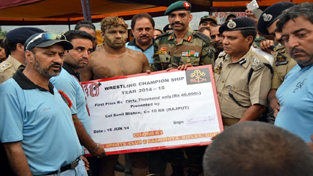
DIG Doda, Ashkoor Ahmed Wani felicitating winner during National Wrestling championship in Doda.
Release G P Funds
Sir,
The G.P. Fund-General Provident Fund is a mandatory subscription Fund and is hard earned money of an employee subscribed towards G P Fund Account on monthly basis towards the said fund. An employee saves the G P Fund for various purposes and needs such for education of children, Yagneopavit Ceremony, repair of house and God forbid for illness and various other unforeseen contingencies.
Many employees have applied for withdrawal of the GP Fund but unfortunately the treasuries are reportedly having Financial crunch across the State and the bills pending with them are not being cleared.
Since these employees are in need of money at this time for the aforesaid purposes, it is, therefore, requested to the Finance Minister Abdul Rahim Rather to kindly direct the concerned authorities of the J&K Finance Department and Director General Accounts and Treasures etc to release the funds for G P Fund on priority basis to all the Treasuries at the State so that these employees may not suffer and the studies of their children may not hamper. Hope for an early positive action to reduce the problem, grievance faced by these G P Fund (Refundable G.P. Fund Advance) A/c Holders-the applicants in various treasuries of the State.
Yours etc..
Ashok K Koul (Lalpuri)
45 Ajiy Colony
Gole Gujaral, Jammu
Female teachers’ plea to Government
Sir,
We the regularized, female, RT and Third Teachers of J&K, want to draw kind attention of the Chief Minister Omar Abdullah Dy CM and Minister of School Education, Tara Chand Ji, and other concerned officials towards the plight of our social, familial and marital lives.
We are facing immense stress and strain as we are not able to do justice to our familial and marital obligations because most of us are married outside our places of residence. We are not able to be present in our inlaws/husband’s homes because of our postings, which again gives us a sense of being homelessness after marriage.
We as female members of our families have also to work as a mother, daughter in law and a spouse, and we have to be more responsible towards our families than our male counterparts, as it is the woman who makes a home and looks after its daily chores.
Due to the nature of our postings, we are not able to do justice to the upbringing of our wards and the lookafter of our aged inlaws. It is worthwhile to mention that many of us get deprived of an immediate familyhood status, which again is a very serious concern matter.
All these things lead and result in a stressfull and unpleasant situations in our familial lives and lead to further deterioration and divisions in one’s family life.
We humbly request all the aforementioned, to please for the sake of longlasting survival of our domestic lives frame such a transfer policy for such female married Regularised RT Teachers, Third Teachers, who are married outside their villages and towns, which may allow them to serve in the areas nearer to their in-law’s homes or in the revenue villages, education zones of their inlaws.
Yuurs etc…
Shahida Bano
Bandipora, Kmr
Students enjoying activity during Summer Camp at Jodhamal School in Jammu.
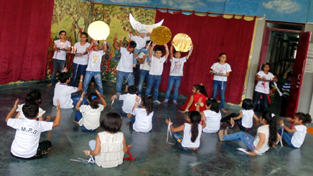
Students enjoying activity during Summer Camp at Jodhamal School in Jammu.
Shun Colonial hangover
Poonam I Kaushish
Politics is the conduct of public affairs for private advantage. This adage rang true last week when some of our jan sevaks were caught with their hands in the till. And a few enjoying a sports extravaganza at the taxpayers’ expense. All cocking a snook at Prime Minister Modi’s espousal of simplicity, efficiency and good governance, thereby underscoring their five-star culture reality!
The issue is not the six MPs and ex-MPs abusing their privileges by putting in fake travel vouchers or six Goa MLAs going to Brazil to watch the FIFA matches with taxpayers footing their Rs 90 lakhs bill. It shows the mindset: Main VIP hoon, tum kaun? Which translates in to not only living life king-size but nauseatingly flaunting it. Showcasing their power via elaborate power trappings and freebies that go with it.
Undeniably, both issues have left a bitter taste in the aam aadmi’s mouth. Already grappling with sky-rocketing prices, shrinking budgets and rising unemployment, it raises several questions: Can our poor country afford expensive legislators? Whatever happened to democracy by the people, of the people, for the people?
Sadly, yesterday’s princes have been replaced by neo-Maharajas Ministers, and MPs who are afflicted by two diseases: Acute Orwellian disorder of “some are more equal than others” and Oliver’s disease, “always asking for more”.
Shockingly, our MPs cost the tax payer Rs.1.30 lakhs per month. Their monthly pay packet: Salary Rs 50,000, office expenses Rs 40,000, constituency allowance Rs 40,000, daily allowance Rs 2000, totaling Rs 1.30 lakh all tax free. Add to this sleek iPads or tablets, pension benefits of another Rs 20,000 per month and the MP Local Area Development Scheme of Rs 5 crore.
Indeed, if sobriety begins at home, should our netagan be living in tony Lutyens’ Delhi replete with seven-star bungalows? With manicured lawns, growing wheat and vegetables, free furniture, air-conditioners, fridges and maintenance to boot, down to a tube-light, all living like Burra Sahib! Costing the tax payer an extra Rs 60 crore annually.
Think. Each house could be sold to wealthy Indians between Rs200-Rs 350 crores, cut into 1000-2000 sq yards plots and auctioned to the highest bidder thereby netting the Government thousands of crores or rented out for Rs 25-50 lakhs monthly. Bad luck, the hoi polloi, packed like sardines live in tin boxes atop each other.
Pertinently, with each State boasting of 5-7star Bhawans in Lutyens Delhi with well-anointed rooms; TV, phone, WiFi et al it would be less of a tax burden if our jan sevaks reside there during Parliament’s session and when they come to attend standing committee meetings. Alternatively, they could rent an apartment or house at their own expense like legislators worldwide. Thereby saving the Government some money.
It doesn’t end just there. Each MP is entitled to free water upto 4000 kl per annum and electricity upto 50,000 units. Beside, Rs 30,000 of furniture, 1,50,000 local calls for 3 telephones and 50,000 free local calls during a year for Internet. Down to washing of sofa covers and curtains every three months! As also a guard. Do our jan sevaks need a sepoy to protect them from their janata they profess to serve? All paid by the aam aadmi who continue to grovel outside soliciting a favour from their undata.
Not only that. Every MP can avail 34 air journeys business class during a year with spouse/companion. Alongside, two air-conditioned executive class train passes which entitles the MP/companion to travel anywhere in India. Further, he gets an Rs 4 lakh interest-free loan for buying a personal vehicle.
More. While travelling they demand high quality handling, read Maharaja treatment: Starting from Airport manager to “meet” MP, accommodate in lounge, escort to plane and cabin crew to offer “compliments of the Captain”. Manager to “monitor”, “liaise” and “ensure” flight operates on schedule, inform counterpart of MP’s seat number, baggage location and “special requirement at destination”.
On arrival, manager to receive MP at arrival gate, escort to immigration, baggage claim, customs et al. Notwithstanding, they don’t deserve this extra importance. All at our expense.
Scandalously, why and for what do our netagan need fancy pay-packets, perks galore and free travel? As also pensions once they demit public office? Considering that there is no jan seva involved that needs monetary compensation? Think each MP cost the tax payer Rs 2.12 lakhs per month and an ex-MP Rs 50,000 at least.
The moot point: Haven’t we had enough? Do they actually deserve this extra importance? Considering, most netas barely discharge their responsibilities honestly and honourably? Whatever happened to democracy by the people, of the people, for the people?
Alas, over the years we have become used to the ‘more equals’ playing havoc with the people and getting away with it. Wherein there is a wide chasm between the aam aadmi and our khaas aadmis. Leading to increasing frustration, disconnect and contempt for the leaders which results in defiance by people at large.
The tragedy is that even as the country saunters into the 21st century for our ruling neo maharajas the vestige of 19th century India still lingers on. Of which ‘follow-no-rules’ is a fundamental part instead rule by law. No IDs’, no frisking and long queues, cars jumping red lights etc to exhibit their ‘power’ might. God forbid, if anyone questions their misdemeanor be prepared for open fury.
What is required is a drastic pruning. Modi needs to cry a halt to all the financial pampering and perks to our legislators, make their incomes and salaries taxable and stop pensions to former legislators, which they don’t deserve. Isn’t it ridiculous that we are paying Rs 6 lakh per month to keep an ex-Minister “in coma” alive, in a private hospital, as his ex-MP wife refuses to take him home.
For starters our netas should follow the Japanese and French example were MPs salaries are fixed in relation to the salaries of the highest paid bureaucrats. In Germany, MPs get remuneration adequate to ensure their independence. In UK the Review Body on Senior Salaries advises the Prime Minister on the pay and pension of MPs, Ministers, judges, defence personnel and senior civil service officers. In Switzerland MPs do not get any salary or allowance; they just get paid leave from their employers on the days of Parliament’s session.
Questionably, why should not our Right Honourables emulate the example of their Swiss counterparts? They may not be employed, but most of them being crorepatis really do not need a job. Besides, since “conflict of interest” is a non-existent concept, our MPs, unlike their American counterparts who cannot earn beyond 15% outside Congress, have no limit to their earnings from all sources, as the scandal over the Office of Profit showed.
For our democracy to enter the next level of maturity we need to rethink the entire gamut of privileges and freebies. Clearly the time has come for our polity to realize that any increase in privileges is co-terminus with an increase in accountability.
Importantly, our Right Honourables need to recognize that they must deserve before they can desire. The bottom line: Stop fawning, shed the colonial hangover, callousness and make no compromises with our Right Honourables. It remains to be seen whether our polity will continue to live life Maharaja-size and reduce hum-toh-janata-ke-sevak-hain to mere tokenism? INFA
Opening of new colleges
Prof Ravinder Chadha
Australia, Brazil, Great Britain, France and many other western countries are making huge investment up to the tune of even ten percent of their annual budget on education sector with a motive to derive rich dividend in future from this potential industry. But they make investment sensibly keeping in view the scope and trend of the market requirements with changing times. In fact, higher education has become a commercialised sector where qualitative productivity alone can survive and gain in this highly competitive world. So, political decisions without taking care of intellectual and economic benefits would amount to throwing money in the dustbin. Once the glory and image of higher learning institutes are lost, it is quite difficult to re-establish it.
The J&K Government recently announced the opening of seven new colleges without appreciating the need of quality education for student community and market requirements. The Government may feel elevated in explaining that it has made colleges accessible to students of far flung areas but that doesn’t solve the problem of poor students who cannot afford to wonder desperately for jobs even after acquiring their degrees in less important subjects.
There are already ninety degree colleges functioning in J&K out of which fifty colleges came into existence after 2007.Since then these colleges are being run in two or three rooms in higher secondary schools or in private rented accommodations of similar dimensions. This is quite illogical and an unplanned approach on the part of Government that a college is opened first and then infrastructure facilities would be taken care of. The past experience speaks volumes of the callous and casual attitude of the Government towards already operational colleges that about twenty five colleges have not got their buildings since their inception and it seems unlikely that they would get these in the next five years. What to talk of structures, the space of a few colleges has yet to ear market. This has resulted in the decline in the standard of higher education in the State. If this point is gauged and realized by the Government immediately, it will help it to initiate corrective measures so as to prevent the further damage.
Already, the situation has given rise to the formation of two set of colleges. The first set comprises of established NAAC accredited A or B’ or B Category colleges and the second set is in quite contrast to the first which cannot afford to invited NAAC peer teams to get their colleges accredited for at least another ten years.
The memory of my first glimpse of GGM Science College of which I am an alumnus, is still preserved in my mind. Today, college has attained NAAC accredited A as well as heritage college status award about which the alumni of this college must be feeling elated. Can anyone and even the Government justify the existing status of two types of colleges?Usually a person hailing from village or sub-urban area has a very high image of a college.
But all his hopes and dreams are shattered, the moment he finds the colleges are being run within the premises of school. Such drawn impressions would take decades to fade away even while new college buildings are erected.
Nobody is against the opening of new colleges but the most important thing is that the existing colleges should at least satisfy the highly demanding input norms like all weather buildings with play grounds, well equipped libraries, separate toilets for boys and girls, fencing around the college boundaries, proper sports equipments, maximum students teacher ratio, availability of medical facilities and sports teacher and minimum hours of instructions. We expect institutions to be competitive at the national level if not globally. It is only then that we can judge whether students measure up to national standard or not. Recently even in existing scenario, students hailing from rural area of the State have proved their potential by competing not only in national level competitions but also in IAS competitions.
On educational platform, Government could have done more by streamlining the system and thereby putting themselves on national map. There is no dearth of resources in terms of institutions, finance and their wise and effective channelization is missing. Did any politician, bureaucrat, social worker or educationist ever thought of upgrading higher education scenario by bringing qualitative change in the colleges so that these could become nationally and globally recognized institutes.
If Government is serious about encouraging higher education sector and wants institutes to pursue their programmes vigorously to transform the whole education scenario in the State, then it should come forward with a concrete policy with a defined time framed document meticulously prepared by visionary personalities. GGM Science College and Amar Singh College have such a fine infrastructure that these colleges can be developed internationally recognized learning institutes provided Government thinks in this direction. I can offer some suggestions in this regard. Firstly, a balanced team of educational, social and political thinkers with visionary outlook and dynamic skills should take charge of managing affairs of these colleges. These are given autonomous status, thus enabling them to fulfill their needs to shape themselves as per the global requirements. The admissions to these colleges be restricted to limited number of students who possess innovative minds and competitive spirit. Introduce latest meaningful techniques of teaching to brush the talent. Though this is not spontaneously process but will definitely yield positive results within short span of time, if intentions are pure.
To boost the opening of new colleges is one aspect and consolidation of infrastructure of existing colleges is another. To my mind, if Government gives priority to second aspect that would fetch it more admiration and appreciation by all sections of the society. Politicians can learn lesson from the State of Rajasthan where people outrightly rejected the populist policy of Ashok Gehlot’s Government of opening new colleges without quality education, thereby giving it humiliating defeat in the elections. We can equally see the outcome of Lok Sabha elections in our State in which especially youth have not favored the populist policies of the ruling alliance but I am fully confident that through qualitative and job oriented education in higher education, Government will not only be able to derive political mileage by attracting youth towards itself but will also provide opportunity to students to exploit their talents in every walk of their life.
(The author is former HoD of Chemistry GCW Parade, Jammu)
Modi’s Bhutan visit
Barun Das Gupta
Prime Minister Narendra Modi has proved his diplomatic mettle in his first foreign trip to Bhutan by restoring trust in the tiny Himalayan kingdom about Indian sincerity in protecting the interests of that country. Modi was quite candid in underlining that Bhutan can depend on India for both political and economic support and it should not feel insecure as a result of domineering attitude of China.
Prime Minister Narendra Modi’s two-day visit to Bhutan, on the invitation of King Jigme Khesar Namgyel, has to be seen in the perspective of China’s efforts for some time past, to increase its presence and influence in the tiny Himalayan kingdom as a part of its ‘string of pearls’ policy to encircle India. That explains the inclusion of the National Security Adviser in the team accompanying the PM, besides the Minister for External Affairs and the Foreign Secretary.
In a bid to make its presence felt in Bhutan, China has been asking the country to allow the opening of a diplomatic mission of China in capital Thimpu. In April, 2012, Zhou Gang, a former Chinese ambassador to Delhi, was sent to Bhutan as a special envoy of the Chinese Government. He carried a terse message from Beijing: if you want to settle the boundary dispute with us, allow us to open our mission here. At present, apart from India, only two other countries have their embassies in Thimpu – Bangladesh and Kuwait.
Bhutan has a 470 km long border with China. It is forty-four per cent of the country’s total border length. As a buffer State between India and China, Bhutan is of immense strategic importance to both the countries. Chumbi Valley which lies at the trijunction of India, Bhutan and China is 500 kms away from the so-called ‘chicken’s neck’ in north West Bengal that connects mainland India to its north-east.
Bhutan’s border dispute with China involves 4500 sq. kms of land on the northern and western parts of the kingdom. Bhutan’s total geographical area is just 38,394 sq. kms. Beijing has been demanding that Bhutan cede to China some of its territory which lies close to the Chumbi Valley in north-west Bhutan. In June last year, troops of China’s PLA entered Bhutan through the Sektang region in the east and the Pang La region in the north. The Chinese set up three posts in Bhutanese territory.
China’s border talks with Bhutan, as with India, are dragging on and on, endlessly. The 21st round of talks was held in August last year, with no sign on the part of the Chinese for a quick settlement of the dispute once for all. No one knows when the next round of talks will be held.
All these developments have been a source of constant worry for New Delhi. Prime Minister Modi’s visit has to be seen against the background of these developments. Bhutan needs India’s help and cooperation not only to accelerate the tempo of its economic development but also to insure its safety and security against its strong northern neighbour.
The Manmohan Singh Government is perceived to have taken a ‘soft’ approach to both China and Pakistan. When Dr Singh visited Bhutan in September last year, India announced a financial assistance of Rs. 4500 crore for Bhutan’s 11th Five Year Plan. In addition India also extended help of another Rs. 500 crore for a special Economic Stimulus Package (ESP).
There is immense scope for developing hydel power in Bhutan. Three hydel projects including Chukha are already supplying about 1500 MW of power to India. New Delhi is also studying the feasibility of a few more hydel projects. This includes the 540 MW Amochu project which will generate 540 MW of power. Security and environmental considerations have held up its clearance so long. But the NDA Government is expected to expedite a decision on Amochu as it has decided to clear big projects at home also. The project has been found to be technically feasible and financially viable. Bhutan’s goal is to generate and supply to India an additional 10,000 MW of hydel power by 2020.
Indo-Bhutan cooperation is going on at different levels. During his two-day stay in Bhutan, Prime Minister Modi unveiled the foundation stone of the 600 MW Kholongchu hydel project, inaugurated the new Supreme Court building and addressed a joint session of the Bhutan Parliament, besides calling on the King and holding extensive talks with his counterpart Tshering Togbay. The visit was not only a re-affirmation of India’s friendship for Bhutan but also a message to China that India’s historical bonds with Bhutan are indissoluble. Feeling insecure as she is from her northern neighbour, Bhutan needed an assurance from India that not only will her independence be respected but her territorial integrity will be defended against possible designs of her aggressive northern neighbour.
China has been trying to drive a wedge between India and Bhutan. Last August, just on the eve of the last round of border talks, a researcher at the government-controlled Shanghai Institute of International Studies wrote in the Global Times that India had manipulated the parliamentary elections in Bhutan and was treating Bhutan as its protectorate. Beijing’s anger at the outcome of the elections is quite understandable. The defeat of the overtly pro-Chinese ruling Peace and Prosperity Party put paid to Beijing’s hope of having a bigger slice of Bhutan market at India’s expense. (IPA)
Tale of neglect
Our border areas have remained backward and neglected despite tall claims of people in power. A number of developmental schemes announced and supported by the Central Government have not been executed as stipulated. Much money is wasted on unplanned projects. Politics plays the spoil sport because each MLA seeks that only his or her constituency should become the beneficiary of the developmental schemes at the cost of more needy and deserving ones.
The case in point is that during the regime of PDP led Government in 2003, the Government had announced with fanfare that the administration would make Buddhan in Mahore (District Reasi) a model village. The news brought great happiness to the local people and the expectation was that on successful completion of the project, some more villages would be lucky to be taken up as model village. Some elementary work in this connection like raising a community hall and shopping complex was done. Some solar lights were installed, some lanes and drains were constructed and promises of more developmental works were made. But in reality, the life of the model village ended there. Five years have gone by, nobody even remembers that a model village had been announced and something more had to be done about it. Today the condition of Buddhan is that the village lacks even the elementary services like health, education, road connectivity water supply and power. The Government High School with 650 students on roll is run by two teachers and the Headmaster. The Primary Health Centre is run by a medical assistant and a qualified doctor is not available in several panchayats of the area. The lone transformer supplying electric power became dysfunctional in March last and it has not been repaired even after expiry of four months. About road connectivity, the less said the better. There is no asphalted road and one can imagine the dismal condition of vehicular traffic in rainy season. Work on Thuroo-Buddhan road has been suspended for want of adequate funds. The Panchayat Ghar is incomplete and the CAPD store is in dilapidated condition. Sordid stories of deprivation and misery are told by one and all in the village and its adjoining areas. Nobody knows what happened to the Central Governments scheme called Pradhan Mantri Gramin Sadak Yojna because no trace of the project is visible anywhere in this village and around. Out of 14 solar lights installed in the so-called model village, only 2 are functional.
It is a pity that a mockery of democracy has been made in our State. Obviously, when the project of making it a model village was floated, funds were allocated for various schemes. How would the paucity of funds be there when the scheme was meticulously drawn and its blue print made? The bitter fact is that authorities discriminate against far flung rural areas and focus their attention on towns and cities only. The people in far flung and border areas have very little voice that would be heard by powers that be.
This is the condition of a so-called model village and similar is the story of other so called “Model Village” across the State. The condition of health services in border areas of our State especially in too vulnerable areas of Poonch and Rajouri districts is dismal. For miles at end, no medical assistance is available to the villagers who live close to the border and are the worst sufferers of enemy shelling. Many people have lost their lives owing to enemy shelling and many more have been crippled or maimed. Seriously wounded people have to be carried over a distance of a score of miles to arrive at a health centre where the wounded could receive some assistance if the medical practitioners are there and not on holiday. We have reports that the villagers close to Krishna Ghati, where Pakistani shelling is very frequent, are the most unfortunate victims because their wounded have to be carried at least a distance of twenty miles to find a health centre.
We would suggest that under Border development schemes, polyclinics should be provided very close to the villages that are vulnerable to enemy fire and have always been targeted. It should also be possible to build underground medical support structure just on the border line at places where there is large concentration of population.