

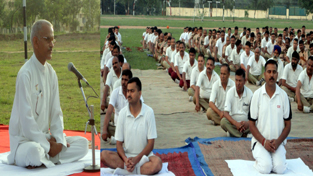
Dignitary addressing during spiritual awareness camp at Udhampur on Thursday.
Dignitary addressing during spiritual awareness camp at Udhampur on Thursday.
Balwant Thakur interacting with media persons at Jammu on Thursday.
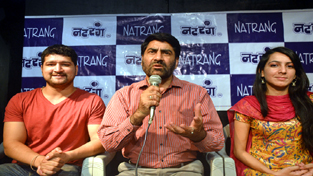
Balwant Thakur interacting with media persons at Jammu on Thursday.
Janak Raj Gupta inaugurating water supply pipeline in Christian Colony.
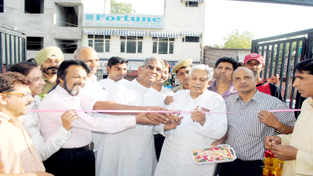
Janak Raj Gupta inaugurating water supply pipeline in Christian Colony.
Crude oil futures up by 0.28% on overseas cues
New Delhi, Jul 17 (PTI) Crude oil futures rose by 0.28 per cent to Rs 6,105 per barrel today as speculators created fresh positions amid a firm trend in Asia.
At the Multi Commodity Exchange, crude oil for delivery in July gained Rs 17, or 0.28 per cent, to Rs 6,105 per barrel, with a business turnover of 1,573 lots.
The oil for the August delivery moved up by Rs 15, or 0.25 per cent, to Rs 6,099 per barrel, with a business volume of 168 lots.
Analysts said the rise in crude oil futures was largely in tandem with a firming trend in Asia after a bullish US stockpiles report raised hopes of resurgent demand in the world’s top crude consumer.
Meanwhile, West Texas Intermediate crude oil for the August delivery advanced by 25 cents at USD 101.45, while Brent crude for September gained two cents to USD 107.19 a barrel in mid-morning trade on the New York Mercantile Exchange. (PTI)
JP Duminy of South Africa celebrating his century against Sri Lanka at Galle on Thursday.
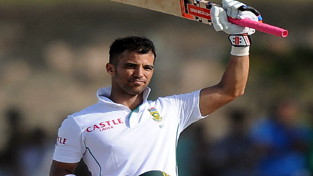
JP Duminy of South Africa celebrating his century against Sri Lanka at Galle on Thursday.
Students presenting cultural item during Sub-Regional Social Science Exhibition at KV Nagrota.

Students presenting cultural item during Sub-Regional Social Science Exhibition at KV Nagrota.
Mentha oil futures down by 1.28% on profit-booking
NEW DELHI, July 17: Mentha oil futures prices today drifted Rs 9.40 to Rs 723.80 per kg as speculators booked profits after recent gains amidst sluggish demand in spot markets.
At the Multi Commodity Exchange, mentha oil for delivery in August eased by Rs 9.40, or 1.28 per cent, to Rs 723.80 per kg in business turnover of 178 lots.
Likewise, the oil for delivery in the July traded lower by Rs 8.40, or 1.17 per cent, to Rs 709.20 per kg in 402 lots.
The fall in mentha futures prices was mostly due to profit-booking by speculators after recent gains and sluggish demand in spot markets from pharmaceutical units, analysts said. (PTI)
Cardamom futures extend gains by 0.74%
NEW DELHI, July 17: Cardamom prices rose further by Rs 6.90 to Rs 935 per kg in futures trade today as speculators created fresh positions, supported by rising demand in the spot markets.
At the Multi Commodity Exchange, cardamom for delivery in August rose Rs 6.90, or 0.74 per cent, to Rs 935 per kg in business turnover of 228 lots.
Similarly, the spice for delivery in September traded higher by Rs 5.60, or 0.61 per cent, to Rs 913 per kg in 39 lots.
Market analysts said fresh positions created by speculators following pick up in demand in the spot markets against restricted arrivals from producing regions mainly led to the rise in cardamom prices at futures trade. (PTI)
Nickel futures weaken by 0.22% on global cues
NEW DELHI, July 17: Nickel prices moved down by 0.22 per cent to Rs 1,152.90 per kg in futures trade today as participants reduced their exposures, tracking a weak trend overseas and sluggish demand from alloy-makers in the spot market.
At the Multi Commodity Exchange, nickel for delivery in July month declined by Rs 2.50, or 0.22 per cent, to Rs 1,152.90 per kg in a turnover of 538 lots.
Similarly, the metal for delivery in August traded lower by Rs 2.90 or 0.22 per cent, to Rs 1,159.20 per kg in 32 lots.
Analysts attributed the fall in nickel prices at futures trade to a weak trend in metal at the London Metal Exchange (LME) and low demand from alloy-makers at domestic spot markets also influenced prices. (PTI)
US officials hail Modi’s steps to firm up ties with neighbours
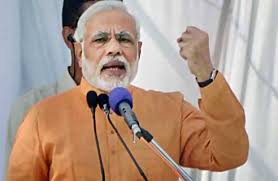
WASHINGTON, July 17: Lauding Prime Minister Narendra Modi’s steps to improve ties with SAARC countries, top US officials, eminent South Asia experts and lawmakers have said he has shown firm commitment towards strengthening India’s relations with its neighbours, including Pakistan.
“When Prime Minister Modi invited the Prime Minister of Pakistan, Nawaz Sharif, and the leaders of South Asia Association for Regional Cooperation (SAARC) countries to his inauguration ceremony, he demonstrated his firm commitment to strengthening India’s ties with its immediate region,” Assistant Secretary of State for South and Central Asia Nisha Desai Biswal told lawmakers during a Congressional hearing.
“That’s good news for India and the region, and greatly beneficial to global stability,” she said.
India, Biswal said, has a chance to take its entire neighbourhood along, enhancing prosperity and peace by boosting trade and building connectivity throughout South Asia and the Bay of Bengal region.
“That India trades much more with Europe, the United States and the Middle East than with its immediate South Asian neighbours is a global economic anomaly, one that India can help address by shaping a connectivity network between India, South Asia and the rest of the continent,” Biswal said.
“The United States welcomes the new government’s efforts to strengthen SAARC, and we were pleased to see Indian Minister of External Affairs Sushma Swaraj make her first official visit abroad to Bangladesh in late June,” she said.
Vikram Singh, a former official of the Obama Administration, said Modi has taken positive steps so far in the conduct of international affairs, starting with his invitation to all India’s neighbours, including Pakistan, to his inauguration.
“The United States will be able to engage with Modi on regional issues –- not just on stability in Afghanistan and Pakistan, but also on Nepal, Bangladesh, Sri Lanka, and the Maldives,” Singh said.
“We will be able to work with India on relations with countries from Myanmar to Japan to Australia. Modi is likely to seek a productive dynamic with China, but on the campaign trail he showed that he will be willing to stand up to China by criticising Beijing’s expansionist tendencies,” said Singh, who is currently vice president, National Security and International Policy Center for American Progress. (PTI)