

BAGHDAD, July 13: Iraqi police say gunmen have killed at least 33 people, including 29 women, in a raid on two buildings in a housing complex in Baghdad.
Police officials say the gunmen showed up in four-wheel drive vehicles before storming the buildings in the Zayounah neighborhood in eastern Baghdad. They say at least 18 people were wounded yesterday.
Police have cordoned off the area.
An Interior Ministry official and hospital officials confirmed the casualty figures.
The motive behind the killings was not immediately clear.
The officials spoke on condition of anonymity because they were not authorised to brief the media. (AGENCIES)
Gunmen kill at least 33 in raid on Baghdad complex
Withdraw Service Tax on PLI
Sir,
Refer news item “DoP follows different yardsticks..” Daily Excelsior 12
It is appreciated that the Daily Excelsior through its correspondent Nishikant Khajuria has raised an important issue that has been hurting the subscribers of Postal Life Insurance in Jammu. The 10.5 percent Service Tax which is levied from subscribers is a great injustice with them. The issue had been brought in the notice of the concerned authorities a number of times, but they did not bother to redress it to the satisfaction of subscribers. Now, when it has come to light that this tax is levied from the people of Jammu only, and not from the people of Kashmir valley it has caused great resentment among them. This discriminatory attitude of the Postal authorities is quite disturbing and condemnable. You can’t have different yardsticks for different regions of the State.
It is quite strange that the employees who want to save for the rainy day, and want handsome returns on the saved money have to shell service Tax which goes into Government coffers. This in no way is justice with people.
The Postal Department is requested to withdraw Service Tax levied harshly from people.
Yours etc….
Amit Kalsotra
Talab Tillo
Lisa Kudrow’s TV show to air this autumn
LOS ANGELES, July 13: Former ‘Fiends’ star Lisa Kudrow’s TV show ‘The Comeback’ will air in the autumn, it has been confirmed.
HBO announced that season two will begin in November, nearly 10 years after the first season aired, reported Ace Showbiz.
“It was almost too fun to play Valerie Cherish the first time around. I look forward to revisiting this resilient and ironically self-unaware character,” Kudrow said.
Producer Michael Patrick King added, “I’m so excited to be working with Valerie Cherish again. It’s great to be able to continue her story and I’m thrilled to have The Comeback come back to HBO, where it all started.”
HBO announced that it would revive ‘The Comeback’ for six all-new episodes earlier in the year.
Kudrow starred in ‘The Comeback’ as a faded television star who allowed her life to be filmed for a reality show.
It has been reported that supporting cast members Malin Akerman and Kellan Lutz will both be back for the second season. (PTI)
Non political non populist Budgets
Shiban Khaibri
It needs a strong will and a courage of fortitude to bite the bullet and 45 days Modi government has done it and demonstrated in a professional manner by presenting its maiden twin budgets – the Railways budget and the General budget for the fiscal 2014- 15. It has made a daring departure from the convention of populism and not sacrificed the basic economic variables to set right and bring on track the Indian economy. Here we should not forget Railway Minister Dinesh Trivedi from TMC in the UPA who showed elementary innovative and need based requirements to be introduced in the Railways and wanted to better the services provided to the passengers by proposing to initiate some measures including revising tariff both passenger as well as freight but was shown the door for daring to suggest stem the rot plaguing the Indian Railways. TMC Chief Mamta Bannerjee urged Dr Manmohan Singh to sack the Minister which he “faithfully” did surprising the people but exposing the motivating political weak will. In other words, it can be deduced that religiously caring for and upholding the coalition political “compulsions” became the priority of the UPA Government and that contributed a lot to get the economic mess heaped up. The travesty of the Railways remained that as many as six Ministers were posted one after the other to head it bestowing no or little time to at least arrest the mounting operational losses, let alone toiling towards expansion and modernization of the net work. It became a means of extending liberal concessions all in the name of the poor by not charging even as much as to attain a break even point in operating costs and “absorbing” the difference of cost of fuel and the chargeable fares. UPA1 and UPA2 are on record to have succumbed to populist vote catching measures at the cost of the health of the economy, Railways being at the top. The economic sink and a dismal fiscal situation, a contribution of the UPA regime on account of chiefly carrying on with the “coalition Dharma” needs urgent salvation. Though there was no vacuum of the requisite talent in the UPA dispensation but to keep sticking to the power, it mercilessly sacrificed economic interests and gave a go by to urgent economic reforms. To reverse this trend, Modi Government has taken and appears to take remedial measures in the days ahead.
The Railway budget presented by the Railway Minister Sadananda Gowda is perhaps the first budget when analyzed on comparative basis after nearly two decades to present a transparent state of affairs of the economic health of the Railways and not to use the occasion to promise the moon and the stars and a train of projects never to be started in different states. As against the UPA’s unfinished projects or even those not yet started amounting to a whooping Rs.180000 crore, some of them the core projects remained confined to hollow promises only and never saw the light of the day, while as the project cost continued to soar high with the passage of time. Gowda has shown the paucity of funds in the Railways and advocated for PPP model and FDI to broaden the spectrum of investments. To create the requisite confidence and trust in the prospective investors including the domestic ones is a real task to be accomplished. Fares have been de-linked from politics in the Railways and attached to the price of fuel. It is a bold historic step which demonstrates no bowing to populism with an eye on votes. Votes are not important as much as the country’s economic interests.
Instead of critically appraising the efficaciousness of the Railways budget, largely accepted and liked by the people across the country, Congress workers chose to demonstrate right when the voice of the Minister in the Parliament was still reverberating with the visionary budget, outside the residence of the Minister and even attempting to prevent him from entering his residence. The criticism was not academic based as they had not bothered to read and understand the budget but a cheap one just for the sake of criticism, culminating in the bizarre mode of ripping off the Minister’s name plate and stamping, stepping on and trampling it brazenly to be “noted and carried” by the media personnel covering the disgraceful event. Should we not introduce reforms and changes in our Railway system looking at least to what our immediate neighbor China has achieved? An occasion to watch the inner and outer of their bullet trains, the unprecedented hygiene, cleanliness, professionalism, the discipline even despite a swarm of people at the Railway station, much far better than any of our finest airports, not to speak of the running interior ambience of the bullet train which was phenomenal and a feast to eyes thanks to our electronic media persons who showed to us where China had reached and perhaps why should we all not aspire to reach that developmental stage and support PM Modi to turn his vision into a reality. At least, let our trains be clean, operationally efficient, and punctual with speed and more so change the condition of our pitiable railway stations which are a sight of horror in terms of cleanliness, lighting system, over crowdedness, squatting, noise and filth.
The security issue concerning the women passengers has been addressed by recruiting a good number of women constables. Likewise in the Union budget, Rs.150 crore is proposed to be spent on women’s’ safety in the country. PM Narendra Modi has rightly opined that the budget showed where we wanted to take the Railways and at the same time where we wanted to take India through the Railways. He further told that the budget was futuristic and growth oriented for the common people as it aspired for better services, speed and safety with focus on the development of the country. Our tourism can get a big boost especially from visitors from other countries when a turnaround is affected in the Railway system.
A word about the General Budget presented by the Modi Government is that the budget encompasses almost all sectors of the economy with particular emphasis on improving the manufacturing sector, infrastructure broad basing and creating climate for massive investments both domestic as well as foreign. The step to increase the FDI to 49% in Defence and Insurance is visionary as not only shall the requirements of the Defence sector be met but production spurt in this sector creates no inflationary tendencies. Likewise reforms in the Banking sector to ensure liquidity of funds and to provide a support base like an increase of Rs.240 crore by way of improving the capital base of Banks by 2018 and a mission of “Banking facilities for all households” like steps are praiseworthy. The increasing trend of the NPA accounts which is anywhere over 9% of the total advances result not only in less liquidity but a strain on the profits.
The most important sector is the Agriculture sector with emphasis on irrigation where funds allocation is 27% more than the last year is with emphasis on more credit to farmers and a rebate of 3% in interest in case of prompt repayments. E-visas, visa on arrival, 5 new tourist circuits, upgrading of 9 airports etc are proposals to promote tourism with an annual growth of 8%. National Highways construction with emphasis on the hitherto neglected North East at a cost of Rs.37850 and Rs.11635 for modernizing the existing ports and harbours shall result in generation of employments to people in a massive way. Proposed construction of 100 new smart cities, metros for all cities with population of over 20 lacs, 4 AIIMS, 5 IITs, 5 IIMs and 12 medical colleges and promoting skill development are innovative steps. Fiscal prudence and not leaving a debt legacy, bringing fiscal deficit to less than 4% and lowering of C/A deficit, an annual growth targeted at over 8%. As of now subsidies have not been reviewed to bring them down which shall have to be addressed sooner than later.
Relaxing entry to restricted areas
Zafri Mudasser Nofil
Relaxing rules in restrictive areas like Arunachal Pradesh, Leh and Ladakh as mulled by the NDA Government will go in a long way in promoting tourism in these picturesque regions.
Minister of State for Home Kiren Rijiju, while speaking on the sidelines of the 6th Asian Ministerial Conference on Disaster Risk Reduction in Bangkok recently, had said that the Narendra Modi Government may relax rules in these restrictive areas to promote tourism without compromising security.
Rijiju, who led an Indian delegation to the conference, said that the People Area Permit (PAP) and Restricted Area Permit (RAP) will be relaxed from certain pockets of Arunachal Pradesh, Leh and Ladakh in Jammu and Kashmir to promote tourism.
Rijiju, who hails from Arunachal Pradesh, said tourists including foreigners, were keen to visit places like Buddhist shrines, and some of these were in the restricted zones.
Emphasising the need to open these areas to domestic and foreign tourists with less restriction and develop infrastructure in the bordering areas, he said, “If you restrict a region it will never open up. Link will always be restrictive. We are not lifting all restrictions. We want to open up for foreigners partially with less restriction easily accessible to all visitors.”
He stressed that there are no plans to lift RAP and PAP, saying, “We want to relax to extent that it does not pose security risk.”
Reiterating that India’s look east can be substantiated only through the northeast, Rijiju said, “The northeast can be a hub of tourism, culture and trade,” adding that it was also important strategically.
Northeast region is a virgin unexplored terrain with vast tourism potential in the form of wildlife sanctuaries, adventure tourism assets, diverse cultural heritage, multi- faceted fairs and festivals, and world famous Buddhist monasteries.
A common perception is that entry to the northeast is highly restricted. There are restrictions in certain areas due to reasons of population composition, remoteness and strategic reasons.
Most areas are freely accessible. The entry of Indian nationals and foreigners are restricted in certain states and parts in the northeastern region under three restrictive regimes which are dealt with by the Foreigners Division of the Ministry of Home Affairs. These are Inner Line Permit (ILP) for Indian citizens, PAP for foreign nationals and RAP for foreign nationals
A foreign national is not normally allowed to go to a protected or restricted area unless it is established to the satisfaction of the government that there are extraordinary reasons to justify such a visit.
Every foreigner, except a citizen of Bhutan, who desires to enter and stay in a protected or restricted area, is required to obtain a special permit from a competent authority delegated with powers to issue such a special permit to a foreigner, on application.
With a view to promote tourism, some areas notified by the Government from time to time can be visited by foreign tourists, either in groups, or by a husband and wife, or by individuals, after obtaining the necessary permit from the competent authority.
Under the Foreigners (Protected Areas) Order, 1958, all areas falling between the ‘Inner line’ and the International Border of the state have been declared as a Protected Area. Currently, protected areas are located in these states: whole of Arunachal Pradesh, Manipur, Mizoram, Nagaland and Sikkim and parts of Himachal Pradesh, Jammu & Kashmir, Rajasthan and Uttarakhand.
However, according to a circular dated December 30, 2010 of the Ministry of Home Affairs, the entire area of Manipur, Mizoram and Nagaland has been excluded from the protected area regime notified under the Foreigners (Protected Areas) Order 1958, initially for a period of one year with effect from January 1, 2011, subject to some conditions.
Citizens of Afghanistan, China, Pakistan and foreign nationals having their origin in these countries would continue to require prior approval of the Ministry of Home Affairs before their visit to Manipur, Mizoram and Nagaland.
Citizens of Myanmar visiting Manipur, Mizoram and Nagaland beyond 16 km from the Indo- Myanmar border would continue to require prior approval of the Ministry of Home Affairs for visiting these states.
All foreigners visiting these states will register themselves with the Foreigners Registration Officer of the district they visit within 24 hours of their arrival.
Under the Foreigners (Restricted) Areas Order, 1963, the areas declared as ‘restricted’ areas are entire Andaman & Nicobar Islands and part of Sikkim.
A foreigner can travel within the northeastern states through the National Highways or by air. While travelling by road, the tour should be undertaken largely through the National Highways.
Where the places to be visited are situated on a National Highway, no other road should be utilised.
In cases where the places, which are to be visited, are not on a National Highway, the tour should be undertaken in such a way that the maximum distance is travelled on a National Highway, restricting the utilisation of other road routes to the minimum. Even Inner Line Permit is required for Indian citizens to enter Arunachal Pradesh, Nagaland and Mizoram. This permit is issued under the Bengal Eastern Frontier Regulation, 1873. The conditions and restrictions differ from state to state.
Spread over an area of 2,65,000 sq.km, the northeast has an ecology and lifestyle, and economy that has been shaped by the major rivers of the region – the Brahmaputra and the Barak, ranges of mountains and thick tracks of jungles and heavy monsoons. The region is a melting pot of variegated cultural mosaic of people and races, an ethnic tapestry of many hues and shades. The folk culture is vital in the region. The primitive culture of at least the Neolithic age now co-exists with the modern and post -modern lifestyle. Well integrated with life and nature, the folk artworks have a common element of tune and tone.
Northeastern states share borders with China in the north, Bangladesh in the South-West, Bhutan in the North-West and Myanmar in the East. All these make the northeast a prospective hub of international tourism, trade and commerce.
Anointment of Amit Shah
Harihar Swarup
Anointment of Amit Shah as the BJP President signals a change in the dynamics within the BJP. With this change, hold of Prime Minister Narendra Modi over the organization is complete. Now he holds sway both over the government and the party and there is no one to challenge his authority. Also, both Shah and Modi need not be as amenable to diktats from Nagpur as the previous party presidents and Prime Ministers have been. This will mean a recalibration of the relationship between the RSS leadership and the party’s.
Shah’s elevation is also a sign of Modi’s political power. The prime minister overrode opposition within the BJP to Shah’s candidature who was charged with murder in connection with the deaths of three people allegedly killed in 2005 by Gujarat police.
In the earlier NDA, Atal Behari Vajpayee was the boss but the party chiefs were lightweights. A heavyweight, LK Advani, became home minister; he was succeeded by Kushabhau Thakre, Bangaru Lakshman, Jena Krishnamurthy and Venkaiah Naidu. All these leaders didn’t have any personal electoral profile to boast of.
In the UPA-I and UPA-II, the party president was all powerful, the Prime Minister being a political light weight. In the present NDA, we have a powerful Prime Minister in Modi and a powerful party President in Shah. There is no question of the two coming to collision as Shah has long been Modi’s confidant and valuable political asset.
There was time when Modi and his aide, Shah, were treated as outsiders, even interlopers, in a party that defined itself mostly by its Delhi based national leadership. Today two men from Gujarat have firmly taken control of the BJP establishment, silencing rivals and dissenters. Even the RSS, which attempted to tighten its grip over the party after forcing L K Advani to step down as party President in wake of the Jinnah speech, seemed to fall in line. There is talk of a generational shift in the party under 49-year-old Shah.
Throughout the Gujarat years, Modi relied heavily on Shah’s organizational skills. The crowning glory that catapulted both to the heart of political power was amazing performance in Uttar Pradesh, where the BJP got a stunning 71 seats. Shah worked tirelessly for this victory and it is no wonder that the party now looks to him to streamline the organization at the national level and ensure that it stays fit for the upcoming elections in Maharashtra, Jharkhand and Haryana. If anyone can pull off the feat of extending the Modi wave, which is losing its earlier momentum because of all round price rise, into the assembly elections, it is Shah.
The Haryana and Maharashtra elections are crucial for the BJP as they could further consolidate its grip and marginalize the Congress even more. To have Shah as the Chief will further boost the morale of the rank and file of the party in these states.
Apart from bright side, Shah has also a bleak side; he carries with him the shadow of the Sohrabuddin fake encounter cases in which he has been charge-sheeted as the key accused and conspirator. In 2010, he had to resign as minister of state for home affairs in Gujarat and serve time even in jail. More recently, he was banned by the Election Commission from addressing public meetings because of a “hate speech” in UP’s riot-torn western region; the ban was lifted, but only after Shah promised to mind his language.
In between Shah’s name figured in the Snoopgate case, in which the Gujarat Government has been accused of deploying state machinery to stalk a young woman. Thus Shah’s career in Gujarat and his successes in UP have an undesirable aspect that could return to haunt the party as it seeks to spread into newer regions in a year of crucial assembly elections.
Prime Minister Narendra Modi congratulated his closest confidant on becoming BJP President and expressed confidence that the party will become stronger under his leadership. “My best wishes to Amit Shah on becoming the BJP President. I am sure that under his leadership, the party will expand and strengthen further,” he said. The Prime Minister said “Amit Bhai started his journey as an ordinary Karyakarta (worker) and has repeatedly proved himself through tireless hardwork and determination.”
With Amit Shah’s appointment as the BJP’s President, it stamps the end of Vajpayee-Advani era in the party. Amit Shah is the first BJP member who was not groomed under any of the top three leaders of the BJP. Neither AB Vajpayee nor LK Advani and nor Murli Manohar Joshi groomed Amit Shah under them. The first BJP member who went on to make it a big without any high-profile surely shows a paradigm shift in party’s internal affairs. Current and past Presidents like Rajnath Singh and Nitin Gadkari were well groomed by mentors in their early days. (IPA)
Shielding the corrupt
It does not augur well for the State Administration to be censured too often by the High Court for its blatant acts of commission and omission when brought to Court’s notice. Everybody knows that a High Court does not ordinarily accept a PIL case for prosecution under rules unless it is satisfied that there is some substance in the complaint. But when a case is accepted, the respondents have to follow the law. And when the respondent fails to go by the procedure, the court has the powers to censure and take further actions.
In the light of this generalization, we find that the State Administration has been failing to maintain normal standard of responding to the directives of the court. In a PIL titled Sheikh Mohd. Shafi and Another versus Union of India and Others, the Division Bench of the High Court has been so much disappointed on non-seriousness of the State Administration Department in responding to the PIL allegations that it had to issue strictures against the Department to the extent of casting aspersions on its integrity and sincerity in eradicating corruption, misappropriation and misuse of authority in a number of cases involving State functionaries. The pronouncements of the Divisional Bench have sent a message that the administration has no scruples to adhere to fair and honest administration. It is so conceited as to hide the facts from the court or circumvent the facts and submit only half truths and hide the major part of the case. Way back in April 2004, the Court had asked the Administration to furnish full details about 147 departmental enquiries pending with the Government. The Court asked for the names, status and posting of the indicted officials/officers, the nature of allegations against them and the status of the inquiry conducted. The main concern of the Court was that officers/officials against whom allegations of corruption or misappropriation are pending should not be posted at positions where they will have to handle matters of public dealing because in all probability they would continue to indulge in corrupt practices and thus bring more shame to the Government. Out of 147 departmental enquiries, reports on only 12 cases were submitted to the Court. On examining them the Court found that even these twelve were not answering most of the questions put to them. These did not disclose the names of the alleged officers/officials not the full detail of the nature of charges against them. This is a cause disappointment to the Court.
What trickles down from the observations of the Division Bench is that the administration is in nexus with the functionaries and is trying to shield them by not furnishing full details of their malpractices when in office. The court has not failed to observe that there are clear indications of corruption that cannot be kept hidden either from the court or from the public. Take the case of functionaries of the Revenue Department who are facing charges of illegal transfer of 1200 kanals of State land in Kot Bhalwal area. The State land had been sold in excess in connivance with the revenue functionaries and the case, when brought to the notice of the administration by the court, was referred to the Divisional Commissioner Jammu in July 2011. Nothing has happened after July 2011, the court observed. Obviously, the inference that is to be drawn is that the Government does not want to disclose the names of persons involved for fear of opening the Pandora’s Box.
This is a very sad reflection on the integrity of the administration. It is a clear indication that sections of administration are not mentally and officially prepared to eradicate corruption and other malpractices from the administration. This is a diseased social set up and functionaries have no qualms of conscience. But we fail to understand why the anti-corruption laws are not made operative in letter and in spirit. Even the Division Bench has also observed the criminal justice institution is slack and ineffective in the State. Unless laws are enforced strictly and the culprits are punished, there may not be any hope of improving the administration of the State. The simple intention of the administration in not revealing the names of the indicted officials and not mentioning their position is to let them continue in position of public dealings and let them continue with their corrupt practices. However, the court has made a generalization that it is not admissible to allow indicted officials to continue at postings where they are to handle public dealing. The comments of the Division Bench in the case under consideration cannot be brushed aside by any responsible Government.
Interestingly, finding itself convinced that the administration was not forthcoming to let anti-corruption drive become meaningful in the State, it has pointed out that it was in August 2013 that powers were given to seven District and Session Judges to deal with corruption cases. They needed Prosecution Officers to begin their work but nearly a year has gone by and the Prosecution Officers have not been appointed with the result that the district judicial authorities cannot proceed with prosecuting of functionaries alleged of corruption. The Court has expressed is displeasure on inordinate delay in appointing the Prosecution Officers.
Pilgrims crossing mountain at Sangam Top on Sunday.—Excelsior/Sajad Dar

Pilgrims crossing mountain at Sangam Top on Sunday.—Excelsior/Sajad Dar
Army chief Gen Bikram Singh inter-acting with troops at Northern Command Headquarters in Udhampur on Sunday.
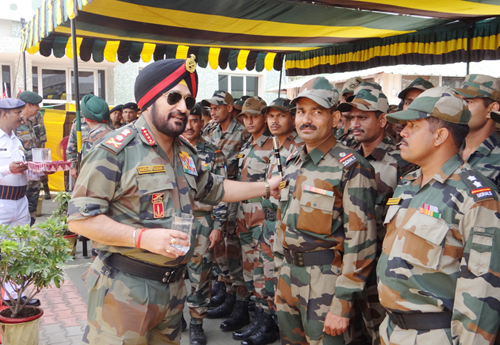
Army chief Gen Bikram Singh inter-acting with troops at Northern Command Headquarters in Udhampur on Sunday.
Open air Theatre at TRC Kishtwar.
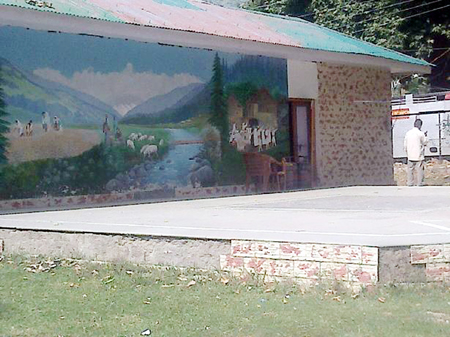
Open air Theatre at TRC Kishtwar.