

An injured of Kishtwar accident being treated at District Hospital, Kishtwar on Wednesday.
An injured of Kishtwar accident being treated at District Hospital, Kishtwar on Wednesday.

Army soldiers and policemen at the spot in South Kashmir where militants killed a TA jawan on Wednesday. — Excelsior/ Sajad Dar
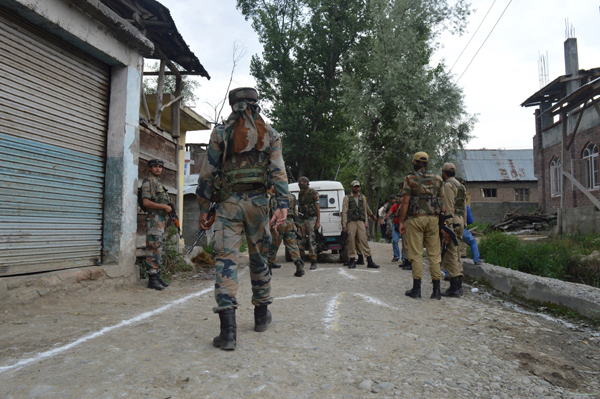
Army soldiers and policemen at the spot in South Kashmir where militants killed a TA jawan on Wednesday.— Excelsior/ Sajad Dar
A passenger vehicle damaged in the accident near HMT on Wednesday. —Excelsior/Amin War

A passenger vehicle damaged in the accident near HMT on Wednesday.—Excelsior/Amin War
An injured BSF jawan being admitted to GMC Jammu on Wednesday. —Excelsior/Rakesh
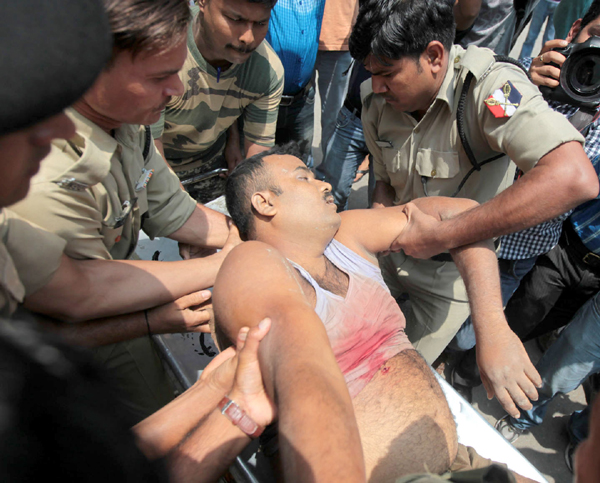
An injured BSF jawan being admitted to GMC Jammu on Wednesday.—Excelsior/Rakesh
Retirement age for teaching faculties
Sir,
Recently the Government of Jammu & Kashmir enhanced the retirement age of the teaching faculties of Universities and of the Govt. medical colleges, from 60 years to 62 years. Though it is a good step but the teaching staff of Govt. Degree colleges and also of the universities, are not very happy on the decision because as per the guide lines / recommendations of the University Grants Commission, the retirement age of the teaching staff at both the places (Universities / Colleges) has to be 65 years and not 62 years. It is not understood that while extending the retirement age for university teaching staff, how the Government has firstly forgotten to include the teaching staff of Govt. Degree Colleges for this announced benefit and secondly the limit of 65 years has been reduced to 62 years ?
For fixing the qualification, pay grades, work load and other assignments for the duties of the teaching staff at both the places (universities / colleges ), are kept same while honouring the directions of UGC but here one finds that Government has given a step-motherly treatment to college teachers by not including them in this concession of raising the retirement age. Government has to reconsider the genuine entitlement of the college teachers which has been denied to them in this order while increasing the retirement age.
Earlier also a few state Governments had taken the decision to keep the retirement age of the university / college teachers at 62 years but at later stage with certain decisions / modification provided in the judgements of Honourable courts, this seems to have been increased up to 65 years. Our State Government can also become generous in further modifying its decision so that the grievances of this highly qualified and most respectable class of personalities are honourably attended for keeping their high spirit to the noble duties of a teacher, ever alive.
Yours etc….
J M Behl
Sainik Colony, Jammu.
Oppositional Politics-A zero sum game
Vishal Sharma
Our parliamentarians have developed a new predilection. They have started putting pettiness at the heart of the political discourse. Frivolity is the new fad. The more frivolous the issue, the more gut wrenching the debate. There is a new found penchant for bending over backwards to show that one is the staunchest card carrying member of this debating club. The choice of the issues, mediocrity of debates and dead pan and sullen looks on the faces of those who sit in the amphitheatre of governance reflect both the quality of their minds and the times we live in.
Ved Prakash Vaidik, a journalist, who has had a meeting with Hafiz Saeed, JuD chief, recently has stirred up a ruckus amongst our political class. If it had had the wider public in angry mood, it would still make sense. For Hafiz has been pronounced by the Indian state as its foremost enemy. He has been held to be involved in some militant attacks in India; most notably he is believed to be the mastermind of the 26/11 Mumbai attack. Hafiz has also often spewed venom against India. Consequently, the people of India see in him a clear and present danger. In that sense Hafiz today represents everything and anything the state of India has come to detest.
The fight against terrorism is mostly a fight against an abstract, amorphous enemy whose only constant is ideology even as its proponents change faces in disparate situations. With Hafiz, however, it’s been different, he has been a visible symbol of hatred; hated as much for the ferocity of violence as for the continuity with which he has unleashed it.
On balance, the vilification of Vaidik’s meeting with Hafiz is tad too uncalled for. How does a scribe meeting Hafiz harm anybody’s cause? In any case, why should our political class take offence at a scribe doing what he is supposed to do? Scribes can’t take their agendas from the bickering political class. They never do neither even in the countries of failing democracies nor strong autocracies; much less a functioning democracy like India.
While there is no evidence to prove that Vaidik’s outreach had the Government’s approval except that he is close to Baba Ramdev, who is a dyed in wool saffron ideologue, It is nonetheless a gesture that should not be dismissed out of hand just as it should not be lapped up. Hafiz’s been unusually moderate in his response barring his usual rant on Kashmir. If he could be bought over by negotiations, it will be a victory just as singular as when he is legally or militarily dealt with. Today this rabble rousing ideologue stands across the fence just as strong. Our ranting and raving against him and US’s listing him as a wanted accused has had no effect on his mobility across Pak. He walks around there free and unfettered. His aura, if anything, has grown further.
The oppositional politics that currently plays out in the parliament on almost every issue is a zero sum game. It is a product of the same shortsightedness and grumpiness in which our political and social cultures are irredeemably steeped in. Just because an election has been lost, cross party consensus is not to be forged; ideological chasms are to be further deepened and national interests are to be compromised no matter what the costs are.
As the feud deepens, the extreme brazenness of this oppositional political discourse is being taken to another level: Adversaries are being witch hunted. Cupboards are being dusted off, past skeletons are being taken out and slung across the necks of the adversaries. The drama over National Herald newspaper is an evidence of this political tug of war currently underway between the Government and the congress. If national herald were a legal issue only, it would not be previously lost to those who are currently pursuing it. The timing is important. So are the trade offs that follow. One, which is doing the rounds is of the post of LoP Vs the post of aide of the prime minister.
Much in the same manner, the opposition of our political class, mostly on the other side of the treasury benches, to Vaidik’s interaction with Hafiz is also a part of their petty and expedient politics. Perhaps, it is also to do with their lack of strategic foresight. They know there is very little this change in discourse will throw up to help the Government in the context of the India-Pak relation. They know hafiz’s trenchant opposition to the state of India just as they know India’s stated position on the subject. But in opposing and even upping the ante on the issue, they are merely creating another window for the politics of quid pro quo.
In all of this, Hafiz’s tone, however, has not been as strident. His tweets have been critical of India’s response and he has hit at the democratic traditions that India so proudly parades all around saying that an Indian journalist’s interview with him has had the entire political class up in arms against him. His mellowed response is perhaps because he has been afforded on platter a platform of political legitimacy. But we should not see his reaction to the angst and anger here over Vaidik’s meet with him, and the subsequent uncalled for statement made by Vaidik in an interview to Pak news channel on Kashmir in some straitjacketed way. Vaidik, and, for that matter, no one even of weightier consequence than him, can change the Kashmir’s relation with India. Kashmir is no longer merely a territorial issue. It is now a raison detre for India itself.
Pursuit of conventional wisdom approach on the issue has not led us past the cul-de-sac of hopelessness. Hence, there is a need to grow out of past approaches. It is rather a time to see the other facet of Vaidik-Hafiz interface. Hafiz’s toned down rhetoric suggests that he can be negotiated and perhaps brought round to a view of sanity. Hafiz has the US chasing him. As much as he may deny and pretend and take refuge behind the jihadi ideology, he also wants legitimacy in the eyes of the people outside his country. Sitting across a negotiating table with Indian emissaries, albeit unofficially, paves the way for his legitimacy or a semblance of it, should he choose to course correct. Therefore, his stakes are not any less.
In India the overriding opinion though is that he should be caught and tried for his crimes in India. But can such a scenario in the face of the Pakistan’s all too clear refusal to cooperate on this issue be a reality? Let’s face it: it is well nigh impossible. At the same time, can we just sit back and let him do what he relishes to do against us? Well, ideally, we can’t and, also, we shouldn’t. But we are helpless. In such a situation, we need to look at other policy alternatives even though some of them may look bizarre on the face of it; For instance, negotiating with him as one of the options may appear bizarre. But it may be well worth a try after all.
Against this backdrop, our political class should have waited and calibrated its response instead of condemning the man and his interviewer roundly. Hafiz indeed has blood on his hands. But in view of the obvious constraints, the best course yet could be to engage him unofficially exactly in the way Vaidik has done and see where it all leads.
Fighting FDI insurance
Dr Daleep Pandita
Recently people gave mandate to the manifesto of a political party on many burning issues that a common man is currently faced with. But certainly not on a less important issue like increasing Foreign Direct Investment (FDI ) in insurance sector and that too so immediate after the assumption of their power. Enhancing FDI in Indian insurance industry at this stage has less relevance for masses and little implications for a common citizen.
When the sanctum sanctorum of Indian insurance industry was thrown open to private and foreign partners with 26 % capping on FDI, it was very well taken that this decision shall improve the services of insurance sector in our country. Enhancing low penetration of insurance particularly at rural level, besides providing quality services both in terms of cost effectiveness and hassle free claim settlements simply remained a distant dream, which is quite true even as on date also. We have not been able to create much needed awareness of real benefits of life and general insurance portfolio in India. The operators by and large, concentrated on their commercial viability aspects, for which apparently they seem to be right also, since insurance industry in India is treated as profit generating industry.
Existing system of insurance in our country has made private and foreign partners less accountable to their operations and result oriented performance in rural and social areas, where there seems to be manipulations of data and figures for the satisfaction of regulator. The fact remains that most of the rural India has little knowledge of such private insurance operators and their functioning. Their presence is concentrated in urban and commercially active pockets of India ignoring our rural population. These operators have also not devised need based low cost suitable products and services to offer for the rural poor. Government sector Public Sector Undertakings are facing with their own internal and market survival problems. These companies are also not provided with adequate infrastructure, particularly human resources to expand their presence in order to cater to the needs of large population.
Under such circumstances ignoring the ground level facts, how increase in FDI in this sector from present 26% to proposed 49 %, is going to address real issues being faced by Indian insurance industry, remains a million dollar question. Not learning real lessons from the past experience, instead focusing on improving quality and making insurance an affordable commodity, raising FDI in insurance segment is simply to please politically influential community and succumbing to the selfish foreign business houses.
In fact, potentially huge and virgin insurance market of India is viewed as a lush green pasture by foreign operators to make their buck fast, of course at the cost of irony and agony of a common Indian. Going to be a strong fast moving vibrant economy, the untapped Indian life and general insurance market offering long term profitable gains, is being viewed as a potential source for making profits by private and foreign trade partners. In fact, life and general insurance portfolio contribute substantially to the country’s economy and infrastructure, so any compromise on its operations mean great loss to our national economy.
The basic need of the hour is to be watchful of our economic interests and develop our own strong mechanism to improve our domestic insurance operations, that has direct bearing on a common man. The growth of this industry offers equal employment opportunities for our youth, which foreign partners do not appreciate and provide such opportunities. Improving Third party claim settlement mechanism both in terms of quick judicial procedures and time bound satisfaction of awards is immediately needed for the justified relief of accidental victims and claimants, in which foreign players are totally disinterested . Diversification of insurance activities particularly to Agriculture and crop based insurance segments not only address our agriculture dependant economy but also cover most of our rural population, which is presently the most needed redressal issues.
Indian Trade Unions and public at large associated with Indian insurance industry, be its employees or intermediatory, are organising strong protests against such moves of present government. Even such resentment is going to pick up more upon political interferences. The common man is least bothered about such constitutional amendments enhancing FDI in insurance from 26 % to 49% when they have failed even to understand and reap the benefits of existing 26 % FDI capping.
Indian people expect competitive and quality services in insurance sector and its percolation down to masses at affordable cost besides hassle free quick claim settlement. Be it through increase in FDI or making existing operators more accountable, results at ground level must speak it of its own. This move of the present Government can be taken as a fake encounter and as an appeasement policy of the Government towards capitalistic business houses, ignoring the basic purpose of insurance services for Indian masses.
( The author is a senior officer with general insurance PSU at Jammu )
Oil Min to move Cabinet to allow RIL to retain gas finds
NEW DELHI, July 16: The Oil Ministry is seeking Cabinet nod to allow Reliance Industries to retain three gas discoveries worth USD 1.45 billion in the eastern offshore KG-D6 block even after expiry of timelines.
RIL has not been able to submit a development plan for D-29, 30 and 31 gas discoveries, which hold an estimated 345 billion cubic feet of reserves, with the prescribed timelines due to dispute with the upstream regulator DGH over tests required to confirm them.
The Oil Ministry feels that taking away the discoveries and rebidding the finds may lead to delay in development, sources privy to the case said.
Also, it feels RIL may go to arbitration which may lead to further delay in production and extra cost associated with the arbitration.
The three finds, which can be quickly put on production by RIL using existing infrastructure of currently producing gas fields as well as those being developed, are worth USD 1.45 billion at current gas price of USD 4.2 per million British thermal unit.
Sources said the ministry is moving the Cabinet Committee on Economic Affairs (CCEA) for relaxation in the Production Sharing Contract (PSC) timelines to help RIL monetise the finds.
Comments on a draft CCEA note are being sought from the ministries of finance and law besides the planning commission before taking it to the CCEA for approval.
Sources said RIL will have to conduct DGH prescribed Drill-Stem Test (DST) on D29, 30 and 31 discoveries and only half of the USD 93 million will be allowed to be cost recovered. (PTI)
New FDI cap for defence
Eklavya
As the Jailey’s maiden budget cleared the decks for 49 per cent FDI in defence, it is pertinent to point out that Indian is currently the importer of the largest value of weapons by any country. According to the Stockholm International Peace Research Institute (SIPRI) India takes in 12 per cent of the global arms imports. This has happened even though the Foreign Direct Investment by military majors was set by the outgoing Congress led UPA Government at 26 per cent which everybody seems to agree is insufficient to attract foreign arms manufacturers in areas where India needs state-of-the art technologies to boost its yesteryears Soviet designed weapons platforms to the fifth generation level.
The implication of a higher Foreign Direct Investment is an expectation that the foreign investor will bring in the desired technology and thus boost the local capability to regenerate itself and be able to modernise as years go by; it remains to be seen whether the desire produces the desired results.
For most of its existence India was a victim of the Cold War and were it not for the Soviet perception that this country had natural affinities with the Communist countries, India would have long been overrun and ravaged by Pakistan as had happened over the centuries before both countries attained independence from British colonialism. By choosing Non-alignment India inherited the legacy of threats and coercion and infusion of the most modern weaponry into the region to stoke rivalries that should best have been left untouched. Pakistan was armed to the gills with the most modern of weapons which encouraged it to provoke India into wars that sapped its economy and all but derailed it from its chosen path of economic development.
It was only after the Chinese aggression of 1962 that Prime Minister Jawaharlal Nehru began to give a fillip to the Indian ordnance factories that were a relic of the British colonialism and laid the foundations of the military industrial complex through the creation of a research and development base and a contiguous Defence Public Sector Undertaking to productionise what was created in the DRDO laboratories. Thus tanks, aircraft, light field guns of 105 mm calibre and a new generation of 5.4 mm calibre small arms replaced the cumbersome .303 rifle. The private sector was not encouraged to participate nor was it overly interested in investing so heavily on creating infrastructure for a private sector military production facility.
The failure of the Congress prescribed 26 per cent FDI scheme has much to do with the private sector’s lack of experience in running a military industrial complex not to mention the desire on the part of the foreign partner to maximise profits and exploit technology generated by years of research and development effort to the full. That applies to arms manufacturers of all nationalities. It is only the perceived self-interest of the Russian Federation that it has taken over where the Soviet Union left off in 1990 when it collapsed. It left a legacy of nearly 80 per cent of dependency by India for its military wherewithal for its defence.
In the meantime a few of the projects initiated soon after the Chinese aggression bore fruit. The Vijayanta tank, the Indian field gun, the missiles under the Integrated Guided Missile Programme, the stretched Leander class frigates, and a host of other building blocks for better equipment began to flow out of the laboratories. However, the inordinate delay in the creation of the Arjun tank and the light combat aircraft (LCA) forced India to continue to depend on foreign sources. The budgets allocated for the armed forces were largely returned unutilised in the Capital account because (1) the indigenous product was not available and (2) there was not enough time to negotiate and complete the process of procurement without falling into the trap of single vendor situation. Over the past decade India has had to blacklist dozens of foreign arms manufacturers for violating the clause not to use middlemen to secure contracts or pay kickbacks to Indians.
In the mid-90s the Parliamentary Committee on Defence had recommended that the Government progressively raise the outlay for defence research and development to 3 per cent of the GDP or 10 per cent of the defence budget whichever was more. Due to a variety of reasons the figure has rarely been able to touch 2 per cent of the GDP. Yet in moments of crisis like the Kargil invasion money was found for the unbudgeted acquisitions running into crores of rupees for equipment that arrived too late to be used in Kargil. Every so often a Chief of Army Staff sounds a warning that reserves of ammunition and other equipment are dangerously low. Kargil proved such warnings to be justified given the manner that the government of the day – a BJP led coalition – had to run abroad to acquire the needed weaponry.
Yet it is not that India was able to secure what it wanted from off the shelf because of restrictive international regimes like the CoCom during the days of the Soviet Union and the renamed Wassaanar Arrangement as also the Missile Technology Control Regime. These blocks were designed to prevent weapons and sensors falling into hands of nations that did not sign the discriminatory Nuclear Non-Proliferation Treaty (NPT) and the Comprehensive Test Ban Treaty (CTBT). Both treaties were aimed at closing the doors to non-signatories from acquiring nuclear or other weapons of mass destruction. All these restrictive regimes exist even today and India has had to negotiate with the Suppliers’ Group for access to nuclear fuel for its safeguarded reactors. Much haggling has yet to be done.
Thus, it is for these reasons that one wonders about the efficacy of the Indian offer of the new FDI cap. Indian negotiators are painfully aware that even as close a collaborator in defence contracts as Israel is sometimes chary about sharing technology incorporated in state-of-the-art military equipment. If a nation or its arms manufacturer does not agree to share the technology of a certain component of equipment, it makes no sense in buying that equipment.
Some nations, the US in particular, insists on intrusive periodic inspections of their equipment to check if the buyer has not tampered with it or tried to replicate it. India has objected to such intrusive inspections. Will this policy change? This is an issue involved in the Poseidon maritime reconnaissance aircraft that India has purchased from the US.
Several other equipments are out of India’s reach because of the embargos placed on their delivery to any foreign nation without a clear licence from the US government.
Then again there is the issue of blacklisting by the Congress-led Government of firms involved in corruption and illegal trade practices. Will the BJP absolve these firms after winning a massive majority largely on the corruption issue?
(Syndicate Features)
Sun Pharma acquires US-based Pharmalucence
NEW DELHI, July 16: Drug major Sun Pharmaceutical Industries has acquired US-based Pharmalucence Inc for an undisclosed amount.
Pharmalucence, which has sterile injectable capacity in the US, has been acquired by one of the subsidiaries of Sun Pharma, the Mumbai-based firm said in a statement today.
The company, however, did not disclose the financial details of the deal.
Earlier this year, Sun Pharma had acquired Ranbaxy Laboratories in an all-stock transaction with a total equity value of USD 3.2 billion along with debt of USD 800 million, taking the overall deal value to USD 4 billion.
Sun Pharma shares were trading at Rs 748.30, up 1.30 per cent from its previous close. (PTI)