

Young participant being felicitated during a Cultural Show organized by Unique Dancing Institute.
Young participant being felicitated during a Cultural Show organized by Unique Dancing Institute.

Winners of various events organized by PYC while celebrating 150th Birth Anniversary of Swami Vivekananda.
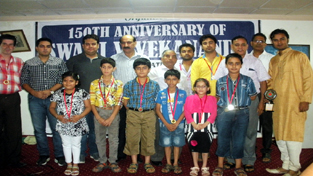
Winners of various events organized by PYC while celebrating 150th Birth Anniversary of Swami Vivekananda.
Moments of action during the opening match of Pro-Kabaddi league between U-Mumbai (black and orange) and Jaipur Pink Panthers in Mumbai on Saturday night. UNI

Moments of action during the opening match of Pro-Kabaddi league between U-Mumbai (black and orange) and Jaipur Pink Panthers in Mumbai on Saturday night. UNI
War like stores recovered in north Kashmir
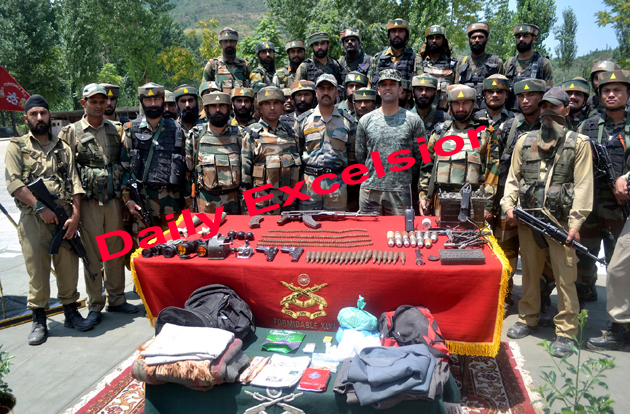
SRINAGAR: Security forces busted a militant hideout and recovered war like stores in the north Kashmir district of Baramulla, official sources said.
They said Rashtriya Rifles (RR) and Special Operation Group (SOG) of State police launched a joint operation today following a tip-off that militants had stored some arms and ammunition in a hideout to be used for causing disturbances in north Kashmir.
Security forces finally unearthed a hideout and recovered large cache of arms and amnmnition, including AK rifles, pistols, grenades, wireless sets and 250 rounds of ammunition. However, no one was arrested, they said. (AGENCIES)
One arrested for extorting money posing as militant: police
SRINAGAR : A person who allegedly extorted money from locals and sarpanches posing as a militant was arrested in Pulawama district in Kashmir, police said today.
Aijaz Ahmad Shah was arrested by a joint team of police, Army and CRPF last evening in village Chakora on charges of extorting money using a toy pistol and posing as a militant, a police spokesman said.
He said police had received information that a person posing as a militant was threatening panches, sarpanches and other civilians and was extorting money from them.
Acting on a tip-off, police along with Army and CRPF arrested Shah and recovered a toy pistol, a tear smoke grenade, cash worth Rs 50,000 and a mobile phone from his possession, the spokesman said.
He confessed to extorting money, the spokesman said.
A case had been registered and investigations were on, he said. *(AGENCIES)
Despite rain Amarnth yatra continues, 3.5 lakh paid obeisance
SRINAGAR: Despite rain last night, pilgrimage was going on smoothly to holy Amarnath cave shrine in South Kashmir Himalayas, where so far 3.40 lakh have darshan of the self-made Ice-Shivlingam since the commencement of the 45-day-long yatra from June 28.
There was rain last night but the weather is pleasent today and pilgrimage was going on smoothly, a yatra official said. They said that fresh batches of pilgrims, including women and sadhus left Baltal and Nunwan Pahalgam base camps for the holy cave early this morning.
Pilgrims, who left Baltal will reach the cave shrine this afternoon, they said, adding that majority of them will start return journey after the darshan at the shrine. However, those, who had night halt after darshan till last evening, have also started their return journey to base camp this morning. However, pilgrims, who left Nunwan Pahalgam base camp this morning, will have night halt at Chandanwari, the last motorable halting station on the traditional route. They said pilgrims, who had night halt at different halting stations on traditional route, also started their journey towards the cave shrine.
However, those pilgrims who had reached Panjterni till last evening, reached the cave shrine this morning and paid obeisance. A yatra official said 4,974 pilgrims paid obeisance at the Holy Cave yesterday.
With this, including those who had paid obeisance today, 3.40 lakh pilgrims have paid obeisance at the Holy Cave since the commencement of the annual Yatra.
(AGENCIES)
Another batch of devotees leave for Amarnath
JAMMU : Amid tight security, the 31st batch of pilgrims today left for the Amarnath cave shrine in south Kashmir Himalayas from here.
As many as 599 pilgrims, including 294 men, 103 women and 2 children, left from the Bhagwati Nagar base camp in Jammu in a cavalcade of 18 vehicles at 4:28 AM, police said.
The convoy has already crossed Kud on Jammu-Srinagar National Highway and would reach their destinations at Baltal and Pahalgam base camps by this evening, they said.
With today’s batch, a total of 51,255 pilgrims have so far left from the Jammu base camp for the Amarnath shrine. (agencies)
DoT seeks info on J&K, HP, U’khand villages having no telephone
NEW DELHI : The government is likely to approach regulator TRAI for details of the villages in Jammu and Kashmir, Uttarakhand and Himachal Pradesh that have no telecom connectivity.
“The Department of Telecom (DoT) is preparing a detailed project report on uncovered villages for which has it has asked TRAI to seek information from telecom operators on unconnected villages in J&K, Uttarakhand and HP,” an official source said.
The move is a part of the government’s agenda of raising rural tele-density to 100 per cent in the next 3-4 years.
The rural tele-density in the country is at present around 44 per cent.
According to DoT estimates, about 56,000-60,000 thousand villages in the country have no telecom connectivity.
The Universal Services Obligation Fund (USOF) wing under the Department has been given responsibility to facilitate telecom connectivity in rural areas. The DoT, however, plans to seek information on unconnected villages from TRAI.
Sources said most of the uncovered villages will get covered under various projects like installation of mobile networks in nine naxal-affected states at an estimated cost of Rs 3,500 crore, increasing connectivity in North East at a cost of Rs 5,100 crore, and plans for connecting Lakshadweep and Andaman & Nicobar islands.
The Telecom Regulatory Authority of India (TRAI) last week had recommended over Rs 2,400 crore-plan to provide telecom connectivity in Lakshadweep and Andaman & Nicobar islands.
However, uncovered villages in three states–J&K, HP and Uttarakhand– do not fall under the proposed schemes.
“From TRAI, DoT wants a list of all unconnected villages state-wise and urgent information is required for three states–J&K, Uttarakhand and HP,” the source said. (AGENCIES)
Ambaran heritage site
Entire world knows that India is one of the most ancient and glorious civilizations known to mankind. Most of its antiquity is depicted either in books or in the shape of archeological and anthropological remains spread over the vast expanse of the land. But historians, antiquarians and archaeologists agree that though many of these archaeological remains have been excavated, exposed, examined and analyzed by eminent scholars yet a large fund of our civilizational treasure still remains buried underground, and is not known to us. We do get sporadic hints in existing historical record like mythological and scriptural lore about the existence of treasures of heritage of the hoary past. But identification of precise sites and follow up action that would entail capital investment and induction of expertise and scrutiny etc. would be required to give them proper exposure. We have the Archaeological Survey of India, a well structured organization with branches in the states to take care of heritage objects. But as we have seen, the ASI is mostly focused on known ruins and heritage sites or monuments and their repair and restoration exercise. Somewhat less attention is paid to new excavations and archaeological finds that could shed much light on obscured facets of our ancient history. For example, in his monumental work Rajatarangini, Kalhan tells at many places about the temples, shrines, viharas, stupas and pillars and other monuments ordered by the king or the queen or their guru or their ministers and commanders. He very often writes that such and such a temple or vihara was consecrated by such and such a king or minister or queen to such and such a deity and proceeds to give the number of priests and mendicants who served at the shrine. But most of the sites remain unidentified and hence unexplored. This is a loss to the historians and antiquarians and we would be many times richer if we had got these excavated and studied.
Kalhan tells us that it was King Ashoka, the Great, who had embraced Buddhism, had undertaken to dispatch Buddhist monks as missionaries and propagators to all the four sides of his kingdom viz. Central Asia, South Asia and South East Asia as far away as Mongolia and Japan. Buddhist missionaries with Buddha’s message of peace travelled the vast Asian tracts along the fabulous Silk Road as part of the caravans carrying merchandise across that part of the globe. Kalhana and other Kashmirian historians have recorded the arrival of Buddha’s message and faith to Kashmira Mandala and the patronage it received from contemporary royalty. Modern historians have conducted expansive investigation into Kashmir’s contribution to the expansion of Buddhism in the region. But unfortunately no attention has been given to the exploration of the route and the stations over which the Buddhist monks carried the message of their master to Kashmir and then to Kapisa, Gandhara (modern Kabul and Qandahar) and across the Badakhshan mountains to Balkh, Bamian, Tirmiz and then to the Central Asian Steppes as is evident from numerous statues of Buddha excavated in Penjikent valley in modern Tajikistan. Existence of a grand Buddhist monastery even today in Mongolia in its full grandeur as it stood even during the days of Chingiz speaks of great fervor and tenacity among the Buddhist monks who carried their master’s message to this distant region. Kashmirian monks are reported to have brought Buddha’s message to Tibet and the name of the Kashmirian Buddhist monk Kamalshree is a household name among the Buddhist scholars of greater Tibet (Lhasa) and Lesser Tibet (Ladakh).
In their lop-sided study of expansion of Buddhism in Northern India including the present day State of Jammu and Kashmir, historians and archaeologists have committed the grave mistake of not paying full attention to the route those ancient sages and savants had adopted. Identification of a site at Ambaran on the right bank of Chenab near Akhnoor with more than 2,000 years old Buddhist Monastic complex and its architectural remains were excavated during 1990-2001 by the Srinagar Circle of ASI under Dr B.R. Mani, the then Superintending Archaeologist, Srinagar Circle of ASI. The team established that the site was abandoned sometimes around 7th century AD because of flash floods in the river and decline of Buddhism in the area.
In all probability, Buddhism must have been introduced in the lands known to Kalhana as Madradesh, the region between Chenab and Ravi, much before it was carried on to the Kashmir valley by Majjhantika during king Ashoka’s reign. Ancient Pali works carry evidence that tells us that prominent disciples of the Buddha like Mahakappina, Khema and Bhadda Kapilani hailed from Madradesha, whose capital was the modern-day Sialkot, and an area contiguous to Jammu.
With excavations made by the ASI team in 1990-2001 at Ambaran, researchers and scholars of Indological and Buddhist studies began evincing interest in conducting more researches in the field. They established that the remains of the monastery and some artifacts recovered from the ruins established that it belonged to Kushan period and was the earliest monastery to have been found in J&K State. But Ambaran attracted attention of the entire world of culture and civilization after His Holiness the Dalai Lama formally visited the site in Akhnoor on November 9, 2011.
We have touched upon Buddhist history in passing. But the point that we need to make is that despite the historical importance of this first ever known Buddhist heritage complex in Madradesha (Jammu region), nothing has been done on the ground for last thirteen years either to explore fully the story of Buddhist advent in Jammu, and the route of its movement or the details of the remains that have come to light at Ambaran. Existence of this heritage site could be the stimulus for looking out for similar sites along the route of the movement of the Buddhist missionaries namely bhikshus in the vast region straddled between Ravi and Chenab. The ASI should formulate a project and constitute a team of experts including academia to make rewarding investigation. May be we are able to find more sites in the region promising rich description of the traces of Buddhist civilization in Northern and North-Western India. It would be in fitness of things to recommend the site for award of national heritage status.