Navjyot Singh
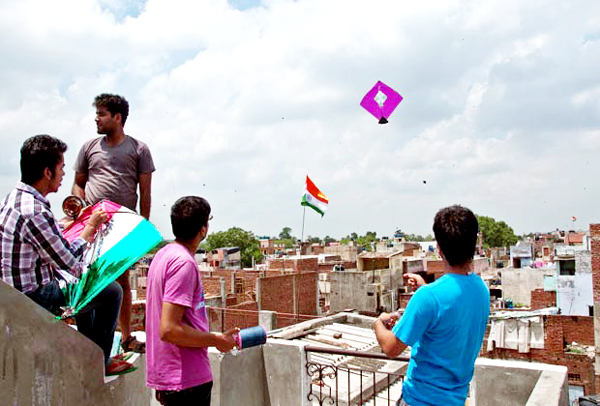
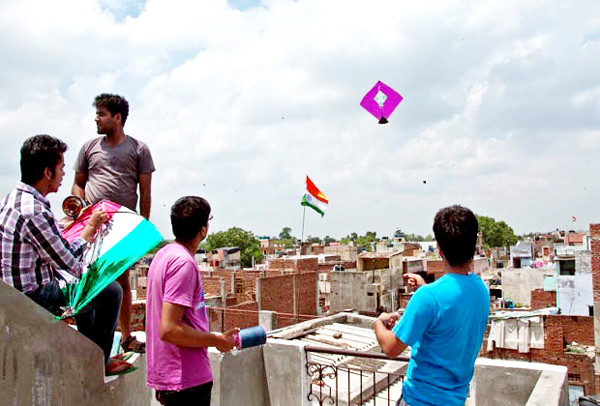
‘On a bright summer day a ten year old boy is on the terrace of his house with his father. He wants to jump around with excitement, but is somehow controlling his enthusiasm. With sparkling eyes he is looking at his father who is equally happy to teach his son an art which he mastered in his youthful days. The hot temperature is somehow neutralized by a slow, steady wind which is also an assurance of a smooth flight of their kite’. This story is shared by many of us and it is reminiscent of a time when traditions and festivals were celebrated with zeal and gaiety, when social networking meant getting together with your friends and family and when kite flying was still a huge thrill for the youth of Jammu, especially in the old city area.
The months of July, August and September used to be the prime months for kite flying in Jammu and the two holidays of Raksha-Bandhan and Janamashtmi were the un-announced championships of kite-flying. On these occasions, friends and cousins used to get together on roof tops and set up their own kite stations for all day long and the bright day sky appeared to be filled with colourful stars of different shapes and sizes. Many enthusiasts would start collecting kites and the flying-string (dor) way before these festivals and kite sellers used to set up shops in the old city area during this season, which sold only kites and dor. Gone are those days and gone is the passion people used to have for the sport. Though kite enthusiasts are still there, but their number is declining day by day. So is the case with the business community dealing with kites. One such shopkeeper Rajat Gupta said, “We have seen a tremendous fall in business in last three-four years, our sale per day should be around 5000 rupees which has fallen down to around 700-800 rupees. Today’s youth prefer whatsapp and internet over kite flying”. Another shopkeeper Monu Sharma basically from Amritsar, whose ancestors are in this business from about a hundred years said, “I have grown up seeing kites being made in our homes, we are a community of about seventy houses and everybody is in this business”. When asked about the changing trends of this tradition he said, “The business which used to be at a high point during these three months, has succumbed to maximum ten to fifteen days”. Same is the case with traditional dor-makers who come from different parts of country like Rajasthan, Punjab, Haryana to set up their business in different parts of city like Panjteerthi, Parade, Gole Market, Satwari etc. Their numbers have decreased to more than fifty percent with the introduction of factory-made plastic string, commonly known as “Chinese dor’ or “gattu”. “Everybody wants the Chinese dor nowadays because of its factory made finish. Our livelihood depends on it, but we are thinking of doing some other job now” said one such dor maker in Satwari area. Even the kite flying enthusiasts are finding it hard to take out time for this childhood passion of theirs. “We only get time for kite flying on holidays like raksha-bandhan and janamashtmi, life is very busy now,” said 22 year old Shiv Verma. A 12th standard student said, “My elder brother is quite an enthusiast; I myself fly kites but not that often as with school and tuitions there is no time left for kite flying”. One young businessman Jabar Singh opined “it’s not only with kite flying; all traditional holidays and practices are losing sanctity with passing time”. A kite flying enthusiast since ages, 64 years old Suresh Gulati said, “I have stopped flying kites only 6 years ago, due to my brain surgery, but still I miss it and it’s sad to see young people today don’t have time for it, even my grand children are not that enthusiastic about it. Not only choices of people have changed, but the cost of living has increased so much that ordinary people nowadays can’t afford to celebrate festivals the way they wish to do it”
This centuries old tradition like other traditions is slowly fading from the city and its fast moving life. City’s younger lot, who used to eagerly wait for this season and festival, to setup tents and music systems, call friends over for kite flying, now gets so much entertainment within the four walls of their air-conditioned rooms that they don’t want to get out in the sun and get tanned or catch flu. People still like to celebrate festivals and spend quality time with family and relatives but their modes of entertainment are changing. They prefer going to malls, cinemas and restaurants over traditional practices like kite flying. This custom of kite flying is just a single thread among many others, which when weaved together form a sheet called culture, but if one thread in the sheet goes loose, it slowly starts to tear apart and when it does, something is lost, the question is how important it is to keep it well. A question creeps in one’s mind that whether you will see any kites in the sky in coming years?
This question was answered by a shop keeper with a confident smile, “I am very sure that love for kite flying will never fade completely from this city” and your faith re-affirms itself when sometimes you see a kite-runner in his fifties flying kite on his roof top and competing with kids lesser than half his age and shouting the ritual slogans of “chal gai yaa” from the top of his lungs, a strike of exuberance exhilarates in you and you know that this bug of kite flying is resilient enough to survive for more time and it will see more flights in coming future.
A FADING PASSION
Quest for Immortality
B K Karkra
Man has been in relentless search of immortality since the times immemorial. Permanence, however, is the jealously guarded preserve of God. No one has ever been permitted even a peep into this Divine portal. Not only the physical being, but even the memories have a limited shelf life— common man can ordinarily hope to live in memory only till his grandchildren are around. Ever increasing longevity is very much within the realm of reality, but immortality is certainly beyond anybody`s reach. Even all the man-made Gods and prophets would live only till our earth does not disappear into some cosmic black hole. Only the God who has who has made man and all else would always be there. Besides Him, ‘atman’ (soul) is also believed to be indestructible, because it is an inalienable part of ‘Paramatman’ (God).
Both seers and scientists have been after the cosmic secrets for ages. They have tried to unravel the mysteries of life and universe in their own preferred ways. The intricacies of what lies within us are no less wondrous than the mysteries of the cosmos. If and when our scientists are able to solve the question of consciousness— they hope to do so by the end of this century— it would certainly be a big leap forward for man to chase his illusion of permanence further.
Consciousness is something what the Upanishads refer to as ‘atamn’ or soul. This is what makes you feel that you are you. Nobody else can be ‘you’. Besides, we are human because we think— ‘cogito, ergo sum’. Deciphering of consciousness would, therefore, lay bare a good part of the mystery surrounding life. After all, this is the quintessence of our being— the seat of self-awareness, social-sense, emotion, memory, reasoning ability and even personality. Body is just a casing for consciousness and mind really is the place where man lives. If the contents the brain could be preserved and taken care of separately, body would go disposable.
Our first curiosity with regard to consciousness would naturally be to know exactly where in our body it is lodged. Our heart is just a pump and liver, a purification facility— though we are often made to feel, as if these organs have something to do with the pulsations of our inner self, particularly the sensation of love. In the 17th century, a French philosopher, Reni Descartes thought that this life-force lay in the pineal gland of the brain. However, the view now is that it lies somewhere in the complex circuitry of the neurons called the spindle cells. Whatever be the truth about these findings, one thing is quite clear that consciousness has its home in brain. It is a kind of software that gets processed in our brain which itself could be construed as hardware. The two are thus integral to each other.
If science is to proceed further from here, it would have to first locate the exact spot in brain which deals with this mystical phenomenon. The next stage would be to decode the information on these nerve cells and download this on some super capacity computers. The whole thing could be viewed this way: A baby is born with a blank memory (His memory disc may well be carrying baggage from his past life also, but that is not retrievable in the ordinary course). Right from the first breath, the child begins receiving messages from his surroundings through his sensory organs. Thus, a plethora of sights, smells, sounds, flavours and feelings make their way to his memory and start getting accumulated there. In course of time, the processing power of the brain also comes in to play and he starts reacting to events in line with what lies embedded in his brain i.e. his experiences.
Consciousness can thus be considered as just another sensory organ or the sixth sense. Anything perceived through this sixth sense means that the brain has already worked on the issue in the light of the data stored therein and arrived at a solution, but the necessary calculations done by it have completely faded from its memory screen. This leaves us with a feeling that things are going to happen in a certain way, but we really do not know why.
Similarly, a computer mimics the human brain. It has a C.P.U. corresponding to the processing power of the brain and RAM for memory. Computer gets inputs through its keyboard, imaging and voice modulations, while brain gets these through the sensory organs. Computer displays the results on its monitor, whereas brain does it through speech, sketches, bodily expressions and actions etc. The computing ability of the supercomputers has already touched around 1% that of brain.
The scientists from various disciplines are currently on the job of networking computer with human brain, so as to be able to download and upload data from one to the other. The effort is thus at digitizing the brain and replicating consciousness. At the moment science has very little purchase on the idea. Yet, the pace at which the computers are evolving and the tremendous progress made in the intricate areas like the genetics gives the hope that, sooner or later, consciousness would also get decoded.
We are told that the Cole Polytechnique Federale de Lusanne of Switzerland (EPFL) has already started making efforts to replicate a neocortical column of brain on an IBM computer. If this works, a number of such simulated cylindrical columns would be linked together to understand the working of what is known as the ‘grey matter’ in the brain. Once this is successfully done, the mysteries of consciousness would start getting unraveled.
Aubrey de Gray is of the view that a person who is to live 150 years may have already been born and the one who may live for 1000 years is in the coming in the next twenty years. In his lecture before the British Royal Academy of Science, he said that all this would be brought about through ‘gene therapies, stem cell therapies, immune stimulation and a range of other medical techniques’. Progressive longevity of life may, therefore, be well within the grasp of man.
Ian Pearson, the head of the futurology unit of the British Telecommunications, is hopeful that by 2050, computer technology would have advanced to a stage where it would be possible to download the contents in a person`s cranium on to a supercomputer. Once this happens, it would also be possible to upload this digital copy in another brain. Initially these simulations may be crude and hazy, but these would get satisfactorily refined with time. The process would also get less laborious and may eventually come within the reach of common man. It is not difficult to understand the staggering implications of this development, related as it is to the overall ‘beingness’ or personality of a person.
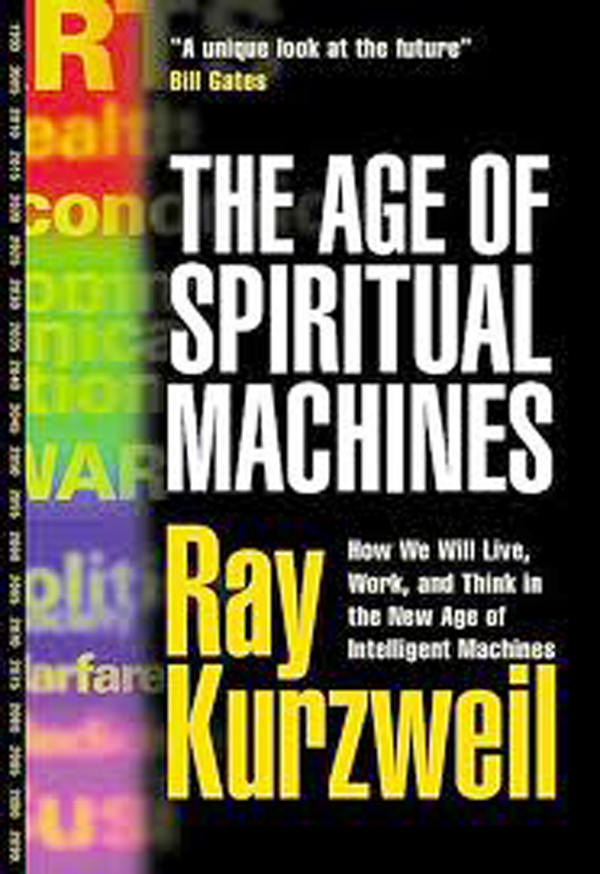
Ray Kutzwell, in fact, goes to the length of asserting in his book, ‘The Age of Spiritual Machines’ that the current generation could be the last one to experience terminal death. The biological puzzle of death is thus waiting to be solved. Our mortality is presently tied to the durability of our hardware i.e. brain. Death occurs when this system crashes, just because it is not yet possible to save its contents (consciousness). If, sometimes in the future, it becomes possible to port the mind-file on to some back-up device, the human battle against mortality would end in a significant victory to man. The prospect is, undoubtedly, fraught both with promises and perils that are impossible to predict immediately. Just imagine, finding yourself in another body and seeing your own body laid in front of you!
Science is simultaneously trying its hand at creation of artificial life and also in the area of the Past Life Regression Therapy. (The PLRT works on the basis that the experiences of past life lie embedded in a corner of a man`s brain incognito. These could be recalled to remedy his psychological ailments of this life, following him from his past life). However, even if man achieves some breakthrough in the field of digitization and preservation of consciousness, immortality would still not be there in his grasp— what if this earth itself gets sucked in a cosmic black hole one day or the digital copies of consciousness get infected with some virus? Man may continue to push his frontiers of knowledge, but God is not going to lose even a bit of His greatness. After all, even brain is not our own creation— it is also a gift from God.
The thread of Love

Ayodhya Nath Kerni
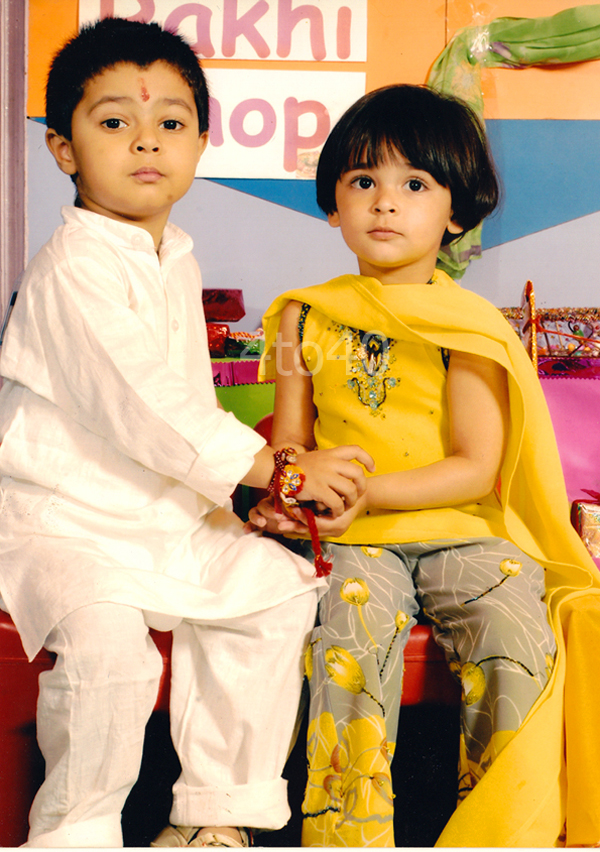
Raksha Bandhan is one of the most joyful festivals celebrated with great fervor In India. It reminds one of the solemn pledge towards the person who ties the colourful thread. The festival falls on full moon day of Shravan lunar calander month. Sisters tie rakhi on the wrists of brothers on this auspicious day and pray Almighty for their long life.
Preparation of Festival
A thali is arranged by keeping the articles like flowers, vermilion powder, rice grains, sweets, fruits and rakhi etc.
A tika is applied on the forehead of brother and a bracelet like woven thread available in market in assorted colours and designs as rakhi is tied on the wrist.
All these rituals take place amid the chanting of the following mantras :
“Suraj shakhan chhodian, Mooli chhodia beej
Behen ne rakhi bandhi / Bhai tu chir jug jee”,
Which means “The sun radiates its sunlight, the radish spreads its seeds,
I tie the rakhi to you O brother and wish that may you live long.”
After her prayer for a long life for her brother, she says that she is tie the ever-protective Raksha to her brother’s wrist and chants:
“Yena baddho Balee raajaa daanavendro mahaabalah
tena twaam anubadhnaami rakshe maa chala maa chala”
This means,” I tie you the rakhi that was tied to king Bali, the king of Demons,
O Rakhi I pray that you never falter in protecting your devotee.
Normally sisters do visit the houses of brothers and tie rakhis. Rakhis are tied not only by real brothers and real sisters but are also being exchanged between other people as a mark of friendship and social harmony. Rakhi was also tied in the past by village purohits (priests) to village yajmans in Jammu region who in turn offered them money and other articles.
Legends
There are many legendary accounts regarding Raksha Bandhan. Once Yamuna tied coloured thread to Yama, the lord of death. Yama was moved by this gesture and granted a boon of immortality on this day. Since those times there is apprehension that any brother who is tied rakhi on raksha bandhan day and offers to protect sister would also receive longevity in accordance with Yama boon.
Once there was a war between Devtas and Aasuras for twelve years. Devtas could not win the war. Dev guru Brihaspati insisted to stop the war. Inderani said on hearing all this that she will tie a rakhi to Indera next day being Shravan Purnima and devtas would win the war. Consequently war was won by the devtas.
Once lord Krishna while handling sugar cane got his finger cut. There was bleeding from his injured finger. Droupadi standing near by tore off a part of her sari and bandaged his bleeding finger. In return for this act of sympathy Krishna promised to protect her in the time of distress. That was how her sari became endless on the day she was disturbed in full public by Kauravas.
The other legend states that as a part of a promise lord Vishnu has been protecting his devotee and demon king Bali, disguising himself as a door man.
Luxmi , goddess of wealth and prosperity ,disguising herself as a woman seeking shelter to live in since her husband has been away, Bali gave her shelter in the palace. She tied rakhi on Bali’s wrist and wished his happiness and prosperity. Bali asked her desire and promised to fulfill it. She requested Bali to release his gate keeper. Bali agreed and kept his promise. Both were released by Bali. Meanwhile their identity was disclosed and lord Vishnu promised Bali to be with him for four months each year.
Historical Account
The other evidence about Raksha Bandhan exists in Indian History. Rana Sangram Singh better known in history as Rana Sanga was an undaunted warrior who defeated the kings of Delhi, Malwa and Gujrat established his fame as mighty leader. After his death his wife Karnavati who originally belonged to Bundi ruled Mewar temporarily in the name of her son Vikramajit. Bahadur Shah the ruler of Gujrat was young and ambitious prince who cherished the desire to seize the kingdom of Delhi. He launched second massive attack on Mewar with its capital at Chittor. Karnavati sent a rakhi to Humayun calling him brother and request for help. She also consolidated the nobles to face Bahadur Shah.
Humayun was in the middle of another military compaign in Bengal when he received rakhi and call for help. Humayun marched towards Mewar with his army but unfortunately reached late and by that time Karnavati committed self immolation to protect herself from indignity of falling in hands of Bahadur Shah. Humayun defeated Bahadur Shah and restored the kingdom to Kanrnavati’s son Vikramajit. This is the most glaring example of Raksha Bandhan. How a muslim emperor was inspired with a pious rakhi of a Hindu lady. He kept aside his strategical warfare plans rather abandoned his military preferences and reached for the rescue of Karnavati. She had two sons Vikramajit and Udey Sinh. The great warrior Rana Pratap happens to be son of Udey Sinh and grand son of Karnavati.
The custom to tie rakhi began from the historical ages. The message behind this is that brothers should become prosper and should protect the sisters at the time of distress and need. The sisters should pray for welfare of brothers. The sisters and brothers may join together to pray Almighty for the strength to serve and protect the nation.
Battered baby syndrome
Dr Vijay Kundal
Definition
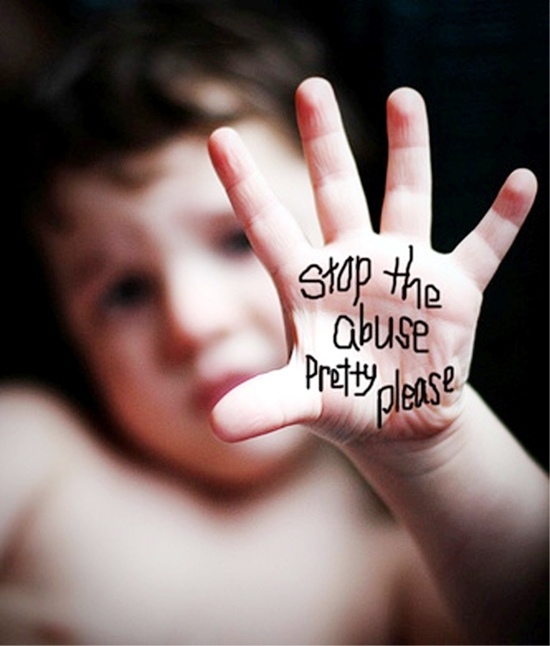
Battered baby syndrome is defined as non-accidental injuries sustained by a child as a result of physical abuse, usually inflicted by an adult caregiver. Internal injuries, cuts, burns , bruises , and bony fractures are all possible manifestations of battered baby syndrome. Because adults are so much larger and stronger than children are, the victim can suffer severe injury or death without the abuser intentionally causing such an injury. Shaking an infant can cause bleeding in the brain ( subdural hematoma ), resulting in permanent brain damage or death. Emotional damage to a child is also often the byproduct of child abuse , which can result in the child exhibiting serious behavioral problems. Battered baby Syndrome is alternatively referred to as child physical abuse or non-accidental trauma.
Causes and symptoms
Battered baby syndrome is found at every level of society, although the incidence may be higher in lower-income households, where adult caregivers may suffer greater stress and social difficulties and have a greater lack of control over stressful situations. Other risk factors include lack of education, single parenthood, and alcoholism or other drug addictions. The child abuser most often injures a child in the heat of anger or during moments of stress. Common trigger events that may occur before assaults include incessant crying or whining of infants or children; perceived excessive “fussiness” of an infant or child; a toddler’s failed toilet training ; and exaggerated perceptions of acts of “disobedience” by a child. Sometimes cultural traditions may lead to abuse, including beliefs that a child is property, that parents (especially males) have the right to control their children any way they wish, and that children need to be toughened up to face the hardships of life. Child abusers were often abused as children themselves and do not realize that abuse is not an appropriate disciplinary technique. Abusers also often have poor impulse control and do not understand the consequences of their actions.
Presentation
Symptoms may include a delayed visit to doctor with an injured child; an implausible explanation of the cause of a child’s injury; bruises that match the shape of a hand, fist or belt; cigarette burns; scald marks; bite marks; black eyes; unconsciousness; lash marks; bruises or choke marks around the neck; circle marks around wrists or ankles (indicating twisting); separated sutures; unexplained unconsciousness; and a bulging fontanel in small infants. Emotional trauma may remain after physical injuries have healed. Early recognition and treatment of these emotional “bruises” is important to minimize the long-term effects of physical abuse. Abused children may exhibit: a poor self-image, an inability to love or trust others, aggressive, disruptive, or illegal behaviour. anger, rage, anxiety , or fear , sadness or other symptoms of depression.
Sometimes emotional damage of abused children does not appear until adolescence or even later, when abused children become abusing parents who may have trouble with physical closeness, intimacy, and trust. They are also at risk for anxiety, depression, substance abuse, medical illnesses, and problems at school or work. Without proper treatment, abused children can be adversely affected throughout their life.
Diagnosis
Battered baby syndrome is most often diagnosed by the doctor or by teachers or social workers. Physical examination will detect injuries such as bruises, burns, swelling, retinal hemorrhages (bleeding in the back of the eye), internal damage such as bleeding or rupture of an organ, fractures of long bones ore spiral-type fractures that result from twisting, and fractured ribs or skull. X rays , and other imaging techniques, such as MRI or scans, may confirm or reveal other internal injuries. The presence of injuries at different stages of healing (i.e., having occurred at different times) is nearly always indicative of Battered baby syndrome. Establishing the diagnosis is often hindered by the excessive cautiousness of caregivers or by actual concealment of the true origin of the child’s injuries, as a result of fear, shame and avoidance or denial mechanisms.
Treatment
Medical treatment for battered child syndrome will vary according to the type of injury incurred. Counselling and the implementation of an intervention plan for the child’s parents or guardians are necessary. The child abuser may be incarcerated, and/or the abused child removed from the home to prevent further harm. Decisions regarding placement of the child with an outside caregiver or returning the child to the home will be determined by an appropriate government agency working within the legal system, based on the severity of the abuse and the likelihood of recurrence. Both physical and psychological therapy are often recommended as treatment for the abused child. If the child has siblings, the authorities should determine where they have also been abused, for about 20 percent of siblings of abused children are also shown to exhibit signs of physical abuse. The prognosis for battered baby syndrome will depend on the severity of injury, actions taken by the authorities to ensure the future safety of the injured child, and the willingness of parents or guardians to seek counseling for themselves as well as for the child.
Prevention and parental concerns
Recognizing the potential for child abuse and the seeking or offering of intervention, counseling, and training in good parenting skills before battered child syndrome occurs is the best way to prevent abuse. The use of educational programs to teach caregivers good parenting skills and to be aware of abusive behaviors so that they seek help for abusive tendencies is critical to stopping abuse. Support from the extended family , friends, clergy, or other supportive persons or groups may also be effective in preventing abuse. Signs that physical abuse may occur include parental alcohol or substance abuse; high stress factors in the family life; previous abuse of the child or the child’s siblings; history of mental or emotional problems in parents; parents abused as children; absence of visible parental love or concern for the child; and neglect of the child’s hygiene. Parents who are in danger of abusing their children (for example, when they find themselves becoming inappropriately or excessively angry in response to a child’s behavior) should seek professional counseling. through a parenting or caretaking crisis and offered guidance about how to better handle the situation. Parents should also exercise caution in arranging for or hiring babysitters and other caretakers. If they suspect abuse, they should immediately report those suspicions to the police or to their local child protective services agency. They should also teach their children to report abuse to a trusted adult.
(The author is Consultant Neonatal & Pediatric Surgeon at Dayanand Medical College & Hospital, Ludhiana)

‘Believe Me’ trailer unveiled
LOS ANGELES, Aug 9: A new trailer for Alex Russell-starrer ‘Believe Me’ has been released.
The movie stars ‘The Host’ star as Sam Atwell, a troubled college graduate who starts a scam charity in order to pay off old debts, reported Deadline.
Sam becomes successful beyond his wildest dreams, but doubts his methods while falling for an idealistic assistant (Johanna Braddy).
The comedy also features ‘Parks and Recreation’ actor Nick Offerman, ‘Happy Endings’ actor Zachary Knighton and Christopher McDonald (‘Thelma and Louise’) in supporting roles.
Will Bakke has previously explored religion in the documentaries ‘Beware of Christians’ and ‘One Nation Under God’.
‘Believe Me’ opens on September 26 in the US. A UK release has not yet been set. (PTI)
Sports Sphere
 Born on November 20, 1989 Indian wrestler Babita Kumari put on a stunning show to win the gold medal beating Canada’s Brittanee Laverdure in the final of the women’s 55kg freestyle category in the 2014 Commonwealth Games at the SECC Hall on Thursday. The 24-year-old Babita, who had bagged silver in 2010 Commonwealth Games, won 9-2 against the 32-year-old Brittanee, who ended up injuring her finger during the bout.
After wining the gold, Babita had revealed that she went against the advice of the doctor, who suggested her not to compete at the Commonwealth Games as her ligament tear injury was serious, and fought her way to a first-place finish, taking home the gold medal. Babita, had won a bronze at the 2012 World Wrestling Championships. At Glasgow, she said her weight category was always 55kg and it was dependant on her as to which category she wanted to compete in, adding that the coach once suggested her if she wanted to fight in 53kg but opted for 55kg as that was the category she will be fighting in at the Asian Games also.
The coaches were keen on Babita contesting in 53kg category, while Jyoti in 55kg as they thought India could then bag gold in both divisions. “My earlier entry was under 53kg category but Wrestling Federation of India took care of changing my weight division ahead of the bout. I was only concentrating on my training,” she signed off. Babita has the distinction of winning a galaxy of medals at the national and international outings. She is considered a top prospect for winning medals in Ashiad and even in World Wrestling Championships.
Identify the Player:
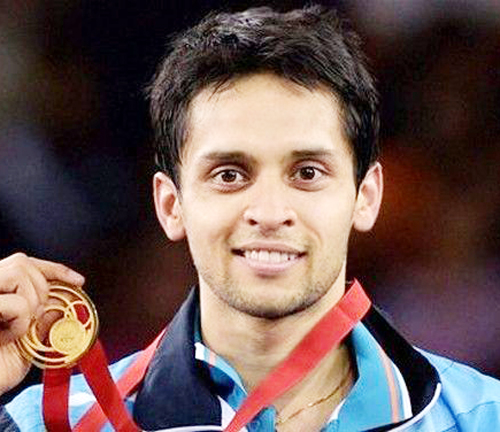
Write a brief description about him in 250 words.
Questions of this week:
1. Who top scored for India in the first innings of the 4th Test match of ongoing series against England?
2. For which team Rajat Bhatia played in IPL-7?
3. Name Indian male wrestlers who won gold medals in the ongoing Commonwealth Games at Glasgow?
4. How many medals India won in weightlifting in recently held Commonwealth Games?
5. Who is Ajay Bhatti?
Answers of the last week:
1. Murali Vijay 2. Kings XI Punjab 3. Babita Kumari 4. Yogeshwar Dutt 5. former International cricketer of J&K.
The best entry of this week was received from Abhimanyu Gupta, H No 71/2 Upper Roopnagar, Jammu..
The other entries of the week were from Tushar Mahajan, H No-55, Lower Laxmi Nagar, Sarwal, Jammu; Sanjay Dhar, R/o Lane No-1, H-No 3, Upper Laxmi Nagar, Sarwal, Jammu; Rajeev Kalsotra from Udhampur;. Sukhdev Singh from Kathua and Dheeraj Sharma from Patoli Brahmana, Jammu.
Dear Contestants, please send your reply within five days to:-
Sports sphere, Daily Excelsior
C/o Excelsior House, Janipur, Jammu. Pin 180007
Or through e-mail: sportsquiz@dailyexcelsior.com