

Dr.Banarsi Lal and Dr.Shahid Ahamad
Forests are useful for human livelihood, soil and water conservation, biodiversity, green house gases, flood control etc. Forests were generally vested with the Government especially after 1947 but usufruct rights of local communities, ethnic groups and tribes continued to be part of management. Irrespective of ownership, forests were treated as open or community resources of local population in the limited sense of traditional rights. Harmonious relationship between official foresters and villagers evolved over centuries on the principles of synergies, obligations, responsibilities, ethics etc. After 1950s commercial demand on forests was increased and regeneration or conservation was ignored by the foresters due to consumerism. Excessive public and private exploitation dwindled productivity or carrying capacity of the resources. Availability of open access goods and services to the poor or disadvantaged sections of the society alienated them from the official opaque process of decision making.
These factors created socio-economic and political conflicts between local stakeholders and so called service providers. Some successful experiments demonstrated that conflicts triggered by forest degrading process could be reversed by restoring transparent partnership among the local communities and forest service. This realization prompted alternative institutional and management strategies based on people’s participation of equitable sharing of rights and responsibilities. The main motive behind was to minimise conflicts and to create new partnership among communities, Government and private sector to ensure forest conservation and its sustainable management. Clarification of forests user’s rights and evolving adaptive policies and programmes were essential for successful implementation of Joint Forest Management. It was accepted that rural people living in and around forest must be brought into the forest management. This strategy involved participatory planning, monitoring, reviewing and strengthening of local institutional structures as well as management agreement.
The earlier forest policies were inadequately responsive to the neoneeds of communities living in and outside the forest areas, while its primary objective was the welfare of the people. The state of economy of the forest-dweller depends on the health of the forests. This strategy was pursued in the National Forest Policy, 1988 which placed emphasis on natural regeneration, preserving biodiversity and adopting management practices which benefited the local people. The Government of India, Ministry of Environment and Forests issued Joint Forest Management Resolution on 1st June, 1990 for the involvement of village community living close to the forests for their protection and degeneration of degraded lands. This policy resolution prescribed benefits to participating communities to meet their demands of forest products by active involvement in afforestation programmes. It paved the way for voluntary agency and non-Governmental organisation to be associated as an interface between the forest departments and the Forest User Groups for the revival, restoration and development of degraded resources. The main features of 1990 Resolution by Ministry of Environment and Forests are as under:
* Develop partnership between communities and forest departments, facilitated by non-Governmental organisations(NGOs).
*Benefits only to the organised communities undertaking regeneration.
* Rights to usufructs to all non-wood forest products to communities subject to successful protection and compliance approved by the state.
* Ten years working scheme involving micro-plans detailing forest management institutions and technical operations to be developed by user organisations with local foresters and NGOs.
* Funding from forest department programmes with encouragement to the communities to seek investments from other agencies.
In 1995, the 1990 Resolution was slightly modified to incorporate women and landless families. The current circular contemplates legal backup of Joint Forest Management committees, 50% general body membership to the women and extension of Joint Forest Management to good forest areas.
The sustainability of Joint Forest Management initiative can be assured only when there is genuine involvement of the community at each level. At present, the communities are performing their duties of protection of forests in a very effective way. Their roles in management, decision-making, access to information etc. need to be strongly strengthened. The foundation of participatory management of forests has been laid. It is the time to build upon these initiatives so that the long-term environmental security and development of forests can be assured.
No organisation can implement major policies, attitudinal and technological changes without complete orientation, change in mind set and training of its staff and communities. Most of the staff members need training in more than one subject which range from courses in basic computer application and advanced applications, watershed management, soil and water conservation techniques and modern nursery and plantation techniques, Participatory Rural Appraisal(PRA) etc. The officials to be trained include the seniors and juniors functionaries as well as members of the communities and NGOs. Human Resource Development (HRD) can play a pivotal role in the continuous and sustained development because ultimately the ability of the department to orient itself to the needs of changing environment would largely depend on the capabilities and attitude of the staff. Successful Joint Forest Management (JFM) depends on a good relationship between the forest department and local communities so that they can work together to mitigate the common objectives. Transparency in Joint Forest Management is of utmost importance.
Joint Forest Management
India and China Army officials meet in Eastern Ladakh on Friday. Another pic on page 6.

India and China Army officials meet in Eastern Ladakh on Friday. Another pic on page 6.
The challenge of hope
M.J. Akbar
Prime Ministers choose one of three options when they step up to the podium at the Red Fort on Independence Day. They speak to their governments; or mumble to themselves; or talk to the people of India. The first is easiest, since government is both narrator and narrative, and can enjoy the false comfort of self-congratulation: we did this [applause]; we will do this [obligatory high-five].
The second option is a consequence of diffidence more than introspection. And if Dr Manmohan Singh made it a habit, it was possibly because introspection told him he had much to be diffident about. Dr Singh was a curious case of a Prime Minister who had to bow before a Supreme Leader in a dysfunctional relationship. He got stuck with the responsibility while Mrs Sonia Gandhi and her temperamental son Rahul Gandhi enjoyed power. The country suffered.
No prizes for guessing Prime Minister Narendra Modi’s preference. He spoke to the people. His problem was not being better than the competition. That would have been too easy. His challenge was to excel himself, after the extraordinary standards he had set during a tumultuous election campaign. Now he had to establish his destination, notch priorities along the perspective and chalk out the route map of delivery, for if you soar without direction you can end up on a long flight to nowhere.
On the morning of 15 August we saw and heard the quintessential Narendra Modi. The horizon was set by his heart, the compass was magnetised by his mind. The thrust of his message was controlled by an elemental idea: India’s progress is not just a Government project; it is a people’s project. As he put it in an eloquent metaphor: if 125 crore Indians take a single step each, then India moves ahead by 125 crore steps.
And so what in previous hands had degenerated into a bookkeeper’s report to the annual general meeting of shareholders, swivelled on a fulcrum that probed, on the one hand, any malaise in national character, and repeatedly dragged our focus towards the curse and indignity of poverty, or the many crimes of gender bias. But this was realism, not pessimism. He also offered a vision that transformed the national mood with the conviction that achievement was not only possible, but within our grasp. The loudest cheers came from the young; the applause of teenage children in the audience at the Red Fort echoed the hopes of hundreds of millions in towns and cities across the land.
The exhilaration was explicable. India had found not just a Prime Minister but also a leader. Narendra Modi asked the questions that no one has raised: Why are we indulgent towards sons at the expense of daughters? Who is responsible for the utter shame of female foeticide? Do we need a law to keep our homes, our streets, our nation clean? When is the poison of caste and communal violence going to end? He challenged Indians to witness the rewards of harmony within ten years. Perhaps it is only the outsider, which is how the Prime Minister described himself, who can clearly see the plain truth of Delhi’s insiders; but it needs leadership to tell the oldest elite of Indian democracy, the governing political-bureaucratic class, that its civil wars had damaged governance to a point where drastic reform was the only alternative.
An obituary notice was read out for the Planning Commission, for the very good reason that it has lost purpose. The significant failure of this body in the last decade has been its smug and arid approach to our gravest national crisis: poverty. A common sense estimate shows that in six decades of planned economy, we have reduced the number of Indians living under the poverty line by only an abysmal half per cent or so every year. This is both astonishing and unacceptable. Moreover, instead of searching for solutions through cooperation with states, the Planning Commission functioned through a series of imperial commands. It told state governments to beg before Delhi, so that they might be awarded their scrap or two. India is a federal nation, in law and practice. The Union Government does not rule directly over any geography other than a few tiny territories. Development works best through state governments. Delhi must be an enabler, not a dictator.
The world, as the Prime Minister noted, is changing. We cannot be insular; we need the creative energy of international cooperation in an era where technological innovation and state-of-the-art manufacturing are largely in the private sector. Jobs, in both industry and agriculture, are the best antidote to poverty, for they link individual welfare to national growth. India must prepare itself, as he said, to become a manufacturing hub of the world.
Prime Minister Modi knows that dreams become a reality only during waking hours. You cannot sleepwalk your way towards enchantment. He has the will to rouse the nation from inertia. The next months will show us how.
Flood water from Basantar entering village Rangoor camp in Ramgarh as bund breaches on Saturday. Another pic on page 6. —Excelsior/Gautam

Flood water from Basantar entering village Rangoor camp in Ramgarh as bund breaches on Saturday. Another pic on page 6. —Excelsior/Gautam
A gateway to heavenly experience
Nagendra Jamwal
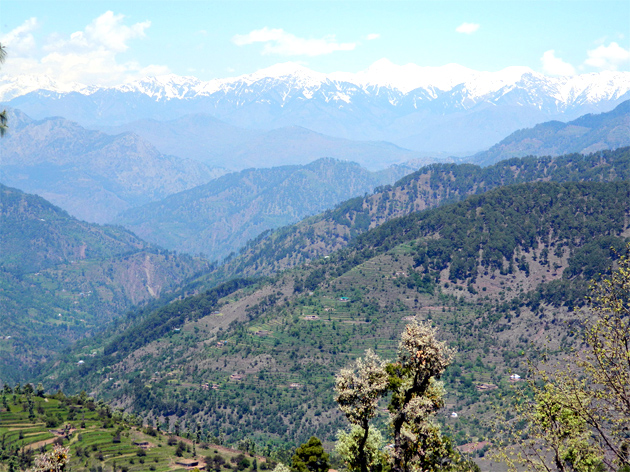 If the sweltering heat of summers and sultriness of monsoon has made you to cringe and forced you to seek refuge in the cool climes, then Kainth Gali- a mountain pass just thirty two kilometers from Udhampur awaits you to provide the cool and refreshing environs to sooth one’s body and soul.
Kainth Gali is a mountain pass at the altitude of 1630 meters between Ladha Dhar having Natha Top in the North-East and Siroli Dhar in the South West. Why it is known as Kainth Gali is shrouded in mystery as the vegetation around the mountain pass hardly contains Kainth trees (Pyrus Pashia) nowadays. May be in the past the mountain pass had large number of Kainth trees. However, even today the pass has lush greenery dominated by Banj Oak tree. Their shiny silver leaves shimmer in the breeze which is a lovely sight to behold. Thickets of blue Pine and Deodar on the adjoining hill tops interspersed by mountain meadows is a sight to be worth photographed.
Kainth Gali was on a ancient trade route from North India to Kashmir as is mentioned by famous traveller Al-Beruni. Al-Beruni has mentioned about a trade route emanating from Kanauj towards the northwest following the foothills of the Himalayas including Billawar, Ladda i.e. the mountain to the left of the Kainth Gali to the fortress of Rajagiri (modern Rajouri) and marching northward to Kashmir valley. Another route which travellers frequented was from Kainth Gali to Lander and then to Ramban. Thus the mountain pass afforded access from Basholi-Ramkot and Udhampur Docn to Panchari- Moungri, Lander and ultimately to Kashmir valley. The location of early medieval temple complexes at Billawar, Babore (modern Manwal) and Krimchi on this route shows the significance of Kainth Gali.
The Krimchi temple structure are just eight kilometers north of Jammu- Srinagar Highway. The Krimchi temple complex was the major staging ground for travellers to Kainth Gali. As one starts ascent from Krimchi Mansar valley, a thick Pine forest on both sides of the road envelops the view. A fresh aroma emanating from green pines wafts through the air thus refreshing the mind and the body.The greenery contrasts with the brown forest floor strewn with the dry Pine needles which is highly inflammable and a major cause of forest fires. Occasionally the red forest soil wherever exposed adds colour to the surroundings. After a ascent of just six kilometers, certain viewpoints afford a Panoramic view of the Udhampur town and the doon on a clear day and is a sight to behold. Every metre ascended enroute to Kainth Gali is escape from the clutches of heat and soothing cool environs embrace a visitor.
Once Kainth Gali is reached, a memorable sight of Pir Panjal range with its snow clad peaks in the near distance leaves the visitor awestruck and the view remains etched in one’s memory for lifetime. During monsoon season, the clouds can be seen ascending from the valley and enveloping the mountains pass in it. During winters the snow covered valley and Pir Panjal in the background attract thousands of tourists from Katra especially when connectivity to Patnitop is cut off. However the visit to Kainth Gali would be incomplete without savouring the authentic Kaladi- type of cheese produced in these parts of the Udhampur and a cup of hot steaming tea.
The importance of Kainth Gali also lies in the fact that two roads emanate from there. On the right a road leads to the famous hill resort of Panchari a offshoot of which goes to Lander. On the left a road leads to Moungri and ultimately to Bomagh area of Reasi which is in the backside of Dhar Shri Mata Vaishno Devi. Just a few kilometers from Kainthgali towards Moungari is a thick Banj Oak forest within which grows the Red Rhododendron locally known as Mitaal. The bushes of Red Rhododendron laden with fully blossomed flowers add natural beauty to the forest. Just as Kainth Gali gives passage from Krimchi Mansar to saucer shape Moungari valley, similarly Dubi Gali and Khour Gali give access to Bhamag area. The whole road length witnesses a number of mountain streams out of which irrigation channels called Kuhls have been created which irrigate the terraced-fields carved out of hills. Many a cascades and water mills add beauty to the landscape.
In the recent years, the people of this region have evinced great interest in horticulture. As a result a large number of orchards of apple, pear and walnut have come up beyond Kainth Gali and has improved the living standard of the people. The existence of temperate agro-climatic zone beyond Kainth Gali is going to be a blessing to the farmers and hospitality industry if properly explored. The Moungri – Panchari area and Bhamag beyond Kainth Gali also abounds with great deal of fauna including Red Indian Jungle fowl, pheasants, Pijjad- a type of mountains goat, and occasionally leopard.
The region beyond Kainth Gali has a natural boundary in Chenab river and can be termed as a heavenly abode- an area of serene natural beauty marked by presence of Shri Mata Vaishno Devi shrine, Shiv Parvati caves shrine at Moungri, the shrine of Sankri Devta situated on a hillock near Panchari, the shrine of Raja Sunkhpal Devta, Bhangan Devta in Bhomag and Sauntal Devta at Gahliote. There is also a annual pilgrimage to Shri Saroli Kalka Mata. A ancient temple dedicated to Kalika Mata is also present in a sacred Deodar grove in Panchari.
In the month of May annual Shiv Parvati Mela also known as Moungri Mela is celebrated. In the month of August a huge religious congregation is held at Sankri Devta. Similarly huge gathering is witnessed in the shrine of Raja Sankhpal in the month of June and Dusshera. Many peaks of adjoining hills of this region have shrines, devoted to local gods or deities.
However, inspite of its historical, religious and geographical value, the tourist potential of Kainth Gali has not been exploited. It is hoped that department of tourism and Patnitop Development Authority would come up with a elaborate plan including construction of view points, wayside amenities and tourist huts and lodges and other infrastructure to enable largescale visits to tourists to this abode of serenity and piousness.
(The author is a KAS officer)
Janamashtami Greetings to All Our Readers.

Janamashtami Greetings to All Our Readers.
inner voice
LORD OF LOVE
Love is not an object but a divine
subject – spiritual and pious, emerging
from the noble thoughts and
rhythmic heartbeats,
disbursing the neat nectar of life for
the sustenance with a secular stamp
and sign…
‘Lord Krishna’ – born to a royal couple,
brought up by a commoner
but a ‘Lord’ always,
said – “I am lucky to have 2 parents,
one to be proud of and the other to be
fond of” – a divine word, spiritual
and supple…
It was heaven’s divine purpose and plan
to incarnate ‘Krishna’ on this planet,
to kindle the flame of love in the
human hearts, to dilute the acridity,
to nourish the lovables and their
love lawn…
Today whole Hindu world is celebrating
Birthday of ‘Lord Krishna’ – divine heart-throb
of millions, busy in a jubilant festival
of dance and singing of holy hymns in ‘His’
praise and utter devotion with zest
and zing…
An Avatar on the earth all-in-one,
no one to come back, confront or consute
but to convert hatred in lucid love,
to win hearts with caring concern and
to conjugate passion with prismatic compassion…
What I pray O Lord is to bless
me with frank and fair love,
to disperse and disburse in total
with devotion, dedication and
determination,
bestow me with divine diagnosis
without any guess…
‘Lord’ on your benign Birthday,
I along with my human fraternity
pray for the universal joy and prosperity
and courage to defeat our vicious whims,
illuminate our ignorance with your
sizzling ray…
– Dr. Roshan Saraf
Time
Time is not like money,
Which can be wasted.
Nor like a pitcure,
Which in book can be pasted.
Time is not like game,
Which can be played everywhere,
Don’t smoke it away like fuel.
Time is not something,
Which can be stored in a sssack.
And time once gone,
Will never come back.
Gourav Praliya
MOTHER
Loving, caring and tender,
All are the words associated with mother.
God could not be everywhere,
So he made mother,
The most wonderful creation of nature.
She is the most important person
in everyone’s life,
As she cares about her child’s life.
The word ‘mother’ evokes powerful
emotion in everyone
As she helps, loves, and understands,
everything of her child.
If the tears, fall down the cheeks of a child,
Her mother will wake up at midnight.
Sleeping on her lap with no regret,
Her smiling face is like heaven,
Her faith has the strength,
Which helps the child to face the world
without fear,
So, mother is that person of everyone’s life,
Who never misguides her child.
So, we should also obey and give
respect to her in our life,
For she is the person who has
brought us to life.
Saksham K Verma
Class: 8th
Never Cry….
Some cry for what
They don’t have
They never see in them
That make them rise
Upto limits of the sky
Just see in you
What can you do
To let all cry for you
When you would be in grave
But you still be brave
Just accept what you have
Leave what you lack
Try to rule the heart
Leave negativity
From you apart
All you need is complacency
And do above your tendency.
Ankush Salgotra
B. Tech 2nd year NIT Srinagar
cipher Decipher
Hi Friends! We are back with your favourite column for the week. Please have a look at OUR MESSAGE before you send in your message to us.
1. To all from Abhi Khullar: “ The greatest pleasure in life is doing what people say you cannot do”.
2. From Sharda Gupta to all: “ Beauty is not in the face; Beauty is a light in the heart and it reflects in your eyes”.
3. To all from Prof Kewal Krishan Gupta: “ An inch of time is an inch of gold but you cannot buy an inch of time worth an inch of gold”.
4. From Abhi Gupta to all: “ The difference between the impossible and possible lies in a man’s determination”.
5. To all from Aagosh Tandon: “ Success is not a result of spontaneous combustion. You must set yourself on fire to achieve it”.
6. From Anil Kumar Nanda to all: “ Pain is only temporary, no matters how long it lasts. It is only to teach you to be stronger”.
7. To all from Rishika Raina: “ Our greatest weakness lies in giving up, the most certain way to succeed is always to try just one more time”.
8. From Akshay Gupta to all: “ All children need to be praised and made much of when they do something good. Only then can we draw the best out of them”.
9. To all from Rishab Raina: “ A creative man is motivated by the desire to achieve, not by the desire to beat others”.
10. From M L Koul to all: “ Life would be more happy if you think of others first”.
11. To all from Rajat Sharma: “ Pluck a flower of success from the garden of education”.
12. From Nazakat Ali Naik to all: “ If you fail to achieve your dreams, change your ways but not your dreams”.
13. To all from Sourav Kundle: “ If you are doing things in a wrong manner then each and every step contributes to our failure from the very beginning, its just at the end, that failure is manifested..!”.
Simon Cowell resurrects Betty Boop for feature film
LOS ANGELES, Aug 16: Music mogul Simon Cowell is making a new ‘Betty Boop’ movie.
The 54-year-old ‘X Factor’ boss will collaborate with Fleischer Studios, which owns the iconic cartoon character, and Australian digital production house Animal Logic, reported Ace Showbiz.
Betty has made numerous appearances on screen. She appeared on Max Fleischer’s ‘Talkartoons’ and then got her own cartoon series. She also made a cameo in 1988’s film ‘Who Framed Roger Rabbit’. This upcoming project, however, will be her first music-driven, hybrid animated comedy.
“Betty is an icon, and one of the biggest stars in the world – I’m thrilled to be working with her. Betty, I’ve worked with some serious divas, but I think you could be the biggest of them all,” Simon said of the feisty starlet famous for her trademark bob hair and mini dress.
Animal Logic’s CEO Zareh Nalbandian said, “I’m thrilled that Animal Logic is part of this exciting new collaboration with Betty. She’s an amazing, iconic and loved character, and we’re going to have so much fun producing her 21st century big-screen debut.” (PTI)
Patricia Arquette returning to ‘CSI’
L0S ANGELES, Aug 16: Actress Patricia Arquette is set to return to ‘CSI’ before taking on the show’s new spin-off.
The actress plays Special Agent Avery Ryan, who heads up the FBI’s Cyber Crime Division that forms the basis for ‘CSI: Cyber’, according to Entertainment Weekly.
Arquette’s character will be reintroduced in CSI on November 2, following a stint in season 14.
The spin-off will be led by Arquette, with Peter MacNicol and James van der Beek among the cast.
It will be the first CSI series to have a female lead and is inspired by Irish Cyber Psychologist Mary Aiken, who will be an executive producer.
‘CSI: Cyber’ is due to start in spring 2015 on CBS, while ‘CSI’ is due to return on September 28. (PTI)