Vocalist Prasant A Samadhar trained talented singers like Shreya Ghoshal and Arijit Singh, but never himself ran for a pure Bollywood playback career. He is now teaming up with maestros Girija Devi and Hariharan for a live stage performance. Shabarni Basu caught up with the singer on music, stage shows and more…
When he was only 14, Prasant A Samadhar was invited to the Rashtrapati Bhavan to perform for the Late Prime Minister Rajiv Gandhi and then President R Venkataraman at the prestigious Mughal Gardens in New Delhi. He received the National Scholarship in Indian Classical Music from the Central Government and later became a scholar at the prestigious ITC Sangeet Research Academy. Inspired and even tutored by Pandit Bhimsen Joshi, the singer can perform a heavy raga, a romantic film song and a heavy-duty fusion number, all with equal ease. Excerpts of an interview: You have paired up the sensational Hariharan, what can the audience expect from such a high-profile Jugalbandhi?
Audience will get something very new. They will understand the difference between film music with that of fusion, light classical and classical music. All will be combined together for the first time on stage. This will also be a learning session for the youngsters and the aspirants of reality shows. They will realize that this is the kind of music that can survive them in long run. It will be a historical event since Hariharan, Girija Deviji and me come together for the first time. It is a combination of three generations. We are aiming to create global unity or rather unity in diversity. Do you feel the same enthusiasm now before your shows even after spending so many years in this field like your first stage performance?
It is more now! Now I am into more creations and innovations. When I performed for first time it was just a show, but now I am more open towards creating something new. I am the first singer from Kolkata to change the format of singing in Dhoti Kurta to jamming with guitar, tabla and keyboards. How does it feel to see your students becoming one of the top singers of the industry?
I am very happy! God gives this opportunity to only a few people. This responsibility was given to me by Kalaynji (of famous composer brothers Kalyanji-Anandji ). He said Prasant you should train them since you know the pulse of 5000 people. He never wanted a person clad in Dhoti-Kurta to train the youngsters. You are a singer yourself, so what gives you more pleasure- to see Arijit, Shreya-bagging awards or when you yourself get one?
It is a big success for me. Am a complete singer now, I have learnt from the guru-sishya parampara (teacher-student tradition). I have performed on stage and now my students are doing the same. This makes me a complete singer now. Do you feel singers now-a-day need to get themselves equally groomed in all other aspects of stage shows besides their vocal training?
Of course! It has to be a combination of all. Where do you feel the Bollywood music stands today?
See, playback singing is a dangerous word, you first need to be a pure singer. People should not think about playback singing. They should become a singer first. It’s like become a pure water so that he or she can take up any singing challenge when required. People now only know certain songs. They download them and then start performing. This in dangerous for our music fraternity. Capitalizing on certain songs is dangerous. I would suggest before you expect something big, become learned and invest yourself in creating something new. Haar maa baap bachhe ko yeh bolte hain ki Maa Saraswati ka shresthh vidya hain sangeet, par bachhe ko yeh sikhate hain chhuttio ke din mein. Music has to be a mainstream profession. A musician can even employ engineers. And what about actors rendering voices to their own songs? Do you think it is bad for the music fraternity?
It’s not okay. The purity or the quality of the music will not remain the same. People will gradually lose respect for the profession. It is very dangerous for the quality of music. People will think anyone can take up singing or any profession. Gradually people will lose respect for each other. We will lose the art of music. Who has been your inspiration in this field?
Pandit Bhimsen Joshi. I respect him deeply as he is the only personality who has stuck to just classical music. He has never deviated from his path. Down five years, how do you intend to contribute in the world of music?
I want to create a dream for everyone to become a “playfront” singer. Playfront means people should sing for themselves. It should be like “this is you, your song” . I want people to become singers and involve themselves in creation and innovation of music rather than running after the playback singing career. (TWF)
Prof. Farooq Fayaz
From the remote past, Kashmir apart from its scenic beauty has been equally appreciated for its rich and colourful literary and cultural pursuits. Even during unfavourable political clime, Kashmiris never lost keen sense of scholarship and artistic zeal and produced monumental works in variegated disciplines of art, culture, literature and aesthetics. True, at different intervals of historical times, Sanskrit and Persian scholarship under the state patronage outshined the chances of literary promotion in vernacular; but the sensible souls, though seemingly illiterate, gifted with creative merit and insight used Kashmiri language as a medium to express their mystic experience. This resulted in the production of vast corpse of Kashmir poetic literature which provided enough chances to sick and sullen Kashmiris to amuse themselves amid political gloom and social strain
Fabricated by specific socio- economic conditions prevailing during 18th and 19th century Kashmir, the Sufi themes constituted the predominant shade of Kashmiri poetry. However, with the beginning of the past century there dawned a new age of socio-political consciousness, which alongside other branches of public life radically influenced the domain of Kashmiri literature as well. Ghulam Ahmad Mehjoor was the first Kashmiri poet to understand this new literary trend and temperament. The major element of divinity and unseen was replaced by human centric aspirations and the reflection of socio-political realities combined with deep sense of love for the soil became the cherished themes of new Kashmiri poetry. Mehjoor’s younger contemporary Abdul Ahad Azad under the new Marxian influence added new element of revolution against social injustice in the growing literary corpse of Kashmiri verse. The two remained dominant voices in modern Kashmiri literary history till 1947.
The shift augmented by Mehjoor and Azad played significant role to acquaint otherwise frozen and monotonous tone of Kashmiri verse with the borders of vibrant literary landscape that was being shaped by new global historical forces and processes .Taking cue from this new literary culture, there emerged a band of young educated writers gifted with exemplary creative mind on literary horizon of Kashmir, who latter days enriched various branches of Kashmiri literature through their writings. This young circle of writers includes Nadim, Kamil, Rahi, Firaq and others.
Following the footsteps of educated literary fellows, Kamil started his literary career by using Urdu as medium of his creative expression. The poet in question immediately shifted to Kashmiri and his shift to Kashmiri proved significant enough on the ground that Kamil’s wide ranged works not only added in terms of quantity to Vernacular literature but his was the remarkable addition to literary corpse of Kashmiri language and literature in terms of its intellectual fertility and richness. No doubt, like his other colleagues in the field, Amin Kamil, under the influence of Marxian literary theory, produced good mass of poetic production but its thematic range was very limited. This is evident from his poetic collection titled “MAS MALLERI”. The collection, though, apparently as the title suggests make one to believe Kamil as a romantic aesthetic abreast with imaginative craft, but contrary to this, a reader discovers undertones of descriptive and addressing style. This set of specific literary behaviour governed by the Marxian influence continued till sixties of the twentieth century after which new literary currents from West began to pour in the neighbouring world. Kamil gifted with an acute degree of wit and vision, very immediately understood the pulse and genuineness of the new literary movement, modified his literary behaviour and outlook and began to see things from the lens of modern literary cultural canons.
From 1960 onwards, Kamil with inborn creative ability comes forward with a mature literary calibre, thought and treatment. Precision, beauty, wit, satire, dramatic treatment and dialogue centric expressions combined with rich, colourful and mysterious background in regional setting becomes the remarkable feature of his literary style. All these qualities provide unmatching originality to his creative style. This distinctive behaviour stands exhibited in his poems like ‘Jungle’, ‘Zero bridge’, ‘Pren Sharah’ and other works in verse. The element of dialogue, theatrical tendency, and symbolic treatment combined together outshine earlier element of description and panoramic. His famous poem “Zero Bridge” symbolically represents the conflict between passion and reason, destiny and endeavour, culmination and concept. As a poet, he is original and provoking. He makes his readers to think about life exclusively in a dispassionate manner and draw results after taking into cognizance multiple forces which keep in shaping the human personality and its various shades. The satirical tone that he adopts, aims at exploring those invisible shades in a given work, which otherwise would fail to seek the attention of the sensitive reader. This does not only apply to his poetic works but it stands true to his prose works as well.
For a long period of time, the assertion has gained momentum that Kamil’s best creative accomplishments stand demonstrated in the form of Ghazal and not in Nazm. I, personally, disagree with the statement on the plea that Kamil was a creative writer par excellence who possessed necessary craft and skill to express his felt experiences in a form he thought suitable for the theme. True, he initiated a path breaking process of experimentation in the form of Kashmiri Ghazal, but that never means he possessed lesser creative merit to conceive, design and articulate a quality Nazm. In his latter poetic collections, alongside the verse in Ghazal, the reader comes across couple of beautiful Nazms on diverse themes.
Every literary production, produced in a given period of time bears imprints of contemporary realities and the milieu of the time. Creative writer seldom attempts to verify truths of his times, instead, complexity and colourfulness of available realities and felt facts do influence writer’s creative personality and these influences unnoticingly stand expressed through metaphoric idiom. Kamil was never a blind follower of convention, he believed in creative innovations which often coaxed him to debase the established literary canons. To quote Kamil: “Time glides so swiftly and with every passing day, it advances new requirements and principles. In the light of these new requirements, I, also attempted to set into motion couple of experiments. This new initiation played a commanding impact on my younger contemporaries and they began to follow the same style. By this assertion, I, never mean that my poems hardly fall short of poetic merit and be treated as unmatching pieces of literary art. However, the truth remains that this style is unquestionably fresh, original and unique.” Kamil exercised considerable influence on the new generation of Kashmiri poets and his style, of course, became a new school of poetic orientation towards the end of the previous century.
Unlike his other contemporary poets, Kamil, through his works articulates a deep sense of detachment from the otherwise established literary traits which according to him lack originality, commitment and truthfulness. This sort of distance brings yet another distinctive feature in his style- i.e.-intense satirical tune. This stands evident in all his works, be it poetry or prose.
Kamil’s creative range is immense, he writes with perfect ease and mastery on themes ranked from every possible sphere of life and a high standard of performance is maintained throughout. The period of poetic activity in his case extended over sixty years.
Besides being a poet with a distinct style, Kamil, by publishing his first and last collection of short stories titled “Kathi Manz Kath” left even his ardent critics spell bound .Kamil had his own ideas about the nature and relevance of fiction writing. For him, Afsana or short story is not a mere matter of relaxation and entertainment but he considers it as a powerful instrument of moral and social suggestion. His short stories present satirically the disillusionment and frustration of contemporary social life. His quick and sensitive imagination enables him to construct his plots and sketch his characters in a manner which provide them larger degree of societal legitimacy and this is the reason why Kamil’s short stories received exemplary recognition from cross sections of Kashmiri society. A serious study of his short stories tends the reader to believe that the author offers variety, flexibility and clarity to vernacular fiction writing.
As a critic and researcher, his craft of analysis and interpretation comes to fore when in his official capacity as chief editor, Kashmiri Sheeraza, Kamil brought out a wonderful collection of Kashmiri Sufi poetry in three volumes. The work gained wide spread appreciation for Kamil as a researcher and after Azad’s monumental work, Kashmiri Zaban aur Shairi, it was acknowledged as the second best endeavour in the domain of Kashmiri literary history. The work offers penetrating insights into the mystic nature and character of Kashmir’s Sufi history and culture. The editorial noting, footnotes, chronological construct and objective interpretation carried in the given work speak volumes about Kamil’s potentiality as a professional researcher.
As playwright and novelist Amin Kamil selects his characters from marginalised sections of Kashmiri society. He presents his characters with all beauty and ugliness against a complex regional sociological background. Like early Victorians, Kamil gives primacy to characters. Incident is used not only to expose a character but also to rope in more characters.
Born in 1924, at Kapren Kulgam, in a respectable family,Amin Kamil, shifted to Srinagar with a purpose to pursue higher education. After doing graduation, he sought admission in law stream in Aligarh Muslim University. On his return to valley, Kamil for a shot time served as a demonstrator in a local city college. After the establishment of J&K Cultural Academy in 1958, Kamil joined the new organization and acted in different positions till he reached to his superannuation. Amin Kamil for his remarkable literary contribution to Kashmiri language and literature has been awarded couple of state and national level awards. His work both in verse and prose has been translated in number of national and international languages.
Neeraj Dubey
In today’s enterprises, multiple vulnerability monitoring and detection, application monitoring and firewall tools are used to manage network threats. Unfortunately, attackers are still succeeding and maintaining beachheads in organizations that don’t even know they’ve been infiltrated until a third party tells them so. This indicates that today’s mixed bag of tools for detection, monitoring and firewalling are not enough. NGFWs grew out of necessity, combining features of multiple tools to give them better visibility and accuracy for detection and prevention of malware and attacks. A Next-Generation Firewall (NGFW) is a hardware – or software-based network security system that is able to detect and block sophisticated attacks by enforcing security policies at the application level, as well as at the port and protocol level. Next-generation firewalls integrate three key assets: enterprise firewall capabilities, an intrusion prevention system (IPS) and application control. Like the introduction of stateful inspection in First-generation firewalls, NGFWs bring additional context to the firewall’s decision-making process by providing it with the ability to understand the details of the Web application traffic passing through it and taking action to block traffic that might exploit vulnerabilities. Next-generation firewalls combine the capabilities of traditional firewalls — including packet filtering, network address translation (NAT), URL blocking and virtual private networks (VPNs) — with Quality of Service(QoS) functionality and features not traditionally found in firewall products. These include intrusion prevention, SSL and SSH inspection, deep-packet inspection and reputa-tion based malware detection as well as application awareness. IT managers in corporate and mid-size businesses have to balance both network performance and network security concerns. While security requirements are critical to the enterprise, organizations should not have to sacrifice throughput and productivity for security. Next-generation firewalls (NGFWs) have emerged as the solution to this thorny problem. Earlier-generation firewalls pose a serious security risk to organizations today. Their technology has effectively become obsolete as they fail to inspect the data payload of network packets circulated by today’s internet criminals. In basic terms, a next-generation firewall applies deep packet inspection (DPI) firewall technology by integrating intrusion prevention systems (IPS), and application intelligence and control to visualize the content of the data being accessed and processed.
Gartner defines an NGFW as “a wire-speed integrated network platform that performs deep inspection of traffic and blocking of attacks.” At minimum, Gartner states an next generation firewall(NGFW) should provide:- a) Non-disruptive in-line bump-in-the-wire configuration. b) Standard first-generation firewall capabilities, e.g., network-address translation (NAT), stateful protocol inspection (SPI) and virtual private networking (VPN), etc. c) Integrated signature based IPS engine. d) Capability to incorporate information from outside the firewall, e.g., directory-based policy, blacklists, white lists, etc.
The SPI generation of firewalls addressed security in a world where malware was not a major issue and web pages were just documents to be read. Ports, IP addresses, and protocols were the key factors to be managed. But as the Internet evolved, the ability to deliver dynamic content from the server and client browsers introduced a wealth of applications we now call Web 2.0. Today, applications from Salesforce.com to SharePoint to Farmville all run over TCP port 80 as well as encrypted SSL (TCP port 443). A next-generation firewall(NGFW) inspects the payload of packets and matches signatures for nefarious activities such as known vulnerabilities, exploit attacks, viruses and malware all on the fly. Organizations are suffering from application chaos. Network communications no longer rely simply on store-and-forward applications like email, but have expanded to include real-time collaboration tools, Web 2.0 applications, instant messenger (IM), and peer-to-peer applications, Voice over IP (VoIP), streaming media and teleconferencing, each presenting conduits for potential attacks. Today, organizations need to deliver critical business solutions, while also contending with employee use of wasteful and often dangerous (from a security perspective) web-based applications. Critical applications need bandwidth prioritization while social media and gaming applications need to be throttled or completely blocked. Moreover, organizations can face fines, penalties and loss of business if they are in non-compliance with security mandates and regulations. In today’s enterprise organizations, protection and performance go hand-in-hand. Organizations can no longer tolerate the reduced security provided by legacy SPI firewalls, nor can they tolerate the network bottlenecks associated with some NGFWs. Any delays in firewall or network performance can degrade quality in latency-sensitive and collaborative applications, which in turn can negatively affect service levels and productivity. Organizations large and small, in both the public and private sector, face new threats from vulnerabilities in commonly-used applications. It’s the dirty little secret of the beautiful world of social networks and interconnectedness: they’re a breeding ground for malware and internet criminals prey on every corner for their unsuspecting victims. Meanwhile, workers use business and home office computers for online blogging, socializing, messaging, videos, music, games, shopping, and email. Applications such as streaming video, peer-to-peer (P2P), and hosted or cloud-based applications expose organizations to potential infiltration, data leakage and downtime. In addition to introducing security threats, these applications drain bandwidth and productivity, and compete with mission-critical applications for precious network bandwidth. Importantly, enterprises need tools to guarantee bandwidth for critical business relevant applications and need application intelligence and control to protect both inbound and outbound flows of traffic, while ensuring the velocity and security to provide a productive work environment. Although NGFWs can increase an organization’s network security and decrease the associated risks, all devices are not up to the task, and proper testing is required to ensure the appropriateness of a particular device.
This starts with knowing your systems, their usage and the risks associated with your environment. Armed with this information, organizations need to compare their baselines against the tools they already have in place to identify weaknesses and create a next-generation system that can meet today’s demands for more integrated and comprehensive network protections. The key for IT administrators is to ensure that the NGFW solution they choose is absolutely scalable to their projected network performance requirements, and which delivers the most robust performance, most useful network analytics and insight, and ease of implementation and administration.
(The author is -Sr. Asstt. Professor, GCET-Jammu)
Dr. Raj Shree Dhar THE UNIVERSE IS UNCREATED, AS THE TIME ITSELF IS, WITHOUT BEGINNING AND END, BUT IT IS BASED ON THE PRINCIPLES…
Twenty billion years ago, something happened- the Big Bang, the event that began our Universe. Why it happened is a greatest mystery. As the big bang occurred, the universe had zero size perhaps a Mathematical Point with no dimensions at all and so must have been infinitely hot. But as the universe expanded, the temperature of the radiation would have been decreased. About a billion years after the big bang, the distribution of matter in the universe had become a little lumpy; as the big bang itself had not been perfectly uniform. Cluster of galaxies fill the universe today.
The suicide rate among galaxies is high. These galaxies are blowing themselves up displaying jets of radiations. Black holes and quasars ranging from millions to billions of times more massive than Sun are suspected in the universe. A quasar is the energy released when gas, dust and star fall into an immense black hole to reach other parts of the universe or even in other universes. In every quasar explosions, millions of worlds, some with life and intelligence may get utterly destroyed.
The discovery that the universe was expanding was one of the greatest intellectual revolutions of the twentieth century. The behavior of the universe could have been predicted from Newton’s Theory of gravity at any time in the nineteenth, the eighteenth or even the late seventeenth century. Will the universe eventually stop expanding and start contracting, or will it expand forever? To answer this question we need to know the present rate of expansion of the universe by measuring the velocities and its present average density.
The present evidence, therefore, suggests that the universe will probably expand forever but we are not really sure about it, it can collapse after at least ten thousand million years, since it has already been expanding for at least that long. This should not worry us since by that time; mankind will long since have died out, extinguished along with the death of our sun.
If the picture of an expanding universe and a Big-Bang is correct, then we must think over more questions. What were the conditions like at the time of Big-Bang? What happened before that? If God created the universe out of nothing, then of course ask next where God comes from. Thus origin of the Universe is an unanswerable question. If God has always existed, then of course universe has always existed. So long as the universe had a beginning, one could suppose that it was created by an outside agency. But if the universe is really completely self- contained, having no boundary or edge, it would be neither created nor destroyed. WHAT PLACE THEN FOR A CREATOR!
If there is insufficient matter to prevent the universe from expanding forever, it must have an open shape extending to infinity in three dimensional analogies. If there is enough matter, then it has a closed shape, curved like a sphere and light cannot escape from it then it is perfectly correct to describe the universe as a black hole. There may be infinite hierarchy of universes, universes within universes, endlessly. To enter these, perhaps a black hole would provide a way.
By mathematical calculation, it has been found that the black holes create and emit particles at a steady rate. The knowledge of Mathematics, Science, the use of all advanced mathematical theories, and an enormous amount of basic mathematics is required to know about the future of universe.
Einstein once asked a question: How much choice did God have in constructing the universe. At least He had the freedom to choose the laws and the principles that the universe obeyed. The usual approach of constructing a mathematical model for the existence of universe cannot answer about its Creator at present.
We have dreams; we have at present undisciplined but ever increasing power. Can we doubt that presently our race will realize our imaginations that it will achieve peace and life, in a universe made lovely than any place or garden we know, going on in widening circle of adventure and achievement?
The time will come when diligent research over long periods will bring to light things which now lie hidden. Many discoveries are reserved for ages still to come. Our universe is a sorry little affair unless it has in it something for every age to investigate. Nature does not reveal her mysteries once and for all.
Old age shelters are a response to capitalist discourse that does not
consider the aged an integral part of the family, writes Onkar Singh.
Seek ye council of the aged for their eyes
have looked on the faces of the years and their ears
have hardened to the voices of life. Khalil Gibran.
Contemporary world seems unlikely to agree with Gibran. The rising popularity of nuclear families,, increasing population of the aged destitutes and proliferation of old age homes and their legitimization by the State and the society apparently point to a glaring disconnect between aged and the family. The aged have everything going against them – their children, the social environment they live in and above all their health. They are a victim of collective conspiracy. One reason seems that old age represents old thoughts that have little relevance to the swiftly changing society of today. Old does not seem to be goldanymore.
Redundant thoughts apart, old age comes with a plethora of physical and mental ailments. Aged people cannot look after themselves least others in the family. Instead they expect to be cared for as dependent on those they had cared for life. But, what a paradox! Whereas all children consider it their legitimate right to inherit property of their parents, looking after them in old age is an unpleasant task that most want to avoid. After all who wants a burden one is better off without?
Aged in the contemporary capitalist society are, in fact, losing relevance. They are a misfit in the new social and economic matrix that the global capitalism is redefining. The joint family system that provided them pivotal role in a household is one of the important pillars of pre capitalist social organization that capitalism has successfully broken. Its replacement by nuclear family has little use for the aged who can better be shifted elsewhere so that labour and consumer markets function more efficiently, hence old age shelters. That is what the old age homes indeed are. Ever thought of a home whose all members are past their sixties?
Separation of the aged from family signals a thought process which implicitly implies that the aged are not an integral part of the family. This frees the children from moral responsibilities of looking after the aged. At the same time it opens up parallel institutions that combine charity and business in running these shelters, thereby fulfilling at the same time welfare objectives of the State. Viewed thus, old age homes constitute an integral part of capitalist expansion in which the State plays ideological role in transformation of the society from pre capitalist to capitalist social order.
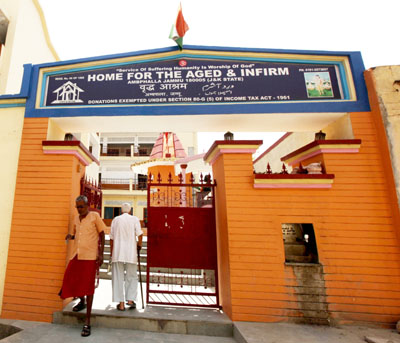
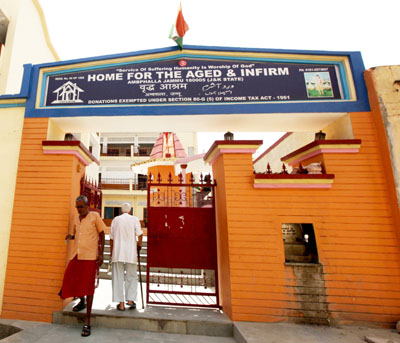
A recent study of Viridh Ashram ofKathua town while revealed on the one hand despondency that prevailed among its inmates, on the other it gave a glimpse of crumbling social order that binds family system. The Ashram that has been in existence for the past almost two decades had 27 inmates whose average age was 75 years, notwithstanding the fact that two of the inmates were above 90 years of age. All were obviously in their twilight years when the need for family members is felt the most. Yet these unfortunate souls were at the shelter running on charity. Where have the values disappeared from the present day generation? Significantly only seven of the inmates were women. It appears women are less likely to leave home than men even under worst of the situations.
The findings further revealed that¾th of the inmates were illiterate,indicating indirectly thatthey must have been labourer throughout their working life leading to greaterprobability of destitution.When asked about their occupation as many as 2/5th told they were labourer throughout their life. Two of the inmates were ex-servicemen and one was a retired school teacher. As many as 52% of the inmates were pensioners.So even education and bank balance are not sufficient to stop destitution in old age.
Another significant finding of the study was that the inmates came from all the major caste groups. Destitution among the aged therefore cuts across class and caste barriers. That was also the case with spatial dimension as well. Although, the Ashram was meant primarily for the aged destitutes of the town and its surrounding areas, yet as many as 52% of the inmates were from far off places including Basohli, Bani, Jammu, Udhampuras also from the districts of Gurdaspur and Amritsar of Punjab. Distance of the Ashram from these places varies between 90 and 140 kms!
Destitution also seems to have intensified in the recent past. While only two of the 27 inmates have been staying in the Ashram for the past 15 years, as many as 62% of them came to stay only during the past 5 years, an indication that destitution among the aged in the region has risen significantly during the past few years.
Our study also found that ¾th of the inmates came to the Ashram voluntarily whereas ¼th came involuntarily. Either way the inmates of the Ashram had to leave their homes due to conditions that were not conducive for them to live with their families;a sad commentary on the present day generation that wants their aged parents to disappear from the home they built and the family they nurtured . After all who leaves one’s home? Not the aged after all. This was confirmed by our further queries on family relations. More than 50% inmates did not have any visit from their family members for a long time. That was also the reason as to why only a little above 50% of the inmates stated that they had visits by the family members at regular intervals and as many as 45% refused to acknowledge having any family relations.
Being old is bad enough. But being old and destitute is worse. The pain of leaving home and family behind by the Ashram inmates has been as torture some as their sufferings from ailments like arthritis, heart diseases, cataract and depression that have crippled them for rest of life with little hope of recovery. They have reached dead end of life. Under such hopeless circumstances the Viridh Ashram has proved to be a boon for these homeless old men and women. But while old age homes do provide a much needed succor to the needy, the national discourse on old age welfare of which such shelters are an integral part, is an ideological stratagem to free young labour of any familial attachment that hinders their supply in the labour market
Old age homes are in fact antithesis of welfare measures that should essentially becentered around the aged insitu. On the contrary, these measures are directed towards fundamental alteration of the concept of family which is being restructured in response to restructuring of the global and local economies. Exclusion of the aged from the family and their junking in old age shelters is a response to such restructuring.
This insidious development on the social front has potentials of destabilizing the social order. It needs reversal which would not be possible without countering capitalism and its ideological ally, the State. This may seem difficult yet the goal is worth pursuing for bringing back the aged to their rightful place in the family.
BEIJING, Nov 15: China today launched a new remote sensing satellite into scheduled orbit from Taiyuan Satellite Launch Centre.
The satellite Yaogan-23 will mainly be used for scientific experiments, natural resource surveys, crop yield estimates and disaster relief, state-run Xinhua news agency reported.
It was carried by a Long March-2C rocket, marking the 198th mission for the Long March rocket family.
China launched the first satellite in the “Yaogan” series, Yaogan-1, in 2006.
The new satellite was put in orbit amid plans announced by China on November 10 to launch around 120 more applied satellites to “accommodate economic and social needs”.
Yang Baohua, deputy general manager of the China Aerospace Science and Technology Corporation, said Chinese economy will continue to record relatively high growth, generating more demand for aerospace technologies.
He, however, did not specify time span during which the satellites would be launched.
“We will focus on building a self-controlled national space infrastructure that can operate continuously and stably for a long time,” he said.
China will launch about 70 remote sensing satellites to detect the near-Earth space environment and predict extreme events and also launch about 20 communication satellites to meet communication demand in national security and public services, he said.
In addition, China will launch about 30 navigation satellites to provide accurate and reliable global positioning and navigation services, he added. (PTI)
MADRID, Nov 15: Lost for half a century, historic photographs of Cuban revolutionary Che Guevara taken by an AFP photographer shortly after his execution have come to light in a small Spanish town.
The dark-bearded guerrilla leader lies in a stretcher with his dead eyes open, his bare chest stained with blood and dirt, in the eight black and white photographs taken after he was shot by the Bolivian army in October 1967.
The photographs belong to Imanol Arteaga, a local councillor in the northern Spanish town of Ricla. He inherited them from his uncle Luis Cuartero, a missionary in Bolivia in the 1960s.
“He brought back the photographs when he came for my parents’ wedding in November 1967,” said Arteaga, 45. “My aunt and my mother told me a French journalist had given them to him.”
He and his aunt found the photos among Cuartero’s belongings after the missionary died in 2012.
“I remembered he had photographs of Che Guevara and my aunt said: ‘Yes, I know where they are,” Arteaga said. “They were in boxes with a load of photos of Bolivia.”
Other rare colour photographs of Guevara’s body by AFP correspondent Marc Hutten, taken after it was laid out by Bolivian soldiers, were published in the international media at the time.
But one of the newly discovered shots seems to have been taken at a different moment. In it, Che appears with matted hair and a jacket crudely buttoned around his chest.
The missionary’s stash of pictures also includes a photo purportedly of the body of Guevara’s revolutionary companion Tamara Bunke, laid on a stretcher with her face disfigured.
An Argentine-born doctor, Ernesto “Che” Guevara came to world prominence as a senior member of Fidel Castro’s revolutionary regime in Cuba.
Hunted by the CIA, he was captured by the military in Bolivia on October 8, 1967, and executed the following day.
His body was displayed to the press in the village of Vallegrande before being buried in secret.
Arteaga believes it was Hutten who gave the photographs to Cuartero, possibly as a means of getting them quickly out of the country.
“He asked my uncle to take the photos because he was the only European leaving Bolivia at that moment.”
After Arteaga rediscovered the pictures, he said, “I searched on the Internet for ‘French journalist Che dead’, and Hutten’s name came up, along with some photos that are just like mine.”
After Cuartero took the photos, his family had no further contact with Hutten, who died in March 2012, shortly before the missionary himself.
Arteaga had the photographs examined by an expert who said they were printed on a kind of paper that has not been made for decades, confirming that they date to the 1960s.
“Hutten told us he had sent four or five reels of photos to AFP in Paris,” said Sylvain Estibal, current head of photography for the Europe and African region at the world news agency. (AGENCIES)
&&&&