

NEW DELHI, June 23: Aluminium prices went up by 0.66 per cent to Rs 106.90 per kg in futures trade today as participants strengthened their positions, supported by an upward trend in base metals pack overseas.
Besides, strong demand in the spot market also influenced metal prices.
At Multi Commodity Exchange, aluminium for delivery in the current month (June) edged up 70 paise, or 0.66 per cent, to Rs 106.90 per kg in a business turnover of 306 lots.
Also, the metal for delivery in July was trading 70 paise, or 0.65 per cent higher at Rs 108.75 per kg in a turnover of 30 lots.
Marketmen said apart from increased domestic demand, a firming global trend in base metals, mainly influenced metal prices in futures trade here. (PTI)
Aluminium futures rise on positive global cues
Mentha oil futures fall 1.67 pc on sluggish demand
NEW DELHI, June 23: Mentha oil prices fell 1.67 per cent to Rs 1,072.20 per kg in futures trade today as speculators trimmed their positions amid sluggish demand from consuming industries in the spot market.
Besides, adequate stocks in the physical market following increased arrivals from producing regions put pressure on mentha oil prices.
At the Multi Commodity Exchange, mentha oil for delivery in June fell Rs 18.30, or 1.67 per cent to Rs 1,072.20 per kg in business turnover of 460 lots.
Similarly, the oil for delivery in July declined by Rs 17.90, or 1.60 per cent to Rs 1,094 per kg in 273 lots.
Analysts said speculators reduced positions due to sluggish demand from consuming industries in the spot market against increased arrivals from Chandausi in Uttar Pradesh mainly pulled down mentha oil prices at futures trade. (PTI)
Zinc futures up 0.69% on overseas trend, spot demand
NEW DELHI, June 23: Supported by a firming trend overseas and pick up in domestic demand, zinc futures prices today edged up by 0.69 per cent as participants built up positions.
At Multi Commodity Exchange, zinc for delivery in July gained 90 paise, or 0.69 per cent, to Rs 130.55 per kg with a business turnover of 37 lots.
The metal for delivery in June month contracts rose 85 paise, or 0.66 per cent, to Rs 130.55 per kg in a business turnover of 622 lots.
Traders said fresh positions created by speculators on the back of improved demand in the spot market and gains in base metals in global market, helped zinc futures to trade higher. (PTI)
Taking care of elders
Sir,
Recently, the World Elder Abuse Awareness Day was celebrated. There are various laws that protect elders but hardly implemented and thus a large section of elders suffer cruelty at the hands of family members, friends and strangers. There is little or no awareness among elders about their legal rights and the effort of Government and civil society groups have not produced satisfactory results. In cities and small towns one can find a large number of elderly people abandoned and thus making them suffer on various counts. It is really heart wrenching that the new generation is not in a position to back them up when elders need them the most. What might be the reason behind this apathy, it can not be justified and as responsible citizens, we must look after our elders and ensure that they do not suffer.
Yours etc…
Vijay Kumar
Kishtwar
Helping the impaired people
Sir,
Impairment in any form- physical, visual or hearing is a great handicap to the affected person who has to struggle a lot to lead a normal life.The greater is the impairment, the less are the chances of success of the impaired person.For example, a person suffering from 40 percent impairment has certainly more chances to get success in comparison to a person who has 75% or more disability.Though, the Government has introduced a system of reservation for the impaired people, it is generally those who having less disabilty,perform better than the severely affected people and thus achieve higher percentage of marks in the qualifying examinations. Thus, they have more chances of being selected for appointment to the Government jobs and those with more severe impairment fail to get good marks and hence the govt jobs.They are more or less fully dependent on their parents or relatives for their sustenance and survival .This it is the duty of the govt to give them relaxation and consider their case on a different level so that they may get justice.The Government also ought to enhance the amount of scholarship for the severely impaired people to enable them to lead a normal life in this age of skyrocketing prices.
Yours etc….
Ashok Sharma,
Udhampur
Kotru’s disappointing comments
Sir,
Mr. M L Kotru’s weekly column “Men, Matters & Memories” on 100 days of Coalition Govt. ( DE June 20) is quite disappointing, not because he holds brief for Mr Mufti Mohd and Kashmiris, to which he actually belongs and have always been associated with, but because he appears to have written his piece on briefing of someone during his sojourn to Kashmir valley without verifying facts. A nationally reputed journalist and highly respected columnist Kotru was expected to be doubly sure about his facts before accusing Jammu of being favourably treated by BJP dominated Mufti Govt. on all issues. He writes that the Govt. has allocated the “AIIMS to Jammu on the insistence of Jatindra Singh”. How ill informed Kotru is! Being anti- Jammu is understandable but saying that AIIMS allotted to Jammu only shows that he has been taken for a ride. This must be true about his other claims including on grants for flood victims.
He questioned, “Why couldn’t Kashmir have an AIIMS?” Mr. Kotru, BJP has given AIIMS to the valley even before the coalition Govt. took oath of office.
I would like to ask him a counter question, Mr. Kotru, why can’t AIIMS be located in Jammu? Doesn’t he know that Kashmir has already a Medical Institute- SKIMS which is equivalent to PGI? A region which has already an Institute gets another one while the other region, Jammu should get none. This is favoritism, Mr. Kotru. People of Jammu are on agitation since 26 April for AIIMS, not only because Kashmir got it but on its merit as Jammu is best suited for an AIIMS which would benefit not only Jammu region but also the people living in the belt of Punjab and Himachal adjoining State border. We are confident that State Govt. would fulfill its written commitment to get another AIIMS sanctioned from central Govt. by 20th July, 2015.
Yours etc…..
K B Jandial
on e-mail
Modern business management
Prof AN Sadhu
A country reeling under extreme demographic pressure is precariously placed in resolving the issue of capital intensive v/s labour intensive technologies or to arrive at an appropriate blend of the two. Recently held elections in Delhi have thrown up new challenges before the Government. Common man is hard pressed and has clearly opted for a new alternative which besides promising corruption free administration, has also promised big concessions such as reduction in electric dues and water charges, curbing price inflation and providing a large number of sophisticated gadgets to monitor women security and similar other things. It will require massive resources which may be hard to become available because of several constraints. Levying more taxes on upper middle class and capitalist class will have its own repercussions which will have to be reviewed in the light of socialist thought on which economic planning was adopted after independence which did not yield the results along the expected lines. This has been sometimes referred to as state capitalism and the present phenomenon is referred to as corporate capitalism. In fact the state capitalismvirtuallydoes not exist now, except in a limited manner. Corporate capitalism is already under fire and has been one of the reasons of BJP’s rout in Delhi elections.What kind of social engineering and economic policy mix will steer the country through the present difficult situation and keep it glued to high growth performance, in order to keep pace with china and other major emerging economies of the world, will be great challenge for the Government. At the home front we need both, the high growth rate as also its trickledown effect among all sections of the society. The programme of inclusive growth will have to be translated from words into deeds to overcome the cynicism, on the one hand, and extreme frustration, on the other. The common man has lost his patience and wants results on the ground.
The issues related to development and environment are being hotly debated all over the world. Environmental degradation and climate change are posing formidable challenges on the development front. Oil and water pollution has become a serious health hazard, particularly, in heavily populated regions of the world. We are faced with alarming decline in forest cover, green patches, water bodies and open spaces for uninterrupted flow of rain and flood waters. Global warming has started melting glaciers and causing serious distortions on climate front. Disposal of industrial waste has become a serious problem. Environmental issues have therefore assumed great importance in economic development of the country. Shrinking agricultural spaces are driving out people from rural areas and burdening the cities with extended slums and allied problems. Water scarcity is posing a serious challenge of water sharing between the regions, both, within the country and across the international borders. Unless, therefore, the environmental issues are properly addressed, the economic development may get seriously hampered.
Most of the countries of the world are witnessing demographic transition. The death rates have fallen considerably all over the globe while on the other hand, in highly populated countries, the birth rates continue to remain high resulting into larger young populations. In fact the world is becoming younger. In our own country about sixty per cent population is below the age of thirty five years. The labour surplus economies have to devise means of transforming this young population into a productive resource, failing which, there will be rising unrest in the youth. Stress will have to be placed on skill formation and raising the competitive levels of the young. The whole issue of prioritising or otherwise of higher education against technical and professional institutions shall have to be revisited very carefully keeping an eye on global job market.
The issue of balanced regional development needs a fresh look. The eastern part of the country, in spite of being rich in natural resources, still lags behind and north-eastern states are also not in a comfortable situation. A vast country with such a large diversity shall have to move forward with an equal attention to all the regions. Even on the global level, this issue is assuming greater importance. Unless all the regions of the world enjoy a level playing field in, in the, emerging economic order, economic issues may become more contentious in the coming years. Ever since the establishment of WTO, sharp difference among the member countries have been coming to the surface in each of its meetings. The developing countries have become more forceful in articulating their concerns and seeking a due share in world trade and commerce besides bilateral and multi-lateral arrangements on more favourable terms.
The good governance and institutional management is key to success. The present government has been given the mandate on that score. The corruption free and the efficient Government carrying out the programmes of inclusive growth, honestly and successfully will steer the country through the difficult times. The efficient monetary and fiscal management is required, on the one hand and on, the other constant endeavour of enhancing the competitive levels to stay in the global market is a challenge to be met.
The subject of management has assumed considerable importance in today’s world. Be it economic planning, be it public administration or be it the corporate world, management plays a crucial role everywhere. Management is more particularly associated with business methodology as initially it is in the corporate sector that it developed. As the economic domains widened within and outside the national boundaries, the necessity of management techniques grew proportionately. Initially the subject of management evolved as a kit of functional tools to facilitate the business processes across the globe more efficiently and profitably. Even though the subject developed as a workable synthesis of economics, commerce, statistics, mathematics and public policy but it has now grown into a full-fledged discipline of specialised knowledge. The fundamentals of management are no longer restricted to business alone; these have become equally useful in economic planning and public administration as well. The emerging management issues and challenges are * Globalisation of business, * Consumer satisfaction, *Ethical corporate culture, * Focus on employee ship and * Innovative management practices.
It is through multinational corporations that the phenomenon of globalisation emerged. Emergence and subsequent multiplication of MNC’s necessitated not only the movement of goods and services but transfer of technology, capital, labour and information across the national boundaries. This initiated the process of global integration. We are now living, virtually, in boundary less world. The primitive concept of self-sufficiency has since given way to the concept of self-reliance which has significantly increased the inter-dependence of nations and which, in turn, has increased the requirement of imports and exports. As a result of globalisation, the competition has increased and in order to survive in modern business world, management practices have to be based on sharper tools, possible only through the transfer of information and technology across the globe. Global business managers are faced with a big challenge of developing cost efficient and quality intensive business practices to stay in international reckoning. More and more business organisations tend to become global, and to manage business in cross cultural environment, business executives have to be trained accordingly. Globalisation, therefore, is not a challenge for economics alone; it is a challenge for management as well.
Consumer sovereignty is supreme. The relative scarcity apart, consumer satisfaction is the determining factor for success in any business.
In the availability of whole range of products, business organisations have to face stiff competition in reaching the consumers and selling their products to them. The consumer satisfaction has become a multiple function of the product content, brand name, packaging and salesmanship; necessitating continuous quality up gradation and competitive edge. Business ethics has also assumed greater importance these days. All the governments have framed laws to check unethical practices and ensure the supply of genuine goods and services to the customers. Business organisations are required to adhere to these ethical and legal norms while operating in the national and global markets. The ethical business norms have to be responsive to social norms, values and attitudes. The business managers have to understand their social responsibilities and base all their decisions on ethical norms. Many a times it so happens that in the race of getting maximum profits, some business organisations resort to unethical business practices and dupe the consumers. The young business managers have to be so trained that they stop these practices and develop more scientific ways of meeting their targets without violating the moral code of business. To fulfil this social responsibility is a big challenge for management. Social responsibility may not deal with consumers alone, it also has to deal with shareholders and other people connected with it. Quality, price, pollution and creation of employment opportunities are all, the elements of social responsibility.
One of the important aspects of modern business management is the shifting of emphasis to employee ship. In the traditional management practices, the employees would be required to work strictly within the frame of instructions given to them by the boss. This is now undergoing a change and employees are asked to innovate and evolve their own methodology and aim at maximising the returns to the business organisation. This leads to innovative methods and creativity among the young business executive. Innovation and change is very important. The business organisations ignoring it , face every prospect of going out of business because technology is changing fast, new products are entering the market at short intervals and consumer tastes and expectations are constantly changing. The wide exposure through print and electronic media, of new products, is posing formidable challenges to the business managers compelling them to keep pace with fast changing business environment.
Saffronisation V/s Secularism
Prof. M.K.Bhat
The application of any inherited knowledge whether Yoga, astrology or Ayurveda for the betterment of society is being termed as saffronisation by some while as others hold pride in applying such knowledge to every walk of life. The total neglect of this knowledge as dogmatic in the last 67 years of our independence had made it indifferent in India while as its acceptance worldwide has been growing over the years. The lack of political will to assess its validity or applying it also contributed to its decay. The best example in this context is Yoga, in America one out of every 6 families is performing yoga while as in India credit for reviving it goes to Baba Ramdev in recent years, otherwise the young generation was almost unaware of it. The governments even after knowing the better uses of this inherited knowledge have worked one step forward two step backward strategy for the political reasons. India may be perhaps the only country where people have to think twice before applying anything of yesteryears for the benefit of its people. Indian traditional knowledge has acquired laurels worldwide and is not against any sect or a community. Had it been so, the various faiths would not have flourished in India rather the Indus civilization could not have existed for so long when other civilizations of that era lost their breath much before? It is this adaptability that makes Indian ethos evergreen.
Swami Vivekananda had very well said that people of India would not have taken his sayings seriously, had he not got high acceptance in the Chicago conference. The situation has not changed despite attaining our independence in 1947. People try to accept things only after the west endorses such traditional knowledge. Many eyebrows were raised by the so called secularists against Yoga despite the world endorsing it as a good step for good health. It may be pointed here that the protagonists and antagonists of traditional knowledge are at loggerheads. Protagonists sometimes want to apply certain concepts which bear least relevance in the present time while as antagonists are out and out to suspect anything irrespective of logic or relevance. They pose themselves as self styled guards against safronisation and even try to find fault within the saffron on the bases of caste and so on. These people in fact have lead to the alienation of minorities especially Muslims from the main stream. These secularists see red in every move of the present government, but the fact remains that despite their rule in the country in the last 67 years of our independence, minorities have not reached to any remarkable position. They rather used minorities for their benefit over the years. On the contrary in the last one year of the Modi government, we have not come across a single policy with its sectarian outlook. Its star policies like JhanDhan Yojana or the insurance policies bear attraction for all and acrimony for none. There is no special attention for any sect so no division in the society. It seems that government realizes that everyone wants to have a comfortable life and problems pinches equally to all .The secularists applied the British principle of divide and rule for their self interest and are feeling nowhere due to the growing acceptance of the present regime among the minorities.
The big challenge before Indian Intelligentsia at present is how to use the traditional acquired knowledge for the betterment of society .Some believe it should be incorporated in schools and colleges across the country while as others want its proper scrutiny before application and there are still others who may try to restrict its application. There are too many questions being raised in favour and against, it is a hard fact that Vedas were written much before various religions came into existence so there is no chance of any bias in them, if they contain anything good why that should not be applied in the schools and colleges . If yoga leads to good health why it should not be taught in schools and colleges .why secularists feel pained in celebrating Yoga day when it was endorsed by 48 Muslim countries , Are Indian Muslims more Muslim than them. The stubbornness of secularists makes sometimes to suspect their intelligence and at other times makes one to suspect their intentions for the development of minorities by keeping them away from the mainstream for political purposes.
It may be said to the credit of various Muslim organizations that boldly supported yoga initiatives in the country. Their steps have conveyed to the pseudo secularists that Muslims better understand what is good for them and need not to rely on the advice of the secular brigade. The secular brigade has not only alienated minorities from the main stream for their self interest but their undue attention is getting reactionary from the majority thereby polarizing the elections or making it easy for the fanatic groups in majority to increase their influence.
Muslim being the biggest minority generally falls in their trap because of illiteracy and lack of leadership. It today people like Sir Syed Ahmed Khan ‘Zakir Hussain to lead with a vision. Partition made it leaderless as the elites among the community opted for Pakistan and made those left as a pawn in the hands of people with low vision.
The Muslims of India feel proud of Indian culture and heritage because it belongs to them also .It is equally a history of their ancestors too. The big stories regarding eating beef, statement by a mad politician , doing yoga or getting places on rent are more a media creation rather than based on reality .It is beyond any doubt that average Muslim respects the sentiments of others like any other community. Secularists in order to keep their business intact rake up sentimental issues and make them point of prestige for the minorities. The matter of the fact is that average Muslim wants economic development, education, health and social well being of their people.
India bears different faiths, ways of living, customs, languages but its common culture binds it together. All the people of this country have same feelings. They have grown wayward because they get an education in schools and colleges which has least relevance towards their development as genuine human beings. They are taught self interest rather than social good .This makes them good technocrats but fail to be good human beings. The education based on the teachings of our ancestors can help us a lot in mitigating various social problems and can lead to integral human development.
The so called secularists raise their eyebrows against such an education system for cheap publicity, get an overwhelming support from media ,political class and the irrelevant educational set up. In the present education setup anything and everything foreign is being taught to propagate alien concepts in young minds. Criticism is good for the health of any democracy, but criticism for the sake of it is bad.
The tussle between secularists and saffronites must settle down for sometime so that an average Indian can think beyond flimsy grounds for his good.
(The author is Sustainable Development Deputy Director (M.A.I.M.S) Guru Gobind Singh Indraprastha University, New Delhi)
MoS for Education, Priya Sethi during her visit to Panjbakhtar temple on Tuesday.
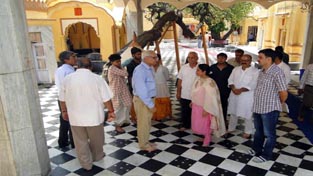
MoS for Education, Priya Sethi during her visit to Panjbakhtar temple on Tuesday.
Minister for CA&PD Ch Zulfkar Ali chairing a meeting at Srinagar on Tuesday.
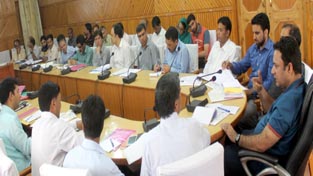
Minister for CA&PD Ch Zulfkar Ali chairing a meeting at Srinagar on Tuesday.