Sunday, May 10, 2026
E-Paper
Home Blog Page 63

India grateful to Vietnam for strong condemnation of Pahalgam attack: PM

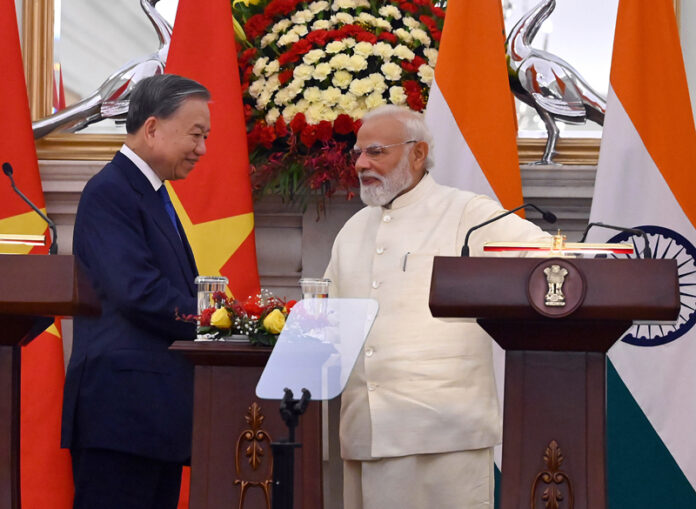
Prime Minister Narendra Modi with Vietnam President To Lam at the Hyderabad House in New Delhi on Wednesday. (UNI)

Both nations set USD 25 bn trade target

NEW DELHI, May 6: India and Vietnam on Wednesday elevated their ties to an enhanced comprehensive strategic partnership and set a USD 25 billion annual trade target by 2030 as Prime Minister Narendra Modi and Vietnamese President To Lam held talks focusing on expanding bilateral ties in areas of trade, defence, and critical minerals in the face of increasing geopolitical upheavals.

Follow the Daily Excelsior channel on WhatsApp  
Following the Modi-Lam meeting, the two sides signed as many as 13 agreements which will provide for deeper two ways engagements in a range of areas including digital payments, rare earth minerals, pharmaceuticals, education, banking and culture.
Modi and Lam also deliberated on the situation in the Indo-Pacific amid China’s increasing assertiveness in the region, and agreed to continue to contribute to the rule-of-law, peace, stability, and prosperity.
It is understood that China’s growing military muscle-flexing in the South China Sea also figured in the delegation-level talks between the two sides.
Elected as president earlier this month, Lam began his first state visit to India on Tuesday, leading a high-level delegation for a three-day trip.
“A decade ago, Vietnam became India’s first comprehensive strategic partner in ASEAN (Association of Southeast Asian Nations) . Since then, our relations have made rapid and comprehensive progress,” Modi said in his media statement.
“Building on this strong foundation, today we are elevating our relations to the level of Enhanced Comprehensive Strategic Partnership. We will now advance our partnership to even higher goals,” he said.
“Our cooperation will reach new levels in every area ‘“ culture, connectivity, and capacity building, as well as security, sustainability, and supply chain resilience,” Modi added.
He noted that the bilateral trade between India and Vietnam has doubled in the last decade to reach USD 16 billion and that the target now is to increase it to USD 25 billion by 2030.
Modi also cited a plethora of agreements signed between the two countries to emphasis that the economic engagement is expected to witness a significant upswing going forward.
“The MoU between our drug authorities will now increase access to Indian medicines in Vietnam. Exports of Indian agricultural, fisheries, and animal products to Vietnam are also set to become easier. Very soon, Vietnam will taste India’s grapes and pomegranates,” he said.
The two sides also agreed to update the India-ASEAN trade agreement by the end of this year. “This will provide a new impetus to trade and investment between India and all ASEAN countries. New initiatives in critical minerals, rare earths, and energy cooperation will ensure the economic security and supply chain resilience of both countries,” Modi said.
“To boost financial connectivity, we have today decided to enhance cooperation between our central banks. India’s UPI and Vietnam’s fast payment systems will soon be linked. Furthermore, we are strengthening state-to-state and city-to-city cooperation between the two countries,” he noted.
Modi said India is grateful to Vietnam for its strong condemnation of the Pahalgam terrorist attack and standing with India in its fight against terrorism.
“In this era of global turmoil and economic challenges, thanks to their talent, good governance, and economic reforms, India and Vietnam are emerging as the world’s fastest-growing economies,” he said.
“Now, through our enhanced strategic partnership, we will support each other’s rapid growth. As the Buddha’s teachings say, ‘If you light a lamp for someone else, it also illuminates your own path’,” Modi said.
He also described Vietnam a a key pillar of India’s Act East Policy and Vision Ocean.
“In the Indo-Pacific region as well, we share a common outlook. Through our strengthening defence and security cooperation, we will continue to contribute to the rule-of-law, peace, stability, and prosperity,” he said.
The Prime Minister said India will broaden its relations with ASEAN with Vietnam’s cooperation. In his remarks, Lam said both sides agreed to deepen political trust and elevate security cooperation.
Last year, the two sides inked a pact to set up a framework for submarine search, rescue and support mechanism. They also signed a letter of intent (LoI) to strengthen bilateral defence industry collaboration. (PTI)
Star Kid India Season 3 auditions held

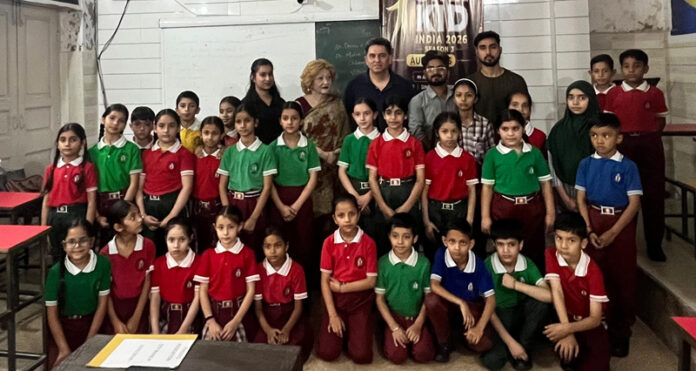
Dignitaries posing with young participants during the programme.

Excelsior Correspondent

JAMMU, May 6: INARA Welfare Foundation organized auditions for Star Kid India Season 3 (2026) at Tiny Tots School, Residency Road, Jammu, witnessing enthusiastic participation from young talents across dance, singing, modelling and other creative performances.
The auditions were held in three age categories—below 5 years, 5–10 years and 10–14 years—where participants showcased confidence, creativity and stage presence. The event was conducted smoothly with the support of Deepak Handa, President of INARA Welfare Foundation, and Veena Handa, Principal, Tiny Tots School.
From Team INARA, Aman Gupta, Founder of INARA Welfare Foundation, along with Tazim and Minalika Rajput, were present on-site to oversee and conduct the auditions efficiently.
Selected participants from this round have qualified for Round 2, which will be held on Saturday at Wave Mall on the occasion of Mother’s Day, offering a larger platform to celebrate and promote young talent.

Dr Jitendra addresses first batch of Academicians, Scientists trained in administration

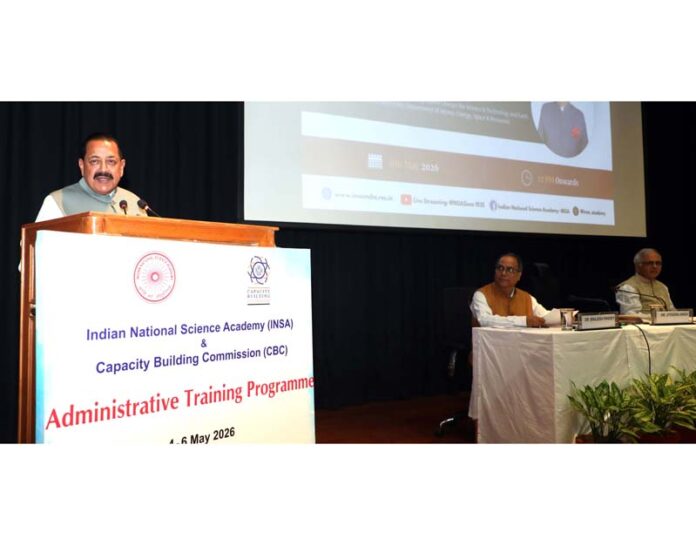
Union Minister Dr Jitendra Singh addressing the valedictory session of the first INSA-CBC Administrative Training Programme at the Indian National Science Academy (INSA) at New Delhi.

Excelsior Correspondent
NEW DELHI, May 6: Union Minister of State (Independent Charge) for Science & Technology; Earth Sciences and Minister of State for PMO, Personnel, Public Grievances and Pensions, Department of Atomic Energy and Department of Space, Dr. Jitendra Singh today presented certificates and testimonials to the first batch of Academicians and Scientists receiving a formal training course in administration and governance.
Dr. Jitendra Singh described the 3-day programme as a first-of-its-kind initiative jointly organised by the Indian National Science Academy and the Capacity Building Commission under the broader vision of Mission Karmayogi. He noted that the initiative emerged from discussions on the gap between scientific expertise and administrative preparedness, particularly for scientists at senior levels who often move into institutional leadership without formal training in governance systems, procurement rules, parliamentary procedures and public administration.
Dr Jitendra Singh said that scientific excellence alone is not sufficient to lead modern institutions, emphasising that scientists moving into leadership roles must also be equipped with governance, administrative and financial management capabilities. Addressing the valedictory session of the first INSA-CBC Administrative Training Programme at the Indian National Science Academy (INSA), New Delhi, the Minister highlighted the growing need for structured administrative training for scientists assuming institutional leadership responsibilities.
The Minister stated that India today stands at a critical juncture, with its scientific ecosystem making global contributions in areas ranging from space exploration and vaccine development to quantum technologies and deep-sea missions. However, he stressed that institutional leadership, resource management and strategic decision-making would be equally important in determining the future trajectory of India’s scientific growth. Referring to Mission Karmayogi, he said the initiative represents a shift from rule-based to role-based governance and from compliance-oriented administration to competence-driven public service.
Highlighting the importance of continuous capacity building, Dr. Jitendra Singh said the programme should not remain limited to a pilot initiative and called for its institutionalisation as a recurring national-level training platform. He also referred to the integration of such learning mechanisms with the iGOT Karmayogi platform, noting that digital platforms can help scale similar training initiatives across India’s scientific establishments.
Addressing the participants directly, the Minister urged them to apply the learnings from the programme within their respective organisations and emerge as change agents capable of improving institutional systems and governance practices. He emphasised that transparency, efficiency and accountability in the use of public resources are moral responsibilities attached to leadership positions in publicly funded scientific institutions.
Prof. Shekhar Mande, President, INSA, highlighted that the programme was conceptualised to strengthen the administrative and institutional capacity of scientists working across government scientific departments and organisations. He noted that 23 scientists from institutions including ICMR, CSIR, DSIR, DST, Ministry of Earth Sciences and DRDO participated in the programme, which covered themes such as administrative vigilance, strategic decision-making, leadership in science governance, public service values, financial management and public decision-making processes.
Dr. Brajesh Pandey, (Executive Director, INSA) highlighted that the programme reflected a larger effort to build institutional and administrative capacities within India’s scientific ecosystem. He underlined the importance of equipping scientific leaders with governance and management capabilities in line with the vision of Viksit Bharat 2047. He also referred to the role of emerging technologies, digital governance systems and collaborative institutional mechanisms in strengthening science administration and public service delivery.

65% of newly elected Bengal MLAs face criminal cases; 61% are ‘crorepatis’: ADR

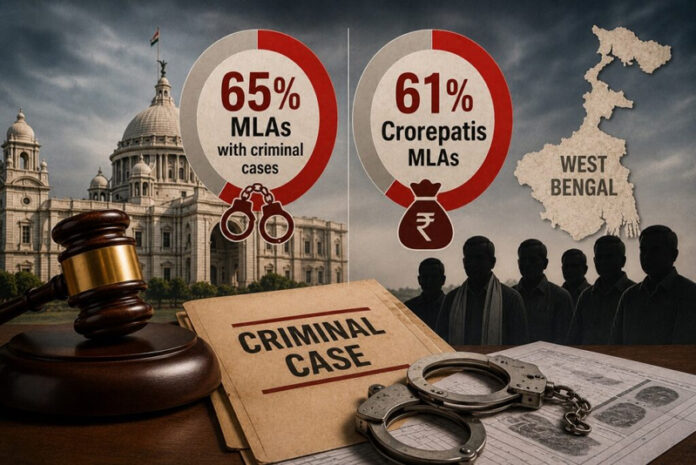
NEW DELHI, May 6: As many as 65 per cent of newly elected legislators in the West Bengal Assembly have declared criminal cases against themselves, marking a sharp rise from the previous election, according to a report by the Association for Democratic Reforms (ADR).
The report, which analysed affidavits of all 292 winning candidates in the 2026 Assembly polls, found that 190 MLAs (65%) have declared criminal cases, up from 142 (49%) in 2021. Of these, 170 legislators (58%) face serious criminal charges, compared to 113 (39%) in the previous Assembly.
Among serious offences, 14 winning candidates have declared cases related to murder (IPC Section 302), while 54 face charges of attempt to murder. Cases related to crimes against women were declared by 63 winners, including two candidates who have disclosed rape charges.
A party-wise analysis showed that 152 of 206 winning candidates (74%) from the Bharatiya Janata Party have declared criminal cases, followed by 34 out of 80 (43%) from the All India Trinamool Congress.
All winning candidates from smaller parties like the Aam Janata Unnayan Party, the Communist Party of India (Marxist), and the All India Secular Front have declared criminal cases. In contrast, both winning candidates from the Indian National Congress have no criminal cases.
The trend is similar for serious criminal cases, with 68 per cent of BJP winners and 31 per cent of Trinamool Congress winners facing such cases.
The ADR report also highlighted the growing wealth among elected representatives. Of the 292 winners, 178 (61%) are crorepatis, up from 54 per cent in 2021. The total declared assets of all winning candidates stand at Rs 1,091 crore, with an average asset of Rs 3.73 crore per MLA, significantly higher than Rs 2.53 crore recorded in the previous Assembly.
Among major parties, the TMC MLAs have average assets of Rs 5.36 crore, followed by BJP legislators at Rs 2.97 crore. The two Congress MLAs reported the highest average assets overall at Rs 17.92 crore.
On educational qualifications, 63 per cent of the winning candidates are graduates or above, while 32 per cent have studied between Class 5 and Class 12. A small number of legislators reported minimal formal education, including one candidate who declared himself illiterate.
The age profile shows that the majority of MLAs (63%) fall in the 41-60 age group, while only 16 per cent are between 25 and 40 years. Around 20 per cent of the legislators are aged between 61 and 80, with three candidates above 80 years.
Women remain underrepresented, with only 37 out of 292 MLAs (13%) being female, a slight decline from 14 per cent in 2021, the report noted.
The ADR report underscored persistent concerns about the criminalisation of politics and the rising concentration of wealth among elected representatives in one of India’s key states. (PTI)

Don’t expect any Cabinet expansion: Farooq

‘Op Sindoor has paid dividends’

Suhail Bhat

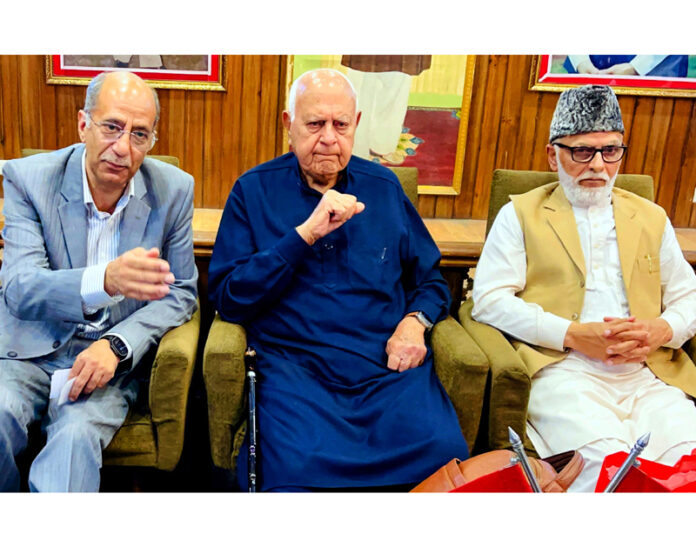
SRINAGAR, May 6: National Conference President, Dr Farooq Abdullah, today ruled out any immediate expansion of the Council of Ministers, dismissing speculation that has circulated in recent days about additions to the National Conference-led Government.

Follow the Daily Excelsior channel on WhatsApp  
“Don’t expect any cabinet expansion,” Abdullah told reporters at the party headquarters, Nawa-e-Subah, responding to questions about whether the Government planned to induct more ministers.

Click here to watch video

His remarks come amid rumors that the government led by Chief Minister Omar Abdullah could soon expand its cabinet. The Jammu and Kashmir government currently has five cabinet members, including the Chief Minister.
Speaking on “Operation Sindoor,” Abdullah said the operation had “paid its dividends” and reiterated his opposition to war. “Wars do not bring solutions. They bring problems,” he said, pointing to the destruction in Ukraine and instability in the Middle East as examples.
Addressing broader political developments in West Bengal, Abdullah said, “The results have come. Mamata is not accepting it. She says that rigging has been done there.”
He also noted shifting political dynamics elsewhere, saying a new government is being formed in Tamil Nadu, the Congress party had won in Kerala, and the Bharatiya Janata Party had secured victory in Assam.
When asked about the influence of SIR, Abdullah said, “Yes, there is an impact of SIR and other things,” without elaborating.
Abdullah, however, dismissed concerns about an impending war in the Middle East. “No, I do not think so. Don’t worry. The world is not ready for war,” he said, citing worsening economic conditions worldwide.
The NC Chief warned that conflict in the region would have severe global consequences due to its concentration of oil and gas resources. “All the petrol and gas is in the Middle East. If there is pressure on this, the condition of the world will get so bad that it will be difficult to survive,” he said, adding that no country wants another war.
Responding to questions about India’s strength, Abdullah said the country was already strong and questioned what more was needed.
On recent reports of explosions in Punjab, he downplayed concerns. “There are always blasts in India. Don’t worry,” he said.
Addressing criticism from opposition parties over issues such as Article 370, statehood and unfulfilled election promises, Abdullah dismissed the attacks. “I think it is a very good thing. This is their job. If they don’t do their job, how will they survive?” he said.
“They can lie and do whatever they want. Our party is doing what it is supposed to do. We will not back down.”

Kashmiri Pandits protest against NFSA integration, minor scuffle with police

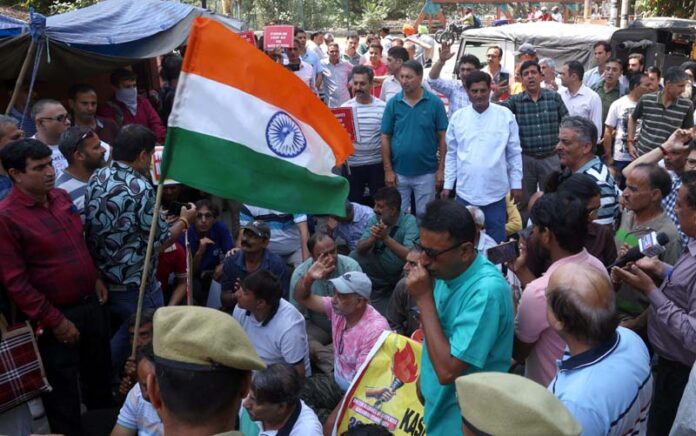
Kashmiri migrants holding protest in front of Relief and Rehabilitation Commissioner's office at Jammu on Wednesday. -Excelsior/Rakesh

Excelsior Correspondent
JAMMU, May 6: Displaced Kashmiri Pandits protested here on Wednesday against the Jammu and Kashmir administration’s move to integrate ration cards into the National Food Security Act (NFSA). Minor clashes broke out between demonstrators and police as they attempted to march towards the Relief Commissioner’s Office.

Click here to watch video

Terming the move a “conspiracy” to dilute their migrant and genocide victim status, the protesters vowed to intensify agitation if the decision is not rolled back.
Hundreds of members of the displaced community, representing groups such as the United Alliance of Kashmiri Displaced Community, Panun Kashmir and various migrant camp residents, joined the protest march, which was also supported by Shiv Sena.
The protesters, including residents of Jagti, Purkhoo, Nagrota and Muthi migrant camps, assembled on the road outside the Relief Commissioner’s Office and raised slogans against implementation of the NFSA.
As they tried to move towards the office, a heavy police contingent stopped them, leading to brief scuffles and pushing between the two sides, said officials.
Police later dispersed the crowd. Afterwards, the protesters staged a sit-in and raised anti-Government slogans.
Community leaders described NFSA as a “black law” and a “trap” for Kashmiri Pandits, alleging that its implementation would dilute their distinct identity as displaced persons and affect their rehabilitation rights.
“It is a black law and a trap for the community to dilute their identity as genocide survivors. The discrepancies in this law amount to outright injustice. For 36 years, Kashmiri Pandits have suffered after their displacement, and now under NFSA, our identity is being diluted,” said Panun Kashmir convenor, Dr Agnishaker who also addressed the protestors.
“We urge the authorities to reconsider the decision pragmatically and address the community’s genuine concerns. In its present form, this is anti-community,” he said.
He also expressed concern over the upcoming census, demanding recognition of their distinct identity as internally displaced persons and victims of genocide.
“If our identity is not included, it will amount to erasing Kashmiri Pandits forever,” Agnishaker said.
Another leader, Arvind Kaul, alleged that their fundamental right to peaceful protest was being curtailed.
“It is our fundamental right to protest peacefully, but we are not even being allowed to do that,” he said, demanding restoration of their rights and continuation of the existing relief system.
He sought permanent rehabilitation for the displaced community, stating that they neither have homes nor their homeland, yet are being asked to register Kashmir as their permanent address.
Echoing similar sentiments, community leader Sunil Pandita said the displaced population would continue their struggle until a permanent and dignified resolution to their displacement is achieved.
“We strongly oppose these laws being imposed on us repeatedly. We will not step back until our demands are met,” he said.
The protesters warned of a larger agitation if their concerns are not addressed, reiterating their demand that the Government focus on rehabilitation in Kashmir rather than altering the relief distribution mechanism.
Those who addressed included Sunil Fotedar of Vision Kashmir, Veer Ji Raina of Thinkers Forum, Ravi Ji ASKPC, Youth 4 PK, Dilip Pandita Victims of Terrorism, Sunil Pandita of Jagti Migrant Welfare Movement, M K Razdan of Durga Nagar Committee, Buta Nagar Camp representatives, Mohan Lal Comrade, Bharat Kachroo, Desh Rattan of AIMCCC, Manesh Sawhney president, Shiv Sena, Ravinder Koul of Relief holders and Sanjay Chowgami.

Young athletes shine at zonal sports meet

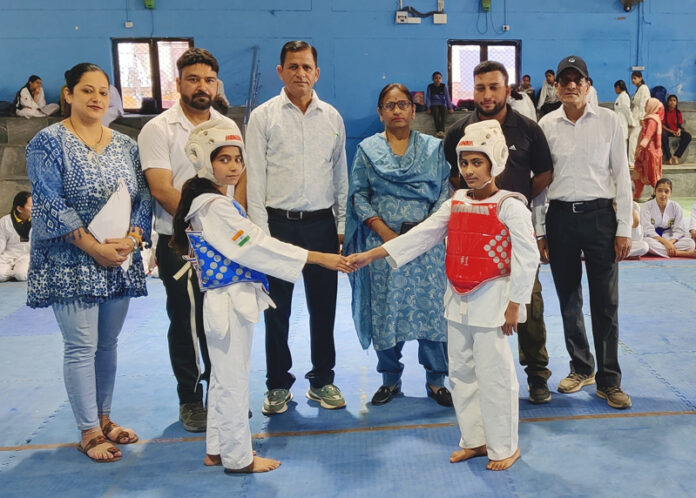
Players being introduced ahead of the match in presence of dignitaries.

Excelsior Sports Correspondent
UDHAMPUR, May 6: The Department of Youth Services and Sports, Zone Jib, Udhampur, today launched an inter-school zonal-level sports tournament for Under-14 and Under-17 girls, marking the beginning of the 2026–27 sports calendar approved by Director General Youth Services & Sports J&K (UT), Anuradha Gupta.
The event witnessed enthusiastic participation as competitions began in Athletics, Karate, Judo, Wushu, Boxing, and Taekwondo under the supervision of Zonal Physical Education Officer Jib, Jyoti Rani Gupta. She encouraged them to display discipline, determination, and sportsmanship while striving for excellence.
As part of the programme, 320 students from 27 Government and private schools took a collective pledge under the Nasha Mukt Bharat Abhiyan, marking 100 days of the anti-drug campaign and reaffirming their commitment to a drug-free lifestyle.
Technical coordination and selection were conducted by Ajit Singh Bandral and Sanjay Sharma (PEMs, ZPEO Office Zone Jib), along with a team of physical education experts, who identified emerging talent across disciplines.
Results: In Judo U-14 girls, Simran Dogra won the -27 kg category, while Janvi Devi secured first position in -32 kg. In U-17 category, Purvi clinched first place in -36 kg and Komal Devi topped -40 kg. In Taekwondo, Purbhi Sharma won the -35 kg U-17 category and Mahi Devi secured -38 kg, while in U-14 category Rudrakshi won -22 kg and Ananya Sharma secured -24 kg. In Wushu, Plasksha won the -40 kg category and Lalita secured first place in -48 kg. In Karate U-14 girls, Nazia won the -34 kg category and Rachna Devi secured first place in -38 kg.
In Athletics, Musrat Begum won the 100m (U-14) and Sonam Riaz (U-17), while Manvi Sharma and Divya secured first positions in 200m categories. In 400m, Sonali Devi won in both U-14 and U-17 categories, Sunakshi Sharma won the 600m U-14, and Gudia Devi clinched the 800m U-17 title.

Don’t drag Quran into politics to hide failures: Mufti to NC

Excelsior Correspondent
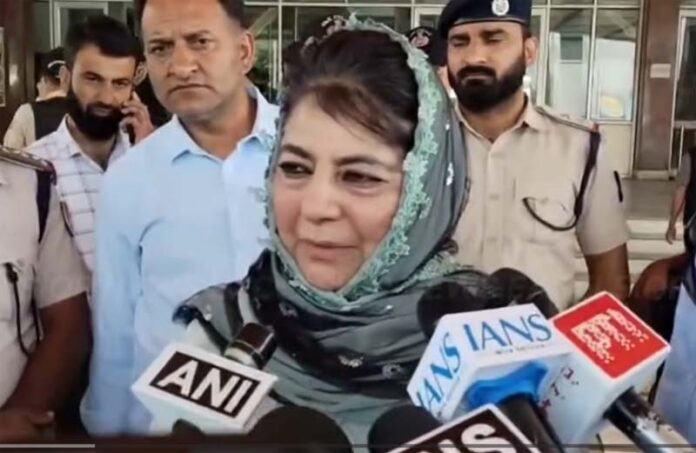
SRINAGAR, May 6: Peoples Democratic Party President Mehbooba Mufti today accused the ruling National Conference of “dragging the Holy Quran into political discourse” and attempting to deflect attention from governance failures.

Click here to watch video

Addressing reporters here, Mufti said the National Conference had “fallen to a new low” by invoking religious sentiment instead of engaging in substantive political debate. She argued that if the party wished to challenge her politically, it should do so on policy and performance rather than religion. “They don’t understand the greatness of the Holy Quran,” Mufti said, adding that those invoking it in politics had remained silent on several key issues affecting the region.
She cited the passage of the Waqf Bill, the closure of Siraj-ul-Uloom School, and alleged surveillance of mosque committees, clerics, and imams as instances where, according to her, the party failed to speak up. She also raised concerns over what she described as the “erosion of the Urdu language.”
Without naming him directly, she referred to decisions taken under departments linked to Omar Abdullah, questioning recruitment practices and alleging that jobs were being filled through “backdoor entries” and outsourcing to banks without public advertisement.
Mufti further accused the National Conference of attempting to divert public attention from pressing issues, including unemployment and administrative actions such as demolition drives. She claimed that houses were being demolished under various pretexts, including alleged links to drug peddling and militancy sympathisers, and that government employees were being dismissed without adequate accountability. “The youth, especially those from open merit categories, are struggling while the Government watches like spectators,” she said.
Mufti appealed to keep religion out of political rivalry. “If they want to fight us, they should do so politically. But for God’s sake, do not involve the Holy Quran,” she said.

Back-to-back explosions near security establishments in Punjab

KLF claim of responsibility being verified: DGP

CHANDIGARH, May 6: Two back-to-back explosions near security establishments shook Punjab on Tuesday night, triggering panic and drawing condemnation from opposition parties, which called them efforts to “destabilise” the state.

Follow the Daily Excelsior channel on WhatsApp  
The first explosion happened around 8 pm in Jalandhar outside the headquarters of the Border Security Force’s Punjab Frontier, while the second blast occurred at around 11 pm near the army cantonment in Amritsar’s Khasa. No injuries have been reported, police said.
An investigation into both incidents is underway.
Amritsar (Rural) Senior Superintendent of Police Suhail Mir Qasim stated that police received reports of a loud sound at around 11 pm on a road in Khasa. “Our teams arrived on the scene immediately,” he said.
Preliminary inspections indicated that someone had thrown an explosive device towards the boundary wall, leading to the explosion, according to the SSP. Police mentioned that a piece of a tin sheet covering the boundary wall had fallen as a result of the blast.
Following the explosion, a team of forensic and bomb disposal squad visited the site to collect samples.
Amritsar (Rural) Superintendent of Police Aditya S Warrier, who also visited the scene, confirmed that further investigations are ongoing. Police added that a team of army officials also assessed the situation, after which the area was cordoned off.
CCTV footage from the vicinity shows the explosion occurring at night. A local villager reported that his family was awakened by a loud sound and came outside their home to see what had happened.
In the Jalandhar incident, the blast ripped apart a scooter, damaged a traffic signal pole and windowpanes of a nearby shop. Locals recounted that the scooter, which was parked outside the BSF headquarters, Punjab Frontier, caught fire shortly after a loud sound. The scooter belonged to Gurpreet Singh, who regularly delivers parcels in the area.
CCTV footage captured the explosion, which resulted in a cloud of smoke. An unidentified man was seen running for cover following the blast.
Talking to reporters on Tuesday night, one of Gurpreet’s relatives said that the scooter caught fire as he was approaching it. He immediately called his father and informed him about the incident. Jalandhar Police Commissioner Dhanpreet Kaur confirmed to reporters late Tuesday that an Activa scooter parked near the gate caught fire suddenly. She stated that Gurpreet is fully cooperating with the investigation.
Punjab DGP Gaurav Yadav said the Amritsar blast was a low-intensity explosion and that no group has claimed responsibility for it. However, he reckons Pakistan’s ISI might be behind the incident.
“We assume that, as today is the Operation Sindoor anniversary, this is part of Pakistan’s ISI designs to cause disruptions in Punjab. Punjab is fighting a proxy war on behalf of the nation against Pakistan,” he said.
Regarding the Jalandhar explosion, the DGP said that the Khalistan Liberation Army (KLF) has claimed responsibility, adding that “we are verifying” the claim.
Opposition parties have condemned the AAP government over the blasts.
Shiromani Akali Dal (SAD) president Sukhbir Singh Badal criticised Chief Minister Bhagwant Mann, who also holds the home portfolio, over the blasts.
“Three blasts in 10 days, two in a single day, May 5: Jalandhar outside BSF headquarters and Sri Amritsar Sahib Army area, April 27: Rajpura rail track. Continued intelligence failures and the collapse of law and order are a matter of grave concern. Chief Minister @BhagwantMann, who is also the state Home Minister, is busy with mimicry and cheap politics. He has forfeited the right to remain in office,” Badal said in a post on X.
Punjab Congress chief Amrinder Singh Raja Warring also slammed the Mann Government.
“Back-to-back blasts have shaken Punjab. Yesterday in Jalandhar, and now near Khasa Camp in Amritsar, this is deeply alarming. Who is trying to destabilise our state? Why has the Punjab Government failed to prevent such incidents? What is the Government of India doing? Repeated lapses point to a serious breakdown of intelligence and security. Punjab’s peace cannot be compromised. We demand accountability and immediate action,” Warring said in a post on X. On April 27, an explosion occurred at a freight corridor rail track in Shambhu in Patiala. Police arrested four members of a pro-Khalistan terror module, backed by Pakistan’s ISI, for the blast. (PTI)

Future-vacancy appointees must stand behind regular recruits: HC

Excelsior Correspondent
JAMMU, May 6: The High Court of Jammu & Kashmir and Ladakh has dismissed a writ petition filed by four Munsiffs seeking higher placement in the seniority list, holding that appointees accommodated against future vacancies cannot claim seniority over candidates appointed earlier against clear and available posts.
A Division Bench comprising Justice Sanjeev Kumar and Justice Sanjay Parihar delivered the judgment in SWP No. 1577/2018, filed by Tabassum Qadir Parray, Meyank Gupta, Sajad ur Rehman and Altaf Hussain Khan against the High Court of Jammu and Kashmir and others.
The petitioners were represented by Advocate Salih Pirzada. The High Court was represented by Advocate M I Qadiri while Government Advocate Waseem Gul, Advocate Showkat Ali Khan and Government Advocate Faheem Nisar Shah appeared for the respondent.
The petitioners had challenged the seniority list of Munsiffs issued by the High Court vide order dated November 19, 2011, claiming that they should have been placed at serial numbers 16, 17, 18 and 26 respectively on the basis of their merit position in the selection list prepared by the J&K Public Service Commission.
The controversy arose out of a selection process initiated in 2008 for recruitment of Munsiffs. The High Court had requisitioned 31 vacant posts, including four backlog vacancies under the Scheduled Tribe category. However, due to an error in the vacancy reference, 35 posts were notified by the PSC and 35 candidates were recommended.
The Court noted that only 31 clear vacancies were actually available. Therefore, 31 candidates were appointed as Munsiffs vide Government order dated April 1, 2011, while the petitioners were not appointed at that stage as they were beyond the available vacancies.
Later, after fresh vacancies arose due to promotions, the petitioners were accommodated and appointed as Munsiffs vide Government order dated September 29, 2011. In the seniority list issued on November 19, 2011, they were placed below those who had been appointed earlier.
The petitioners argued that since their names figured in the same select list and their merit position was higher than some of the appointed candidates, their seniority ought to be fixed on the basis of merit rather than the date of appointment.
Rejecting the argument, the Division Bench held that the petitioners were not appointed simultaneously with those who had been appointed against clear vacancies. The Court observed that the petitioners were appointed later against future vacancies and, therefore, their date of first appointment had to be taken as September 29, 2011.
The Bench held that a candidate does not acquire an indefeasible right to appointment merely because his or her name appears in a select list, particularly when the selection is beyond the number of available vacancies. It further observed that the selection process legally came to an end with the appointment of 31 candidates against the available vacancies.
In strong observations, the Court said that the appointment of the petitioners against future vacancies was de hors the rules and irregular, if not void ab initio. The Bench further remarked that the High Court had taken a compassionate view by accommodating the petitioners against future vacancies and that they could not thereafter seek to overtake those who were regularly appointed earlier.
The Court also held that the petition was hit by delay and laches, as the seniority list had been finalized in 2011 and challenged only in 2018, after nearly seven years. During this period, the seniority position had already been acted upon and promotions to the rank of Sub-Judge had been made.
Relying on settled Supreme Court law, the Bench reiterated that seniority once settled and acted upon cannot be unsettled after a long delay, especially at the instance of persons who approach the court belatedly.
Dismissing the petition, the High Court held that the challenge to the seniority list was not only barred by delay and laches but was also devoid of merit.