Saturday, May 16, 2026
E-Paper
Home Blog Page 62

Fight Drugs Not Each Other


Dr. Ashaq Hussain
joinchemistry@gmail.com

The fight against drugs is not just a policy, it is a responsibility we all share”

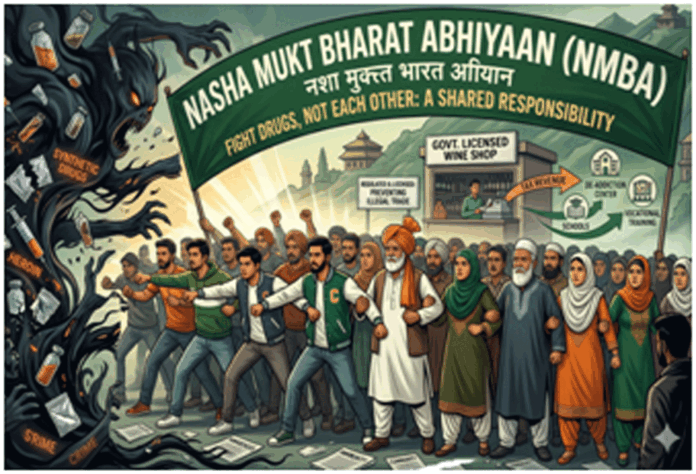
In recent weeks, like the other parts of Nation,  Jammu and Kashmir too is witnessing  a strong and determined push by the administration through the 100-day Nasha Mukt Bharat Abhiyaan (NMBA), a campaign aimed at freeing society, especially the youth, from the grip of drug addiction. Streets, colleges, and public spaces have become centres of awareness activities, rallies, and outreach programmes. Yet, alongside this visible effort, a wave of criticism has emerged on social media. Many people argue that the government appears to be sending mixed signals, on one side is promoting anti-drug campaigns while simultaneously allowing the opening of numerous wine shops. To some, this looks like a contradiction; to others, even an “eye-wash.” However, a deeper and more balanced understanding reveals that the issue is far more complex and rooted in practical governance, public health priorities, and socio-economic realities.

For me, at the heart of the NMBA campaign lies an urgent and alarming crisis, the rapid spread of hard drugs such as heroin and synthetic substances like chitta. These are not merely intoxicants; they are highly addictive, life-threatening chemicals that destroy individuals and families within a short span of time. Present reports indicate a troubling rise in addiction cases, particularly among the youth. Unlike alcohol, which is socially and legally regulated, these drugs enter the region through illegal channels, often linked to cross-border smuggling networks. In many cases, the earnings from this illicit trade are believed to fund criminal activities and even terrorism. This transforms the drug menace from a simple public health issue into a matter of national security.

Thus, viewed in this light, the NMBA campaign is not just an initiative but is an emergency response to a serious and immediate threat. The focus is clear: to break the supply chains of dangerous drugs, to rehabilitate those already affected, and to prevent new users from falling into the trap. Police crackdowns, property seizures of drug peddlers, and intensified surveillance are all part of this effort. Simultaneously, awareness programmes in schools and colleges aim to educate young minds about the devastating consequences of drug abuse. These actions demonstrate that the campaign is not merely symbolic but backed by concrete measures on the ground.

The controversy around the opening of wine shops, however, stems from a broader moral and social concern. Many people believe that alcohol, too, is addictive and harmful, and therefore should not be promoted in any form. While this concern is valid, the government’s approach distinguishes between illegal narcotics and regulated substances and so is the motive of NMBA campaign. Alcohol, despite its risks, is a legal product in India, governed by strict laws related to production, distribution, and consumption. The opening of licensed wine shops is part of a regulated system that allows the state to monitor quality, enforce age restrictions, and prevent the circulation of spurious or toxic liquor, which has historically led to fatal incidents.

Complete prohibition of alcohol, though appealing in principle, has often produced unintended consequences. Experiences from various regions have shown that bans tend to create thriving black markets, where unregulated and often dangerous products are sold. Such underground networks then not only pose greater health risks but also strengthen criminal elements by diverting money away from the state’s formal economy just like the present Narcotic trade. By maintaining a regulated framework, the government seeks to minimize these risks while keeping control over the system.

Another important dimension often overlooked in public debates is the role of revenue. Taxes collected from the sale of alcohol constitute a significant portion of the state’s income. This revenue is used to fund essential public services such as healthcare, education, infrastructure development, and, importantly, de-addiction and rehabilitation programmes. In a paradoxical but practical sense, the income generated from a regulated substance is being used to combat the far more dangerous and unregulated drug menace. While this may appear contradictory at first glance, it reflects a strategy of using available resources to address a larger crisis.

Above all, it is also crucial to recognize the difference in the nature and impact of substances being discussed. Alcohol, when consumed responsibly and within legal limits, is treated as a matter of personal choice in many societies. In contrast, substances like heroin and synthetic opioids have no safe level of consumption. They lead to rapid physical and psychological dependency, severe health deterioration, and often fatal outcomes. Moreover, their illegal nature means that users are exposed to unsafe products and criminal environments, further increasing the risk to their lives and society at large. The NMBA campaign, therefore, prioritizes the elimination of these high-risk substances that pose an immediate threat to public health and safety.

Still for me as a common citizen, public concerns should not be dismissed. The perception of contradiction can weaken trust and reduce the effectiveness of even well-intentioned initiatives. For the NMBA campaign to achieve its desired impact, it must go beyond enforcement and awareness and adopt a more holistic and inclusive approach even to restrict the open consumption of alcohol. One of the most important steps is strengthening de-addiction and rehabilitation services. Many individuals struggling with addiction require medical treatment, psychological counselling, and long-term support to reintegrate into society.  Equally important is the role of education and community engagement. Awareness campaigns should not be limited to occasional events but integrated into school curricula and community programmes. Skill development and employment opportunities can also play a vital role in prevention. A large number of youth fall into addiction due to unemployment, frustration, and lack of direction. Providing meaningful opportunities can help channel their energy in a positive direction.

Technology can further enhance the effectiveness of the campaign. Helplines, mobile applications, and online counselling platforms can provide accessible support to those in need, especially in remote areas. Anonymous reporting systems can encourage citizens to share information about drug-related activities without fear. At the same time, strict monitoring of licensed alcohol outlets is necessary to ensure that regulations are followed, and misuse is minimized. This includes enforcing age restrictions, preventing over-selling, and conducting regular inspections.

Ultimately, the NMBA campaign represents a critical step in addressing one of the most pressing challenges of today. While the debate over alcohol policy continues, it is important not to lose sight of the primary objective, protecting the youth from the devastating effects of hard drugs. The government’s approach, though complex and sometimes controversial, is driven by the need to tackle an immediate crisis while managing long-term socio-economic realities.

The road to a drug-free society is neither simple nor free of contradictions. It requires difficult choices, sustained efforts, and the active participation of every section of society. Criticism and debate are healthy in a democracy, but they must be accompanied by understanding and constructive engagement. The NMBA campaign is not a perfect solution, but it is a necessary beginning. With sustained efforts, deeper awareness, and a shared sense of responsibility, this mission can drive real change and ensure a healthier future for our youth. Let us join hands with the NMBA campaign, because a nation’s future rests in its young minds and drugs remain its most silent and dangerous enemy.


Dr.  Ashaq Hussain is Associate Professor Chemistry at Govt Gandhi Memorial (GGM) Science College, Jammu and can be reached at joinchemistry@gmail.com
International Nurses Day celebrated with enthusiasm at GMC Jammu

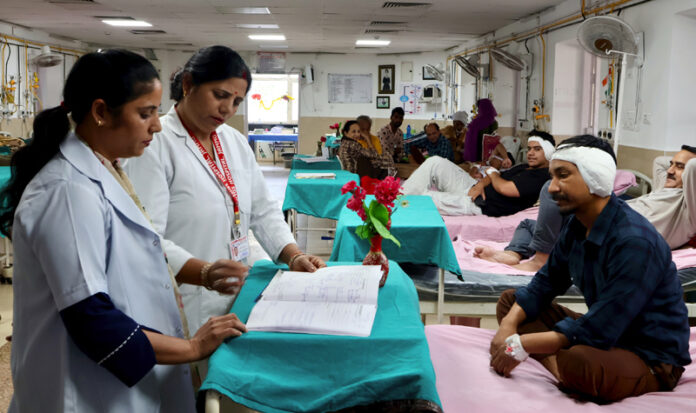
Nurses attend to patients in a hospital ward on the occasion of International Nurses Day, in Jammu on Tuesday. (UNI)

Excelsior Correspondent
JAMMU, May 12: International Nurses Day was celebrated with great enthusiasm and fervour at Government Medical College (GMC) Jammu. The programme commenced with the traditional lamp lighting ceremony symbolizing compassion, dedication, and the noble spirit of the nursing profession.
The event was graced by Dr Ashutosh Gupta, Principal and Dean, GMC & Associated Hospitals Jammu as the chief guest and Dr Shelly Mahajan as the guest of honour. Other dignitaries present on the occasion included Deep Raj (Adminstrator GMC and AHJ) Abdul Jabbar (Personnel officer), Dr Virender Trisal (Medical Superintendent, GMCH), Dr Shaista Ganai (Deputy MS GMC), Dr Rehana Khurshid (MS SSH), faculty members, matrons from GMC &AHJ and other staff.
On the occasion, Matron GMCH Jammu was specially honoured with a crown in recognition of her dedicated and selfless services towards the nursing profession and patient care. Various cultural programmes and performances were presented by GMC staff and students, adding colour and enthusiasm to the celebration.
Mementos and appreciation certificates were distributed to recognize the dedication, commitment, and invaluable contribution of nurses towards strengthening healthcare services.
While addressing the gathering, Dr Ashutosh Gupta stated that nurses act as a vital bridge between doctors and patients, ensuring proper care and attention to every aspect of a patient’s well-being during their stay in the hospital, including administration of medicines, coordination of investigations, emotional support, and overall patient management.
He acknowledged the indispensable role played by nurses in the healthcare system. He further emphasized the need for developing specialized nursing groups for various facilities and departments such as oncology, cardiology, critical care, neurology, neurosurgery, and other specialized units in order to further strengthen patient care services.

Workers of construction company meet DC, raise issues

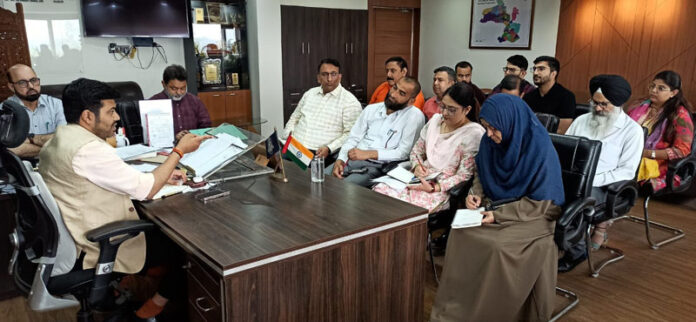
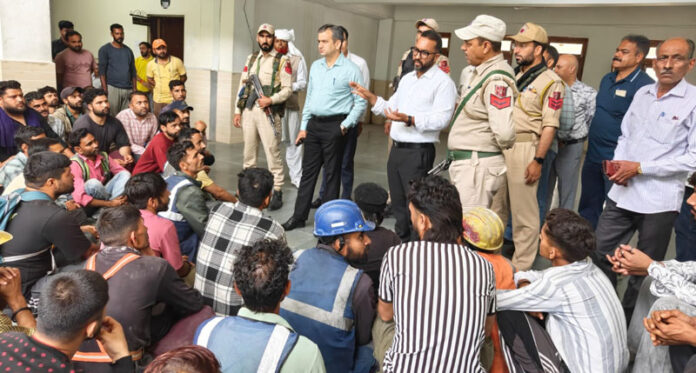
Workers of Nirman Vridhi Construction Company raising issues before Deputy Commissioner Ramban on Tuesday. —Excelsior/Parvez Mir

Excelsior Correspondent
RAMBAN, May 12: Workers of Nirman Vridhi Construction Company engaged by NHAI met Deputy Commissioner Ramban under the leadership of Social Activist, Fairoz Khan and raised the issues regarding wages, working conditions and labour law violations.
They submitted a memorandum highlighting their issues and demanded that salary slips be issued to them regularly and wages should be paid to them on time.
The workers alleged that they are being harassed and threatened and claimed lack of proper safety measures at worksites and absence of transport facilities for them.
Another major issue raised was the alleged violation of labour laws and regulations by the company.
The Deputy Commissioner Ramban assured the delegation that all labour laws, rules and regulations would be implemented properly and the genuine concerns of the workers would be addressed.

Bengal Reclaims Itself

By Hardeep Singh Puri
pibjammu@gmail.com

Howrah was once called the Sheffield of Asia. The jute mills along the Hooghly were the largest concentration of organised industry on the subcontinent. Kolkata was India’s commercial capital, head office to the Birlas and the Tatas, to ITC, Britannia, Coal India, Hindustan Motors, Garden Reach Shipbuilders. IISCO at Burnpur dates to 1918, Durgapur Steel Plant to the Second Plan. In 1950-51, Bengal produced roughly 27 per cent of the country’s manufacturing output. I knew that Calcutta. Before I joined the Foreign Service, one of my first jobs was at Hindustan Lever in the city, and Calcutta then was still a place where a young man arriving with his trunks could be sure he had come to where the country’s commerce was conducted. The lights stayed on. The trams ran. The companies hired.
What had taken a century to build was dismantled by something more deliberate than economic mismanagement. The Left Front took office in 1977 and held it for thirty-four years. Beneath the rhetoric of the working class, an organised shadow state took root. Permission to build, to run a shop, to set up a kiln, to register a transport route, to hold a panchayat meeting, came with a cut. The cadre collected. The party banked. The unionism that drove out capital was the visible part. The extortion that drove out the citizen was the part the cameras did not film. By the 2000s, when the Left Front itself attempted to reverse course and bring Tata Motors to Singur, the Trinamool Congress in opposition staged a hunger strike that drove the project to Gujarat in 2008. The mafia changed colours; it did not dissolve.
The Trinamool Congress took power in 2011 on the promise of poriborton. What followed was the same machinery in a new uniform. The cut became cut-money. The cadre became syndicate. Bengal’s 27 per cent share of national manufacturing has fallen below 5 per cent. Per capita income, once 127 per cent of the national average, has slipped to 84. More than six thousand registered companies have moved their head offices out of Kolkata. The children of Bengal who would once have worked in Howrah or Salt Lake now live in Bengaluru, Hyderabad, and Pune. The voter who watched her jobs and her money walk out of the state had a score to settle, and a ballot in her hand to settle it with.
At the centre of the score was a record on women that no incumbent in independent India has had to defend. A woman Chief Minister presided over the torture and killing of the women of her state. The rape and murder of a postgraduate trainee doctor at the RG Kar Medical College in August 2024. The night-long vandalism at the crime scene by a mob the Kolkata Police chose not to disperse. The Calcutta High Court’s order transferring the investigation to the Central Bureau of Investigation, on the finding that the Kolkata Police’s enquiry did not inspire confidence. The forty-two-day strike by junior doctors, many of them women.
Sandeshkhali, January 2024. The women of an island in the Sundarbans came out into the streets against a Trinamool district council member who remained a fugitive for fifty-five days while the State Police filed nothing. A Chief Minister whose own movement once spoke of poriborton has presided over a regime in which the women of her state had to seek refuge in courts, in central agencies, and on the streets, against her own cadre. It is reprehensible. It is unconscionable.
What the women of Bengal had to endure was matched only by what the state’s young people had to give up. Twenty-one crore rupees in cash, recovered from a single locked flat in Salt Lake on the night of the first Enforcement Directorate raid. Further recoveries on associated properties pushed the total past fifty crore. The arrest of the sitting cabinet minister Partha Chatterjee, who as Education Minister had presided over the West Bengal School Service Commission. The Calcutta High Court cancelling, in April 2024, the appointments of twenty-five thousand seven hundred and fifty-three teachers, Group-C and Group-D staff under a recruitment found illegal at the gate. A ruling carried to the Supreme Court and upheld in 2025.
An entire school recruitment cycle meant to give Bengal’s young people a foothold in life turned into a counter at which posts were sold and the legitimate candidate could not see the queue. Layered above that scam was the ration scam that pulled in another sitting cabinet minister, Jyotipriya Mallick. Layered above, the cattle scam, the cut-money culture, the syndicate raj. The voter understood the connecting tissue. The first to suffer in a state run by a mafia is the citizen who refuses to pay the bribe.
Against this record stood a record of another kind. Four crore twenty-one lakh houses completed under the Pradhan Mantri Awas Yojana over the past decade. Fifteen crore tap-water connections under Jal Jeevan Mission, against a base of three crore in 2019. Ayushman Bharat covering approximately fifty-five crore beneficiaries with a five lakh rupee annual cover. Direct Benefit Transfer rendering obsolete the leakage that once defined every welfare programme in Bengal. None of these are abstractions. They were the floor on which every Bharatiya Janata Party karyakarta in Bengal stood when she asked for the vote.
Behind that floor stood a network. The party’s booth-level cadre, the panna pramukhs, the karyakartas who endured intimidation, threats, and physical violence across electoral cycles, did the unglamorous work of registration, transport, and turnout in conditions other parties had abandoned. The threats against the Prime Minister and the Home Minister, the declarations of what would follow once central forces left, the lives lost in earlier rounds of post-poll violence, were not rhetoric the karyakarta had to be reminded of. She had lived through it. The Honourable Home Minister, Shri Amit Shah, walked Bengal himself, district by district, sometimes returning to the same town within weeks, knowing what his cadre was carrying. What they were attempting was not an electoral upset. It was the breaking of a citadel.
The faces of this breakthrough tell their own story. Smt Ratna Debnath, the mother of the RG Kar victim, fielded by the Bharatiya Janata Party in Panihati and leading by margins that demolished a fifteen-year Trinamool stronghold. Smt Rekha Patra, who stood on her own soil at Sandeshkhali to demand what the state had refused her, and who carried that demand to a contest in Hingalganj. Voters of districts that had been Left for thirty years and Trinamool for fifteen, turning to the lotus for the first time. On Sunday, 4 May 2026, Bengal settled the score. The Bharatiya Janata Party won 206 of 293 declared seats. Forty-nine years of mafia rule, in two successive uniforms, have ended. This was not only an electoral verdict. It was a moral one.
The breakthrough is already being contested. The Special Intensive Revision of the electoral rolls, which removed ninety lakh ineligible names from a state where ineligibility had been allowed to accumulate for 15 yers, is being characterised by the losing side as voter suppression. The data settles the question. Of the twenty constituencies that saw the highest deletions during adjudication, the Trinamool Congress won thirteen. Samserganj, Lalgola, Bhagabangola, Raghunathganj and Metiaburuz, the five with the most deletions, all returned a Trinamool MLA in both 2021 and 2026. Of the forty-nine constituencies in which the winning margin was lower than the number of electors removed during the revision, twenty-six were won by the Bhartiya Janata Party, twenty-one by the Trinamool Congress, and two by the Congress. A targeted exclusion does not produce a near-even split between the winning party and the losing one The 92.93 per cent voter turnout, the highest in the state’s history, settled the question of whether the rolls were credible. By disputing the verdict the voter has already delivered, the losing party only confirms the dadagiri the voter rejected, and the wisdom of the choice she made.
Bengal has voted, and Bengal has chosen. What the voter has asked for is not difficult to read. Peace, and freedom from the violence that has shadowed her streets. Prosperity, and the return of work to the city she lives in. Stability, and an administration that does not collect a cut for letting her live. A cultural and economic renaissance in the state that gave the country its first industrial belt, its commercial capital, and the early architects of national administration. The Calcutta I worked in is recoverable. Bengal is ready to resume its contribution to a Viksit Bharat by 2047. Behind every welfare delivery and infrastructure decision of the past decade has been a Prime Minister who treats the citizen as the unit of account. The reward for keeping faith with that citizen has now been recorded.

(The author is Union Minister of Petroleum & Natural Gas)

Drug peddler held with heroin

Excelsior Correspondent
RAMBAN, May 12: Police here today arrested a man from Dharamkund area and recovered heroin from him.
On receipt of reliable information, cops from Police Station Dharamkund established a Naka on link road leading to the Police Station.
During Naka checking, one Muneer Ahmad Khan, son of Ali Khan, resident of Parthmulla Gool, District Ramban, was intercepted.
Thereafter, in the presence of the Executive Magistrate 1st Class (EMIC) Ramban, his personal search was conducted during which heroin like substance was recovered from him.
In this regard, FIR No. 07/2026 under Sections 8/21/22 of the NDPS Act was registered at Police Station Dharamkund and investigation started.
The arrest and recovery were made by cops under the leadership of SHO PS Dharamkund, Inspector Joginder Singh Chib, under the supervision of SDPO Gool and under the overall supervision of SSP Ramban, Arun Gupta.

JMC launches special drive to make Jammu ‘clean and green’

JMC Commissioner Dr Devansh Yadav chairing a meeting with senior officers of the Corporation.

Excelsior Correspondent
JAMMU, May 12: Jammu Municipal Corporation (JMC) is set to launch a special city-wide campaign to transform Jammu into a clean, green and environmentally sustainable city.
In this connection, Commissioner Dr Devansh Yadav chaired a comprehensive meeting with senior officers and officials of the Corporation to discuss strategies for strengthening sanitation measures, expanding greenery and ensuring maximum public participation in the initiative.
During the meeting, Dr Yadav said that cleaning and restoration works are presently underway at more than 20 ponds and water bodies across Jammu city and the exercise will continue in the coming weeks.
To ensure long-term maintenance and protection of these water bodies, he said local committees comprising residents living near the ponds would be constituted. These committees would adopt the ponds and actively participate in their upkeep and cleanliness.
Highlighting the Corporation’s commitment towards environmental conservation ahead of the forthcoming monsoon season, Dr Yadav informed that over 40,000 trees and saplings would be planted across different parts of Jammu city under the Clean Jammu, Green Jammu initiative.
To encourage greater public involvement, JMC has also introduced a volunteer participation mechanism through which citizens can register themselves for plantation drives and adopt a tree through swachh.jk.gov.in/clean-jammu-cert. Each adopted tree would be linked to the concerned citizen through a dedicated QR code, ensuring accountability and fostering a sense of ownership towards environmental protection.
The Commissioner further stated that flowering plants and ornamental saplings would also be planted in vacant spaces across the city to enhance aesthetic appeal and green cover of Jammu.
Meanwhile, the Housing and Urban Development Department has introduced amendments to the Building Bye-laws, enabling citizens to self-certify and directly upload building maps online, thereby simplifying the approval process.
Appealing for active participation, Dr Devansh Yadav urged residents, social organizations, volunteers and youth groups to join hands with JMC in making Jammu a truly clean and green city.

Awareness march organized under ‘Drug-Free J&K’ campaign

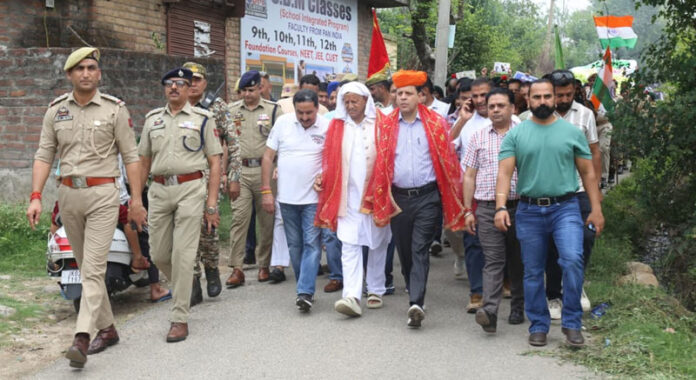
Mahant Baba Yashpal and Sanjeev Verma (Chief Electoral Officer, J&K) leading an awareness march at Jandiyal in Nagrota Constituency.

Excelsior Correspondent
JAMMU, May 12: Under the guidance of the Lieutenant Governor Manoj Sinha, an inspiring awareness march was organized today in the Nagrota Assembly Constituency as part of the 100-day public awareness campaign under the “Drug-Free Jammu & Kashmir Campaign.” The event was organized by Shri Kailakh Jyotish avim Vedic Sansthan Trust.
The awareness march commenced from Jandiyal Chowk and concluded at RMG International School, Jandiyal, Jammu. A large number of youths, students, social organizations, administrative officials, teachers, and local residents participated in the march.
Mahant Baba Yashpal of Baba Ballo Ji Devsthan Mathwar and Sanjeev Verma, Chief Electoral Officer, Jammu & Kashmir, jointly flagged off the march.
The entire area echoed with powerful slogans such as “Quit Drugs – Embrace Life” and “Save Youth – Save the Future.” Carrying awareness placards and banners, the youth conveyed the message that drug addiction destroys not only individuals but also families, society, and the future of the nation.
Mahant Baba Yashpal, in his inspiring address, stated that youth power is the greatest strength of any nation. He urged the youth to adopt the path of values, education, spirituality, and national service in order to become agents of positive social change.
Sanjeev Verma stated that drug abuse has become a serious social and moral challenge facing society today. He emphasized that the Government’s anti-drug campaign must be transformed into a people’s movement so that every family and every young person becomes a part of this mission.
Addressing the gathering, Mahant Rohit Shastri from Shri Kailakh Jyotish avim Vedic Sansthan Trust said, “This is not merely a campaign against drugs, but a great mission to save society and future generations. Until every citizen actively participates in this fight, the dream of a drug-free India will remain incomplete.”
Also present on the occasion were SP Rural Ravinder Singh, Tehsildar Bhalwal Monica Sharma, DSP Varinder Gupta, Managing Director of RMG International School Rohit Gupta, former BDC Kuldeep Kumar, and former sarpanchs Pratap Singh, Balbir Singh, Sanjeev Singh, Anjali Sharma, Vandana Kumari and Rajdev Singh.

House Committee visits Charar-i-Sharief constituency; reviews implementation of Jal Jeevan Mission

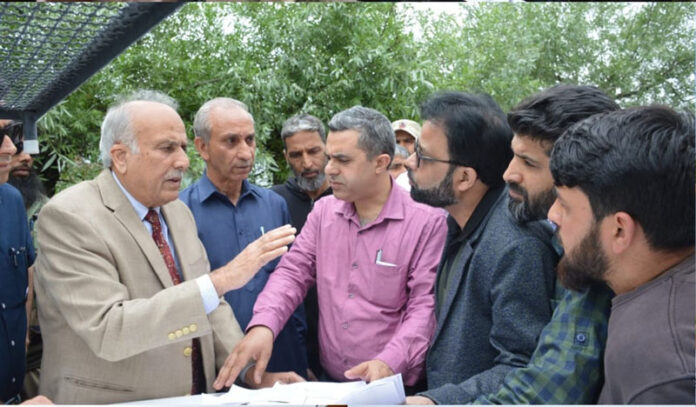
House Committee during visit to Charar-i-Sharief on Tuesday.

Excelsior Correspondent
BUDGAM, MAY 12: The House Committee on Jal Jeevan Mission (JJM) today conducted an extensive visit to various areas of Charar-i-Sharief Constituency to review and monitor the implementation of the Mission.
The committee was led by its Chairman Justice Hasnain Masoodi and accompanied by MLA Chadoora Ali Mohammad Dar, MLA Tral Rafiq Ahmad Naik, MLA Pattan Javaid Riyaz Bedar, MLA Poonch Ajaz Ahmed Jan along with senior officers and officials of the Jal Jeevan Mission Department.
During the visit, the committee inspected ongoing works at Dadompora, Nagam, Zaloosa, various water supply schemes and pipeline installations across the Charar-i-Sharief Constituency.
The purpose of the visit was to assess whether the ongoing works are being executed in accordance with the prescribed norms, standards and regulations of the Jal Jeevan Mission. The committee reviewed the functioning, quality standards and progress of various schemes and interacted with the concerned officials regarding on-ground implementation.
The committee emphasized transparency, accountability and strict adherence to JJM guidelines to ensure the effective and timely completion of water supply projects for the benefit of the public. Necessary directions were issued to the concerned departments to maintain quality standards and proper regulation in all works under execution.

Power shutdown

Excelsior Correspondent

JAMMU, May 12: Chief Engineer (Distribution) JPDCL Jammu has informed that the power supply to Pochhal, Cherhar, Huller, Pohi, Workshop and adjoining areas will remain affected on May 13 from 8 am to 3 pm.

3 vehicles seized for illegal mining

Excelsior Correspondent
SRINAGAR, May 12: The police seized three vehicles involved in illegal mineral extraction during a crackdown in south Kashmir’s Pulwama district today.
An official spokesperson said the operation was carried out in the Nallah Rambi, where officers seized a JCB machine, a dumper and a tractor suspected to have been used for unauthorised mining activities. “In this connection, a case under FIR No. 59/2026 has been registered under Section 303(2) of the Bharatiya Nyaya Sanhita (BNS) and Section 3 of the PPD Act, while further investigation has been taken up,” he said.