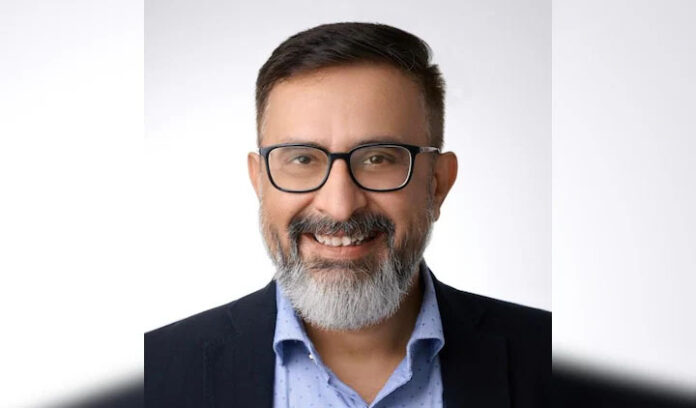
NEW DELHI, May 4: Adobe on Monday announced the appointment of Manoj Nagpal as Vice President, Global Delivery Center and Shared Services, effective immediately.
Based in Bengaluru, he will lead initiatives to expand delivery operations, promote innovation, and develop high-performing teams to drive global business expansion, the company said in a statement.
He will report directly to Scott Bajtos, Global Vice President, Consulting, Customer Engineering & Customer Success at Adobe.
“India is a strategic hub for Adobe’s global delivery and innovation agenda. Manoj’s proven track record in driving customer success and helping enterprises realise value from digital transformation investments will help advance our shared goal of building customers for life,” Bajtos said.
Nagpal holds more than 30 years of expertise, most recently having served as Managing Director of OpenText India, where he oversaw services and customer success operations while growing the company’s presence in India. He has also held senior leadership positions at GXS, GE, and Xerox.
India hosts Adobe’s second-largest workforce, with more than 8,000 employees across five campuses. (PTI)
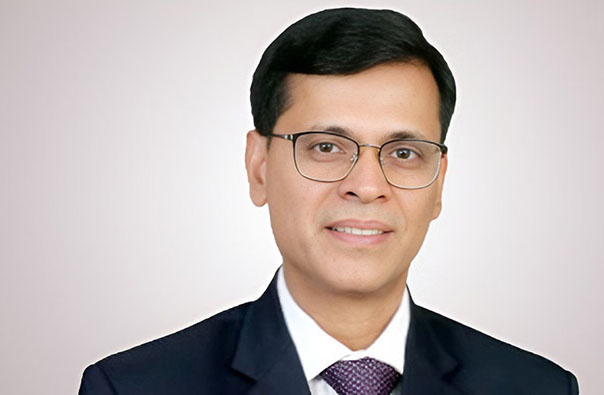
NEW DELHI, May 4: Two-wheeler maker Hero MotoCorp Ltd on Monday announced the appointment of Sachin Agrawal as its new Chief Technology Officer effective May 21, 2026.
Agrawal will succeed Vikram Kasbekar, who is stepping down from the position but will continue to serve on the board of the company as Executive Director, MotoCorp said in a regulatory filing.
In his role, Agrawal will lead the next phase of the company’s R&D transformation across both the Hero Centre for Innovation and Technology (CIT) and the Hero Tech Centre Germany (TCG), it added.
He has over 29 years of experience in automotive Research & Development (R&D) and technology leadership and prior to joining Hero MotoCorp, he served as Executive Vice President & Head – R&D and Technology at VE Commercial Vehicles, a joint venture between Volvo Group and Eicher Motors, the filing said.
He began his career at Daewoo Motors, contributing to the design of the Matiz chassis system in South Korea, it added. (PTI)
NEW DELHI, May 4: A Dairy products maker Milky Mist Dairy Food Ltd has raised about Rs 482 crore from Jongsong Investments Pte Ltd, an indirect wholly-owned subsidiary of Temasek Holdings, in a pre-initial public offering (IPO) funding round, according to a public announcement.
The fundraise includes a primary capital infusion of around Rs 357 crore and a secondary share sale worth about Rs 125 crore ahead of the company’s proposed IPO.
As part of the primary issuance, the company allotted 5,43,789 equity shares at Rs 139.76 apiece, aggregating to Rs 7.6 crore. It also issued 25 lakh compulsorily convertible preference shares (CCPS) at the same price, raising about Rs 349.4 crore. The CCPS will be converted into equity shares on a 1:1 basis prior to listing.
The entire primary investment was led by Jongsong Investments, marking a significant institutional backing from Temasek.
In addition, promoters Sathishkumar T and Anitha S divested 89,43,903 equity shares at Rs 139.76 per share, aggregating to Rs 125 crore, as part of the secondary transaction.
The pre-IPO placement comes ahead of Milky Mist’s planned market debut.
In July, Milky Mist Dairy Food filed preliminary papers with markets regulator Sebi to raise funds through its maiden public offering.
Proceeds from the public issue will be used to fund debt repayment, expansion, and modernisation of the Perundurai manufacturing facility, which includes setting up whey protein concentrate, yogurt, and cream cheese plants. Further, funds will be invested in deploying visi coolers, ice cream freezers, and chocolate coolers, and general corporate purposes.
Founded in Erode, Tamil Nadu, Milky Mist is a leading dairy brand in India, exclusively focused on premium value-added dairy products, including paneer, cheese, yogurt, ice cream, butter, ghee, and packaged foods.
Unlike traditional dairy companies, Milky Mist does not sell liquid milk, enabling higher margins and strong positioning akin to FMCG companies. (PTI)
NEW DELHI, May 4: India’s manufacturing sector activity witnessed mild recoveries in growth of new business intakes and production, but rates of increase were the second-weakest in nearly four years.
The seasonally adjusted HSBC India Manufacturing Purchasing Managers’ Index rose from 53.9 in March to 54.7 in April, signalled the second-slowest improvement in overall operating conditions in close to four years.
HSBC India Manufacturing Purchasing Managers’ Index (PMI) is a gauge of overall conditions derived from measures of new orders, output, employment, supplier delivery times and stocks of purchases.
In the PMI parlance, a print above 50 means expansion, while a score below 50 denotes contraction.
The two largest sub-components of the PMI, new orders and output, rose since March but trailed readings seen in at least three-and-a-half years.
“India’s manufacturing PMI rose to 54.7 in April, up from 53.9 in March, but still marking the second-slowest improvement in operating conditions in nearly four years,” said Pranjul Bhandari, Chief India Economist at HSBC.
Survey participants indicated that advertising and demand resilience supported sales and production, but that growth was hampered by competitive conditions, the war in the Middle East and a reluctance among clients to approve pending quotes.
“Spillovers from the Middle East conflict are becoming more evident, particularly through inflation: input costs increased at the fastest pace since August 2022, and output prices rose at the quickest rate in six months,” Bhandari said, adding that “output, new orders (including exports) and employment all grew moderately, pointing to continued resilience in India’s manufacturing sector.”
Meanwhile, new export orders expanded sharply at the start of the first fiscal quarter, with the pace of growth reaching a 7-month high. Firms noted better demand from clients in several countries, including Australia, France, Japan, Kenya, mainland China, Saudi Arabia, the UAE and the UK.
On the price front, companies continued to indicate that the war in the Middle East exerted upward pressure on inflation. Input costs and output charges rose at the quickest rates in 44 and six months respectively.
Amid reports of higher prices for aluminium, chemicals, electrical components, fuel, leather, petroleum products and rubber, average cost burdens rose further in April. Panellists often attributed hikes to the Middle East war.
The overall rate of inflation climbed to its highest in August 2022. Subsequently, goods producers lifted their fees to the greatest extent in six months, the survey noted.
In terms of employment, despite only a marginal increase in outstanding business volumes, manufacturers recruited additional workers at the start of the first fiscal quarter. Moreover, the rate of job creation was marked and the strongest in ten months.
Indian manufacturers remained optimistic towards growth prospects. However, the overall level of positive sentiment slipped since March. Confidence was pinned on hopes that marketing efforts would bear fruit and that pending projects would be approved.
The HSBC India Manufacturing PMI is compiled by S&P Global from responses to questionnaires sent to purchasing managers in a panel of around 400 manufacturers. (PTI)
NEW DELHI, May 4: State-owned BHEL on Monday posted a two-fold jump in consolidated net profit to Rs 1,290.47 crore during the quarter ended March 31, supported by growth in revenues.
It had reported a net profit of Rs 504.45 crore in the same period a year ago, the company said in an exchange filing.
During the fourth quarter, its total income surged to Rs 12,553.50 crore from Rs 9,142.64 crore in the January-March period of preceding 2024-25 financial year.
For the entire FY26, the company’s net profit jumped to Rs 1,600.26 crore from Rs 533.90 crore in the year ago.
The board of the company also approved a final dividend of Rs 1.40 per share of Rs 2 each for the fiscal ended March 31, 2026. BHEL is India’s largest engineering and manufacturing enterprise in the energy and infrastructure sectors. (PTI)
NEW DELHI, May 4: Realty firm Godrej Properties on Monday reported a 70 per cent increase in consolidated net profit at Rs 649.88 crore for the quarter ended March on higher income amid strong housing demand.
Its net profit stood at Rs 381.99 crore in the year-ago period.
Total income rose to Rs 3,806.65 crore during January-March quarter of 2025-26 fiscal from Rs 2,681.06 crore in the corresponding period of the preceding year, according to a regulatory filing.
During the full 2025-26 fiscal, the company’s net profit grew to Rs 1,850.20 crore from Rs 1,399.89 crore in the preceding year.
Total income rose to Rs 8,410.88 crore in the last fiscal from Rs 6,967.05 crore in the 2024-25 fiscal.
Pirojsha Godrej, Executive Chairperson, Godrej Properties, said the company delivered a record-breaking 2025-26 fiscal with its highest ever bookings, collections, operating cash flows, earnings, and business development.
“The demand for residential real estate in India remains strong across key markets and the company will continue to seek to gain market share through outstanding design, timely delivery, and high-quality developments,” he said.
Pirojsha said the company acquired several land parcels last fiscal to develop housing projects worth over Rs 42,000 crore.
This would ensure that the company continue to have a strong launch pipeline in the year ahead, he added.
“The record operating cash flow of Rs 7,830 crore we generated in FY26 will enable us to continue to invest for growth while ensuring a strong balance sheet,” Pirojsha said.
With a robust launch pipeline and strong balance sheet, the chairperson said the company is confident of a strong 2026-27.
However, Pirojsha said the company would “remain watchful about potential global security-led disruptions to the economy and sectoral demand”.
Godrej Properties, one of the leading real estate developers in the country, achieved a 16 per cent increase in its sales bookings or pre-sales during the last fiscal at Rs 34,171 crore.
The company sold 17,513 units with a total area of 27 million sq ft, an annual volume growth of 5 per cent.
The board of directors has recommended a dividend of Rs 10 per share (200 per cent) for 2025-26, subject to approval of members of the Annual General Meeting. (PTI)
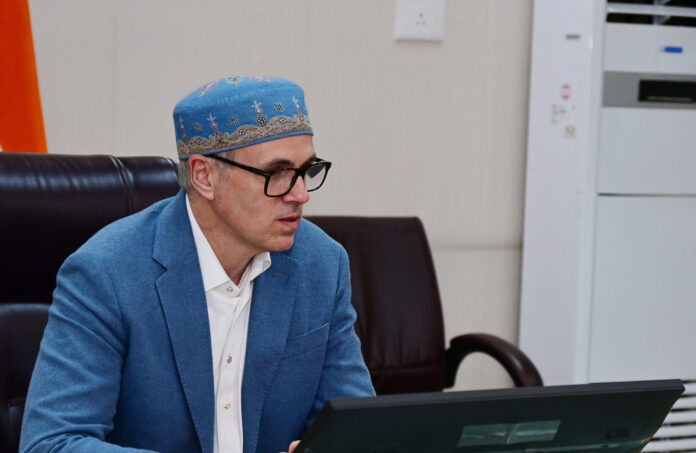
SRINAGAR, May 4: Jammu and Kashmir Chief Minister Omar Abdullah reviewed the functioning of various departments and sought improved inter-departmental coordination at a meeting of administrative secretaries here on Monday.
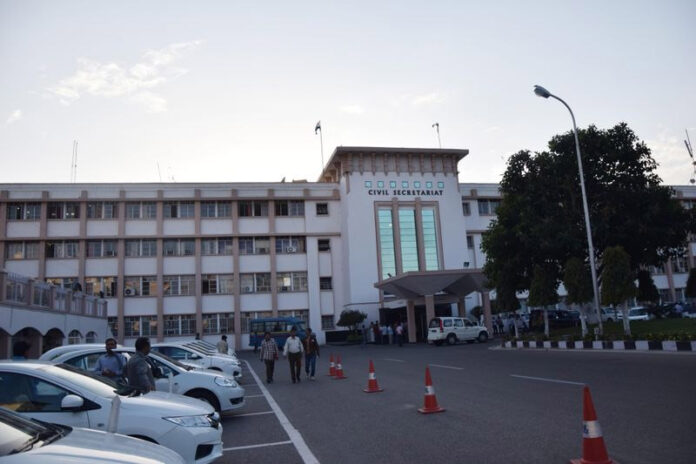
Soon after the Civil Secretariat reopened here as part of ‘Darbar Move’, the chief minister inspected the offices, reviewing overall functioning and the facilities available for employees as well as the public.
“He toured key sections, including ministers’ chambers, officers’ rooms, clerical halls, and the newly renovated public waiting area, and interacted with staff and citizens. He assured that further improvements would be made to strengthen facilities and enhance the quality of public service delivery,” the office of the chief minister posted on the official X handle.
Abdullah chaired a meeting with administrative secretaries. The deputy chief minister, cabinet ministers, and advisor to the chief minister were also present.
“The chief minister emphasised the need for timely execution of works, effective implementation of directions on the ground, and improved interdepartmental coordination. He further directed the Estates Department to ensure proper arrangements, including adequate residential facilities for employees, and the smooth functioning of offices,” it added.
RAMBAN/JAMMU, May 4: Undeterred by high temperatures and difficult terrain, four youths from Uttar Pradesh and Madhya Pradesh have been on an extraordinary, over nine-month-long journey to the revered Amarnath Shrine, performing ‘dandavat pranam’– a rigorous religious practice involving full-body prostrations — to spread “a message of Sanatan Dharma” and “communal harmony”.
Traversing the winding stretches of the Jammu–Srinagar National Highway in Ramban district, the young pilgrims have been advancing entirely through full-body prostrations — a form of pilgrimage where devotees move forward by repeatedly lying flat on the ground — as they make their way towards the cave shrine housing the naturally formed ice lingam of Lord Shiva at an altitude of about 3,880 metres in the South Kashmir Himalayas.
The pilgrims, Jatinder Rajput, Rohit Ray and Nayain Jain from Madhya Pradesh, along with Amit Rajput from Uttar Pradesh, began their journey months ago.
While the trio from Madhya Pradesh started on September 3, 2025, Amit Rajput set out earlier on July 23, 2025.
“We are on a dandavat pranam yatra to seek the blessings of Baba Barfani. It was our long-cherished wish, and we have been on this journey for over nine months,” Amit Rajput said.
Unlike conventional pilgrimage, the group has been moving along step by step through repeated prostrations, while taking intermittent breaks. “For nearly a year, our daily routine has revolved around lying flat on the ground, rising, and inching forward,” said Rohit Ray.
Carrying minimal belongings on a bicycle, including blankets, water and limited food supplies, the youths have braved extreme weather, from scorching plains to the cold and rugged Himalayan terrain.
Despite the physical strain, they remain resolute, chanting “Baba Barfani” for motivation.
The annual Amarnath Yatra is scheduled to commence on July 3 via the traditional 48-km Nunwan-Pahalgam route in Anantnag district, and the shorter but steeper 14-km Baltal route in Ganderbal district, concluding on August 28 on the occasion of Raksha Bandhan.
The youths said their journey is guided by a higher purpose, upholding the values of Sanatan Dharma and advocating for the recognition of the cow as India’s national animal.
Beyond spirituality, they emphasised a message of unity and harmony. “Religion teaches peace and coexistence. Those who spread Hindu-Muslim hatred do not truly understand their faith,” they said, highlighting lessons drawn from interactions with people across regions.
As they continue through Ramban, their weather-beaten appearance reflects the hardships endured, but their steadfast faith and message of unity have turned the yatra into a living testament of devotion and social harmony. (AGENCIES)
JAMMU, May 4: The Government of Jammu and Kashmir has issued a roster for availability of Ministers at Civil Secretariat, Jammu, for the month of May 2026.
As per the order, Surinder Kumar Choudhary, Deputy Chief Minister, will remain available from May 4 to May 8, followed by Sakeena Masood (Itoo), Minister for Health and Medical Education, School Education, Higher Education and Social Welfare, from May 11 to May 15.
Nasir Aslam Wani, Advisor to the Chief Minister, will be available from May 18 to May 22, while Javid Ahmad Dar, Minister for Agriculture Production, Rural Development and Panchayati Raj, Cooperative and Election Departments, will remain present from May 25 to May 29.
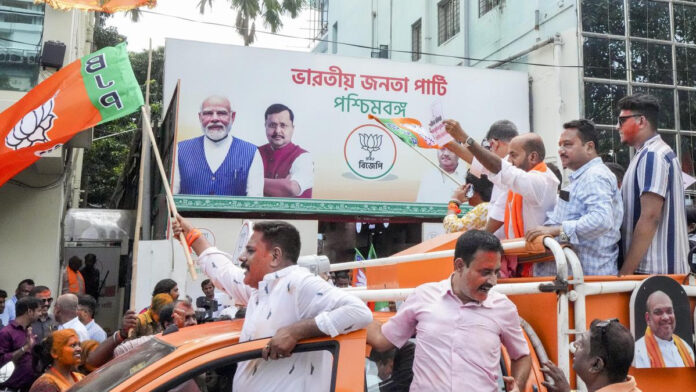
Kolkata, May 4: Signalling a potential political churn in West Bengal, long dominated by TMC’s Mamata Banerjee, the BJP crossed the halfway mark on Monday, leading in 193 assembly seats against the TMC’s 94 as counting progressed, according to Election Commission data.
With the majority mark of 148 in the 294-member House breached in early trends, the BJP’s surge pointed to a possible breakthrough, while the ruling TMC sought to narrow the gap in what has emerged as a closely watched electoral contest.
The early numbers, indicating a possible outcome that could reshape the state’s political landscape following a fiercely fought election, also suggested a geographically split mandate, with the BJP pushing ahead in border, tribal and industrial regions, while the TMC held ground in parts of Kolkata and select rural strongholds.
Amid these trends, Banerjee urged TMC candidates and counting agents to remain vigilant and not leave counting centres, alleging a “game plan” by the BJP and the EC to project an early saffron lead.
In a video message, the TMC supremo appealed to party workers to stay put and not lose morale.
“I appeal to everyone that neither TMC candidates nor counting agents should abandon counting centres,” she said.
As trends on the Election Commission website showed the BJP leading in around 193 seats against the TMC’s 90-odd tally at that stage, Banerjee asserted that her party was ahead in a significant number of constituencies not fully reflected in the data.
“We are still ahead in 170 seats and there are around 70 to 100 seats where we are leading, but they are not sharing the data,” she said. Her remarks came against the backdrop of an uneven pace of counting across constituencies.
In many of the nearly 190 seats where the BJP was leading, only 5-6 rounds had been completed, and in some, just two rounds, while a few had reached 10-11 rounds.
Given that most constituencies typically go through 18-22 rounds, the process appeared far from the halfway mark even by around 2 pm, suggesting that early leads could still see significant shifts as counting progresses.
Even as the broader trend favoured the BJP, Banerjee was ahead in her Bhabanipur stronghold by 9,475 votes over BJP challenger Suvendu Adhikari after 11 rounds of counting.
The Bhabanipur contest witnessed sharp swings through the morning, with Banerjee leading in the first round, trailing in the second, and regaining the advantage in the third, underlining the volatility of early trends.
However, in Nandigram, the other marquee battleground, Adhikari was ahead by over 3,135 votes against TMC’s Pabitra Kar after two rounds of counting. Beyond the headline numbers, the trends indicated a deeper churn in the state’s political landscape.
For a party that has known uninterrupted power since 2011, the current numbers — with the BJP surging ahead in over 190 seats and the TMC trailing well behind — suggest the possible unravelling of a carefully constructed political machine that thrived on centralised authority, welfare outreach and relentless booth-level mobilisation.
The scale of the shift is reflected in emerging vote share patterns, with the BJP’s share rising to around 44.8 per cent, a sharp jump from 2021, while the TMC’s dipped to nearly 41.7 per cent, indicating erosion across segments that once formed its dependable base.
Perhaps more telling is the churn in the 177 constituencies where voter deletions had exceeded previous victory margins, a silent faultline that appears to have turned electoral.
The BJP was holding ground in all the seats it had won in this category in 2021 and making inroads into several of the 120 segments that the TMC had previously dominated, pointing to a deeper, more systemic shift rather than a transient swing.
Initial trends from across the state showed several TMC heavyweights trailing, triggering concern within the ruling camp.
In Cooch Behar district’s Dinhata, minister Udayan Guha was trailing by 6,259 votes against BJP’s Ajay Ray after four of the 24 rounds of counting. TMC’s Manas Ranjan Bhunia was trailing in Paschim Medinipur district’s Sabang constituency, where he has won seven elections earlier, with BJP’s Amal Kumar Panda ahead by 693 votes after the third round.
In Kolkata, BJP’s Purnima Chakraborty was leading by 1,430 votes over TMC minister Shashi Panja, signalling early cracks in some urban pockets for the ruling party.
In Monteswar, BJP’s Saikat Panja was ahead by 13,308 votes over TMC’s Siddiqullah Chowdhury, while in Asansol Dakshin, BJP leader Agnimitra Paul was leading by 18,812 votes.
Assembly Speaker Biman Banerjee was trailing by 1,448 votes in Baruipur Paschim.
The BJP was also leading in a number of seats, including Dinhata, Gosaba, Baghmundi, Bankura, Durgapur Purba, Binpur, Nayagram, Rajganj and Bhagwangola, indicating traction across Junglemahal, north Bengal and industrial belts.
In contrast, the TMC retained leads in pockets such as Deganga, besides urban seats like Kasba, Ballygunge, Bhabanipur and Entally, and rural belts including Singur, Raina, Jamalpur, Khandaghosh, Sitai, Malatipur and Mothabari. The CPI(M) was leading in Domkal in Murshidabad district, while the ISF was ahead in Minakhan in South 24 Parganas.
Aam Janata Unnayan Party chief Humayun Kabir was leading in Nowda and Rejinagar, whereas the Congress was leading in Raninagar seat in Murshidabad district. (Agencies)