Sunday, April 26, 2026
E-Paper
Home Blog Page 35654

National TT coaching camp to be held from Oct 28 to Dec 8: SAI

NEW DELHI, Oct 24: A national table tennis training camp, featuring four-time Commonwealth Games gold-medallist Sharath Kamal along with 10 other players, will be held in Sonepat from October 28 to December 8, the Sports Authority of India (SAI) said on Saturday.

SAI has sanctioned Rs 18 lakh for the camp, which will be the first national camp for the sport since the announcement of the nationwide lockdown due to the COVID-19 outbreak in March earlier this year.

“The Sports Authority of India has approved the national coaching camp for Table Tennis, which will commence on 28th October till 8th December,” SAI said in a statement.

“The camp comprising 11 players (5 male, 6 female) and four support staff will be conducted by the Table Tennis Federation of India at the Delhi Public School, Sonepat.

This follows multiple attempts by the Table Tennis Federation of India to hold the camp but not succeeding at them for failure to convince players to join.

Sharath Kamal will be part of the men’s training group where he will be joined by Manush Shah, Manav Thakkar, Sudhanshu Grover and Jubin Kumar.

The women’s training group will comprise Anusha Kutumbale, Diya Chitale, Suthirtha Mukherjee, Archana Kamath, Takeme Sarkar and Kaushani Nath.

“I had been training at home in Bengaluru but looking forward to return to a camp environment where I can get to see my compatriots in the Indian team after a long time and train with them,” said Archana Kamath, who is a part of the Target Olympic Podium scheme development group.

Kamath, a semifinalist at the 2018 Youth Olympics, said her ultimate goal is to qualify for the Olympics.

SAI also said that “campers will be staying in the residential facilities at DPS, Sonepat” and abide by the Standard Operating Procedures for the resumption of sporting activities.

India won eight medals at the 2018 Commonwealth Games. The country won two bronze medals for the first time ever at the Asian Games the same year. (PTI)

 

Over 100-year-old Durga at Pranab Mukherjee’s ancestral house

MIRATI (WB), Oct 24:
The over 100-year-old Durga Puja at the ancestral house of former President Pranab Mukherjee in West Bengal’s Birbhum district is being organised as usual but for every single moment misses the presence of patriarch, who died in August this year.
From chanting Chandi slokas to supervising every single ritual since the day of ‘Bodhan’ till ‘Bisorjon’ and guiding the priests, Mukherjee was an integral part of this 126-year-old puja which hogged attention of the national and international media.
He would make it a point to come to the village, around 250-km from Kolkata, during the puja days every year amid his hectic schedule as Union minister or President.
He could not visit only during 2015 after his wife’s death.
Head Priest Rabi Chattoraj said “we are missing his physical presence while conducting rituals. As we were performing Mahasaptami and Mahastami puja we missed the guidance of Pranab da. But somehow I feel he is with us and helping us to conduct every ritual smoothly.”
Chattoraj recalls how Mukherjee would memorise the entire scripture and did not have to look at the pages for once.
“He had told us he had been reciting some of the shlokas every day from a young age and knew every step of the puja like the back of his hand. He had a razor sharp memory,” Chattoraj said.
“Every year there would be phone call from him days before the puja from Delhi enquiring about minutest details. No such call came this year,” Chattoraj said.
Mukherjee’s son Abhijit Mukherjee, who is present at the family puja along with other family members, said “we are following every single ritual as enunciated by father, who had supervised every ritual and was present throughout before the deity even last year. It is hard to believe he is no more around us.”
There is not much media presence this year around this time as Miriti has lost its famous son and the goddess looks sad perhaps. (PTI)

Volleyball tournament concludes

Excelsior Sports Correspondent
REASI, Oct 24: Police Martyrs Volleyball tournament, organised by District Police at Arnas, concluded, here today.
SSP Reasi, Rashmir Wazir was the chief guest while Addl SP Surjeet Kumar Bhagat was the guest of honour of the concluding ceremony. About eight teams of Arnas and its adjoining areas participated in the tournament.
The chief guest awarded the winning team (Judda team) with cash prize Rs 3000 along with winning trophy while runner-up team was awarded with Rs 2000 cash prize along with runner-up
SDPO Arnas, Dr Satish Bhardwaj, SHO Arnas Inspector Rajesh Gautam and prominent citizens of the area were also graced the function.
Speaking on the occasion, the SSP congratulated all the teams for participating in Police Martyrs Memorial tournament. She said our martyrs without caring for their lives fought till their last breath for peace of J&K and gave supreme sacrifices of their lives while protecting and safeguarding the nation.
“Reasi Police will organize more such sports events in near future to provide a platform to the local youth for excelling their talent in the respective sports field,” she added.

Virat is most complete player across formats, feels Root

LONDON, Oct 24: England Test skipper Joe Root considers Virat Kohli as the “most complete player” across all formats, saying he has an all-round game and his ability to chase down totals in white-ball cricket is “extraordinary”.

Root also called countryman Jos Buttler as the “most complete white-ball batsman” in the world currently.

It has been widely accepted that Kohli, New Zealand skipper Kane Williamson, Australia’s Steve Smith and Root are currently the leading batsmen in world Test cricket.

“Virat is probably the most complete player out of the three of them across formats. His ability to chase things down in the limited-overs format and to pace it as well as he does as often as he does and be not out at the end is extraordinary,” Root was quoted as saying by ‘ESPNCricinfo’.

“He’s got a very good all-round game but you wouldn’t say he’s weaker against spin or pace.”

Kohli followed up his disastrous 2014 tour of England by producing 894 runs across the three formats against the home team in 2018.

“He obviously struggled on his first tour to England, but he scored really heavily when he came back. And similarly, elsewhere in the world, he’s put in massive performances. All that with the weight of India on his shoulders, as well,” Root said.

The 29-year-old said he tries not to measure himself against other players but likes to watch the top three go about their business.

“I try not to measure myself against Kohli, Williamson and Smith. But I do watch a lot of how they go about constructing different types of innings across the three formats.

“You’re looking at three of the greatest players the game has seen. They’re three brilliant people to watch play and learn from. I’m not sure I’d put myself in their bracket, to be honest,” he added.

Root hailed Williamson’s technique and how the Kiwi finds a way to trust his defense under pressure.

“I look at how late Kane plays the ball, how still and correct he is. How, under pressure, he finds a way to trust his defence on any given surface. That’s a great quality to have.”

He added that despite not being the most graceful to watch, Smith is an exceptional player who is able to manipulate the bowlers to bowl where he wants.

“You look at Smith and at times he’s just awful to watch. But you’d pay to have him in your team. He’s a fantastic run-scorer. The way he thinks about the game and manages passages of play is exceptional,” Root said.

“He makes bowlers bowl where he wants them to and his self-confidence you can see by the way he leaves the ball and some of his idiosyncrasies.”

Talking about Buttler, the skipper said the wicketkeeper batsman has the ability to “demoralise” the opposition with his destructive batting.

“Jos has been the most complete white-ball batsman we’ve had ever. The way he can play a number of different scenarios. He can just demoralise attacks and very quickly swing games massively in your favour.”

Root said that the best of Buttler is yet to come, likening him to South African batting maestro AB de Villiers.

“I think he’s a phenomenal player and I still don’t think we’ve seen the best of him yet. Hopefully this summer in Test cricket can unlock doors for him.

“I saw a piece about AB de Villiers and he said it took him 50 Tests to work out his Test game. I think it’s very similar to Jos, to be honest.”  (PTI)


Male Infertility Genetics

Dr Richa Sharma, Dr Amit Basnotra
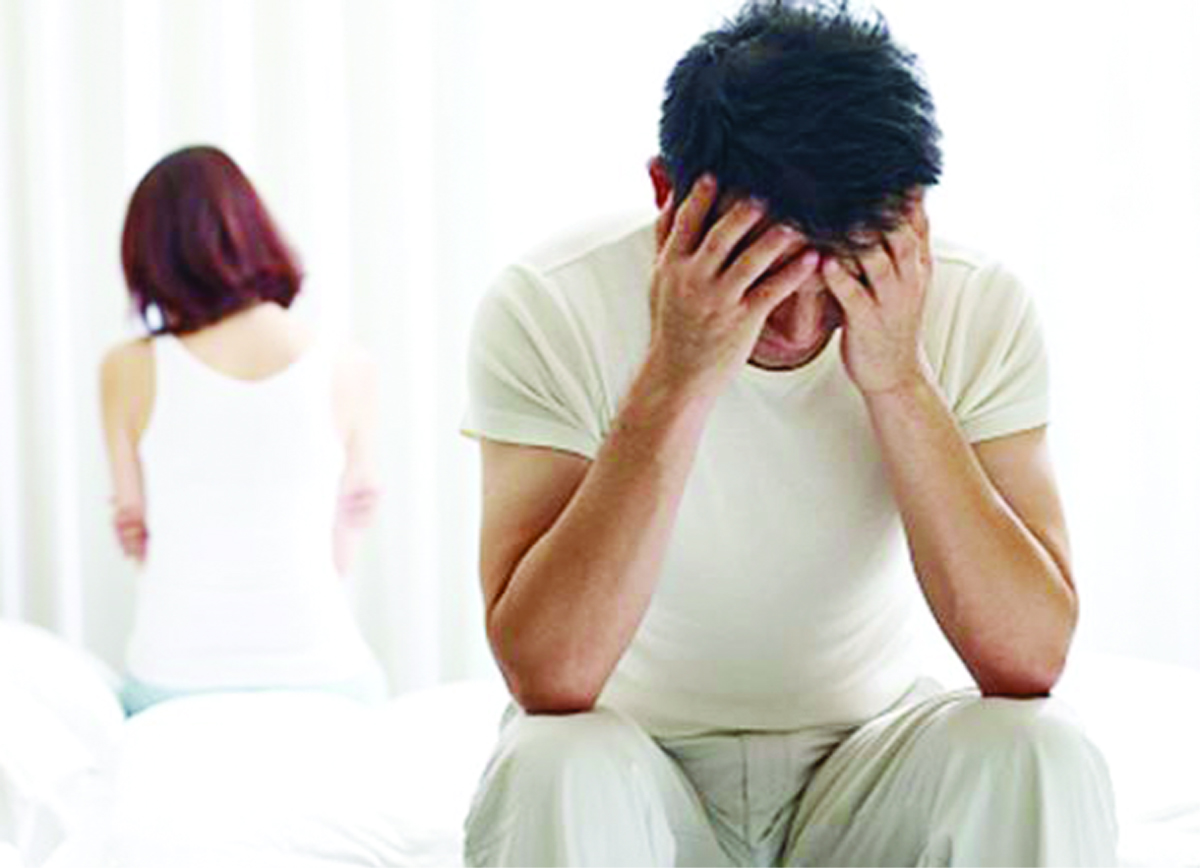
Genetics plays an important role when we talk of ART(Asssited Reproductive techniques) as everyone wants their genes to be carried further to the next generation but some may be suffering from treatable or resistant conditions or those which carry high risk of passing on to the genetic defects so not advisable to go by the routine ways of treatment. Such couples need indvidualization of treatment approach
Infertility affects upto up to 15% of couples of reproductive age.With advanced science many new options have paved the way.
A clear diagnosis of the cause of male factor infertility can be made in only a small proportion of men who present with infertility as many will be labeled as idiopathic male factor infertility for which there are no specific therapies and to add to worries is that there is no single test which can predict the fertility potential of an individual as there may be many confounding factors in that
Genetic abnormalities in males can vary from chromosomal abnormalities to numerical and structural involving autosomes and sex-chromosomes and microdeletions on Y-chromosome and their application is key to management and counseling of such couples
What are the Implications of Genetics abnormality in Male Infertility ?
Male infertility can have variable causative factors ranging from specific cause to idiopathic (unknown factors) to genetic factors
It helps us to –
* Study into depth of problem of male infertility which was earlier ignored or not taken care of
* Genetic counseling Of couples affected with this problem
Clinical Presenatation-
* Patient may be asymptomatic,has wide spectrum of sign symptoms as part of some syndromes or anomalies
* Long history of primary infertility
* May have family history of subfertility or Infertility or delayed conception
* May have history of birth of babies with abnormalities or intrauterine demise
* History of recurrent miscarriages
* Deviated growth pattern and secodary sexual charactersitics
* Derranged semen parameters ranging from oligozoopsermia to teratozoospermia to nil sperms(Azoospermia)
Whats the need of Genetics in Male Infertility and what can be done ?
Assisted reproductive technologies (ARTs) such as intracytoplasmic sperm injection (ICSI) provide chance of baby in such cases provide they don’t have any genetic abnomalities so that their own sperms can be used as use of chromosomally abnormal sperm from these patients may result in transmission of genetic abnormalities to their prospective child
Prevention is better than cure
Science has no doubt advanced but not all aspects still covered as many grey zones there which needs lots of reseraches
What we can do at present is to detect and diagnose genetic defects at early stage so that future generation can be spared
That’s why screening for genetically determined male factors is very important before enrolment for assisted reproductive technologies and it can be done by various means like –
Peripheral blood karyotyping
Testicular biopsy (Diagnostic and Therapeutic both)
Analysis of chromosomal constitution of spermatozoa
DNA analysis of blood and spermatozoa to detect microdeletion on Y chromosomes and DNA damage percentage can also be checked by DNA Fragmentation Index(DFI)
Types of Genetic Abnormalities-
SEX CHROMOSOMAL ABNORMALITIES AND MALE INFERTILITY –
Numerical Abnormalities
46, XX Males
Structural Abnormalities of Y Chromosome
Reciprocal Translocations Involving Sex Chromosomes
Microdeletions on Y Chromosome
AUTOSOMAL ANOMALIES AND MALE INFERTILITY-
Robertsonian Translocations
Reciprocal Translocations
Inversions
It has been observed that there is an increase in the percentage risk of chromosome abnormalities in the infertile male population as compared to the general population adding to the transmission risk to the next generation too. But not to forget that thorough investigation of the man should be accompanied by investigating his partner too as at least a third of couples with infertility have problems with both partners
(The authors are Senior IVF and Fertility Consultant and Senior Gastroentrologist)

Breast cancer Be aware be prepared

Dr. Surbhi Kudyar
As the month of October blooms in our calendar it starts with a message of ” GIVE HOPE, SAVE LIFE” as it is marked as the Breast cancer awareness month.
Breast Cancer the dreaded disease has spread its paws in women of all ages. And has become a major problem both in western countries and in India. According to a recent survey, India will record 1,80,000 new cases of breast cancer and approximately 80,000 women will die from this disease in 2020. Stastistics are so sad that every 4 minutes a women is being diagnosed with breast cancer in India, and every 13 minutes we lose a life because of breast cancer in India. Such are the worrisome statistics of this disease in our country.
The Pink Ribbon which we see the whole month of October personifies Breast cancer awareness. The roots and the goals of this awareness month dates back to 1985 where it started as a week long event which was started by Betty Ford who was a Breast cancer survivor and was the wife of then president of United States Gerald Ford, as a partnership between the American Cancer Society and the pharmaceutical division of Imperial Chemical Industries. The early goal of Breast Cancer Awareness Month was to educate women about breast cancer and early detection tests so that they could take charge of their breast health. One of their key goals that they wanted to achieve was to promote mammograms as an important tool to be used in the fight against breast cancer. The first nation-wide campaign that utilized the pink ribbon was back in 1992 by Estée Lauder cosmetics. They handed out an impressive 1.5 million of them and ushered in the pink ribbon as the premier visual reminder of Breast Cancer Awareness Month.
Risk Factors:
Late marriage, late age of childbirth and little or no breastfeeding
Breast lumps- not all lumps are cancerous but all lumps need evaluation to rule out cancer.
Almost one third of all breast cancer patients are believed to have familial disease pattern, and some 5% are believed to be hereditary, with BRCA1 and BRCA 2 gene mutations having been identifies as the major genetic causes. If someone inherits such a gene, the chances of developing breast cancer are 80% and ovarian cancer is 40% in lifetime.
Dense breast tissue – Women with dense breast tissue have a higher chance of developing breast cancer.
Diet and lifestyle choices: Women who smoke, eat high fat diet, drink alcohol are more at risk of developing breast cancer.
Radiation Exposure: Frequent exposure to X-Rays and CT scans may raise a women’s chance of developing breast cancer.
Obesity: Overweight women are at a higher risk of developing breast cancer.
Oestrogen exposure – factors such as early menarch, late menopause, HRT (Hormone replacement therapy), alcohol, obesity, lack of exercise and stress causes increased oestrogen exposure and increase chances of developing breast cancer.
Women who had undergone IVF therapy for pregnancy also have more tendency to develop breast cancer because of increased exposure to hormones.
Smoking is an important risk factor for developing cancer.
So a healthy stress free lifestyle, timely pregnancy, adequate lactation and abstinence from Tobacco and alcohol are certain measures which can definitely decrease the incidence of Breast cancer.
Signs And Symptoms
A breast lump or thickening that feels different from the surrounding tissue
Change in the size, shape or appearance of a breast
Changes to the skin over the breast, such as dimpling
A newly inverted nipple
Peeling, scaling, crusting or flaking of the pigmented area of skin surrounding the nipple (areola) or breast skin
Redness or pitting of the skin over your breast, like the skin of an orange
Lump can be felt in the axilla (armpit) also.
DIAGNOSIS AND TREATMENT
Tests and procedures used to diagnose breast cancer include:
Breast exam : Breast self Examination is the key to early detection and Prevention.
Mammogram. A mammogram is an X-ray of the breast and are not harmful.
Breast ultrasound: Ultrasound may be used to determine whether a new breast lump is a solid mass or a fluid-filled cyst.
Removing a sample of breast cells for testing (biopsy). A biopsy is the only definitive way to make a diagnosis of breast cancer. During a biopsy, your doctor uses a specialized needle device guided by X-ray or another imaging test to extract a core of tissue from the suspicious area. Biopsy samples are sent to a laboratory for analysis where experts determine whether the cells are cancerous. A biopsy sample is also analyzed to determine the type of cells involved in the breast cancer, the aggressiveness (grade) of the cancer, and whether the cancer cells have hormone receptors or other receptors that may influence your treatment options.
Breast magnetic resonance imaging (MRI) is used with mammography and breast ultrasound, is a useful diagnostic tool. Recent research has found that MRI can locate small breast lesions sometimes missed by mammography. It can also help detect breast cancer in women with breast implants and in younger women who tend to have dense breast tissue. It helps to detect any cancer in the opposite breast, extent of cancer in the breast, number of lumps in each breast.
PET Scan – is done for whole body evaluation for any metastatic disease.
CT- Scan – Abdomen and Chest for metastasis.
Bone scan – For any bony metastasis.
TREATMENT:
Surgery in operable cases it can be Lumpectomy or Breast conserving surgery where a part of breast tissue is removed, Mastectomy where the whole of breast is removed these methods are adopted depending on the size, site and the extent of the tumor accompanied with Lymph node dissection in the axilla( armpit).
Chemotherapy and Hormonal therapy depending on the receptor status of the patient
Radiation therapy known as brachtherapy.
Immunotheray.
Palliative care.
NEED OF THE HOUR is awareness about breast examination, beginning from 20 years of age, and regular screening from a breast surgeon, so that it can be detected early and treated successfully.
“Early detection is the key to prevention.”

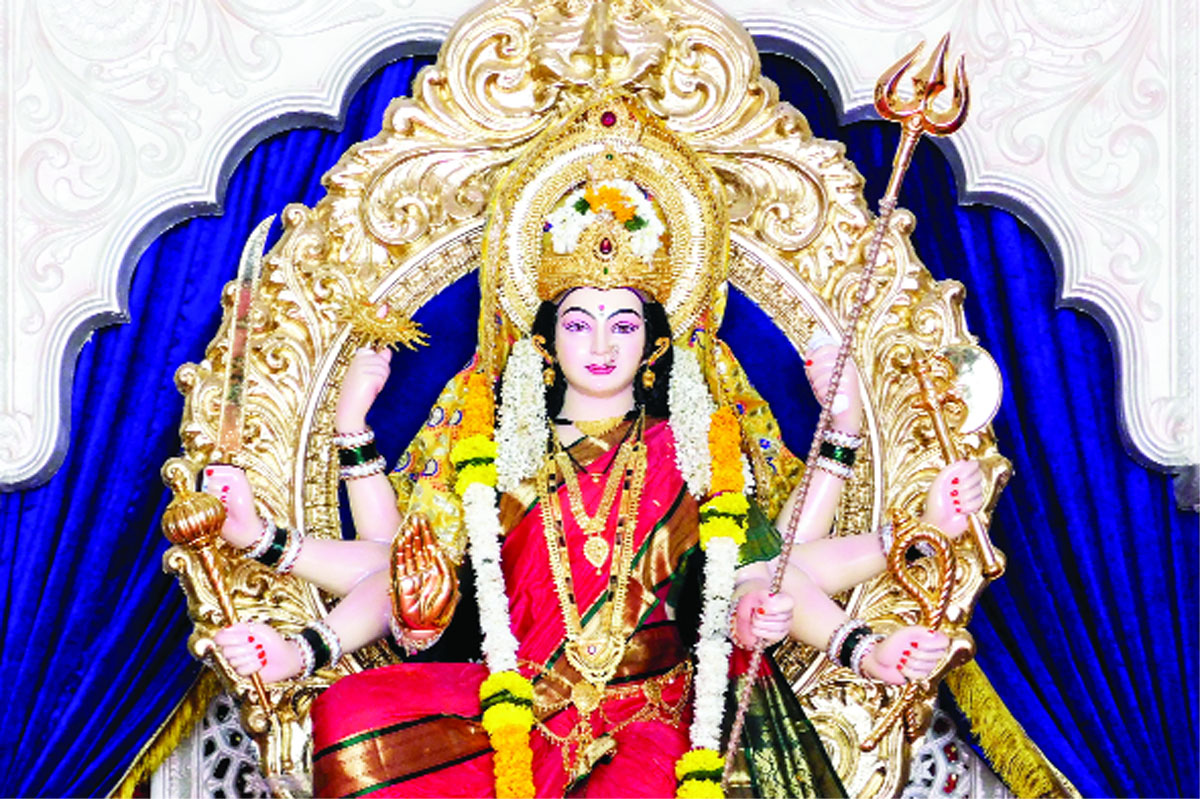
Devi Mahatmyam Glory of the divine mother

Chander M. Bhat
The mother is the sole support of her child. In dangers and perils, in prosperity and happiness, it is the mother who is the safe refuge. That is why a child is inclined to its mother right from the movement of its birth. He knows that he has his mother, so he lives without fear. The idea of God as mother dates right to the Vedic age in the religious history of India. Brahman and the power of Brahman are one. The divine soul who is above all attributes and distinctness appears in reality full of attributes in playfulness. In the Vedic age, the affectionate mother was regarded as the all-prevailing divine soul. She imparted to the gods the knowledge of the truth by destroying their pride after manifesting herself. Brahma, Vishnu, and Mahesh are captivated by her charm. How insignificant is the condition of living beings? It is she who was bound her sons by the spell of her infatuating power. Again it is she who frees them mercifully from all bonds. That is why even the gods when they are in danger have sought the help of the Divine Mother the patrimonial power for deliverance. Living beings cannot get liberation without her mercy.
All the bonds…physical or spiritual are removed by her mercy. She is merciful to those sons who seek protection but she is frightful and ruthful to the wicked. She is then known as Candi that all-pervasive powers of Brahman appear then in the violent image of the killers of the demons. In the mythological age, Sage Markandia has created a unique image of the great Goddess of patrimonial power in his Markandiya Puran. Here, on the one hand, she is merciful as an affectionate mother and on the other hand, she is violently furious. Chamunda Candi having ruthful blood shut eyes. This supreme Goddess by means of her three Gunas, Satva, Rajas, and Tamas has manifested herself thrice and restored the peace and comfort of her creation. The part of the Purna in which the glory of the unthinkable power of the Goddess Mahamaya has been sung in 700 verses is called Sri Sri Candi or Sri Durga Saptishati. Here the story has been compiled into 13 chapters using a dialogue of different characters after being divided into three major sections as Prathamacaritra: Chapter 1; Madhyamacaritra: Chapter 2, 3, and 4 and Uttamacaritra: Chapter 5 to 13.
The Shakti cult is centered around the concept and the worship of God as the Divine Mother. To call on God as Mother is the most characteristic feature of Hinduism. The root of this cult can be traced to the Rgveda itself. The Ambhrnisukta and the Ratrisukta are pointers to this. Some of the minor Upanisads like the Devi Upanisad as also the tantras (Saktagamas) have expounded this cult in greater detail.
The first section starts with the story of a king, Suratha by name, and the merchant Samadhi, both of whom have been deprived of their wealth and possessions by their own near and dear ones. They met at the hermitage of the sage Sumedhas, to where they had come, seeking peace. After hearing from each other about the tragedies that had struck them, they approached the sage Sumedhas, with the question as to why they were still mentally attached to their possessions and their relatives even though the latter had deliberately wronged them. In his long reply, the sage described this blind attachment and infatuation as the direct result of the power of moha or maya, the spell cast by the Devi on all the living beings. When their curiosity to know more was roused, the sage started describing in detail, the stories related to her. In her first Charita the Goddess Mahahaxhmi who is formless and belongs to the original history of creation is the great power of God. She protects the whole universe and also Vishnu the preserve of the whole universe. In this role, she is the creator and having awakened by the prayer of Brahma who rose from the lotus-like the navel of Visnu and inspired her to kill Madhu and Kaitabha the two demons who came out the ears of the Bhagwan Vishnu. She is the image of bliss, content due to the ecstasy of creation and the prayer of Brahma.
In the intermediate charita she is Maha Lakshmi, the embodiment of energy and truth. She is the Divine Goddess, killer of the demon Mahishasur having a manifestation in all the gods. In this section, the king of the asuras or demons had usurped the kingdom of heaven and driven away all the devas or gods including Indra. Then these gods under the leadership of Brahma came to Visnu and Siva and recounted their tale of woe. As the two gods got angry, a brilliant light emerged from their faces, the energies of all the others too emerged similarly out of them, merging into one huge mass of brilliant blazing light and power, which took the form of Goddess Durga. As all the gods equipped her with their respective weapons, she went to Mahisasura, challenged him to the fight, and ultimately killed him. The heavenly region was restored to the gods. The Devi Durga promised to come to the rescue of the gods whenever they called upon her for help.
In the latter role, she is the supreme consciousness Maha Saraswati, the giver of wisdom. She freezes the demon from the thoughts of evil by manifesting the true identity to them and with her various forms killed Sumbha and Nisumbha and also Canda, Munda, and the other demons that rose to lives from the seeds of their own blood, “the rath beeju”. She is the Goddess Candi, the unified power of existence, consciousness, and bliss. This unified power of truth, consciousness, and bliss assumed the form of Goddess Candi, the all truth, wisdom, will, and achievement. She is without form but she takes up the form for the good of her worshippers.
The sage has expressed the blissful image as mentioned in the three charitas earlier and the glory of the Goddess in the language of magnificent poetry. The words of the courage of Goddess and the description of her war with demons all appear in a unique poetic suggestiveness.
Sri Sri Candi is read in the morning after a bath, after performing daily religious service. A self-restrained person should have a seat facing either the east or the north and should read Sri Sri Candi with devotion and understanding, chanting with the correct pronunciation. The best way is to chant it correctly from the memory without looking at the book. In case of inability to do it, it would be proper to place the book on a table or a desk after worship and then it should be read attentively and meaningfully neither in too loud nor in a too low voice, neither too rapidly nor too slowly. Before reading any charita, one should meditate on the image of the deity. A bell has to be rung at the beginning and at the end of each chapter. The reading of Sri Sri Candi would be most proper if it is done on Tuesday or Saturday, the meant for the Divine Mother, or on the day off meant for the worship of the Goddess such as the 8th, 9th, and 14th of new moon day and vice versa. In case of one’s inability to read the entire Candi, daily four elegies of the Goddess from the 1st, 4th, 5th, and the 11th chapter should be read. Reading should continue until a chapter is completed. The best reader of Sri Sri Candi pronounces the words rather than reads it mentally.

A peep into economic wisdom of the past

Suman K Sharma
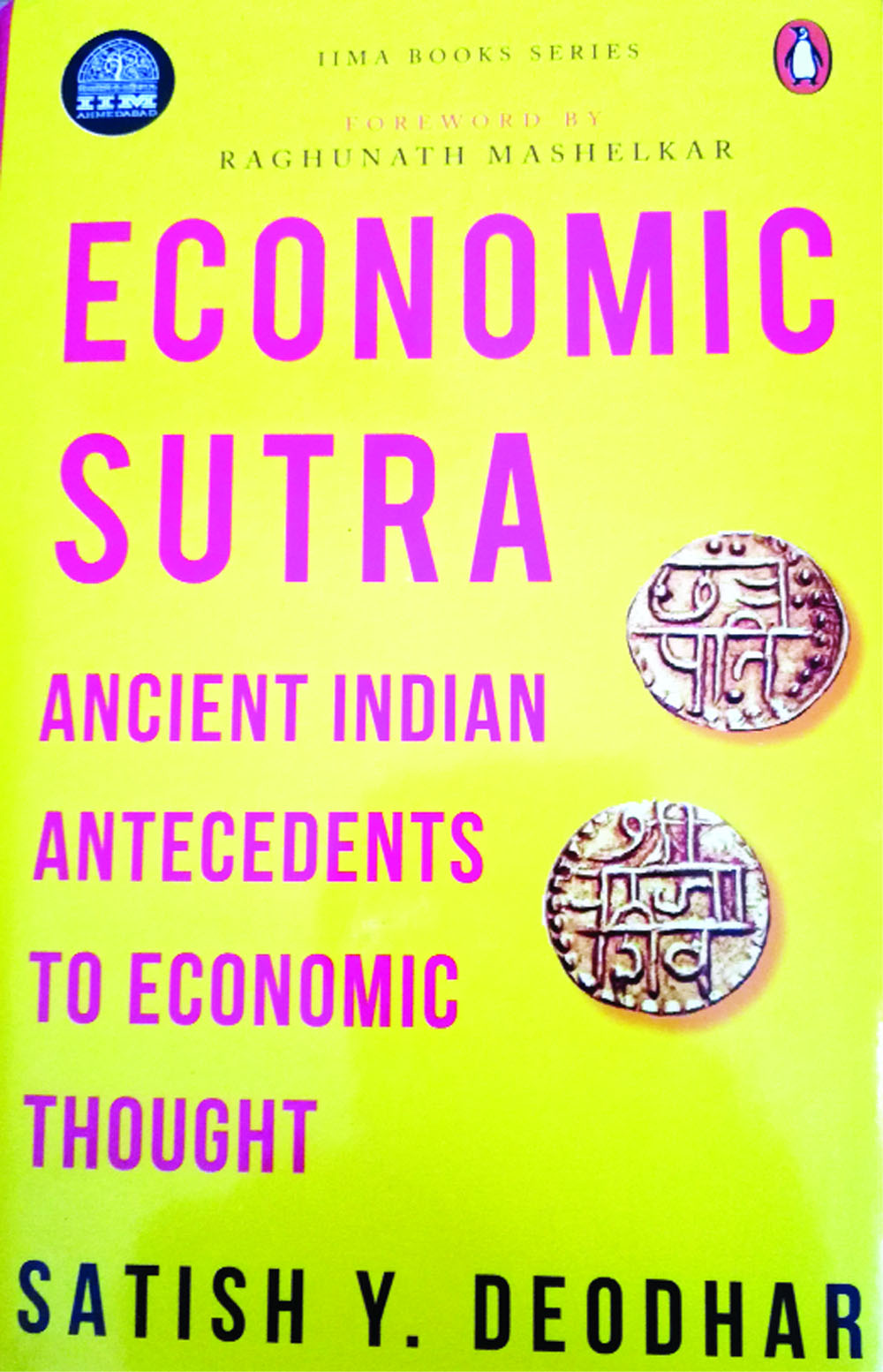
Prof Satish Y Deodhar’s Economic Sutra, of IIMA Books Series,is no ordinary book. You are expected to first take a test of sorts at a crossword puzzle appended to it and then re-do the test after finishing the book. It should not come as a surprise. The don teaches economics at the prestigious Indian Institute of Management; Ahmedabad and wants you to know how much you have gained from the treatise he has put together so painstakingly. The140 pages text, barring endnotes et cetera, covers over 3,500 years of India’s history of India’s political economics ‘from the time of the Saraswati-Sindhu civilization dating back to 2500 BCE, through the Golden Age of the Gupta Dynasty until the sixth century CE and ending with the early medieval period when the West Asian incursion into India began around the eleventh century CE.’ (page xvii). This seemingly impossible feat evokes Sutra-how our ancient sages encapsuled a whole lot of information in their aphorisms and then strung these pearls of wisdom together for a keen learner. A thread of continuity runs through the diverse elements of the book, making it a seminal work on the ancient India’s contribution to economic thought.
Not other-worldly
It is generally thought that we in India are other-worldly, content with what we have, and that culturally we are not inclined to improve our lot through economic activity. The Economic Sutragives a lie to such thinking and does it convincingly by way of paraphrased extracts from the relevant texts. Several hymns of Rig Veda (15th century BCE) ‘relate to matters on desire, material prosperity, wealth and interest rate’ (p.24). In circa 700 BCE, Panini, the grammarian, laid down rules and symbols for expressing interest in percentage terms’ (p.27). Hymn 117 of Book X of Rig Veda prescribes charity to alleviate poverty (p.36). There is story in Katha Upanishada of Shukla Yajur-Veda (10th century BCE), about Sage Vajashravas giving away all his worldly possessions in alms (p.39). The varna system, predecessor of the much-maligned jati-pratha (caste system),was developed during the Vedic times to cater to the requirement of division of labour on guna-karma (aptitude and deeds) basis (p.136). It got stratified during the millennia, till a Western scholar like Max Mueller proposed identification of communities as to how long or short a person’s nose was! (pp 74-87).What a travesty of a well-conceived social order!
And then we got Kautilya’s Arthashastra. Written in Sanskrit around 4th century BCE, this treatise stands out as ‘a culmination of the elements of economic thoughts that had appeared in sacred and secular texts over the millennia’ (p.95). It gave to the contemporary world the concepts of private ownership of land, the state acting as a market facilitator for the private sector (p.64). Arthashastra also proposed ‘variability of interest as per the riskiness of business operations, institutional apparatus for the credit market, business contracts, rules of inheritance and jurisprudence for dispute settlement’ (p.126).
The author highlights the distinction between the modern economic theory and the Indian texts. While the former ‘focuses on the pursuit of material wealth and pleasures alone, (the latter) ….have treated economic well-being as one of the four purusharthaor life objectives…..dharma, artha, kama and moksha, that is, righteous conduct, acquisition of wealth, pleasure and love and salvation, respectively.’ (p.22).
Ancient India – a land of riches
It is no wonder then that with such sound ideology to follow, ancient India was at the height of its glory. ‘In the first millennium CE, India’s GDP had acquired about one-third to half of the world’s GDP.’ (p.10). We traded with Egypt, West Asia and South-East Asia to our great advantage. ‘Greco-Roman world imported about 120 items from India, it exported only 30 items to her.’ (p.121). The items they imported from India were much more precious than their exports ‘of scant value’ to our country. That resulted in large scale trade deficit with India. In fact, Pliny, the Elder (23-79 CE) had complained that money was being drained on imports from India. (pp. 121-22). Commercial activities were categorised: agriculture, trade and commerce, animal husbandry and lending at interest. (p.52). Professionals such as astrologers, basket-makers to butchers,…weavers to warriors, jewellers, gold-smiths were an integral part of the socio-economic system. They were well organised into guilds. ‘The guilds were not just for name-sake but they had an economic purpose to discharge.’ (pp.52-54) Kautilya fixed wages – from 48,000 panas per year for the king’s ministers to 60 panas for servants and such like (p.113).
The Fall
If indeed we were conceptually and materially on a such a strong footing historically, it would be natural to ask how ‘the abysmally slow GDP growth in the first three decades of India’s independence was christened and slammed as the Hindu Rate of Growth?’ (p.14) Why had Deepak Lal to pejoratively describe stagnation of Indian economy as ‘Hindu Equilibrium’? (p.19). The answers lie implicitly in physical destruction of the repositories of our knowledge by foreign invaders and deliberate obfuscation of the ancient texts during and after the British Raj. In 1193 CE, the Nalanda University was burnt to cinders by Bhakhtyar Khilji. And so were Vikramshila, Jagaddala and Odantapuri (p.11). As for the ancient texts, the author cites the infamous quote from Lord Macaulay’s ‘Minute on Education’: ‘A single shelf of a good European Library was worth the whole of Indian literature of India and Arabia…’ (p.13).
Prof Deodhar’s style is simple and readily accessible even to the uninitiated. The book is free from any kind of jargon and academese. The Foreword by Raghunath Mashelkar, former Director General, Council of Scientific and Industrial Research (CSIR) and illuminating endnotes appear as value additions. Some repetitions do have crept in and these can be ignored, seeing the overall worth of the book. Economic Sutra is a must read for all those who believe with the author that a keen look at history has many advantages in the study of subjects like economics.

Ramnagar The site of rare specimens

Anil Paba
An international team of researchers has unearthed a 13 million year old fossil of a newly discovered ape species in Jammu and Kashmir’s district Udhampur which is the earliest known ancestor of the modern day gibbon. It provides important new evidence about when the ancestors of today’s gibbon migrated to Asia from Africa. The fossil, a complete lower molar, belongs to a previously unknown genus and species ( Kapi ramnagarensis), and represents the first new fossil ape species discovered at the famous fossil site of Ramnagar in nearly a century.
Prof Rajeev Patnaik (Head of the Department, Dept, of Geology, Panjab University, Chandigarh) told the author that in 2010, an international team comprising of paleontologists and geologists from India and the United States led by him including Prof. Chris Gilbert (City University of New York),Dr Biren Patel(University of California) and Dr. Chris Campisano ( Arizona State University) initiated new paleontological and geological fieldwork in Ramnagar area of district Udhampur. Their research has since then been supported by various agencies like (Department of Science and Technology-PURSE grant to PU, Ministry of Earth Science of India to Rajeev Patnaik) and US based (Leakey Foundation) grants. They focused on studying South Asian mammalian (in particular, primate evolution and biogeography). Their team has documented a number of new fossiliferrous localities from which they have recovered new primate fossils representing a new Sivaldapid genus and species (Ramadapis sahnii; Gilbert et al., 2017) , a large bodied -ape attributed to Sivapithecus (Gilbert et al., 2019) and a new small- bodied ape ( Gilbert et al., 2020) (Figure 1).
According to Chris C Gilbert, “there are other primate species known during that time, and no gibbon fossils have previously been found anywhere near Ramnagar. Since the fossils were discovered in 2015; years of study, analysis and comparison were conducted to verify that the tooth belongs to a new species, as well as to accurately determine its place in the ape family tree”. It pushes back the oldest known fossil record of gibbons by at least 5 million years, providing a much- needed glimpse into the early stages of their evolutionary history. In addition to determining that the new ape represents the earliest known fossil gibbon, the age of the fossil around 13 million years old, is contemporaneous with well known great ape fossils, providing evidence that the migration of great ape, including orangutan ancestors, and lesser apes from Africa to Asia happened around the same time and through the same places.
There have been several reports of the discovery of fossils claimed to be of man’s ‘true ancestors’ from time to time. They include two, named Proconsul and Kenyapithecus, from Kenya; two, named Ramapithecus and Sivapithecus, from locations in India, Pakistan, China and Kenya; and two, named Dryopithecus and Rudapithecus, from Europe. These ape-like creatures lived at various time between about 8 and 20 million years ago. Of these the one that created a sensation and which was once regarded as man’s oldest direct ancestor was Ramapithecus, fossils of the upper jaw of which were first found in the Siwalik Hills in India.
But G. E. Lewis was the first to recognize the Siwalik hominid Ramapithecus from Haritalyangar, a village near Bilaspur, Himachal Pradesh. Later Elwyn Simons’ efforts in the late sixties and early seventies led to an upsurge in research around Haritalyangar, resulting in some outstanding discoveries of fossil primates. Recently, Haritalyangar has yielded additional new evidence of fossil apes, information about their habitat and the main cause of their extinction.
Fossil apes and other mammals have been known from Miocene -aged Lower Siwalik deposits surrounding the town of Ramnagar district Udhampur ( Jammu and Kashmir, India) since Barnum Brown’s American Museum of Natural History expedition in 1922.
Significantly, the first primate fossil discovery at Ramnagar was made by US born collector Barnum Brown in 1924 when he found an important fossil jaw of an early great ape (now known as Sivapithecus indicus), which is a close relative of the living orangutan. Paleontological fieldwork has continued on and off in the Ramnagar region since 1922, resulting in the recovery of a large number of vertebrate fossils, including small number of additional ape specimens attributed to the genus Sivapithecus and a single adapoid primate, Sivaladapis palaeindicus ( Pilgrim,1927; Gregory et al.,1938; Vasishat et al., 1978; Thomas and Verma, 1979; Gaur and Chopra,1983; Nanda and Sehgal,1993; Basu,2004; Kelley,2005; Sehgal and Patnaik,2012).
Over the past century, numerous specimens collected near Ramnagar (J&K) India have proven to be important in understanding the evolution and biography of many mammalian groups, including hominoid apes. Since 2010, they have received fossil prospecting in the lower Siwalik deposits near Ramnagar in an attempt to better understand the evolution, biogeography timing and paleoclimatic context of mammalian radiations in Asia, with a particular focus on primates.
It is believed that the age of the new sites and the Ramnagar region in general, can be bracketed by micro and macro-fauna to approximately 14-12.7 Ma which suggests the area may slightly be older than the classic ape-bearing Chinji deposits on the Pakistan Potwar Plateau. Thus, the Ramnagar region may represent the first occurrence of apes and other mammalian lineages in the Siwalik.
Future plans: According to Rajeev Patnaik that primates are rare elements of the fauna across known Siwalik localities, the recovery of these primate specimens by their team is promising; it shows that the Ramnagar region provides the rare opportunity to obtain additional rare specimens that can now be uncovered with additional fieldwork. Also they are now focusing on the diet and habitat of these primates and associated mammals to understand the influence of climate change on their evolution.

Bhalessa : A place of scenic spots

Sadaket A Malik
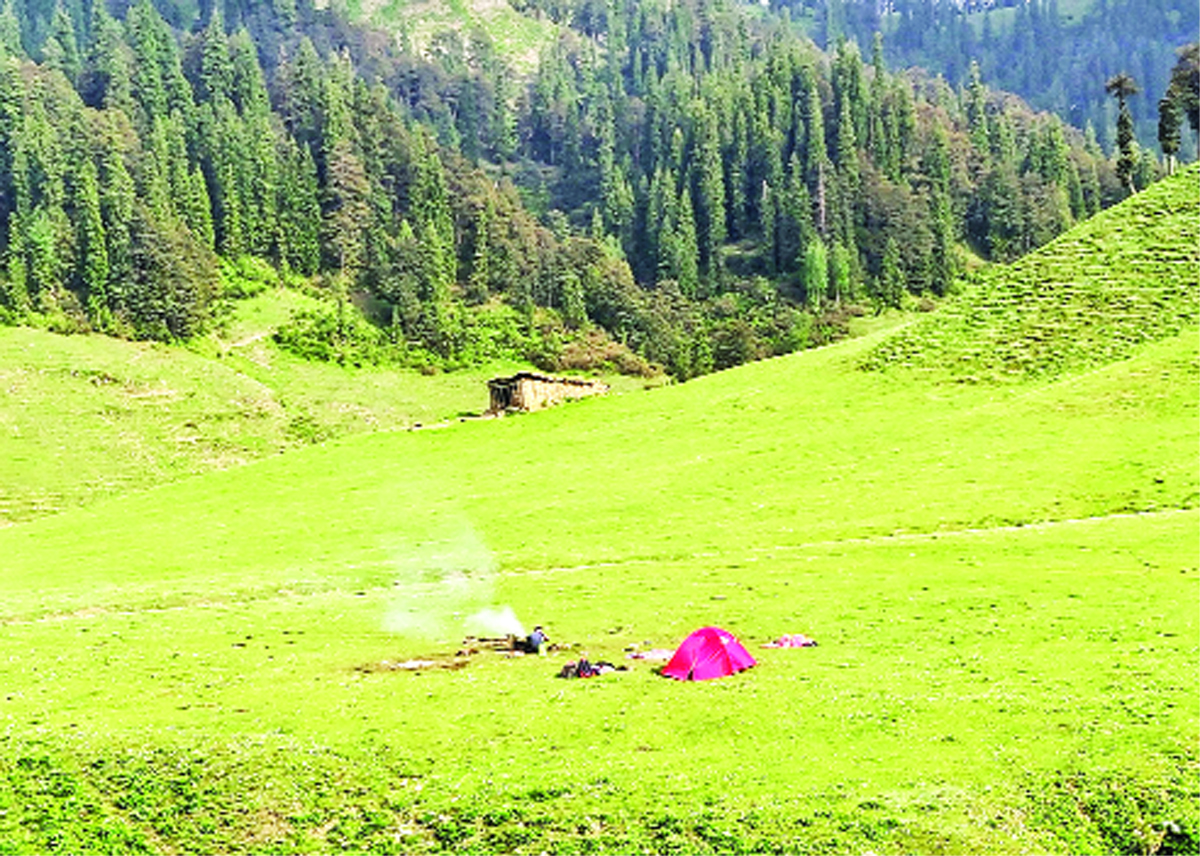
Bhalessa is known for its picturesque valleys and villages. It has more then three dozen sites that can attract tourists, travellers and mountaineers. These tourist spots are natural landscapes and not managed by any government departments as of now.
Bhal Padri, a hill station in Changa block is a beautiful hotspot of Bhalessa and has not been explored as of now.
Kanthi Dhar : There lies via Kilhotran a beautiful meadow of Khanthi Dhar. A local fair is held here (mela) annually. The people from all walks of life participate in this fair.
Makan and Chuchool: Makan and Chuchool is a beautiful place, there are some small Streams/ Nullahs such as Beer Sow with its origin from Ludoo Kansar, Kanchu sohow near Makhan Chuchool. These rivers flow through gorges and are mainly exploited for generation of Hydel Power
Mehal Dhar : Mehal Dhar is another valley of Bhalessa in Chilly area.The area is full of snowy mountains and is presenting a heart touching beauty to the tourists. In summer season, the Hindu pilgrims visit this place. Historically speaking, in ancient times, the valley was named after Prince Mehal Nag who lived here. He was Raja of Bhalessa.
Damote Dhar : This area of Bhalessa town is located in the upper reaches of Bharti-Dhosa on the one side and is spread up to chilly Mano-kota on the other side. The valley is connecting snow clad mountains in winter and is glorious in summers.
Bach Dhar: Located at the upper reaches of Jitota Bhalessa connecting Bhaderwah is a picturesque place and looks scenic during summers.
Nagni Dhar : Nagni lies in Chanti Ginshana area of Bhalessa, and is a main centre for tourists.
Rohari Meadows : Nature has endowed Bhalessa with adventure, beauty, and glory. The beautiful Rohari Dhar lies in the near khaljugasar- the last panchayat of Bhalessa. The cold air touches the hearts of tourists here. On the either side of Rohari there lies areas of Mankun and Chishool, The pedestrian can reach the area of Chamba within two hours. If we analyse the distance by road, if developed by the authorities, the area shall get directly connected with the Himachal Pradesh, thereby opening the vistas of trade and knowing each others cultures and traditions
Goha Dhar : Connecting border of Chamba District of Himachal Pradesh, there lies Dhar quite attractive for most of the tourists here.
Lamhote Meadows : Situated in chilly pingal Tehsil of Bhalessa, and has a beautiful look. It can attract the tourists across the state.
Soin Bhagar:
It is well known place in Bhalessa and can be a best tourist spot.
Ghasheer Top :
A well known place for the trekkers and the mountaineers. It is a hub of tourists but has not been adopted as of now by the tourism authorities.
Talaie :
Surrounded by Gamgul, Dagan, Mandral and Kawali meadows in Changa block of Bhalessa, the places are attractive for the mountaineers and travellers.
Dhosa Meadows : Adjacent to Bharti villages of Changa lies beautiful meadows of Dhosa. Dhosa is a beautiful valley in Changa Bhalessa.
Chilly Meadows:
The meadows located in Chilly are of mismerising view and can be best for tourist huts and spots.
Kahara Meadows:
Number of meadows lie in Kahara Tehsil of Bhalessa and can be better tourism hotspots if developed.