

Srinagar, May 4: In a decisive action under the ongoing Nasha Mukt Jammu & Kashmir Abhiyaan, Srinagar Police on Monday demolished an illegal residential structure belonging to a habitual drug peddler in the Palpora Noorbagh area of the city.
The accused has been identified as Mohammad Irfan Sheikh alias Iff, son of Mohammad Ashraf Sheikh, a resident of Pamposh Colony, Palpora Noorbagh. He is a known narcotics offender involved in multiple cases under the NDPS Act, including FIR No. 134/2024 registered at Police Station Safakadal under sections 8/21, 29, and FIR No. 48/2025 registered at Police Station Sangam under section 8/21.
According to officials, investigation and verification revealed that the demolished structure had been illegally raised on land acquired and developed using proceeds generated from drug trafficking. The construction was carried out without lawful authority, in violation of revenue laws.
Police further stated that close associates and family members of the accused are also reportedly involved in multiple NDPS cases across the Valley, indicating the existence of a wider narcotics network.
Acting on credible inputs and following due legal procedures, the demolition was carried out in coordination with concerned authorities after completing all codal formalities.
The action sends a strong message that properties created from the proceeds of drug trafficking will not be spared, and individuals involved in the narcotics trade will face strict and visible consequences.
Reiterating its zero-tolerance policy, Srinagar Police urged citizens to come forward and support efforts to eradicate the menace of drugs and safeguard the youth and society.(KNC)
Srinagar Police Demolishes Illegal Structure Of Notorious Drug Peddler, Issues Stern Warning

Fake MBBS Admissions Racket Busted, 18 NEET Aspirants Rescued; 4 Fraudsters Held

NEW DELHI, May 4: Delhi Police busted an organised racket that allegedly duped NEET aspirants and their families by promising guaranteed MBBS admissions and arrested four people, including the suspected mastermind and a doctor, an official said on Monday.
Eighteen students, which included minors, were rescued from the alleged fraudsters, who had taken them to undisclosed locations on the pretext of providing “exam questions” — ahead of the NEET (UG) 2026 examination on May 3, police said.
The “fake” question papers were allegedly created using previous years’ material and coaching institute content.
They allegedly demanded Rs 20 to 30 lakh from families of the students and took a token payment, claiming to get them guaranteed seats in medical colleges.
The action was initiated following specific input received on May 2 from Surat Police about a suspect operating from Delhi and claiming to facilitate medical admissions through NEET. Technical surveillance led investigators to Mahipalpur Extension, where multiple hotels were searched.
The police eventually zeroed in on four accused persons staying at a hotel, including Vinod Bhai Bhikha Bhai Patel, who had allegedly lured aspirants from Gujarat.
During questioning, it emerged that the accused had collected large sums of money, original class 10 and 12 mark sheets, and blank signed cheques from parents in exchange for false assurances of securing MBBS seats.
Investigators said the accused had taken some students away from their guardians. Police laid a trap near a hospital in Ghaziabad and rescued three students while apprehending the alleged mastermind, Santosh Kumar Jaiswal. Subsequent raids at a flat in Ghaziabad led to the rescue of 15 more students, some of whom were minors scheduled to appear in the NEET exam on May 3.
They were counselled and allowed to sit for the examination, police said. Two more accused — Sant Pratap Singh and Dr Akhlaq Alam alias Golden Alam — were arrested from the flat.
Police said the gang had devised a well-planned modus operandi to exploit the aspirations of medical aspirants. Jaiswal allegedly conceptualised the scheme, while Alam prepared fake question papers using previous years’ material and coaching institute content. Singh arranged logistics and accommodation, and Patel acted as a broker to approach families.
The accused allegedly demanded Rs 20 to 30 lakh from each applicant and collected token payments, documents and cheques as part of the fraud.
During the operation, police recovered 149 pages of purported questionanswer material, three blank signed cheques belonging to victims, and other incriminating documents.
A case has been registered under relevant sections of the BNS and further investigation is underway to identify other members of the network. (Agencies)
Stock markets end higher; Sensex rallies 356 points

BJP On Course To Make History In Bengal, Poised To Retain Assam; Vijay Rewrites Script In Tamil Nadu, UDF Set To Win Keralam
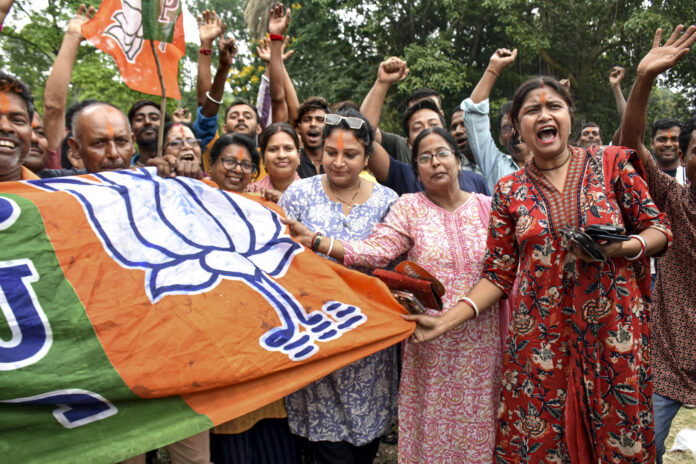
New Delhi, May 4: The results and trends of assembly polls on Monday signalled some tectonic political changes with the BJP on course to form its first government in West Bengal and actor-turned politician Vijay writing a new script in Tamil Nadu.
BJP-led NDA is on course to a sweeping victory in Assam as is Congress-led United Democratic Front (UDF) in Keralam, and NR Congress-led alliance in Puducherry.
BJP’s expected victory in West Bengal will mark a significant moment for the party as it had been for long a marginal player in the state dominated for years by the Congress, Left parties and later Trinamool Congress. It is also the home state of the BJP’s ideologue Syama Prasad Mookerji.
The BJP had won 77 seats in the last assembly polls. According to the latest results from ECI, BJP is leading in 191 seats and has won seven on 293 seats for which counting was held on Monday, reflecting the steadfastness of its campaign during which it amplified every issue on which it could target the ruling Trinamool Congress. BJP also outdid the Trinamool Congress in terms of promises for various sections of society as the election saw a lot of heat and dust over the Special Intensive Revision of electoral rolls.
Trinamool Congress, which swept the last assembly poll by winning 212 of 294 seats, is leading only in 88 seats and has won one seat. The Congress and Left parties again fared poorly in the state. Congress is leading in two seats and the Left parties in one. Trinamool Congress has been in power in West Bengal for 15 years.
In Tamil Nadu, Vijay broke new ground as he took the election away from the two Dravidian parties, which have dominated the state’s politics for over six decades.
Vijay’s Tamilaga Vettri Kazhagam (TVK) is leading on 105 seats and has won 3 , DMK is leading on 52 seats and has won six, AIADMK is leading on 45, PMK on 5, Congress is leading on four seats and has won one, BJP is leading on three, DMDK is leading on one, VCK on two, Amma Makkal Munnettra Kazagam (AMMKMNKZ) and CPI(M) is leading on two seats. Polling was held on 234 seats in the state.
As per current trends, Vijay will fall short of a majority in the 234-member state assembly and will need the support of other parties to form a government.
Vijay, who had the massive backing of youth in the state, rode on the popularity that film stars have in the southern state. He combined his appeal with an agenda that heightened the anti-incumbency against the DMK-led government.
People in the state, apparently tired of power alternating between the alliances led by DMK and AIADMK, decided to back the challenger who came with a fresh perspective.
Congress-led UDF is on course for a handsome victory in Keralam and will form government in the southern state after 10 years of LDF rule.
While the Keralam victory is a morale booster for Congress, it failed to perform to expectations in Assam, where its top state leader, Gaurav Gogoi lost his election.
Congress had failed to oust the Pinarayi Vijayan government in the last assembly polls but ran a relatively unified campaign this time, leaving the issue of Chief Minister to be settled after the polls. Keralam victory has come for Congress after a series of losses in assembly polls since the 2024 Lok Sabha polls. The Congress was seen to have allowed the victory in the Haryana polls slip from its hands.
Congress has won 39 seats in Keralam and is leading on 24 seats. CPI(M) has won 19 seats and is leading on seven, IUML has won nine and is leading on 13, CPI has won five seats and is leading on three, Kerala Congress (KEC) has won six seats and won seat. RSP has won three seats, BJP has won two seats and is leading on one.
Keralam BJP President Rajeev Chandrasekhar said party got support from all sections.
“We saw the local body elections when the people of Thiruvananthapuram gave the NDA the mandate to govern the municipal corporation. In this election, there was a strong anti-incumbency against the CPM. We have put forth a vision of PM for development and opportunities for all,” he said.
In Assam, the BJP-led NDA was looking for its third successive win in assembly polls and performed according to its expectations, with the alliance winning close to 100 seats in the 126-member House.
This was the first assembly election in the state with Himanta Biswa Sarma as Chief Minister and the party improved its performance compared to the 2021 polls.
The BJP is ahead in 69 seats in Assam and has won 13, Congress is leading on 20 seats, Bodoland Peoples Front (BoPF) on nine, AGP on 8 and AIUDF on two, Raijor Dal (RJRD) on two, Trinamool Congress on one and independent on one.
In Puducherry, NR Congress has won 9 seats and is leading on two, DMK is leading on four and has won one, BJP is leading on one seat and has won two, TVK has won one seat and is leading on one seat and Congress and AIADMK have won one seat each.
Polling was held in Assam, Keralam and Puducherry on April 9, in Tamil Nadu on April 23 and in West Bengal on April 23 and 29. (Agencies)
The Scroll That Never Ends: How Infinite Feeds Are Rewiring Teen Brains

There’s a moment every parent recognizes. You call your teenager’s name. Nothing. You call again. Still nothing. They’re not asleep. They’re scrolling — thumb moving in that slow, hypnotic rhythm, eyes glazed, completely gone. It looks peaceful. It isn’t.
Infinite scroll was designed to keep people moving through content without ever hitting a natural stopping point. No page breaks. No “end.” Just more. The engineer who invented it, Aza Raskin, has since publicly regretted it, estimating the feature costs humanity around 200,000 hours of collective attention every single day. For adults, that’s a problem. For teenagers, whose brains are still actively developing, it’s something closer to an emergency.
The Brain That’s Still Being Built
The teenage brain isn’t just a smaller adult brain. It’s a different machine entirely — one that’s mid-construction. The prefrontal cortex, the region responsible for impulse control, decision-making, and recognizing long-term consequences, doesn’t fully mature until the mid-twenties. Meanwhile, the brain’s reward circuitry is running hot. Teens feel pleasure more intensely and are far more sensitive to social feedback than adults.
Social media platforms exploit this perfectly. Every like, comment, and share triggers a small dopamine release. The content is unpredictable — sometimes rewarding, sometimes not — which creates the same variable-reward loop found in slot machines. Teenagers aren’t weak for getting hooked. They’re neurologically vulnerable in ways that adults simply aren’t.
Researchers are finding that heavy social media use during adolescence is correlated with changes in how the brain processes rewards and social information. The brain learns what it practices. When a teen spends four or five hours a day seeking digital validation, the brain begins to prioritize that feedback loop above others.
It’s Not Just “Too Much Screen Time”
The conversation usually gets flattened into a debate about hours. How much is too much? Is two hours okay? What about weekends? But duration alone misses the point.
What matters just as much is what the scrolling is doing to the brain’s baseline. Infinite feeds are engineered to create a state of restless stimulation. The content shifts every few seconds — funny, then shocking, then sad, then aspirational. This rapid context-switching trains the brain to expect constant novelty. When that novelty disappears — in a classroom, in a conversation, sitting quietly with a book — the brain protests.
This is why so many teens report feeling inexplicably bored or anxious when they’re offline. It’s not that real life is boring. It’s that their brains have been recalibrated.
Anxiety, sleep disruption, difficulty concentrating, and a fragile sense of self-worth tied to online metrics are showing up in clinical settings with increasing frequency. Therapists and counselors specializing in adolescent mental health and behavioral treatment are seeing a generation that struggles to tolerate discomfort, boredom, or any experience that doesn’t offer immediate stimulation.
The Comparison Engine
Infinite feeds don’t just keep teens scrolling. They keep them measuring.
Every piece of content is an implicit comparison. Bodies. Friendships. Parties they weren’t invited to. Achievements. Aesthetics. Lifestyles. The algorithm doesn’t show an average cross-section of life — it surfaces the best, the most curated, the most extreme. Teens know this intellectually. They still feel it emotionally.
For girls especially, research consistently links heavy social media use to body image issues and depressive symptoms. But boys aren’t immune. The feed serves them dominance hierarchies, physical ideals, and performance culture in a different packaging, with similar psychological costs.
What Actually Helps
Banning phones entirely rarely works and often backfires. What does work is a combination of structural changes and honest conversation.
Turning off auto play and infinite scroll features where possible is a practical start. Many platforms now offer tools to set time limits, though they’re easy to override. Keeping phones out of bedrooms at night is one of the highest-impact changes families can make — sleep is when the brain consolidates learning and regulates mood, and feed-scrolling before sleep is particularly disruptive.
But beyond the technical fixes, teens need adults who take this seriously without being dismissive or alarmist. The instinct to say “just put the phone down” is understandable and almost entirely useless. These platforms are built by teams of engineers whose entire job is to make putting the phone down feel impossible.
Families who are noticing real behavioral changes — declining grades, social withdrawal, mood instability, irritability when devices are taken away — should consider reaching out to professionals who specialize in adolescent mental health and behavioral treatment. Early intervention changes outcomes. Waiting for things to “even out” is a gamble worth reconsidering.
The Bigger Picture
Infinite scroll is a design choice, not a law of nature. Some countries and school districts are already moving to restrict teen access to social media entirely. The debate will continue for years.
In the meantime, the teenagers growing up inside these systems need adults who understand what they’re actually navigating. Not a moral failure. Not laziness. A very sophisticated machine, pointed directly at the most vulnerable parts of a brain that’s still figuring out who it is.
The scroll never ends. But the conversation about it has to start somewhere.
The Most Dangerous Mobs in Minecraft and How to Beat Them

There are about 4.3 million active users of Minecraft Realms. By March 2025, that has increased by 17% annually. This figure indicates that more individuals are being killed by Minecraft mobs than ever before. Knowing which species can kill you is essential for enjoying the game.
Ranking the Deadliest Creatures in Minecraft
Not all Minecraft mobs are created equal. Some are annoying. Others are genuinely terrifying.
Here are the most dangerous mobs on the Minecraft mobs list right now:
- Warden: Nearly blind but extremely dangerous. One hit deals massive damage, even through armor.
- Ender Dragon: The classic final boss. It destroys blocks and is immune to most attacks.
- Wither: Summonable and deadly. It inflicts the Wither effect, draining health over time.
- Elder Guardian: Lives underwater and inflicts Mining Fatigue, making you nearly helpless.
- Creeper: Quiet, fast, and explosive. A single surprise encounter can destroy everything.
Running a modded setup makes these encounters even more intense. The best top hosting for modded Minecraft servers gives you stable performance during these high-stress fights. Lag during a Warden encounter is basically a death sentence.
The Importance of Reading a Mob Before It Kills You
In Minecraft, every mob telegraphs its future move. Acquiring knowledge of those signs keeps you alive.
Before it explodes, the creeper hisses for roughly 1.5 seconds. Your window is that. Go quickly. With every blow, the Warden intensifies its aggression and emits vibrating pulses. Directly combating it is nearly always a mistake. Instead, slip past it.
Modded Minecraft changes these rules. Mods add talents, speeds, and attack patterns to mobs. Before encountering an unusual monster, consult the mod documentation. Modified mobs behave differently from vanilla ones.
Agnes Larsson, a developer at Mojang, once said: “Minecraft had been my favourite game for many years before I joined Mojang. It was always my dream to work on it.” That passion shows in how carefully each mob is designed. Every creature has a logic. Learn it, and you gain a real advantage.
Armor, Potions, and Patience as Your Survival Stack Against Elite Mobs
Equipment matters. But knowing how to use it matters more.
Wear full Netherite armour and utilise Swift Sneak to fight the Warden. This lets you squat and move fast. Silence helps the Warden stay calm. Battle the Ender Dragon with a Power V bow and many arrows. Start by destroying End Crystals. They soon heal the dragon.
Potions change disputes, although they’re often ignored. Strength potions dramatically boost damage output. Regeneration potions keep you healthy during long wars. Before attacking a boss-level mob, have two of each.
You undervalue patience. Raging against expert Minecraft mobs almost usually ends badly.
Lessons from Minecraft’s Most Punishing Deaths
Some deaths are fair. Many are not. Here is what experience teaches you.
The Enderman is one of the most deceptive mobs on the Minecraft mobs list. Players unintentionally assault when they make eye contact. Always look at its feet, not its face.
Phantom attacks in-game players who haven’t slept for three days. Sleep can be disregarded throughout a long build. Phantoms suddenly appear and ruin everything. Remind yourself to bed.
Other Nether run-killers include the Magma Cube. It fractures into cubes when hit. After the big one dies, new players celebrate. They die as smaller ones charge at them.
Summary
Minecraft grows because it challenges players constantly. The Minecraft mobs list have grown tremendously over time. Each new addition brings fresh threats. As Marcus Persson once reflected: “My original plan to have this be a shorter project are mainly driven by my desire to make more games and not just get stuck creatively.” That restless creativity is exactly why the game still surprises people after all this time.
Mughal Road Closed Amid Fresh Snowfall In Upper Reaches

Jammu, May 4: Following fresh snowfall in upper reaches, Mughal Road has been temporarily closed for precautionary measures via Peer Ki Gali.
DTI Poonch Manzoor Ahmad Kohli said that Mughal road, connecting Shopian with Rajouri-Poonch districts was closed following snowfall at Pir Ki Gali for precautionary measures.
He said that Traffic movement has been stopped on Mughal Road due to fresh snowfall in upper reaches of the area and due to slippery conditions, People are advised to avoid travelling on Mughal Road until the road becomes passable,” he added.
US-Led Task Force Tells Ships To Reroute On First Day Of New Effort To Reopen Strait Of Hormuz

Engineer Rashid Moves Delhi High Court To Modify Interim Bail Order
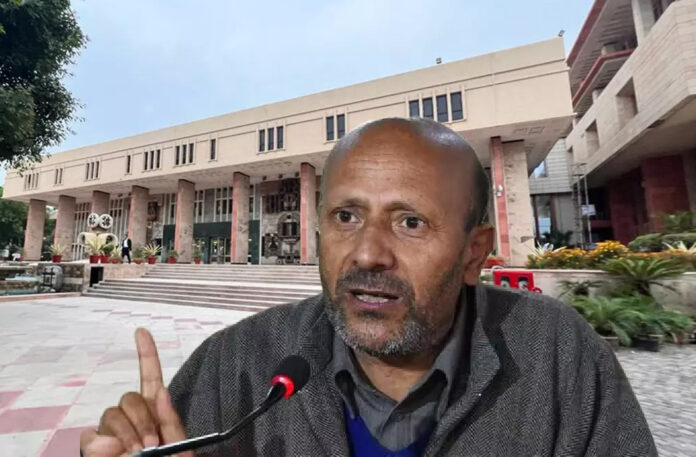
NEW DELHI, May 4: Baramulla MP Sheikh Abdul Rashid alias Engineer Rashid on Monday urged the Delhi High Court to modify its earlier order granting him one-week interim bail in a terror funding case and allow him to be with his ailing father, who has been shifted to AIIMS Delhi from Srinagar.
A bench of Justices Prathiba M Singh and Madhu Jain, which had confined the Baramulla MP to Srinagar for the duration of his interim bail, listed the matter for hearing on Tuesday and asked him to furnish a local address.
The senior counsel for Rashid submitted that he has a flat in Delhi, which has been allotted to him as a member of Parliament.
The court, however, observed that it would not permit Rashid to stay in a place that also houses other MPs.
“That is not good enough. You can’t be in the MP house where other MPs are living. I can’t permit that. It will be a security issue,” the bench said. The senior counsel said he would furnish the address of a private residence to the court.
The National Investigation Agency’s (NIA) counsel submitted that since the court has effectively granted custody parole in the matter and Rashid was no longer required to be outside Delhi, he should be permitted to visit his father from the jail itself, especially when the interim bail was expiring on May 6.
Custody parole entails a prisoner being escorted by armed police personnel to his place of visit.
The NIA lawyer further stated that the condition of the petitioner’s father was stable and he was shifted to AIIMS Delhi on the family’s request.
Rashid’s counsel said that pursuant to the interim bail, he was released on April 30 and reached Srinagar the same day.
He said Rashid’s father was airlifted to AIIMS Delhi after his health took a serious turn, but he was unable to relocate himself on account of the court order confining him to Srinagar.
“I am stuck in Srinagar. I am not allowed to come. He is here. I am there,” the senior lawyer said.
The court granted the interim bail to Rashid on April 28 on the condition that he could either visit the hospital where his father was being treated or remain at home.
It also ordered that at least two police officials would accompany him in plainclothes at all times.
The court passed the order while dealing with Rashid’s appeal against an April 24 trial court verdict refusing to grant him interim bail.
Rashid was arrested for allegedly funding separatists and terror groups in Jammu and Kashmir. He has been lodged in Delhi’s Tihar Jail since 2019 after the NIA arrested him in the 2017 terror-funding case.
After being named in a chargesheet in October 2019, a special NIA court framed charges against Rashid and others in March 2022 under sections 120B (criminal conspiracy), 121 (waging war against the government) and 124A (sedition) of the Indian Penal Code and for offences relating to terrorist acts and terror funding under the Unlawful Activities (Prevention) Act. (Agencies)
LG Saxena Meets Union Minister CR Patil; Discusses Key Water Resource And Irrigation Initiatives For Ladakh
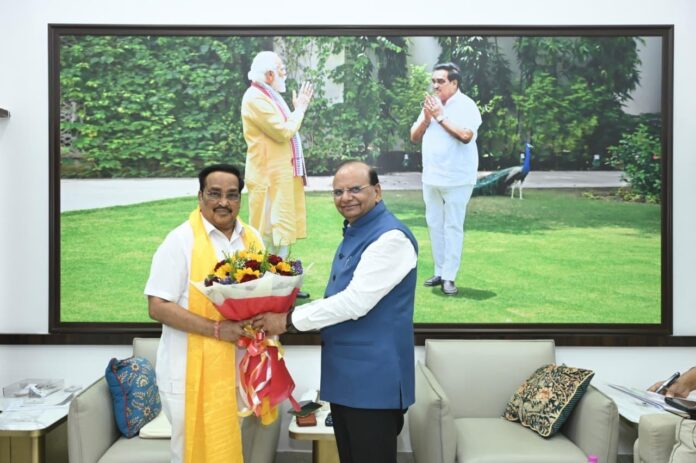
Leh, May 4: The Lieutenant Governor of Union Territory of Ladakh, Vinai Kumar Saxena, called on the Union Minister for Jal Shakti, CR Patil, in New Delhi and discussed various ongoing water resource, irrigation, and flood management projects in Ladakh.
The Lieutenant Governor apprised the Minister about the Project Him Sarovar, an ambitious initiative of the UT Administration launched recently in Ladakh, which aims at conserving the snow and glacial melt by constructing water bodies in villages. The LG informed that 50 water storage ponds, in the first phase, are being constructed to harness and store snowmelt and glacial runoff. The Lieutenant Governor explained that the project is designed to address seasonal water shortages, particularly for irrigation during the lean period.
Patil appreciated the initiative of the Lieutenant Governor in conceptualising Project Him Sarovar and acknowledged its potential in addressing Ladakh’s unique water challenges. The Minister assured that a committee of experts would be constituted to examine the technical aspects of the project and explore ways to further strengthen and scale it, to enhance water security in the Ladakh region.
Saxena also extended an invitation to the Union Jal Shakti Minister to visit Ladakh and witness firsthand the ongoing initiatives and the unique water management challenges of the region. The Minister kindly accepted the invitation and assured the LG to visit Ladakh soon, along with the team of experts and officials.
Lieutenant Governor Saxena also thanked Patil for sanctioning Central Assistance of ₹8.75 crore for various water-related projects in Ladakh, which would help improve irrigation efficiency and optimise water usage in command areas.
The Lieutenant Governor further highlighted a comprehensive five-year plan for conservation, rejuvenation, and harvesting of water resources, including revival of traditional water bodies, upgradation of irrigation canals, creation of percolation tanks, artificial glaciers, automated ice reservoirs, solar lift irrigation systems, and promotion of drip irrigation. Patil assured that all necessary support would be extended by the Ministry to Ladakh.
Saxena briefed the Union Minister on key schemes being implemented with support from the Ministry of Jal Shakti, including the Accelerated Irrigation Benefits Programme (AIBP) under PMKSY, Flood Management and Border Areas Programme (FMBAP), and National River Conservation Programme (NRCP).
During the meeting, the Lieutenant Governor highlighted the unique challenges faced by Ladakh, including its fragile ecology, extreme climatic conditions, glacial dependency, and dispersed population across remote mountainous terrain. He emphasised the need for sustained financial and technical support from the Government of India to ensure water security, agricultural sustainability, and climate resilience in the Union Territory.