

Excelsior Correspondent
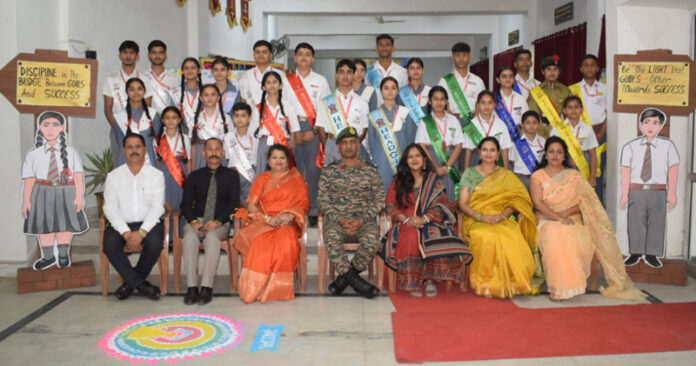
JAMMU, Apr 29: Army Public School Rakhmuthi organized a programme with great zeal and grandeur in the school auditorium. The occasion was graced by the Chairman APS Rakhmuthi as chief guest and SO to Chairman. Principal Shaswati Ghosh warmly welcomed the distinguished guests.
The programme commenced with the ceremonial lighting of the lamp symbolizing the invocation of wisdom and knowledge, followed by mesmerizing group song and dance presentations by students.
The chief guest entrusted responsibilities to the newly elected members of the Students’ Council by presenting them with badges and insignia of their respective roles. The office bearers included Head Boy Pradeep Chib and Head Girl Sonam Bhau, along with Vice Head Boy, Vice Head Girl, Sports, Library, Cultural and Discipline Prefects and Senior and Junior House Captains of Gandhi, Nehru, Ambedkar and Patel Houses. They pledged to uphold the values and honour of the institution.
Academic achievers were also felicitated with prizes. The chief guest highlighted the importance of balancing academics with co-curricular activities and encouraged students to excel in all fields.
APS Rakhmuthi holds programme
SMART Bazaar launches ‘Full Paisa Vasool’ sale

Excelsior Correspondent
JAMMU, Apr 29: Ahead of beginning of the month, SMART Bazaar today launched its ‘Full Paisa Vasool’ event starting from 29th April to 3rd May, giving customers the perfect time to stock up and save more.
During these 5 days, customers can enjoy great deals on everyday essentials like atta, rice, pulses, edible oils and other kitchen and home needs, things that are bought every month and take up a big part of the budget.
The idea is simple: help families save more on what they buy the most.
The offers are also easy to understand, with clear price cuts and value deals, so customers don’t have to spend time figuring out complicated discounts. They can quickly see what’s cheaper and pick what suits them best.
At SMART Bazaar, customers can finish their full monthly shopping in one place and feel confident that they are getting the right value for their money.
With ‘Full Paisa Vasool’, the focus is simple, when you shop, you should feel like you’ve truly saved.
Exit polls predict BJP win in Assam, edge in WB; DMK to return in TN

UDF to take Kerala, NDA Puducherry
NEW DELHI, Apr 29:
Several exit polls on Wednesday predicted a thumping victory for the BJP in Assam and a clear edge for the party over the ruling TMC in West Bengal, while projecting a return of the DMK Government in Tamil Nadu and a comeback by the Congress-led UDF in Kerala after 10 years.
Follow the Daily Excelsior channel on WhatsApp
The pollsters also forecast a return to power for the AINRC-led NDA Government in Puducherry.
Axis My India predicted a sweep for the BJP in Assam, forecasting 88-100 seats for the BJP and its allies and 24-36 seats for the Congress and its partners.
People’s Pulse predicted that the NDA would get 68-72 seats while the Congress plus would secure in the range of 22-26 seats.
Matrize said the NDA is likely to get between 85-95 seats and the Congress and its allies 25-32. The Assam assembly has 126 seats with the magic mark being 64.
In Kerala, Axis My India forecast that the UDF would get 78-90 seats, LDF 49-62 and NDA 0-3.
People’s Pulse predicted that the Congress-led UDF would get 75-85 seats, the LDF 55-65 and the NDA 0-3.
Matrize forecast 60-65 seats for the LDF, 70-75 seats for the UDF and 3-5 seats for the NDA. Kerala Assembly has a total of 140 seats with the magic mark being 71.
In West Bengal, the People’s Pulse exit poll predicted that the TMC would get 177-187 seats, BJP 95-110, Left Front 0-1 and the Congress 1-3.
Matrize, however, predicted a BJP edge in the state, and said it is likely to get 146-161 seats. It said the TMC would get 125-140 seats.
P-Marq predicted 150-175 for the BJP and 118-138 to the TMC.
West Bengal has a total of 294 seats with the majority mark being 148.
In Tamil Nadu, the People’s Pulse predicted 125-145 for the DMK-led alliance, 65-80 for AIADMK-BJP and 18-24 for TVK.
Matrize forecast that the DMK-Congress would get 122-132, NDA 87-100 and TVK 10-12.
The Tamil Nadu has a total of 234 seats with the magic mark being 118.
Most exit polls have had a chequered history and have been off the mark on several occasions in the past.
In Puducherry, Axis My India predicted 16-20 seats for the NDA and 6-8 for the DMK-Congress. It said the TVK is likely to get 2-4 seats in the assembly. There are 30 elected seats in Puducherry.
The counting of votes for all the five assemblies — West Bengal, Tamil Nadu, Puducherry, Kerala and Assam — will be taken up on May 4.
Polls were conducted in a single phase in Assam, Kerala, Puducherry and Tamil Nadu. West Bengal saw two-phase polling on April 23 and 29. (PTI)
UK PM Starmer condemns antisemitic stabbing of 2 men near synagogue

LONDON, Apr 29 : British Prime Minister Keir Starmer on Wednesday led condemnations of an antisemitic attack in north-west London, which involved two men being stabbed after a knifeman was seen running down a street near a synagogue.
The Metropolitan Police said Counter-Terror officers are leading an investigation after a 45-year-old male suspect was Tasered and arrested.
Jewish volunteer patrol group Shomrim said the man was seen running along Golders Green Road armed with a knife, attempting to stab Jewish members of the public.
Two male victims were stabbed and are stable as they were treated by non-profit emergency medical service Hatzola, the Hebrew word for rescue.
“The antisemitic attack in Golders Green is utterly appalling,” said Starmer.
“Attacks on our Jewish community are attacks on Britain. Thank you to Shomrim, Hatzola and the police for acting swiftly. Those responsible will be brought to justice,” he said.
The Met Police said the suspect also attempted to stab police officers before being arrested on suspicion of attempted murder.
“Two men – one in his 70s and one in his 30s – were treated at the scene for stab wounds. They have been taken to the hospital, and both are in a stable condition,” the Met Police said.
“Specialist officers from Counter Terrorism Policing are leading the investigation and working with the Metropolitan Police to establish the full circumstances and any links to terrorism,” it stated.
Earlier, Starmer told the House of Commons the attack was “deeply concerning” and that such offences have been taking place “too much recently”.
Armed police are on patrol in the area, which remains cordoned off as the Met Police continue an investigation into the latest in a series of attacks in the heavily Jewish neighbourhood in north-west London. Alleged arson attacks on four Jewish community ambulances in late March were followed by a memorial wall being targeted in an attempted arson attack on Monday in the Golders Green area of London, prompting a counter-terror police probe.
“There has been an appalling attack on two Jewish Londoners in Golders Green,” said London Mayor Sadiq Khan.
“London’s Jewish community have been the target of a series of shocking antisemitic attacks. There must be absolutely no place for antisemitism in society. The Met have stepped up high visibility patrols in the area,” he said.
UK Home Secretary Shabana Mahmood also condemned the “abhorrent attack”, with Opposition Leader Kemi Badenoch describing it as an “epidemic of violence against Jewish people” which is now a “national emergency”. (PTI)
The Ultimate Donation

There is a particular kind of courage that asks nothing of the living. It asks only that, in the moment of greatest grief, a family pauses long enough to say yes – yes, let some part of our beloved live on in another. This courage, quietly exercised in hospital corridors across the world, has become one of modern medicine’s most profound gifts. In India, however, that courage remains heartbreakingly rare. India, a civilisation that has enshrined compassion as a cornerstone of every faith it has nurtured, records fewer than one deceased organ donor per million population. In a country of 1.5 billion souls, the list of those who have pledged or donated organs in death runs to mere thousands – a figure that shames neither the individual nor the family, but the system that has failed to reach them. With nearly 1.73 lakh accidental deaths each year – many involving young, healthy individuals – the gap between what is possible and what is achieved is not merely a medical statistic. It is a silent catastrophe measured in lives that need not have been lost.
The mathematics of organ donation is staggering in its generosity. A single donor can restore sight to two people through cornea donation, give the gift of life to kidney patients, save a child with a failing liver, and offer a future to someone whose heart has grown too weak to carry on. One life, extinguished by tragedy, can illuminate five, six, seven others. It is, by any measure, the most extraordinary arithmetic humanity has ever devised. Recent developments offer cause for cautious optimism. The government advisory to states – focusing on training first responders, upgrading trauma centres, and integrating organ donation awareness into emergency protocols – represents a pragmatic and overdue intervention. Time is the most unforgiving element in organ transplantation; the window following brain stem death is cruelly narrow, and without alert, coordinated hospitals, those precious hours are lost. In Jammu and Kashmir, the Lieutenant Governor, Manoj Sinha, has taken the commendable step of not merely presiding over Naman Diwas – a day to honour organ donors and their families – but also registering himself on the Ayushman Bharat Organ Donation Registry. His call for SOTTO J&K to take its message into schools, places of worship, and community meetings is precisely the kind of top-down leadership that can shift entrenched social attitudes.
Yet infrastructure and political will, however necessary, are not sufficient on their own. The deeper challenge is cultural. Many families refuse donation out of emotional anguish, religious misapprehension, or a fear – sometimes whispered, sometimes spoken plainly – that agreeing to organ donation might hasten a declaration of death. These fears deserve not dismissal but patient, respectful engagement. Religious leaders across all traditions in India have affirmed that organ donation is not merely permissible but also honourable. The task is to ensure that this message reaches families not only in times of crisis but long before – so that when the moment arrives, there is a pre-existing framework of understanding to draw upon.
Awareness, however, is only one part of the equation. Ease of donation is the other, and it is one that the system has neglected with frustrating consistency. A grieving family cannot be expected to navigate labyrinthine bureaucratic processes in the hours following their loss. They are not in any condition to wait – physically, emotionally, or psychologically. The final journey of their loved one cannot be held hostage to administrative inertia. The donation process must be made genuinely simple, transparent, and emotionally supported. Digital registration systems, clear legal communication, and dedicated transplant coordinators who can stand alongside families with both competence and compassion are not luxuries; they are prerequisites for any serious national effort.
The scale of unmet need is arresting. India requires nearly one lakh corneas annually; only a third of that demand is met. Thousands of patients with kidney, liver, and heart failure wait for transplants that may never arrive. In J&K, the establishment of SOTTO in 2019 and the expansion of transplant facilities to GMC Jammu/Srinagar and Command Hospital Northern Command mark genuine institutional progress – yet the number of brain-dead donor cases remains modest. The infrastructure now exists; it is society that must meet it.
Short range naval anti-ship missile clears critical salvo trial

NEW DELHI, Apr 29: In a boost to India’s maritime strike capabilities, the Defence Research and Development Organisation (DRDO) and the Indian Navy on Wednesday successfully conducted the maiden salvo launch of the short-range naval anti-ship missile system.
The salvo launch was carried out from the Navy’s helicopter platform off the coast of the Bay of Bengal in Odisha.
Defence Minister Rajnath Singh complimented the DRDO, the Navy, the Indian Air Force and industry partners involved in the project for the successful trial of the Naval Anti-ship Missile-Short Range (NASM-SR).
“During the trial, two missiles were launched in quick succession from the same helicopter, making it the first salvo launch of an advanced air-launched anti-ship missile system,” the defence ministry said.
It said all test objectives were fully met as per the data captured using various range tracking instruments like radar, electro-optical system and telemetry deployed by the Integrated Test Range (ITR), Chandipur.
“Along with proving the salvo launch capability, the missiles demonstrated the waterline hit capability. The test launches were witnessed by senior scientists from DRDO, users’ representatives from the Indian Navy and the Indian Air Force and Development-cum-Production Partners (DcPP),” the ministry said.
The NASM-SR missile uses a solid propulsion booster and long-burn sustainer.
The ministry said all critical subsystems like the seeker, integrated avionics module, advanced navigation and guidance using fibre-optic gyroscope-based inertial navigation system and guidance algorithm were developed indigenously by different laboratories of DRDO and Indian industries.
The missile system has been developed by Hyderabad-based Research Center Imarat in collaboration with several other DRDO laboratories. (PTI)
Expedite installation of smart meters in all offices: Govt
Excelsior Correspondent
JAMMU, Apr 29: Jammu and Kashmir Government has issued fresh directions to expedite the installation of pre-paid smart electricity meters across all Government establishments, public sector undertakings (PSUs), corporations, and other state-run institutions.
According to a circular issued today by the Budget Division of the Finance Department, all administrative departments have been asked to ensure the early installation of pre-paid smart meters in Government office buildings as well as residential quarters owned by the Government and its affiliated bodies.
The circular reiterates earlier instructions and emphasizes strict compliance to ensure a smooth transition from the conventional billing system to a pre-paid metering mechanism. Departments have been directed to coordinate closely with the Power Development Department and its distribution companies for timely execution.
As part of the transition process, all outstanding electricity dues are to be cleared using available funds after proper reconciliation of pending bills. The Finance Department noted that 50 percent of the required funds under the designated electricity charges head have already been released to facilitate this process.
Following the installation of pre-paid smart meters, all future electricity payments are to be made in advance by Drawing and Disbursing Officers (DDOs) from the allocated budget, similar to payments made for other essential services such as telephone and internet.
Departments have also been instructed to closely monitor electricity consumption to ensure it remains within the sanctioned budget. However, provisions have been made for departments delivering essential or critical services to seek additional funds, subject to proper justification and actual requirements.
After an initial implementation period of one to two months, departments may submit estimates for any additional financial requirements to the Finance Department for consideration.
Kashmir growers seek 100% duty on imported apples

*Demand revival of MIS, rollout of crop insurance
Excelsior Correspondent
Srinagar, Apr 29: A major umbrella body of fruit growers in Kashmir has urged the Centre to impose import duty of over 100% on American and European apples, warning that reduced tariffs under trade agreements are hurting the livelihoods of more than seven lakh families dependent on the horticulture sector.
In a memorandum submitted to Union Agriculture Minister Shivraj Singh Chouhan, the Kashmir Valley Fruit Growers-cum-Dealers Union raised a series of long-pending issues, including crop losses, lack of insurance, inadequate storage infrastructure and rising input costs.
The memorandum follows a fresh round of discussions with the minister and builds on assurances made during his visit to the SKUAST convocation last year.
Describing horticulture as the backbone of J&K’s economy, the Union said the reduction of import duty on foreign apples from 50% to 25% under Free Trade Agreements has failed to protect local growers.
It urged the Centre to raise the duty to over 100% to safeguard incomes, noting that the Valley-widely known as the “Land of Fruits”-depends heavily on apple cultivation for livelihoods, education and healthcare.
Highlighting structural losses, the Union said over 40% of apple produce each season falls under Grade C or consists of fallen fruit, pushing growers into financial distress.
It called for the revival of the Market Intervention Scheme, under which such produce was earlier procured by the government at fixed rates, but which has remained discontinued for several years.
The growers also pointed out that a Crop Insurance Scheme for horticulture, though announced, has yet to be implemented. Terming it a lifeline for marginal farmers, especially during natural disasters, they sought its immediate rollout on the lines of the agriculture sector.
The memorandum called for the establishment of at least 200 Controlled Atmosphere (CA) cold stores across north and south Kashmir with subsidy support, restoration of the top-up subsidy scheme for CA stores in Pulwama and Shopian, and creation of a separate horticulture estate with single-window clearance for processing units such as cold stores, juice plants and canning factories.
The Union warned that inadequate storage infrastructure leads to distress sales and post-harvest losses, particularly with the expansion of high-density plantations in south Kashmir.
Among other demands, the growers urged the Centre to allocate funds for the Clean Plant Programme at Wadoora in Sopore, for which land has already been acquired, establish a Krishi Vigyan Kendra in Baramulla to strengthen farmer training and technology access, and set up a dedicated horticulture university in north Kashmir.
They also sought clarity on the status of the disease-free plantation initiative announced earlier.
The memorandum flagged skyrocketing prices of pesticides and fertilisers, stating that high MRPs have made them unaffordable for marginal growers, and urged Government intervention to regulate prices. It also sought classification of tree spray oil as an agricultural product.
With the fruit season approaching, the Union demanded priority movement for fruit-laden trucks on the Srinagar-Jammu National Highway, even during convoy restrictions, to prevent spoilage of perishable produce such as cherry, plum, pear and early apple varieties.
RBI allows banks to extend relief measures to borrowers without their requests in disaster-hit areas
MUMBAI, Apr 29: Banks are allowed to extend relief measures to all borrowers without waiting for their requests, according to the Reserve Bank’s revised guidelines for calamity-affected areas, which take effect from July 1.
Following stakeholders’ feedback on draft directions on relief measures, the central bank on Wednesday issued a series of directions for commercial banks, small finance banks, local area banks, cooperative banks, NBFCs, and All India Financial Institutions. Besides, two repeal directions have also been issued.
The guidelines will come into force from July 1, 2026.
“Lenders are permitted to extend the relief measures to all borrowers without waiting for a request from them, with an opt-out clause for such borrowers who desire to opt out at any point till the end of 135 days from the date of declaration of natural calamity,” the RBI said while issuing the directions.
One of the directions said that a bank may operate its calamity-affected branches from temporary premises under advice to the concerned regional office of the RBI.
Also, it should make arrangements to render banking services in the affected areas by setting up satellite offices, extension counters or mobile banking facilities under intimation to the Reserve Bank.
“A bank shall take immediate action for the restoration of ATM services at the earliest. During the period, it shall provide alternative arrangements to address the immediate cash requirements of the affected areas,” it said.
A bank, at its discretion, can provide relief measures such as a waiver /
reduction of various fees and charges in respect of customers in the areas where a calamity has been declared for a period not exceeding one year.
Borrowers will be eligible for resolution whose accounts are classified as ‘Standard’, but which are not in default for more than 30 days with the bank as on the date of occurrence of the calamity.
“Borrower accounts, which may have slipped into NPA between the date of occurrence of the calamity and implementation of the resolution plan, shall be upgraded as ‘Standard’, upon implementation of the resolution plan,” it said.
The central bank has also mandated that a bank should make an additional specific provision of 5 per cent of the outstanding debt in respect of borrowers for whom a resolution plan has been implemented.
The additional specific provisions shall be over and above the applicable prudential provisions, subject to a ceiling of 100 per cent.
In January, the central bank issued draft directions on relief measures in areas affected by natural calamities for stakeholder feedback.
One of the suggestions the RBI received was regarding relaxing the eligibility criterion to include all ‘Standard’ borrowers, including those overdue up to 89 days.
To this, the central bank said the objective is to provide relief to borrowers impacted by the natural calamity, but who are not stressed otherwise.
“In any case, the revised framework is more relaxed than the extant norms,” it added.
Stakeholders had suggested reducing the additional provisioning to nil or capping it at 2 per cent instead of 5 per cent per event of restructuring, but the RBI did not accept it, saying the additional provision balances the heightened risk in such accounts while not subjecting them to higher provisioning applicable to a regular restructured account.
In June 2023, the RBI had proposed to issue guidelines rationalising the extant prudential norms for implementation of resolution plans in respect of exposures affected by natural calamities, inter alia, harmonising the regulatory instructions applicable to different Regulated Entities (REs). (PTI)
Volkswagen launches Taigun in Jammu

Excelsior Correspondent
JAMMU, Apr 29: Volkswagen unveiled the new Taigun, a premium SUV crafted for customers who value driving dynamics, safety and purposeful design, in a function held here today.
The vehicle was launched by Volkswagen Passenger Cars India, Brand Director Nitin Kohli and Atul Abrol (Director WOC automobiles Pvt Ltd).
Speaking on the occasion, Nitin Kohli said, “The Taigun has been a key pillar of our India portfolio. Since its introduction, it has played a significant role in our SUVW journey, contributing to the brand’s growth with its robust build quality, strong safety credentials and fun-to-drive performance. The new Taigun builds on this strong foundation with a sharper design and meaningful enhancements across key pillars. With this introduction, we are reining forcing our commitment to bringing aspirational, well-engineered products that strengthen our SUVW portfolio and make German engineering even more accessible to Indian customers.”
With its compelling blend of design, technology, comfort, safety and performance, the new Taigun is poised to further strengthen Volkswagen’s position in India’s competitive SUV segment, catering to customers who seek a dynamic, safe and feature rich driving experience.