LONDON, Apr 29 : London police say the stabbing of two Jewish men has been declared a terrorist incident.
Metropolitan Police say they are investigating whether Wednesday’s attack specifically targeted the Jewish community.
The force says the attack in the Golders Green area left two men, aged 34 and 76, hospitalized with knife wounds. A 45-year-old man has been arrested on suspicion of attempted murder. (AP)
JAMMU, Apr 29: In a major step towards strengthening women’s participation in Bar leadership, the High Court of Jammu & Kashmir and Ladakh has directed all Bar Associations across the Union Territories of J&K and Ladakh to ensure 30 percent reservation for women advocates in their governing or executive bodies.
The direction has been issued through a circular by the office of the Registrar General, High Court of J&K and Ladakh, in compliance with the directions passed by the Supreme Court in Deeksha N Amruthesh Versus State of Karnataka & Ors, Special Leave to Appeal (C) Nos. 1404 of 2025.
As per the circular, all Bar Associations falling within the jurisdiction of the High Court of J&K and Ladakh have been impressed upon to reserve 30 percent of the posts of governing or executive members for women advocates to ensure their adequate representation in Bar bodies.
The circular further provides that where women advocate members are not available or do not contest elections, the shortfall in representation shall be filled through nominations. Such nominations will be made by the concerned Administrative Judge in consultation with the concerned District and Sessions Judge, elected office bearers and the senior-most women members of the respective District Bar Associations.
It has also been clarified that the tenure of nominated women members shall remain co-terminus with that of the elected members, meaning they will continue only for the same term as the elected executive body.
The J&K High Court Bar Association Jammu, Kashmir Advocates Association and all District and Tehsil Bar Associations across J&K and Ladakh have been asked to take immediate steps for implementation of the directions.
The High Court has also directed the concerned Bar Associations to submit compliance reports within one week from the date of issuance of the circular.
The circular has been issued by order of Registrar General M K Sharma and circulated to Principal District and Sessions Judges, Presidents of Bar Associations, Registrars of the High Court, Judicial Academy and other concerned authorities for information and necessary compliance.
CHANDIGARH, Apr 29: In a step towards strengthening disaster preparedness, the Haryana government will conduct a mock exercise on a flood disaster scenario on May 14, covering 13 flood-prone districts.
Financial Commissioner, Revenue and Disaster Management Department, Sumita Misra, said here on Wednesday that the exercise is being organized in coordination with the National Disaster Management Authority (NDMA) as part of the annual State/UT mock exercise calendar for 2026’27.
According to the official communication issued by the Department of Revenue and Disaster Management, the mock exercise will be conducted in four stages to ensure comprehensive preparedness.
The first stage, orientation and coordination conference, will be held on May 6, through video conferencing, involving officials and stakeholders from the State and district levels.
This will be followed by a table top exercise on May 12, where various response scenarios will be discussed and strategies tested.
The third and the key phase, the physical mock drill, will take place on May 14, involving active participation of all concerned agencies on the ground.
Misra stated that the exercise will be conducted in 13 identified flood-prone districts — Gurugram, Ambala, Faridabad, Fatehabad, Kaithal, Karnal, Kurukshetra, Panchkula, Panipat, Palwal, Sirsa, Sonipat and Yamunanagar.
These districts have been selected due to their proximity to rivers and canals and their geographical vulnerability to flooding, making them critical for preparedness planning.
The primary objective of the exercise is to review disaster management plans and standard operating procedures at the State, district and departmental levels. It will also focus on defining stakeholder roles under the Incident Response System (IRS) and integrating them into the overall response mechanism.
Misra further said the drill will strengthen coordination among district-level emergency support functions and improve communication systems during disaster situations.
The mock exercise will also emphasize building public awareness through media, local bodies, non-governmental organizations and community participation.
Authorities aim to identify gaps in resources, logistics, communication and response capacity so that corrective measures can be implemented ahead of the monsoon season, she added.
Misra highlighted that such exercises are essential to ensure that all stakeholders, from administration to emergency responders, are fully prepared to handle flood situations efficiently.
The initiative is expected to enhance the State’s readiness and ensure a coordinated and timely response in the event of an actual disaster. (PTI)
NEW DELHI, Apr 29 : Gold prices declined by Rs 1,500 to Rs 1.52 lakh per 10 grams in the national capital on Wednesday due to profit booking as rising crude oil rates raise concerns over inflation ahead of the US Federal Reserve’s decision.
However, silver prices posted a modest gain of Rs 500 to Rs 2,44,500 per kilogram (inclusive of all taxes) from Tuesday’s closing level of Rs 2,44,000 per kg, as per the All India Sarafa Association.
Gold of 99.9 per cent purity decreased by Rs 1,500, or 1 per cent, to Rs 1,52,800 per 10 grams (inclusive of all taxes). The yellow metal had settled at Rs 1,54,300 per 10 grams in the previous session.
Bullion traders weighed higher energy costs tied to tensions in West Asia, which could keep inflation elevated and force central banks to stay restrictive for longer.
Gold traded weak on Wednesday as continued profit booking and rising crude-led inflation concerns kept pressure on precious metal prices, Jateen Trivedi, VP Research Analyst – Commodity and Currency, LKP Securities, said.
Higher oil prices are reinforcing expectations that the US Federal Reserve may maintain a tighter stance on monetary policy, which supports the dollar and limits upside in bullion rates, he added.
Traders are now focused on the Fed’s policy decision and comments from Chair Jerome Powell for signals on how officials view shaping the outlook for interest rates amid ongoing US-Iran uncertainty, Trivedi said.
According to the World Gold Council, India’s gold demand rose 10 per cent on-year to 151 tonnes during the January-March quarter, led by strong investment demand despite elevated prices.
In the international market, spot gold fell USD 23.31, or 0.51 per cent, to USD 4,573.75 per ounce, while silver traded 0.18 per cent lower at USD 72.99 per ounce.
Gold was trading near USD 4,570 per ounce after US President Donald Trump ordered preparations for an extended blockade of the Strait of Hormuz as Washington and Tehran remained divided over issues including nuclear enrichment, Praveen Singh, Head of Commodities at Mirae Asset ShareKhan, said.
On the outlook, Hareesh V, Head of Commodity Research, Geojit Investments Ltd, said: “Gold may not immediately surge to USD 5,000, as ongoing geopolitical tensions in West Asia continue to weigh on investor sentiment.”
However, the long-term outlook remains firmly bullish, supported by strong fundamentals such as central bank demand, inflationary pressures, and limited supply growth, he added. (PTI)
Winning team posing along with dignitaries during a programme.
Excelsior Sports Correspondent
SAMBA, Apr 29: The Inter APSs Cluster-I Football Tournament for U-17 Girls, hosted by Army Public School Samba, concluded on an exciting note with APS Jammu Cantt emerging as champions.
In the final match, APS Jammu Cantt defeated APS Samba by 2-1 in a closely contested encounter, showcasing excellent teamwork, discipline and tactical play. APS Samba secured the runners-up position after a spirited performance, while APS Damana finished third with a commendable display of skill and sportsmanship.
The three-day tournament witnessed enthusiastic participation from various Army Public Schools of Cluster-I, providing a platform for young players to display their football talent, coordination and competitive spirit.
The tournament was conducted under the guidance of the school administration of Army Public School Samba with active support from the organizing committee, officials and staff, ensuring smooth conduct of the event. The prize distribution ceremony marked the conclusion of the tournament, where winners and participants were felicitated with trophies, medals and certificates. The Principal and Chairman, APS Samba congratulated all teams for their performances and appreciated their sportsmanship.
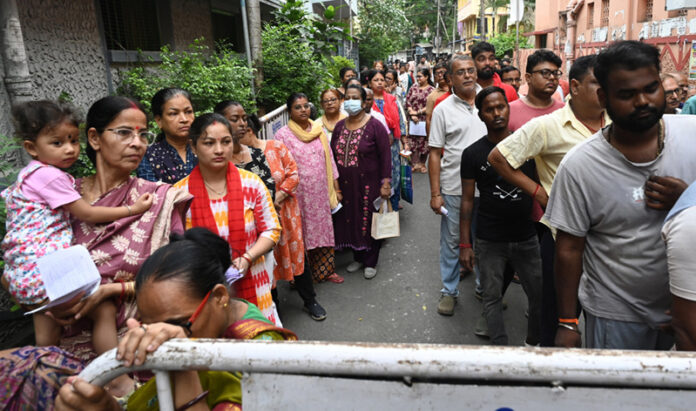
People wait in long queues to cast their votes during the West Bengal Assembly polls at the Belgachhia constituency in Kolkata on Wednesday. (UNI)
KOLKATA, Apr 29:
West Bengal’s high-stakes assembly elections ended on Wednesday with a massive voter turnout of 91.66 per cent in the second and final phase, capping one of the most intense electoral contests in the recent years and setting the stage for a far-reaching verdict on whether Chief Minister Mamata Banerjee will continue her dominance or the BJP will break the TMC’s hold in the state.
With 91.66 per cent at the closing of the voting, and reportedly lakhs of voters still waiting in queues to cast their ballots, the second phase of polls across 142 constituencies in South Bengal looked poised to match the first phase’s record voter participation of 93.19 per cent.
The metropolis of Kolkata recorded a turnout of around 87 per cent at that time, with Purba Bardhaman district topping the chart at 92.46 per cent.
A communication from the Election Commission said 91.66 per cent turnout was recorded in the second phase of polls till 7.45 pm, putting the combined poll percentage over the two-phases at 92.47 per cent. The first phase of polling was held on April 23 and the counting will be on May 4.
“This is the highest-ever recorded poll-participation since Independence in West Bengal,” it said. (PTI)
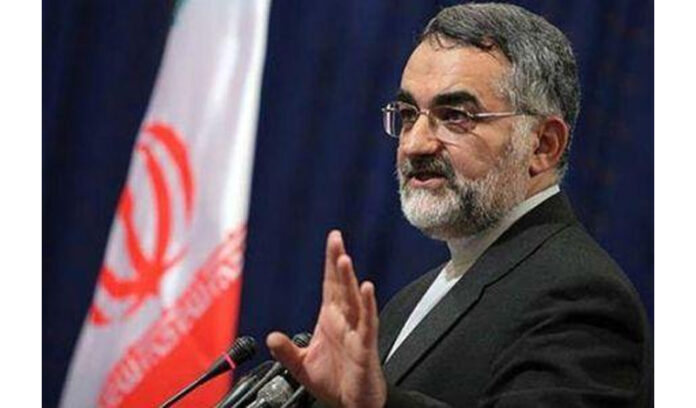
TEHRAN, Apr 29 : Alaeddin Boroujerdi, Deputy Head of the Iranian National Security Committee, addressing the parliament, today said that Iran “will never relinquish its control over the Strait of Hormuz,” in response to US threats.
In remarks carried over by state media, Boroujerdi claimed Iran still had a sufficient stockpile of missiles and drones to carry on the war, and can sustain it for several more years, noting that Washington and other Western countries had now finally “come to believe in the capabilities of the Islamic Republic,” after witnessing Iran’s surprising resilience.
The lawmaker said that Parliament Speaker Mohammad Bagher Ghalibaf was managing Tehran’s negotiations with Washington, which so far have been facilitated indirectly, via mediator states like Egypt and Pakistan, since the first round of talks ended in failure in early April.
Since the April talks, Iran has maintained a strong blockade of the Strait of Hormuz – a crucial water corridor for global energy flows, only permitting a select few vessels to transit the waterway with coordination – and reportedly charging massive tolls, holding oil and gas flows to ransom. The US, in response, has imposed a military blockade of all Iranian ports and vessels linked to the country, which Tehran has criticised as “piracy”.
Boroujerdi dismissed the US blockade as ‘ineffective’, calling it “a passive and worthless move” and claiming that Washington would “not dare act” against some vessels “because they belong to other countries, such as China and others that the United States does not dare confront.”
The Pentagon said that, as of Tuesday, it had forced 39 vessels attempting to enter or depart from Iranian ports to turn around since the blockade began.
AGRA (UP), Apr 29 : Police responded within eight minutes to a distress alert posted by a passenger on X (formerly Twitter) and arrested four people for allegedly harassing a woman and a girl on a moving bus in Agra, officials said on Wednesday.
According to police, at 12:27 am, a passenger posted on X that some youths were harassing two girls on a bus (MP07ZT2099) travelling from Kanpur to Ahmedabad as it approached Namner crossing in Agra.
The Agra Police social media team responded within eight minutes, alerting the Rakabganj police station at 12:35 am and initiating coordinated action, officials said.
UP-112 was also engaged promptly, seeking the victim’s contact details at 12:36 am and confirming assistance by creating an event by 12:38 am, police said.
UP-112 is Uttar Pradesh’s centralised emergency response system.
Police contacted the victims to verify the incident and obtain the exact location. Based on this, the Rakabganj police launched an intensive checking drive at Namner Crossing.
Officials said police intercepted the bus within 30 minutes of the initial alert and apprehended the four accused on the spot. Legal action was initiated against them, officials said.
Police said the accused are residents of Kanpur Nagar and were travelling to Ahmedabad for work-related purposes.
Officials said the swift response and coordination between the social media team and field units ensured timely intervention, providing immediate relief to the victims and other passengers, who expressed gratitude towards the police.
Uttar Pradesh police reiterated its commitment to women’s safety, stating that strict and prompt action is being taken against crimes related to women under a zero-tolerance policy.
Rahul Srivastav, PRO to the DGP and Social Media In-charge of UP Police, said, “The UP police has consistently strengthened social media as a crucial bridge between citizens and the police. In this case, an online distress alert by a female was responded to within eight minutes by the social media monitoring teams of Agra Police and UP-112.”
He said, “The alert was promptly verified, shared with field units and converted into coordinated ground action, which subsequently led to the arrest of the accused. This seamless online-offline coordination shows how technology, real-time monitoring and responsive field policing are making citizen safety more accessible, immediate and effective.” (PTI)
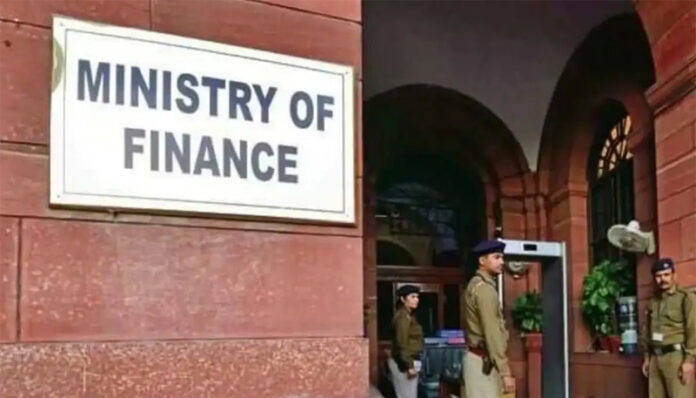
NEW DELHI, Apr 29: The ongoing conflict in West Asia poses a significant supply-side shock with rising risks to inflation, trade and financial flows, though India’s strong domestic demand, policy buffers, resilient financial system and continued public investment are expected to provide a measure of insulation to the economy, the finance ministry said in a report said.
Prolonged uncertainty, particularly around energy and fertiliser supplies, could test the resilience of India’s macroeconomic stability, the Monthly Economic Review for April released by the finance ministry said on Wednesday.
On top of this, the El Nino Southern Oscillation (ENSO) is expected to keep India’s Southwest monsoon below normal, it said, adding that most rainfall districts are expected to receive below-normal rainfall this season.
Therefore, it said, risks are tilted to the upside for inflation, fiscal and external deficits and to the downside for economic growth.
However, it said, while striving to sustain economic growth, policy is expected to safeguard medium-term fiscal and external stability.
Observing that India enters FY2026-27 at the intersection of domestic resilience and external turbulence, the report said, encouraging a 7-7.4 per cent forecast for the upcoming financial year, only to be clouded by an altered macro-outlook in the wake of the war in West Asia.
The Indian economy is estimated to grow at 7.6 per cent, the strongest in recent years.
Noting that a ‘supply shock’ is apparent in the economy, it said that an accompanying demand compression is a serious concern, given high prices, rising inflation, and a reduced pace of economic activity.
Inflation may become cost-push as businesses/producers pass on their increased input costs to protect their profit margins, it said.
A wide spectrum of downstream industries relies directly on the petroleum sector, and it is likely that input cost pressures will be felt widely across the economy, it said.
To temper cost pressures in critical sectors like agriculture, it said, the government has taken various measures such as increased allocation of natural gas to the fertiliser production, waiver of customs duty and around 12 per cent increase in nutrient-based subsidy for the upcoming kharif season.
Beyond the production structures, it said, the conflict has seriously dented investors’ confidence, disproportionately affecting Emerging Markets and Developing Economies (EMDEs), including India.
The consequent weakening of the rupee is another pressure point for domestic inflation, as that could raise import prices, it said.
The report said that repairing the damage to the oil and gas production/supply infrastructure in the Gulf region may take several months.
If such a gradual recovery is not supported by a good kharif output (a weather shock /below normal monsoon as predicted by the IMD – possible El Nino conditions), it is likely that the price shock felt at the headline inflation might spill over to the core measure through the cost-push channel, it said.
Yet it remains to be seen whether the spill-over effect will be strong/widespread or weak/ limited, as it depends on a range of factors such as the size of the shock, variability in the pass-through duration across different markets/commodities, price flexibility/ rigidity in sectoral markets, energy intensity of different sectors, etc, it said.
The crisis in West Asia is not expected to adversely affect financial stability, as key indicators for capital adequacy, liquidity, and asset quality in both SCBs and NBFCs remain strong, it said.
Further, it said, the RBI will continue its proactive approach to ensure adequate liquidity to meet the economy’s productive needs.
To sustain momentum in the country’s trade performance, the report said, the government has introduced targeted measures complementing its diversified trade strategy.
These include the RELIEF scheme; efforts to improve turnaround times and easier switching of fuels; and reforms under the Advance Authorisation Scheme to enable faster approvals and enhance transparency and predictability, alongside the approval for the establishment of the Bharat Maritime Insurance Pool, it said.
Additional interventions, it said, such as strengthened port coordination, advisories to improve transparency in shipping line pricing, monitoring of insurance risks, and relaxations to facilitate the movement of stranded cargo, further support trade flows.
Looking ahead, it said, the conclusion of recent free trade agreements is expected to reinforce trade performance by expanding market access and deepening integration with global value chains.
“For most economies, the current global drift is a source of vulnerability. However, for India, with its strong domestic fundamentals and tradition of strategic autonomy, it can be an opportunity,” it said.
First, it said, a multipolar world creates space for India to convert diplomatic goodwill into durable economic gains.
As a manufacturing destination, services hub and a large consumer, India can push for more ambitious trade agreements and diversified supply chains, it added.
Observing that recent developments underscore that resilience cannot be created overnight in times of crisis, but must be built through sustained and deliberate efforts over years, such as developing strategic energy reserves, accelerating the shift to renewables, and strengthening domestic manufacturing capacity.
As far as strengths go, India can capitalise on its strong domestic fundamentals and active trade engagement to move forward at the speed the moment demands, it added. (PTI)
BJP Mahila Morcha taking out rally in Jammu on Wednesday.
Takes out ‘Mashal Padyatra’
Excelsior Correspondent
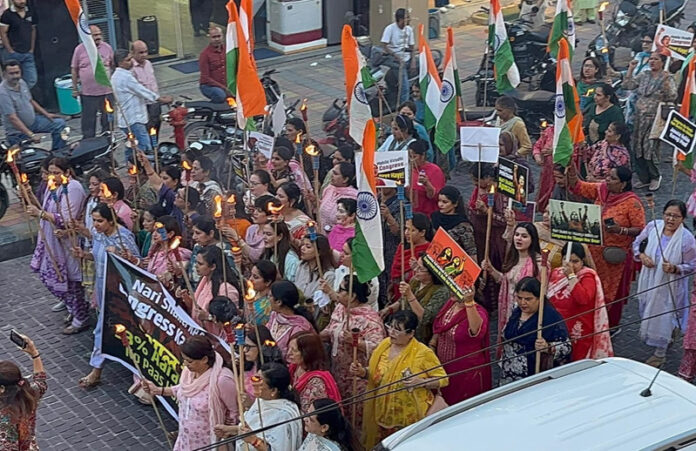
JAMMU, Apr 29: Mahila Morcha of Bharatiya Janata Party (BJP), Jammu & Kashmir led by its president Neha Mahajan, organized a “Jan Aakrosh Mahila Mashal Padyatra” to register strong protest against the opposition parties over their stance on the proposed 33% Women’s Reservation Bill, 2026.
The march commenced from Apsara Road, Gandhi Nagar, with women participants carrying Mashals (torches), symbolizing collective resolve and growing awareness for political empowerment.
BJP J&K president and Member of Parliament (Rajya Sabha), Sat Sharma, BJP national secretary and MLA RS Pura, Dr Narinder Singh, J&K BJP vice presidents, Priya Sethi, and Rekha Mahajan, MLA Bahu constituency, Vikram Randhawa, MLA East constituency, Yudhvir Sethi, Ex MLA Bishnah, Ashwani Sharma , general secretary, Gopal Mahajan, State spokespersons, Purnima Sharma, and Rajni Sethi, district president Jammu, Rajesh Gupta, president Jammu South, Naresh Singh Jasrotia, Mahila Morcha Prabhari, Veenu Khanna, Seh-Prabhari, Shailja Gupta, general secretary, Mahila Morcha, Urvashi Gupta, and others were amongst the prominent present in the Padyatra.
Sat Sharma strongly criticized the opposition for opposing the Bill. He stated that denying adequate representation to women in Legislative bodies reflects a lack of genuine commitment toward women empowerment. He emphasized that the BJP remains steadfast in its resolve to ensure greater political participation of women and urged opposition parties to clarify their position on this crucial issue.
Dr. Narinder Singh termed the opposition’s resistance as regressive. He remarked that the Women’s Reservation Bill is a historic step aimed at strengthening democracy by ensuring inclusive participation. He asserted that blocking such progressive legislation deprives women of their rightful opportunities in governance.
Priya Sethi stressed that women across the nation are increasingly aware of their rights and are demanding equal representation in decision-making processes. She stated that any attempt to hinder this progress is unacceptable and reflects a narrow mindset that undermines women’s capabilities and contributions.
Mahila Morcha President, Neha Mahajan described the Mashal Padyatra as a powerful expression of women’s collective voice. She said that women are no longer willing to be sidelined and are asserting their rightful place in governance.