

Excelsior Correspondent
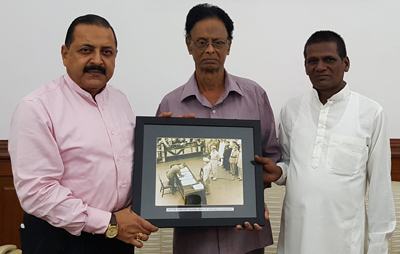
NEW DELHI,Oct 22: Netaji Subhash Chandra Bose was an icon of India’s freedom struggle and regardless of how historians portray him, Netaji’s patriotism has inspired three successive generations of Indians.
This was stated by Union Minister of State (Independent Charge) Development of North Eastern Region (DoNER), MoS PMO, Personnel, Public Grievances, Pensions, Atomic Energy and Space, Dr Jitendra Singh here when he was presented a rare 1943 photograph of Subhash Chandra Bose signing the documents of take-over of Andaman & Nicobar after the liberation of the islands from foreign rule. The photograph was brought from Port Blair by Comrade M. Lingamayya, Chairman of All-India Forward Bloc.
Pertinent to mention that it was in 1943 that Netaji Subhash Chandra Bose had hoisted the National Flag of India for the first time at the Gymkhana Ground, Port Blair, the current capital of Andaman and Nicobar Islands, declaring the Islands as the first Indian territory to be freed from the colonial rule. The Andamans had, for some time during the Second World War, fallen into the control of the Japanese and it was during this period that Subhash Chandra Bose also paid a visit to the terrifying Cellular Jail (Kala Paani) in Port Blair during his famous escapade to different places.
Expressing joy and gratitude for the gesture, Dr Jitendra Singh told the visiting delegation of All-India Forward Bloc that while Netaji Subhash Chandra Bose stands out as one of the most glorious milestones of India’s freedom struggle, the memories of his visit to Andaman and Nicobar Islands will always remain the most indelible narration of those tumultuous times. Netaji’s visit to the Islands not only marked the beginning of the end of the British rule in India but also served as a booster for hundreds of freedom fighters whom the British had lodged in most inhuman conditions in the Cellular Prison and for whom Netaji had arrived as a lease of fresh air, he said.
The members of visiting delegation also apprised the Union Minister of various grievances and concerns relating to the Andaman and Nicobar Islands. The demands listed by them included enforcement of uniform air fares from Port Blair to other destinations, filling up of vacant posts in administration in order to reduce the hardships of the common public, appointment of a Lokayukta to curb corruption, improvement in internet and mobile services, introduction of inter-island ships to promote tourism and streamlining of public distribution system.
Dr Jitendra Singh took a note of the demands raised before him and assured that the same will be put up at the appropriate level.
 Follow our WhatsApp channel