

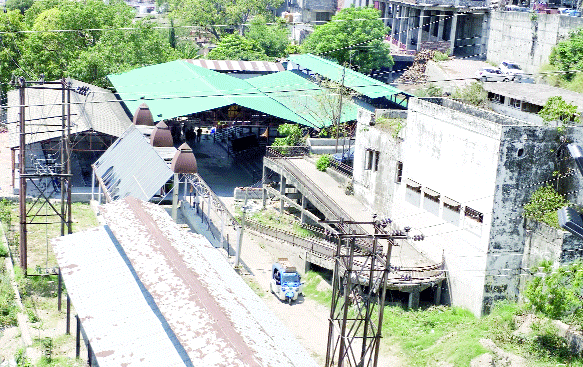
There is a quiet but telling measure of any society’s conscience: how it treats its spaces of final farewell. By that measure, Jammu – and indeed most cities of the Jammu division – stand in uncomfortable judgment. The cremation grounds of this city, where families arrive broken by grief and seeking a moment of dignified closure, have been reduced to sites of chaos, neglect, and civic indifference. Jammu city’s four principal cremation grounds – Jogi Gate, Shastri Nagar, Shakti Nagar, and Channi Himmat – each carry their own catalogue of dysfunction yet share a common thread: systematic abandonment by those entrusted with their upkeep. Of these, Jogi Gate, the oldest and most visited, stands as the starkest symbol of institutional apathy. Decades ago, an electric crematorium was installed here with much fanfare. It failed, was never meaningfully repaired, and was eventually discarded – a rusting monument to half-measures. Renovation work on the pyre sites that followed turned into a prolonged dispute between the contractor and the Jammu Municipal Corporation, dragging on for years while grieving families bore the brunt of the dysfunction.
What has seen consistent development at Jogi Gate, paradoxically, is commercial construction – shops and halls that generate revenue for the entitled committee – while basic necessities like adequate parking, functional water tanks, and hygienic facilities remain perpetually pending. Leaking water tanks, a mosquito-infested fountain, filth heaped along the Tawi riverbank, and the stench rising from an adjoining nullah carrying the sewage of parts of the Old City greet every mourner. Last year’s floods submerged the entire cremation ground, and it remained in that condition for months, neglected by an overburdened JMC, until a group of spirited youth volunteered to clear the muck. That citizens had to step in where civic bodies failed says everything.
Shakti Nagar and Channi Himmat present a different but equally troubling picture. Traffic chaos at both sites has become a ritual accompaniment to cremations. The main road approaching Shakti Nagar has been under some form of construction for nearly a decade – first road widening, then main drainage works, then a flyover – leaving the cremation ground perpetually mired in disruption. The canal adjoining Shastri Nagar cremation ground, which turns into something worse than a drain during winters when water flow is reduced to a trickle, is an open health hazard. At Channi Himmat, the cremation ground effectively chokes the approach road to the residential colony during peak hours, inconveniencing both mourners and residents. Parking has seen some improvement at Jogi Gate and Shastri Nagar, but the situation at the other two sites demands immediate, structured intervention.
Beyond Jammu city, the story grows grimmer. In Udhampur, Purmandal, and other towns of the division, cremation and burial grounds exist in states of utter neglect. The horrifying instances of bodies being swept downstream during heavy rainfall are not aberrations – they are symptoms of a system that has simply stopped caring. This is a humanitarian failure that demands accountability, not excuses.
What makes all of this particularly inexplicable is that Jammu has been the recipient of hundreds of crores under the Smart City Mission. Roads have been reimagined, facades redesigned, and infrastructure celebrated in press releases. Yet these four cremation grounds – used by thousands of families every year, at their most vulnerable moments – have received no meaningful share of that vision or funding.
The path forward is clear, though it requires both political will and social awakening. First, a transparent audit of the Sewa Samitis managing these sites – with full financial disclosure – is non-negotiable. Second, a comprehensive blueprint for each cremation ground must be developed, prioritising parking, bathing facilities, clean water, waste management, and amenities suited to the diverse rituals of different communities. Third, the revival of electric crematoria, with proper maintenance provisions this time, must be seriously pursued. Fourth, a single accountable authority must replace the current diffused responsibility that ensures everyone is in charge and no one is answerable.
Society, too, must shed its resigned acceptance. Silence is not satisfaction – it is surrender. Citizens who demand better roads and cleaner markets must extend the same insistence to their cremation grounds. Collectively, the attitude that all is acceptable must be rejected. An honourable last rite is the least the departed deserve.
 Follow our WhatsApp channel
