

By Sadaket Ali Malik
sadaketmalik.blogspot.com
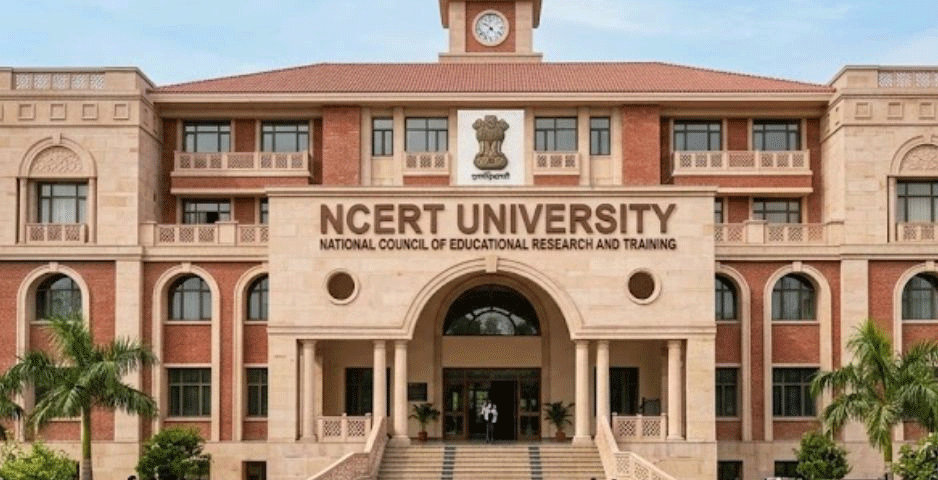
The decision to grant the National Council of Educational Research and Training the status of a deemed-to-be university represents far more than an administrative upgrade; it signals a structural shift in India’s education system, where a body that has historically shaped school knowledge now acquires the authority to produce, certify, and institutionalize it at higher levels, and to fully grasp the magnitude of this transition, one must begin with the historical trajectory of NCERT itself, established in 1961 as a central advisory body to guide school education in post-independence India, at a time when the country faced deep regional disparities in curriculum, pedagogy, and access, and over the decades it evolved into the intellectual backbone of India’s schooling system by developing National Curriculum Frameworks, designing textbooks, conducting large-scale surveys, and influencing policy directions that reach virtually every classroom in the country.
Today, NCERT’s scale is staggering, as its textbooks are used by more than 11 crore students either directly through central boards or indirectly through state adaptations, while its publishing division prints and distributes over 5 crore textbooks annually, making it one of the largest educational publishers in the world, and its influence extends further through digital transformation, with more than 6,400 QR-coded textbooks linked to e-content and nearly 2.9 lakh digital learning resources available on platforms such as DIKSHA, which have collectively recorded billions of learning sessions, demonstrating how NCERT has already transitioned from a traditional print-based institution into a hybrid digital knowledge hub, and beyond content, its research and survey work, including the All India School Education Survey and National Achievement Surveys, provides critical data on school infrastructure, learning outcomes, and systemic gaps, shaping policy decisions at both central and state levels.
Despite this extensive reach, the challenges within India’s education system remain profound, particularly in teacher training and technological integration, where statistics reveal structural gaps that NCERT’s new role aims to address, as India has over 58 lakh teachers across school levels but a significant proportion lack continuous professional development, with only limited numbers receiving specialized training in areas such as inclusive education or digital pedagogy, while infrastructural data indicates that barely 25–30% of secondary schools have reliable internet access and less than 40% of teachers are adequately trained to integrate technology into teaching, highlighting a disconnect between policy ambitions under modern reforms and classroom realities, and it is precisely this gap that NCERT’s transition into a university seeks to bridge by enabling it to design and offer formal degree programmes in teacher education, curriculum studies, educational leadership, and emerging fields like artificial intelligence in education, thereby converting fragmented training efforts into structured academic pathways that can be scaled nationally.
This expansion aligns closely with the vision of the National Education Policy 2020, which emphasizes multidisciplinary learning, continuous teacher development, and the integration of technology into education, and NCERT has already been at the forefront of implementing these reforms through initiatives such as the rollout of new textbooks under the National Curriculum Framework 2023, nationwide teacher orientation programmes, and the introduction of digital and competency-based learning approaches, and with its new university status under the regulatory oversight of the University Grants Commission, it can now institutionalize these efforts by offering undergraduate, postgraduate, and doctoral degrees that directly feed into the school education system, potentially creating a standardized national ecosystem for teacher preparation and educational research.
However, the scale of NCERT’s influence also raises critical concerns about centralization, because an institution that already controls curriculum design, textbook production, and learning assessments will now also train teachers and grant degrees, effectively consolidating influence over both the content and delivery of education, and in a country as diverse as India, where education has historically balanced national objectives with regional variations, such concentration of authority risks narrowing the space for alternative pedagogical approaches and diverse academic perspectives, particularly in light of recent debates surrounding curriculum revisions and textbook changes, which have highlighted how educational content can become a site of ideological contestation, making it essential to question whether an institution so closely linked with government policy can simultaneously function as an autonomous academic space that encourages critical inquiry and intellectual diversity, which are fundamental to any university system.
At the same time, the argument for strengthening NCERT’s role cannot be dismissed, because India’s education system requires institutions capable of operating at scale to address persistent issues such as uneven teacher quality, lack of research in school education, and slow adoption of technology, and NCERT, with its decades of experience, nationwide infrastructure, and established credibility, is uniquely positioned to fill this gap by bridging the divide between research and classroom practice, something that many traditional universities have struggled to achieve, and if its expanded mandate is used to foster innovation, enhance teacher capacity, and promote evidence-based educational reforms, it could significantly improve the quality and consistency of education across the country.
Ultimately, the transformation of NCERT into a deemed university encapsulates a deeper tension within modern education policy between the need for standardization and the preservation of diversity, between efficiency and autonomy, and between centralized reform and decentralized innovation, and whether this move becomes a milestone in educational progress or a step toward deeper control will depend not on the change in status itself but on how its powers are exercised, how transparency and academic freedom are maintained, and how space is preserved for multiple voices within the educational ecosystem, because in shaping how teachers are trained and how knowledge is produced, NCERT is no longer just influencing education in India, it is redefining it.
 Follow our WhatsApp channel
