

Mass evacuations, crops damaged, roads cut off
Suhail Bhat
SRINAGAR, Sept 3: Two days of incessant rainfall has pushed Kashmir to the brink of flooding, with the Jhelum River crossing the danger mark at multiple locations, forcing mass evacuations, damaging crops, and disrupting connectivity in parts of the Valley.
Follow the Daily Excelsior channel on WhatsApp
Officials said that at 11 pm Jhelum was flowing at 27.65 feet at Sangam in Anantnag, against the danger mark of 25 ft. At Ram Munshi Bagh in Srinagar, the level stood at 22.13 ft-just above the flood level of 21 ft-while at Asham in Bandipora, it was 12.18 ft, below the danger mark. Tributaries, including the Vishow, Lidder, Rambiyara, Sheshnag, and Sindh streams, swelled above or near flood levels.
Continuous heavy downpour has triggered flood-like situations in most parts of South Kashmir, inundating villages, damaging bridges, and leaving thousands of people stranded. Standing crops, orchards, and residential structures have suffered extensive damage, while the administration has launched rescue and relief operations on a war footing.
Meanwhile, Chief Minister Omar Abdullah appealed to people not to panic, saying that “Dal Gates have not been opened, Kandizaal bund has not been breached or broken. The Jhelum is climbing but at a much slower rate than was feared. The administration is not going to lower its guard; we continue to monitor the situation very closely, but at the same time we appeal to people not to believe rumours that are being spread unnecessarily.” Omar shared the update on his social media platform X.
In the Pulwama district, the overflowing Romshi Nallah breached its banks, partially submerging Gundipora, Hassanwani, Uribagh, and Badibagh villages. Residents said rainwater entered their homes, damaged stored food grains, and destroyed paddy fields and apple orchards, threatening their livelihood.
The situation worsened after the approach road of Chandrigam bridge in Awantipora caved in, forcing its closure for vehicular movement. The Roads and Buildings Department, Awantipora, has diverted traffic through the Chandrigam-Amlar-Bargam-Noorpora route until the bridge is repaired. Meanwhile, the Kaihgam area of Awantipora witnessed massive waterlogging, with streets and houses submerged. “The drainage system has collapsed. We are virtually trapped inside our homes, unable to move out even for essentials,” said a resident.
In the Anantnag district, the swelling Brengi stream inundated several low-lying areas. The water entered important institutions, including the BDO office, Anantnag, Sout-ul-Awliya Darul Uloom, and Idhara Tehqiqat, as well as many residential areas and offices, forcing closure of official and educational activities. “Paddy fields and orchards are under the water. If the water does not recede soon, the damage will be irreversible,” a farmer from Pulwama, said.
Similar situations were witnessed in South Kashmir’s Kulgam, especially in Khudwani-Qaimoh, where water entered residential areas. Authorities said rescue teams, along with men and machinery, have been deployed at vulnerable points to strengthen embankments and restore connectivity. At many places, including SIDCO Lassipora, electricity lines suffered damage, cutting power supply to many areas. Efforts are on to restore supply in the affected regions, they said.
District officials confirmed that thousands of people have already been shifted to safer places in Pulwama, Kulgam, Anantnag, and parts of Shopian. The water level in most water bodies continues to rise, causing fear among residents, while the administration remains on high alert.
The heavy downpour left dozens stranded and inundated low-lying areas. Nearly 2,500 residents from nine villages in Kulgam were shifted to safer places after the Vishow stream breached its banks. In Srinagar, floodwaters entered Dangerpora, submerging houses.
Authorities said while Jhelum continues to flow above danger marks at Sangam, Pampore, Ram Munshi Bagh, and Asham, the declining levels in tributaries may stabilize the situation if rainfall does not resume. “Rain has stopped at most places in Jammu and Kashmir now. Just a patch of rainy clouds is hanging over the Kulgam belt-bringing only light rains at this moment. As per the satellite images, no new cloud developments are taking place,” MeT said.
The MeT said, given the forecast and satellite data, the rains are expected to cease completely now. “Significant improvement in weather is expected from onwards (small developments can’t be ruled out); however, they pose no threat. Dry weather is expected to prevail tomorrow,” it added.
Divisional Commissioner of Kashmir, Anshul Garg, said the administration is fully mobilized. “Rainfall was intense in South and Central Kashmir through the night, which pushed up water levels at Sangam and Ram Munshi Bagh. IMD reports suggest rains will recede, and we should get relief by evening. Still, contingency plans are active,” he said.
He added, “About 2,500 people were evacuated from nine villages in Kulgam as the Vishow Nallah crossed danger levels. Disaster teams, police, and SDRF are on the ground; emergency centres are functional; and power and telecom services are working. We must all remain cautious and follow advisories. People should stay away from water bodies.”
Garg said no major inundations had been reported in Srinagar so far, though vulnerable localities such as Kursu Rajbagh and Pamposh Colony were being closely monitored. “If there is a need for rescue, teams are in place. DCs and magisterial teams are active across districts. Evacuation will be done immediately wherever required,” he added.
The Srinagar-Jammu highway, Mughal Road, and Sinthan Pass remained closed due to landslides and flooding, triggering panic. Fresh landslides at Bajri Nallah on Zojila Pass cut off the vital Kashmir-Ladakh link road, while Zero Point in Drass witnessed the season’s first snowfall, blanketing peaks in white.
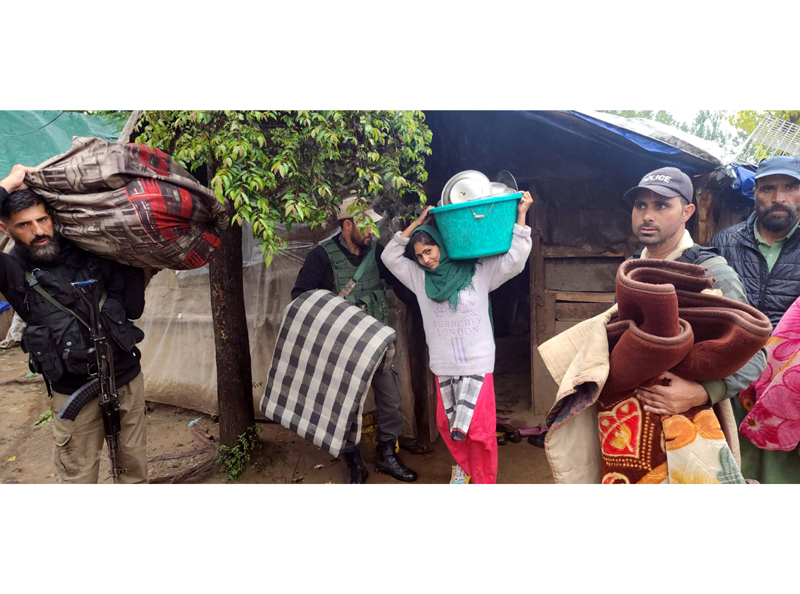
Rescue operations were launched across districts. Anantnag police evacuated 25 nomadic families stranded under a bridge after the Lidder stream swelled, while in Kulgam’s Brazloo village, five families were shifted to safety. In Shamsipora-Turkatachloo, an Army rescue team joined locals to plug a breach in the Vaishow bund, preventing water from flooding the village. Villagers hailed the effort, saying it provided immediate relief.
Meanwhile, a joint meeting to review flood preparedness was held at the Police Control Room in Srinagar, attended by senior officers from the civil administration, Army, CAPFs, SDRF, IGP Kashmir, divisional heads, and all DCs and SSPs of the Valley. A spokesperson said officials reviewed embankment protection, evacuation protocols, contingency arrangements, and alternate communication plans. “It was resolved to maintain high readiness, position manpower and machinery at vulnerable points, and ensure real-time information sharing with the public. The establishment of joint control rooms with representatives of all key agencies was also discussed,” he said.
Emergency helplines remain active as panic spreads across the Valley with water levels in the Jhelum continuing to rise. Residents in several areas of Srinagar, including Lal Chowk, Dalgate, Sonwar, Downtown, and the city outskirts, were seen shifting household goods to upper floors to prevent damage.
Shopkeepers in the city centre, uptown, downtown, and the outskirts also moved their merchandise to safer locations, working late into the evening. People living along the Jhelum banks kept a close watch on the water level, fearing a further rise.
Meanwhile, authorities have urged residents to remain vigilant and strictly follow advisories. “People need to remain alert and heed official advisories. The situation is being closely tracked, and contingency measures will be implemented wherever necessary,” officials said.
 Follow our WhatsApp channel
