

Vivek Koul
vivekkoul2013@gmail.com
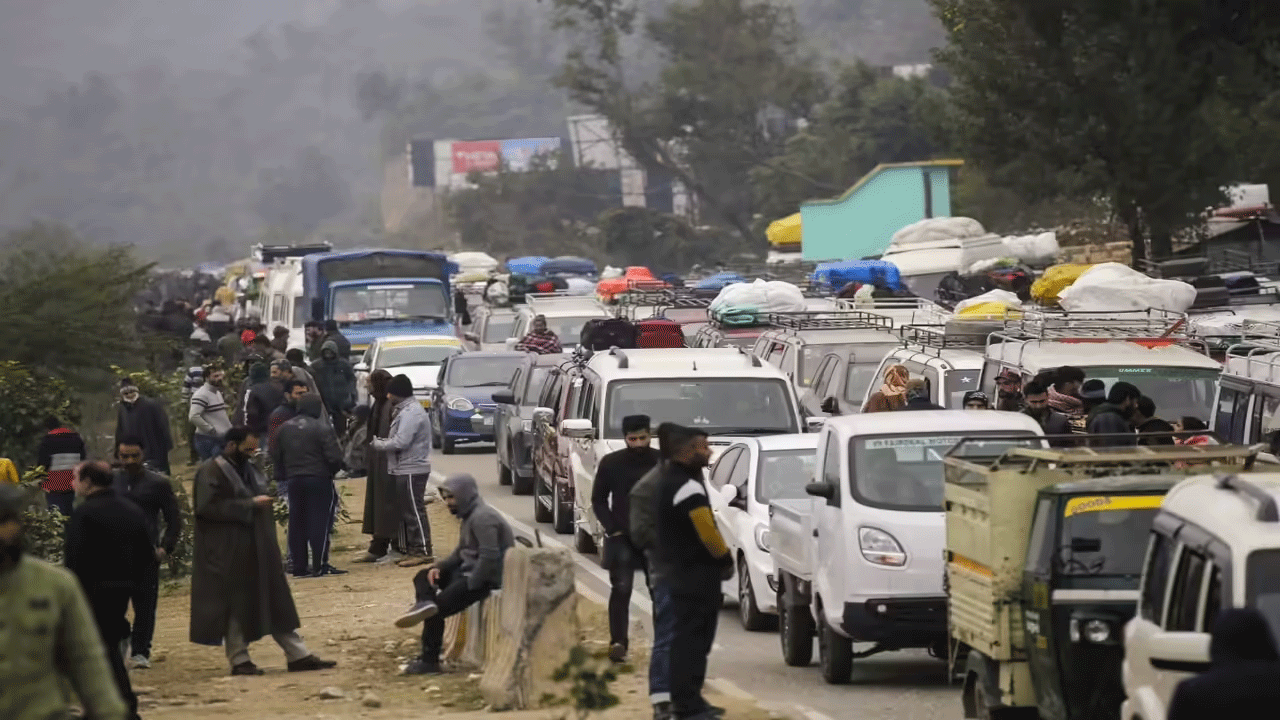
The problem of traffic congestion in Jammu has assumed alarming proportions and has now emerged as one of the most pressing civic challenges confronting the city. With every passing day, the number of vehicles on the roads is increasing exponentially, while the road infrastructure has largely remained static, outdated, and grossly inadequate to cope with this ever-expanding volume of traffic. The inevitable consequence of this imbalance is chronic congestion, prolonged traffic snarls, and an overall deterioration in the quality of urban life. Jammu, once known for its relatively smooth traffic flow and serene ambience, is today grappling with near-paralysis on several key arterial routes, particularly during peak hours. One of the most glaring examples of this crisis can be witnessed on the stretch from Talab Tillo to Canal Road. This corridor, which serves as a vital link for daily commuters, has become a persistent bottleneck where vehicles crawl at an exasperatingly slow pace. During morning and evening hours, when office-goers, students, and commercial traffic converge simultaneously, the situation becomes chaotic and unmanageable. What should ideally be a short and seamless commute often turns into a frustrating ordeal lasting hours, eroding both productivity and mental well-being. The congestion on this stretch is not merely an inconvenience; it reflects a systemic failure in traffic planning and enforcement. The condition further deteriorates on the road from Canal Road to Jewel Chowk, which has perhaps become the most congested and suffocating stretch in the entire city. The road here is exceedingly narrow and completely incapable of accommodating the enormous vehicular load that it is forced to bear daily. Vehicles remain stuck bumper to bumper, with no room for manoeuvrability, and even emergency services find it difficult to navigate through this stretch. It is not uncommon for commuters to spend an inordinate amount of time traversing this short distance, leading to widespread frustration and a sense of helplessness. Life, quite literally, comes to a standstill during peak hours, as the relentless gridlock cripples movement and disrupts routine activities.
There is an urgent and undeniable need for the construction of a flyover connecting Canal Road to Jewel Chowk to alleviate the burgeoning traffic pressure on this route. Such an infrastructure intervention would not only streamline vehicular movement but also significantly reduce travel time and fuel wastage. Flyovers, if planned and executed judiciously, can act as effective pressure valves by segregating through traffic from local traffic. Unfortunately, despite the obvious necessity, such long-term solutions continue to remain confined to discussions and proposals, while commuters continue to suffer on a daily basis. Ironically, even where road-widening initiatives have been undertaken, their benefits are being systematically negated due to lack of discipline and enforcement. The widening of the road from Talab Tillo Chowk to the Guest House was intended to ease congestion and facilitate smoother traffic flow. However, this widened carriageway has effectively been converted into an informal parking lot by motorists, who park their vehicles indiscriminately along the roadside. This rampant misuse of public road space has rendered the widening exercise futile, as the effective width available for moving traffic remains severely constricted. As a result, traffic jams and snarls continue unabated on this stretch as well. The role of traffic police and enforcement agencies becomes critically important in such a scenario. The persistent problem of roadside parking can only be addressed through strict and uncompromising enforcement of traffic regulations. Vehicles parked illegally along busy roads must be seized or penalized heavily to deter such behaviour. Without consistent enforcement, any infrastructural improvement is bound to fail. The same pattern of illegal parking and resultant congestion is visible on the Canal Road to Jewel Chowk stretch, further compounding the problem and intensifying commuter distress.
A similar and equally distressing situation prevails on the Amphalla to Janipur road, which has also become notorious for traffic congestion. This route witnesses heavy traffic throughout the day, and the absence of adequate road width, combined with haphazard parking and frequent stoppages, leads to chronic bottlenecks. The cumulative effect of congestion across multiple corridors is that the entire city of Jammu now finds itself engulfed in an unending cycle of traffic snarls. What was once limited to a few trouble spots has now spread to almost every major road and even to residential colonies. Within residential areas, the menace of wrong parking along narrow lanes has emerged as a significant source of irritation and conflict. Vehicles parked without consideration for space or access often block lanes, making it difficult for other residents to pass through and for emergency vehicles to respond swiftly. This rampant disregard for civic sense has fostered frustration, dejection, and a growing sense of lawlessness among commuters and residents alike. The absence of designated parking spaces within colonies has exacerbated this problem, pushing residents to encroach upon public lanes as a matter of routine.
Adding to the chaos is the unregulated operation of matadors and minibuses within Jammu city. These vehicles frequently stop at arbitrary locations in the middle of the road to pick up or drop passengers, as there are no clearly demarcated stoppages or strictly enforced halting points. Such erratic behaviour disrupts the natural flow of traffic and creates sudden obstructions, leading to congestion and frequent near-accidents. The lack of accountability and monitoring of these vehicles has turned them into major contributors to traffic disorder. In light of these multifaceted challenges, it is imperative for the traffic department and civic authorities to adopt a comprehensive and proactive approach. Traffic awareness campaigns must be initiated at the grassroots level, particularly within residential colonies, to inculcate a sense of responsibility and discipline among citizens. Awareness alone, however, will not suffice unless it is backed by firm enforcement and punitive measures against habitual offenders. Simultaneously, the creation of adequate and well-planned parking spaces for the general public is essential to discourage roadside and illegal parking. Road widening projects, construction of new flyovers, and development of alternative routes must be undertaken as priority infrastructure initiatives to normalize traffic conditions in Jammu city. Such measures, if implemented with foresight and sincerity, can significantly mitigate congestion and restore a semblance of order to the city’s roads. Above all, the elimination of wrong parking through strict enforcement must become a non-negotiable objective of the traffic department. Unless decisive and coordinated action is taken, traffic congestion will continue to worsen, undermining the livability, efficiency, and overall urban character of Jammu.
 Follow our WhatsApp channel
